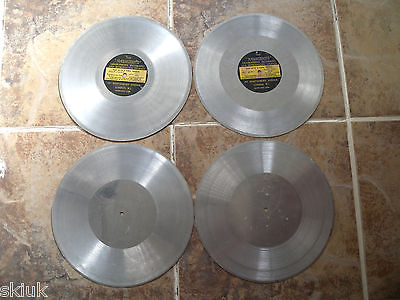
4x VERY RARE UK 10" ALUMINIUM RECORDS 1930's BILLY TOWN JAZZ DANCE BAND
£
310
$
411


Favourite Auctions
To save auctions to your favourites, please login
If you don't have an account, please register
Description
4x VERY RARE UK 10" ALUMINIUM RECORDS C1930's BILLY TOWN JAZZ DANCE BAND * THE "MARGUERITE" RECORDING STUDIOS LONDON * DON'T HAVE THE EQUIPMENT TO PLAY THESE SO WE CANNOT GIVE A CONDITION REPORT *
Most recordings on bare aluminium are believed to have perished in the scrap metal drives held during World War II
In the field of audio recording, an aluminium disc (or aluminum disk in the USA) is a phonograph (gramophone in the UK) record made of bare aluminium, a medium introduced in the late 1920s for making one-off recordings. Although sometimes used for making amateur studio or home recordings or in coin-operated "record-your-voice" booths at fairs and arcades, during the first half of the 1930s bare aluminium discs were primarily used to record radio broadcasts for the private transcription disc archives of performers or sponsors.[1]
In the recording process, a sufficiently amplified audio signal was sent to a heavily weighted electromagnetic recording head with a blunt diamond stylus that indented, rather than cut or engraved, a sound-modulated groove into the surface of the metal. Normally, a completely blank disc was used and the recording head was slowly carried toward its center by a dedicated feed mechanism. Some low-end recording units economized by eliminating the feed mechanism, relying instead on the use of discs already cut with a narrow blank groove that guided the stylus, which simply impressed its vibrations into the upper region of the existing groove. This cost-cutting approach produced recordings with a very limited dynamic range and generally inferior sound. In either case, because of the grain structure of the metal and its resistance to the side-to-side motions of the recording stylus, significant surface noise was inherent and the high-frequency signal content was heavily attenuated.
The recording had to be played back with a fiber needle such as cut and pointed bamboo or a plant thorn, as an ordinary steel needle in a typical heavy pickup would severely damage the soft aluminium surface. Even when playing a bare aluminium disc with a modern lightweight magnetic cartridge, a hard stylus that does not correctly fit the contour of the groove will score its surface and tend to skip and repeat, damaging the disc as well as degrading the quality of the recovered audio. Because the blunt recording stylus typically bore down on the aluminium at a substantial angle, it produced a disproportionately shallow groove, so that optimum playback with modern equipment requires a custom stylus with an unusually large tip radius.
In 1934, the Pyral Company in France and the Presto Recording Corporation in the United States independently created the so-called acetate disc by coating a layer of nitrocellulose lacquer onto the aluminium, which now served only as a rigid support.[1] Engraving the groove into an easily cut and grainless lacquer, rather than indenting it into bare metal, made it possible to produce a broadcast-quality recording that preserved high-frequency detail and was nearly noiseless when new. As a result, professional recording services soon abandoned the use of bare aluminium blanks, although some amateur and novelty use persisted into the 1940s. From an archival perspective, the changeover traded long-term stability for superior sound quality. A bare aluminium disc can remain unchanged indefinitely if carefully stored, while the coating on a lacquer disc is subject to chemical deterioration, tending to shrink and become brittle due to the loss of unstable plasticizers, which can cause the lacquer to develop cracks, split off from the aluminium base disc, and in severe cases disintegrate into an unsalvageable rubble of tiny flakes.[2]
Most recordings on bare aluminium are believed to have perished in the scrap metal drives held during World War II.[1] Aluminium was declared to be a critical war material and civilians in the US were urged to do their patriotic duty by finding and turning in anything made of it. The collected "scrap" was melted and recycled.[1]
In other fields, aluminium disc may refer to the aluminium core discs used for the "platters" in hard disk drives, or to discs used in various other products or manufacturing processes.
Packaging
All Records are dispatched in Professional Record Mailers with card stiffeners to ensure undamaged goods"MINT: The record itself is in brand new condition with no surface marks or deterioration in sound quality. The cover and any extra items such as the lyric sheet, booklet or poster are in perfect condition. Records advertised as Sealed or Unplayed should be Mint.
EXCELLENT: The record shows some signs of having been played, but there is very little lessening in sound quality. The cover and packaging might have slight wear and / or creasing.
VERY GOOD: The record has obviously been played many times, but displays no major deterioration in sound quality, despite noticeable surface marks and the occasional light scratch. Normal wear and tear on the cover or extra items, without any major defects, is acceptable.
GOOD: The record has been played so much that the sound quality has noticeably deteriorated, perhaps with some distortion and mild scratches. The cover and contents suffer from folding, scuffing of edges, spine splits, discolouration, etc.
FAIR: The record is still just playable but has not been cared for properly and displays considerable surface noise; it may even jump. The cover and contents will be torn, stained and / or defaced.
POOR: The record will not play properly due to scratches, bad surface noise, etc. The cover and contents will be badly damaged or partly missing.
BAD: The record is unplayable or might even be broken, and is only of use as a collection filler."
WE ACCEPT PAYPAL * UK CHEQUE'S ONLY * UK MONEY ORDERS * UK POSTAL ORDERS * BANK * PAYMENT WITHIN 5 DAYS PLEASE* WE ALWAYS GET PROOF OF POSTAGE * WE CANNOT BE RESPONSIBLE FOR UNINSURED ITEMS SENT BY STANDARD INTERNATIONAL MAIL WHICH GET LOST OR DAMAGED IN THE POST * WE COMBINE POSTAGE COSTS FOR BULK PURCHASES AND ALWAYS REPLY TO FEEDBACK LEFT * POSTAL CHARGES CANNOT BE REFUNDED * PLEASE VIEW OUR OTHER ITEMS FOR SALE IN OUR EBAY SHOP
price rating