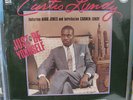
WILLIE THE LION 10" PIANO GREAT HARLEM MEMORIES Dial305
$
50


Favourite Auctions
To save auctions to your favourites, please login
If you don't have an account, please register
Description
WILLIE "THE LION"
HARLEM MEMORIES
U.S. DIAL 305 MONO 1950
10" LP
VINYL= VG
JACKET= VG++++ NO SEAM SPLITS, STRONG SPINE NO WRITING...INCREDIBLE SHAPE!!!
VERY RARE!!!!!
LP 305 Willie "The Lion" Smith - Harlem Memories
Willie "The Lion" Smith (p) Paris, France, January 29, 1950Don't You Hit That Lady Dressed In Green
Maple Leaf Rag
Don't You Dare To Strike Me Again
Shine
The Darktown Strutters' Ball
Pork And Beans
Chevy Chase
Oh, You Devil Rag
When I Walk With Billy
Buddy Bolden's Blues
Passionette
REVIEW By JOHN LUCAS (1965)
Is it necessary to denigrate Jelly Roll in order to celebrate Willie the Lion? For over two decades Leonard Feather has been doing everything in his power (grown increasingly great through measures best known and kept to himself) to deflate New Orleans Jazz in general and Mister Jelly Lord in particular. His motives, whatever they are, must be mixed. Basically, I suspect, such music suits neither his taste nor his purpose. A hired hand, no matter how disguised, he cultivated a taste for Ellington and adopted the purpose of serving the Duke. It appears as simple as ABC. As arranger-bandleader-composer, though deceased, Morton remained his only real rival in the field. Because the Duke knew this too, it was easy for Leonard to encourage him to express contempt for the ghost of Jelly Roll. And it was no more difficult for Feather to persuade Ellington’s mentor, Willie the Lion, to assail the New Orleans achievement in favor of the Harlem Jazz he represents.
Feather had a point worth making: jazz did emerge almost simultaneously in separate sections of the country and no area, town, or quarter enjoyed a monopoly on quality. Leonard chose to right a slight wrong with another big one, however, by urging Willie to declare (or seem to say) that jazz actually began in New York and there reached its peak. On November 8, 1957, he supervised a Smith recording session released on Dot DLP-3094 as The Lion Roars. The disc concludes with Feather putting a question no more predetermined than the answer: “While we have the time I’d like to ask you, Willie, your feelings about the theory that jazz was born in New Orleans and that Jelly Roll invented it there?” His feelings thereupon prompted the Lion to roar:
Ha, ha, ha! That’s one of the worst things I ever heard. You know, as I told you before, most of the jazz I heard was in the brickyards — and then, another thing, I think jazz comes from the person’s soul and from the person who happens to be that person. But Jelly Roll Morton was a guy that always talked a lot and what he talked about, he couldn’t back it up. ‘Cause he used to be around the Rhythm Club everyday and he used to stand out on the corner and he used to bull and con all those fellows, you know, about what he did — had his twenty-dollar gold-piece on — he would stand out there with a bank-roll, as we call it, meaning money. So every time I’d come around the Rhythm Club, all the guys who played piano used to keep quiet, ‘cause we used to have jam sessions around there and I used to lay Fats and Jimmy. Sometimes I’d even lay for Tatum. Then we had four or five more guys who used to get in a session there. So I used to come around specially on Saturdays looking for Jelly Roll and these other guys. . . . And I went around this Friday and he was standing on the corner. So I said: ‘Look, Mister One-Hand, let’s go inside and let me give you your lessons and your cutting.’ So I took Jelly inside by the piano. I was the only one that he would stand and listen to and didn’t open his mouth. I must have played nearly everything you could name and, when I got through, the cats said: ‘Well, Jelly Roll, I guess you’ll keep quiet now!’ And true as I’m sitting on this chair, Jelly would talk a lot but he couldn’t play a lot.
Willie assumes, here as elsewhere, that what he knows and feels is the whole truth. Not even Morton was more egocentric and, by Smith’s own admission, he got around much more than the Lion. Jelly Roll was thus somewhat better qualified to consider temporal and geographical issues as well as to assess collective and individual accomplishments. Moreover, in conducting Morton’s spontaneous discussions and demonstrations for the Library of Congress, Alan Lomax had no ax to grind or carefully refrained at least from doing so. Therefore these recordings (The Saga of Mister Jelly Lord. Riverside RLP-9001 — RLP-9012) and the book augmenting them with interludes by Lomax (Mister Jelly Roll, Grove Press E-35) still constitute the most rewarding documentary in the annals of jazz.
Nevertheless, Willie too has a tale to tell and plenty of talent for telling it well. At least we possess that story (Music on My Mind: Memoirs of an American Pianist. Doubleday, New York, 1964). Employing essentially the same process as Lomax, namely interrupting the Lion’s more or less improvised monologue with historical interludes of his own, George Hoefer has likewise as his principal aim to elicit the facts and let them interpret themselves. He is the very type of responsible, objective, impartial critic — with no hypothesis or hobby to ride to death, leaving trampled reputations in his wake. As a result, we recognize not only obvious differences between New Orleans and Harlem but also surprising similarities between Morton and Smith.
Ideal representatives of their respective schools, each of them displayed a large loyalty to his generic style and a strong sense of his personal genius. As pianists both mounted a two-fisted attack (despite Smith’s disdainful observation), both stressed the significance of melody, both favored a medium tempo (though each contributed a Fingerbuster), and both demanded the right to improvise freely. As recording artists both preferred selecting and directing their bands, composing and conducting their tunes. As apologists for jazz they insisted that this new music, incorporating elements common to operas and symphonies, takes trained musicians to play at all properly. Jelly was twenty-five in 1911 when fourteen-year-old Willie first heard him in New York, but like the man the boy was already accustomed to ragging the Miserere from Il Trovatore and superimposing one semi-classic strain upon another. Even then they agreed completely on attitude, that is, the importance of showmanship. The following passage from Music on My Mind has precise counterparts in Mister Jelly Roll:
Wherever they were from, the old-time piano men tried to develop their own individual style of playing. Because, you see, if one player had a way of performing that made him stand out from the others it would make him a big hit with the ladies and that was one thing we were all looking for all the time. You had to be real sharp in the way you dressed, the manner in which you approached the piano, and in the originality of your ideas; that is, if you wanted to compete for the ladies. . . .
It is amusing to discover that, whereas the Lion came really to know him only after the Crash, he had known the bride long before Morton married.
“Some people used to put me on by asking whether jazz was born in New Orleans and whether Jelly Roll invented it,” laments the Lion, “I said once that that was one of the worst things I had ever heard.” The reference is clear to all familiar with his recording of The Lion Roars. Now, with no undue coaxing or cajoling from Hoefer, Willie voluntarily recants by calling Jelly “quite a piano player and composer in his own right.” He then continues (emphasis mine):
Morton was a man with strong spiritual and magnetic forces; when he sat down to play he could hold an audience by the strength of his strong personality. He was a sharpshooter and had always traveled in fast company. He was intelligent, had something to offer, and as far as I could tell, he was always able to back up what he said. . . . It used to make me mad to hear the New York cats who hadn’t been out to Harlem making fun of Morton. Like myself, Jelly Roll had played in all kinds of places, and that was the way you learned about life — playing in all the different back rooms. . . .
Small wonder that, no longer a bird of Feather’s, the Lion reserves for a closing paragraph his last word concerning certain jazz writers: “They can also be the kind of character who is inclined to follow the dollar sign. Sometimes they’ll say anything if they think it will bring them a buck. They should learn to govern their tongues and look at the water before they jump. . . . Sometimes I think that eight people out of ten are phony.” So the Lion changes his tune. Lover of cognac and sauterne, he has grown discontent with pressing grapes of sour vintage. This is not to say, however, that between Smith and Morton the distinctions are illusory or negligible. The present volume can call for support upon recordings too, and in the case of Willie and Jelly it is as enlightening to compare their discs as their books. My assumption is that jazz fans should, if they do not, have access to the essential records I mention.It would, for instance, be hard to imagine a more complete contrast in valid conceptions of ensemble function and solo procedure than these two demonstrate respectively on Twelfth Street Rag (RCA-Italiana LPM-10052) and Climax Rag (Jolly Roger 5035). Ragtime classics both, the former was composed by Euday Bowman in 1909 (1914) and the latter by James Scott in 1914. The Lion recorded Twelfth Street with Sidney Bechet’s New Orleans Feetwarmers in New York in October of 1941, fifteen weeks after Morton’s death in Los Angeles. Only the leader’s clarinet and Braud’s string bass were Orleanian in origin. Trumpeter Shavers, guitarist Barksdale, and drummer Catlett belonged almost as much to Harlem as Goshen-born Smith himself. They tear down Twelfth Street, Willie included, at a pace Morton would never have countenanced. With his New Orleans Jazzmen of September 1939, he had prescribed an alternative or supplied an antidote. On Climax Rag the alien trumpet of De Paris, trombone of Robinson, saxophone of Cauldwell, and guitar of Lucie obey the Jelly Roll orders and conform to New Orleans conventions — while clarinetist Nicholas, bassist Braud, and drummer Singleton join fellow-townsman Morton in showing the way. Totally distinct in most respects, both records have much to recommend them.
Should some object that one pair of selections will scarcely suffice to compare the two as orchestral pianists, let them listen as well to Panama made by the Morton Seven in January of 1940 (Commodore 20018) and That’s a Plenty done by the Dixieland All-Stars in May of 1959 (Roulette R-25015). Both flagwavers, cut in New York, feature septets dominated by trumpeter Red Allen and drummer Zutty Singleton — mustering in addition a trombonist, a clarinetist, a saxophonist, a bassist, and of course a pianist. They make for much the same difference, it seems to me, but Willie’s work here is so compelling that this Dixiecats record should be added to Hoefer’s otherwise reliable discography.
The distinction is even easier to detect in their solo recordings. I submit, for a start, a comparison between their versions of three jazz standards — Maple Leaf Rag (Scott Joplin, Saint Louis, 1899), Buddy Bolden’s Blues (Buddy Bolden, New Orleans, approximately 1899), and Ain’t Misbehavin’ (Fats Waller, New York, 1929). Morton recorded the first and last at Washington in May of 1938 (Riverside RLP-9003, 9006), the other at New York in December of 1939 (Mainstream S/6020). Smith cut Maple Leaf and Ain’t Misbehavin’ in New York exactly twenty years after Morton (Grand Award 33-368), Buddy Bolden in Paris exactly ten years after Morton (Dial LP-305). Both entertainers sing the last two numbers as well, and their vocalizing differs as vastly as their keyboard activity.
“When the Lion performs the work of other composers,” comments Hoefer, “he usually embellishes them with his own interpretations.” Depending upon his intention, the same may or may not be said for Jelly Roll. If we elect to judge on the evidence of Maple Leaf Rag, weighing Morton’s memory of Joplin against Scott’s piano-roll transfer and Smith’s recollection of Morton in turn against Jelly’s recorded “transformation,” our verdict must pronounce the former infinitely more faithful to the original. Presumably, then, all Jelly Roll’s recreations possess an authenticity superior to the Lion’s. This simply means that we can rely on Everyone Had His Own Style (Riverside RLP-9007) on which Morton resurrects the forgotten New Orleans figures (Albert Cahill (Carroll), Buddy Carter, Sammy Davis, Tony Jackson, Game Kid, Kid Ross, Alfred Wilson) to an extent impossible in the case of Reminiscing the Piano Greats (Dial LP-305) whereon Smith does likewise for the house-rent-party pianist of Harlem (Eubie Blake, Ford Dabney, Bob Hawkins, Abba Labba, and Lukey (Luckey) Roberts). It does not signify that Willy (Willie) is therefore inferior to Jelly as a jazzman, however, for the creative capacity has little to do with eclecticism or emulation.
The fairest test of their creativity is surely afforded by solo performances of original compositions. There are perhaps two dozen available and arbitrary pairs to compare. A thorough job would involve using, besides those I am about to specify, at least half a dozen others by Morton (Frogimore Rag, Grandpa’s Spells, Milneberg Joys, Mister Jelly Lord, Winin’ Boy Blues, Wolverine Blues) and half a dozen others by Smith (Bring On the Band, Concentratin’, Morning Air, Passionette, Relaxin’, Zig Zag). In order to appraise their range and variety within a reasonable length of time, play the following precisely as I propose. Do not protest too strenuously that the progression seems contrived or imposed.
check it out Grading Records
The following is the grading system first developed by Goldmine Records. Virtually all methods currently in use for the grading of records, is based in some way, shape, or form, on this system. Rather than offer some variation of the original system first developed by Goldmine, the Record Collector's Guild will display the Goldmine record grading method in it's entirety.
Visual or Play Grading?
In an ideal world, every record would be played before it is graded. But the time involved makes it impractical for most dealers, and anyway, it's rare that you get a chance to hear a record before you buy through the mail. Some advertisers play-grade everything and say so. But unless otherwise noted, records are visually graded.
How to Grade
Look at everything about a record. It's playing surface, it's label, it's edges...under a strong light. Then based on your overall impression give it a grade based on the following criteria:
- Mint (M) Absolutely perfect in every way. Certainly never been played, possibly even still sealed.(More on still sealed under "Other Considerations"). Should be used sparingly as a grade, If at all.
- Near Mint (NM or M-) A nearly perfect record. Many dealers won't give a grade higher than this implying (perhaps correctly)that no record is ever truly perfect.
The record should show no obvious signs of wear. A 45 RPM or EP sleeve should have no more than the most minor defects, such as almost invisible ring wear or other signs of slight handling.
An LP cover should have no creases, folds, seam splits or other noticeable similar defects. No cut-out holes, either. And of course, the same should be true of any other inserts, such as posters, lyric sleeves and the like.
Basically, an LP in near mint condition looks as if you just got it home from a new record store and removed the shrink wrap.
Near Mint is the highest price listed in all Goldmine price guides. Anything that exceeds this grade, in the opinion of both buyer and seller, is worth significantly more than the highest Goldmine book value. - Very Good Plus (VG+) .
A Very Good Plus record will show some signs that it was played and otherwise handled by a previous owner who took good care of it.
Record surfaces may show some signs of wear and may have slight scuffs or very light scratches that don't affect one's listening experiences. Slight warps that do not affect the sound are "OK".
The label may have some ring wear or discoloration, but it should be barely noticeable. The center hole will not have been misshapen by repeated play.
Picture sleeves and LP inner sleeves will have some slight wear, lightly turned up corners, or a slight seam split. An LP cover may have slight signs of wear also and may be marred by a cut-out hole, indentation or corner indicating it was taken out of print and sold at a discount.
In general, if not for a couple things wrong with it, this would be Near Mint. All but the most mint-crazy collectors will find a Very Good Plus record highly acceptable. - Very Good (VG) Many of the defects found in a VG+ record will be more pronounced in a VG disc. Surface noise will be evident upon playing, especially in soft passages and during a song's intro and fade, but will not overpower the music otherwise. Groove wear will start to be noticeable, as with light scratches (deep enough to feel with a fingernail) that will affect the sound.
Labels may be marred by writing, or have tape or stickers (or their residue) attached. The same will be true of picture sleeves or LP covers. However, it will not have all of these problems at the same time, only two or three of them.
Goldmine price guides with more than one price will list Very Good as the lowest price. This, not the Near Mint price, should be your guide when determining how much a record is worth, as that is the price a dealer will normally pay you for a Near Mint record. - Good (G), Good Plus (G+) Good does not mean Bad! A record in Good or Good Plus condition can be put onto a turntable and will play through without skipping. But it will have significant surface noise and scratches and visible groove wear (on a styrene record, the groove will be starting to turn white).
A cover or sleeve will have seam splits, especially at the bottom or on the spine. Tape, writing, ring wear or other defects will start to overwhelm the object.
It is a common item, you'll probably find another copy in better shape eventually. Pass it up. But, if it's something you have been seeking for years, and the price is right, get it...but keep looking to upgrade. - Poor (P), Fair (F) Generally worth 0-5 percent of the Near Mint price. The record is cracked, badly warped, and won't play through without skipping or repeating. The picture sleeve is water damaged, split on all three seams and heavily marred by wear and writing. The LP cover barely keeps the LP inside it. Inner sleeves are fully seam split, crinkled, and written upon.
Satisfaction is guar-un-teed. :)
We are...
Patapsco Trading Post
SHIPPING
We ship world wide. Arrangements can be made for insurance if desired, and will be an additional handling/insurance fee. **I COMBINE SHIPPING FOR MULTIPLE WINS!!***
U.S....$4.00 FIRST LP...$1.00 EACH ADDITIONAL
CANADA $8.99 FIRST LP $2.00 EACH ADDITIONALOVERSEAS/OTHER...$16.99 FIRST LP...$4.00 EACH ADDITIONAL (UP TO 4 ALBUMS TOTAL. 5TH ALBUM IS $16.99.....6TH IS $4.00 ETC)
PAYMENT
We accept Pay Pal only.
Thanks for your interest, and enjoy your day! Feel free to e-mail me with any questions.
price rating

![BLANK/LEMON TREE - PETER TOSH & THE WAILERS [SKA] 7](https://www.popsike.info/php/thumbnail.php?url=https://www.popsike.pics/pix/20160609/291787121680.jpg)