NDIKHO XABA & NATIVES free jazz LP private press HEAR
$
477


Favourite Auctions
To save auctions to your favourites, please login
If you don't have an account, please register
Description
Rare vintage Afro Jazz LP featuring NDIKHO XABA and the NATIVES on the private TRILYTE label out of Oakland, California, from approximately the late sixties.
Self-titled. Catalog number is LR-7001. Stereo pressing on medium thick vinyl, label is red with black text.
"…J. Plunky Branch (sax) from Virginia, an internationally acclaimed jazz and rhythm & blues musician and producer, and bassist Ken Shabala (Kent Parker) from Brooklyn, had met in college and formed a group called the Soul Syndicate with Kent Parker the lead singer. From 1966-68 they played the college and club circuit in New York and set attendance records at The Cheetah Nightclub in Manhattan. After college Plunky and Kent Parker migrated to San Francisco, where in 1969 they met Lon Moshe (Ron Martin) and joined an African-avant garde gpoup called Ndikho Xaba. The group recorded one LP called "Ndikho and The Natives" (this LP) led by South African pianist/percussionist, Ndikho Xaba. Plunky later joined Oneness of JuJu..."
Guaranteed to be original and authentic. I do not sell boots or modern reissues.
Track Listing:
Side One:
- Shwabada (N. Xaba) - 12.13
- Freedom (P.D.) - 3.25
- Flight (N. Xaba) - 3.30
Side Two:
- Nomusa (N. Xaba) - 12.03
- Makhosi - 6.50
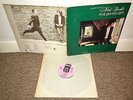
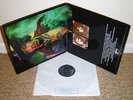
Jacket: Jacket is in fair condition with obvious flaws. There is noticeable surface wear on both the front and reverse. There are moisture stains along the top seam visible on both front and reverse. There is wear and splitting along the seams and spine. Overall a serviceable but unattractive jacket, probably acceptable to many collectors given the extreme rarity and desirability of this record, coupled with the fact that the vinyl is in nice shape.
Vinyl: Vinyl has been little played, although it was not stored under the best conditions. Retains nearly 100% of original gloss and only a small number of scuffs or light marks. There is a bit of minor surface noise, although it is well below the music and after perhaps the first minute of each side becomes quiet, so that the overall listening experience is very enjoyable. I have included a sound clip with portions of the first track from each side so that you can hear the sound quality from the actual record.
<< To hear portions of "Shwabada" and "Nomusa" from this actual record, please click on the "AUDIO" button inside the e-Commerce Player box at the top of the page. >>
As with all my records, your satisfaction is fully guaranteed. If not happy, simply return it in same condition for a full refund of purchase price plus one-way postage.
For your convenience I accept most payment forms including Paypal, money orders, and other direct methods of payment. Personal checks drawn on U.S. banks are also ok but require 7 business days for funds to clear.
Shipping is $3.55 to anywhere in the U.S. via USPS media mail, (insurance, priority mail, and overseas shipping available at additional cost.)
I welcome international bidders, and I am happy to ship to anywhere in the world.
I pack all albums in sturdy cardboard custom mailers for safe shipment.
Write with any questions, check my feedback, and bid with confidence! Good luck with your bids!
On Oct-13-08 at 15:09:45 PDT, seller added the following information:Personnel are as follows: Nkiko Xaba - piano, percussion, bullhorn, seaweed horn; Plunky - tenor, soprano sax, flute, percussion; Lon Moshe (Ron) - vibes, percussion; Duru (Baba) - congas, percussion; Shabalala (Kent) - bass; Kieta (Kieth) - drums. Arranged by Ndikho.
On Oct-13-08 at 15:21:11 PDT, seller added the following information:From the liner notes:
SIKHULEKILE
We welcome you to the exciting, vibrant, alive sounds of Nkikho Xaba and the Natives. Nkikho is a native of South Africa who is in self-imposed exile in this country.
He is the musical arranger/catalyst for the group and the Natives make marvelous use of his talent and knowledge in producing the music of "Mother Africa," the full excitement and spirituality of which is captured in this, their first album.
In Africa, music pervades almost every facet of life. To quote Ndikho, "I developed from a complex situation. I can be anything I want to be. In your way of understanding, I can be in the bush, I can be in the metropolitan areas. I can be anything at anytime because of the situation that made me. As a result, when it comes to music I have all these modes which we try to present to you."
The Natives are African brothers born in this country; their ability to play this music is living testimony to what we have always known, but seldom admitted: Black People in this country are an African people. The Natives are unique in many ways. They are as selflessly dedicated as they are diverse in their musical talents. They are proud that they have been able to incorporate the African principle of Ujamaa: the understanding of their colective worth both as musicians and as Human beings.
The album opens with Shwabada, a tribute to Ndikho's family, the Xaba's. "The song is a spiritual offering to my ancestors. Its mode is etherial, much like that of Flight which deals with man's oneness with the universe. Both of these compositions are suspended; just as the heavenly bodies are suspended; just as we are suspended between our origin and our destination."
Also included on side one is a brief but inspired vocal rendition of Freedom.
"A tribute to the struggles of Africans in this country for oh so long..."
Nomusa is a song co-written by Ndikho and his beautiful wife for whom the song is named. Side two ends with Makhosi which is a tone poem - Habitation scene depicting "all that has gone before us; all the way back into the ages." Of special note here, is the use of one of the many instuments made by Nkikho himself. This particular one is a horn, fashioned from a piece of giant tubular seaweed, which he more than effectively uses to produce the deep eerie tone heard toward the end of the track.
I sincerely hope you enjoy the group and the first of what I'm sure will be many great recordings. Again, welcome to the sounds of Africa; welcome to the sounds of Ndikho and the Natives.
THULANIE (poet, freelance jazz reviewer)