BOB DYLAN Blonde On Blonde 33 Speed Mono 1st Press
£
64
$
85


Favourite Auctions
To save auctions to your favourites, please login
If you don't have an account, please register
Description
A BREAKDOWN OF THE ARTIST/S :-
For over 40 years, Bob Dylan has remained, along with James Brown, the most influential American musician rock and roll has ever produced and the most important of the '60s. Inscrutable and unpredictable, Dylan has been both deified and denounced for every shift of interest, while whole schools of musicians took up his ideas. His lyrics — the first in rock to be seriously regarded as literature — became so well known that politicians from Jimmy Carter to Vaclav Havel have cited them as an influence. By personalizing folk songs, Dylan reinvented the singer-songwriter genre; by performing his allusive, poetic songs in his nasal, spontaneous vocal style with an electric band, he enlarged pop's range and vocabulary while creating a widely imitated sound. By recording with Nashville veterans, he reconnected rock and country, hinting at the country rock of the 1970s. In the 1980s and 1990s, although he often seemed to flounder (particularly in the 1980s), he still had the ability to challenge, influence, and surprise listener — something he did more reliably from the late-1990s forward than at any time since early in his career.
Robert Allen Zimmerman's family moved to Hibbing, Minnesota, from Duluth when he was six. After taking up guitar and harmonica, he formed the Golden Chords while a high school freshman. He enrolled at the arts college of the University of Minnesota in 1959; during his three semesters there, he began performing solo at coffeehouses as Bob Dylan; he legally changed his name in August 1962.
Dylan moved to New York City in January 1961, saying he wanted to meet Woody Guthrie, who by then was hospitalized with Huntington's chorea. Dylan visited his idol frequently. That April he played New York's Gerdes Folk City as the opening act for bluesman John Lee Hooker, with a set of Guthrie-style ballads and his own lyrics set to traditional tunes. A New York Times review by Robert Shelton alerted A&R man John Hammond, who signed Dylan to Columbia and produced his first album.
Although Bob Dylan contained only two originals ("Talking New York" and "Song to Woody"), Dylan stirred up the Greenwich Village folk scene with his caustic humor and gift for writing deeply resonant topical songs. The Freewheelin' Bob Dylan (Number 22, 1963) included the soon-to-be folk standard "Blowin' in the Wind" (a hit for Peter, Paul and Mary), "A Hard Rain's a-Gonna Fall," and "Masters of War," protest songs on par with Guthrie's and Pete Seeger's. Joan Baez, already established as a "protest singer," recorded Dylan's songs and brought him on tour; in summer 1963 they became lovers.
By 1964, Dylan was playing 200 concerts a year. The Times They Are a-Changin' (Number 20, 1964) mixed protest songs ("With God on Our Side") and more personal lyrics ("One Too Many Mornings"). He met the Beatles that year and reportedly introduced them to marijuana. Another Side of Bob Dylan (Number 43), recorded in a single session on June 9, 1964 and released on August 8, concentrated on personal songs and imagistic free associations such as "Chimes of Freedom"; Dylan repudiated his protest phase with "My Back Pages." In late 1964 Columbia A&R man Jim Dickson introduced Dylan to Jim (later Roger) McGuinn, whose band the Byrds would in 1965 have its first hit with "Mr. Tambourine Man," kicking off the mid-decade folk-rock boom. Meanwhile the Dylan-Baez liaison fell apart, and Dylan met 25-year-old ex-model Shirley Noznisky, a.k.a. Sara Lowndes, whom he married in 1965.
With Bringing It All Back Home (Number Six), released early in 1965, Dylan surprised listeners for the first of many times by turning his back on folk purism; for half the album he was backed by a rock & roll band. On July 25, 1965, he played the Newport Folk Festival (where two years earlier he had been the cynosure of the folksingers) backed by the Paul Butterfield Blues Band, and was booed. The next month, he played the Forest Hills tennis stadium in Queens, NY, with a band that included members of Canadian band the Hawks (including drummer Levon Helm and guitarist Robbie Robertson), which accompanied him on tour and later became the Band. "Like a Rolling Stone" (Number Two, 1965) became Dylan's first major hit as a performer.
The music Dylan made in 1965 and 1966 revolutionized rock. The intensity of his performances and his live-in-the-studio albums — Highway 61 Revisited (Number Three, 1965), Blonde on Blonde (Number Nine, 1966) — were a revelation. His lyrics were analyzed, debated, and quoted like no pop before them. With rage and slangy playfulness, Dylan chewed up and spat out literary and folk traditions in a wild, inspired doggerel. He didn't explain; he gave off-the-wall interviews and press conferences in which he'd spin contradictory fables about his background and intentions. D.A. Pennebaker's documentary of Dylan's British tour, Don't Look Back, shows some of the hysteria that came to surround him and the cool detachment with which he would always regard his celebrity. As "Rainy Day Women # 12 & 35" went to Number Two in April 1966, Dylan's worldwide record sales topped 10 million, and more than 150 other groups or artists across a wide range of genres had recorded at least one of his songs.
On July 29, 1966, Dylan smashed up his Triumph 55 motorcycle while riding near his Woodstock, New York, home. With several broken neck vertebrae, a concussion, and lacerations of the face and scalp, he was reportedly in critical condition for a week and bedridden for a month, with aftereffects including amnesia and mild paralysis. Though the extent of Dylans' injuries was later questioned by biographers, he did spend nine months in seclusion. As he recovered, he and the Band recorded the songs that were widely bootlegged — and legitimately released in 1975 — as The Basement Tapes (Number Seven), whose droll, enigmatic, steeped-in-Americana sound would be continued by the Band on their own.
In 1968 Dylan made his public re-entry with the quiet John Wesley Harding (Number Two), which ignored the baroque psychedelia in vogue over the prior year; Dylan wrapped his enigmatic lyrics in such folkish ballads as "All Along the Watchtower" (later covered, and redefined, by Jimi Hendrix). On January 20, 1968, he returned to the stage, performing three songs at a Woody Guthrie memorial concert, and in May 1969 he released the overly countryish Nashville Skyline (Number Three), featuring "Lay Lady Lay" (Number Seven , 1969) and "Girl From the North Country," with a guest vocal by Johnny Cash and a new, mellower voice.
Dylan's early-'70s acts seemed less portentous. His 1970 Self Portrait (Number Four) included songs by other writers and live takes from a 1969 Isle of Wight concert with the Band. Widely criticized, Dylan went back into the studio and rush released the mild and twangy New Morning (Number Seven, 1970). By mid-1970 Dylan had moved to 94 MacDougal Street in Greenwich Village; on June 9, he received an honorary doctorate in music from Princeton.
George Harrison, with whom Dylan cowrote "I'd Have You Anytime," "If Not for You," and a few other songs that summer, persuaded Dylan to appear at the benefit Concert for Bangladesh; Leon Russell, who also performed, produced Dylan's single "Watching the River Flow." That year he also released his first protest song since the mid-'60s, "George Jackson." In 1971, Tarantula, a collection of writings from the mid-'60s, was published to an unenthusiastic reception.
Dylan sang at the Band concert that resulted in Rock of Ages (1972) but didn't appear on the album; he sat in on albums by Doug Sahm, Steve Goodman, McGuinn, and others. Late in 1972 he played the role of Alias in and wrote a score for Sam Peckinpah's Pat Garrett & Billy the Kid (Number 16, 1973). Writings and Drawings by Bob Dylan, a collection of lyrics and liner notes up to New Morning, was published in 1973. Between Columbia contracts, Dylan moved to Malibu in 1973 and made a handshake deal with David Geffen's Asylum label, which released Planet Waves (Number One, 1974); Columbia retaliated with Dylan (Number 17), a collection of embarrassing outtakes from Self Portrait. (Dylan has never been reissued on CD.) Dylan and the Band played 39 shows in 21 cities, selling out 651,000 seats for a 1974 tour; the last three dates in L.A. were recorded for Before the Flood (Number Three, 1974).
Dylan scrapped an early version of Blood on the Tracks, recutting several songs with local Minneapolis players, and the result hit Number One in 1975. He cowrote some of the songs on the platinum Desire (Number One, 1976) with producer Jacques Levy; before making that LP, Dylan had returned to some Greenwich Village hangouts. A series of jams at the Other End led to the notion of a communal tour, and in October bassist Rob Stoner began rehearsing the large, shifting entourage (including Baez and such Village regulars as Ramblin' Jack Elliott and Bobby Neuwirth) that became the Rolling Thunder Revue, which toured on and off — with guests including Allen Ginsberg, Joni Mitchell, Mick Ronson, McGuinn, and Arlo Guthrie — until spring 1976. The Revue started with surprise concerts at small halls (the first in Plymouth, Massachusetts, for an audience of 200) and worked up to outdoor stadiums like the one in Fort Collins, Colorado, where NBC-TV filmed Hard Rain. The troupe played two benefits for convicted murderer Rubin "Hurricane" Carter (subject of Dylan's "Hurricane," from Desire), which, after expenses, raised no money. Dylan's efforts helped Carter get a retrial, but he was convicted and one of the witnesses, Patty Valentine, sued Dylan over his use of the name in "Hurricane." (In 1985, a federal judge overturned Carter's conviction, freeing him after nearly 20 years in prison.)
In 1976 Dylan appeared in the Band's farewell concert, The Last Waltz, which was filmed by Martin Scorsese. His wife, Sara Lowndes, filed for divorce in March 1977. She received custody of their five children: Maria (Sara's daughter by a previous marriage, whom Dylan had adopted), Jesse, Anna, Samuel, and Jakob. (It was revealed in 2001 that in 1986 Dylan had secretly married backup singer Carolyn Dennis, six months after she gave birth to the couple's daughter, Desiree Gabrielle Dennis-Dylan. The couple divorced in 1992.)
In 1978 Dylan took a $2 million loss on Renaldo and Clara, a four-hour film including footage of the Rolling Thunder tour and starring himself and Joan Baez. He embarked on an extensive tour (New Zealand, Australia, Europe, the U.S., and Japan, where he recorded Live at Budokan), redoing his old songs with some of the trappings of a Las Vegas lounge act.
In 1979 Dylan announced that he was a born-again Christian. The platinum Slow Train Coming (Number 24, 1979) netted Dylan his first Grammy (for Best Rock Vocal Performance, Male). His West Coast tour late in 1979 featured only his born-again material; Saved (Number 24, 1980) and Shot of Love (Number 33, 1981) continued that message. In late 1981 he embarked on a 22-city U.S. tour; in 1982 amid rumors he had repudiated his born-again Christianity, Dylan traveled to Israel. Infidels (Number 20, 1983), recorded with a band that included Mark Knopfler, Mick Taylor, and reggae greats Sly and Robbie, answered no questions. Despite its title, the album was more churlish than religious, although Dylan did admit that "Neighborhood Bully" was about Arab-Israeli relations.
Biograph (Number 33, 1985), a five-LP retrospective with 18 previously unreleased tracks, helped put Dylan's long career in perspective, but Empire Burlesque (Number 33), released the same year, puzzled listeners with its backup singers and cluttered production by dance-music specialist Arthur Baker. A tour with Tom Petty and the Heartbreakers in 1986 supported the sloppy, cryptic Knocked Out Loaded (Number 53). Dylan then toured in 1987 with the Grateful Dead as his backup band, yielding the concert album, Dylan & the Dead (Number 37, 1989). Dylan delayed release of Down in the Groove (Number 61, 1988) twice in six months. The final product, with guests including Eric Clapton, Steve Jones (Sex Pistols), rappers Full Force, and members of the Dead, sounded tentative and unfocused. But as "Lucky," one-fifth of the Traveling Wilburys, Dylan seemed to genuinely enjoy participating in a group project.
Dylan was inducted into the Rock and Roll Hall of Fame in 1989 and later that year released his best received album of the '80s, Oh Mercy (Number 30). Produced by Daniel Lanois (U2, Robbie Robertson) in New Orleans, it was a coherent collection of songs, and Dylan sounded reenergized and engaged. But as he had throughout his career, Dylan defied expectations. On his Never Ending Tour, started in 1988, Dylan recast his songs, at times throwing them away with offhand performances. His appearance on the L'Chaim — To Life telethon led to rumors he had joined a Hasidic sect. Under the Red Sky (Number 38, 1990), the follow-up to Oh Mercy, was widely panned.
In 1990 Dylan was named a Commandeur dans l'Ordre des Art et des Lettres, France's highest cultural honor. At the 1991 Grammy ceremony, where he was given a Lifetime Achievement Award, Dylan's whimsical acceptance speech and almost unintelligible performance of "Masters of War" (the first Gulf War had recently started), left some fans scratching their heads, with others applauding his pugnacious attitude. Dylan opened up the vaults for The Bootleg Series, Vols. 1-3 (Rare & Unreleased) (Number 49, 1991), 58 outtakes, live tracks, demos, and rarities that proved his prolific virtuosity.
On October 16, 1992, Columbia marked the 30th anniversary of Dylan's first album with Bobfest, an all-star concert at New York's Madison Square Garden featuring more than 30 artists, including Neil Young, Pearl Jam's Eddie Vedder, Tom Petty, George Harrison, Eric Clapton, Johnny Cash, Lou Reed, and Dylan himself. Broadcast live on pay-per-view, it was released as an album and video the next year. As if to bring his career full circle, Dylan recorded two folkish solo guitar and vocal albums, Good as I Been to You (Number 51, 1992) and World Gone Wrong (Number 70, 1993).
In the mid-'90s Dylan revived his live concerts by assembling one of the best bands of his career — he stopped throwing away his songs, instead playing both country-rock and acoustic string-band versions of his best compositions. He made a triumphant appearance at Woodstock '94, though he had snubbed the 1969 festival. In late 1994 Dylan performed on MTV's Unplugged with his new band augmented by Pearl Jam's producer Brendan O'Brien on keyboards; highlights were released on the 1995 Unplugged album (Number 23).
Hooking up again with producer Lanois, Dylan recorded the deep-blue songs of Time Out of Mind, which debuted (and peaked) on the Billboard chart at Number Ten, becoming his highest-charting release (as well as his most acclaimed) in nearly 20 years. The same year Dylan found himself on the road touring and crossing paths with his son Jakob Dylan's band the Wallflowers.
Other highlights of the year for Dylan included performing before Pope John Paul II in Bologna, Italy; the inaugural release on his Egyptian Records label (The Songs of Jimmie Rodgers — A Tribute); and receiving the Kennedy Center Lifetime Achievement Award from President Bill Clinton at the White House. That year he had a brush with death when he suffered a serious heart infection that landed him in the hospital for a few tense days. In 1998 he picked up three Grammys for Time Out of Mind (Album of the Year, Best Contemporary Folk Album, and Best Male Rock Vocal Performance for the track "Cold Irons Bound"), and released The Bootleg Series Vol. 4: Live 1966: The "Royal Albert Hall" Concert, one of the most legendary of all live rock performances. (It's the one where an audience member, incensed at Dylan's electric performance, shouts, "Judas!" Dylan's response: "I don't believe you. You're a liar! [to band] Play fucking loud," before crashing into "Like a Rolling Stone.") Also that year, Dylan's Time Out of Mind song "To Make You Feel My Love" was turned by Garth Brooks into a Number One country smash.
In 2000, Dylan received the prestigious Polar Prize and performed a new song, "Things Hve Changed," for the soundtrack of the movie Wonder Boys. (It was also included on The Essential Bob Dylan, a two-CD anthology, later that year.) The song went on to receive a Grammy Award and Dylan's first-ever Oscar. Another kind of retrospective occurred with the fascinating Japan-only Live 1961-2000: Thirty-Nine Years of Great Concert Performances (2001), which collected some of Dylan's most striking performances from throughout his concert history.
In summer 2001, Dylan took his road band back into the studio and in a quick burst recorded "Love and Theft", whose title was a reference to Eric Lott's groundbreaking minstrelsy study of the same name. It was a canny title: Dylan here played the same cracked voice and doomy viewpoint that fueled Time Out of Mind for laughs, even cracking a knock-knock joke in "Po' Boy." The effect was as hard-hitting as Time Out of Mind, and the album won every major critics poll, with several reviewers reading deeply into the fact that an album as apocalyptic as this one was released on September 11, 2001.
From there, Dylan scooped out his vaults some more, with volumes 5 and 6 of The Bootleg Series (covering the Rolling Thunder Revue and a 1964 Philharmonic Hall performance, respectively) as well as the early Live at the Gaslight 1962, which was initially sold only through Starbucks. He also penned a book of impressionistic memoirs, Chronicles Vol. 1, to great acclaim. No Direction Home, the Martin Scorsese documentary and its accompanying two-CD soundtrack, were released in 2005; the film (which had limited screenings before airing on PBS and becoming available on DVD) did a sharp job of capturing Dylan's life and work through 1966. But Dylan was still in trim, as he demonstrated on the road and with 2006's Modern Times, which merged the approaches he'd taken on his previous two albums, making Bob Dylan the oldest performer in rock to make unassailably superb albums
THE RARITY OF THE RECORD :- One of Bob Dylans most collectable album ever, copies of this album have been known to fetch over £1000. This copy is the earliest first pressing of this album, very rare and much sought after
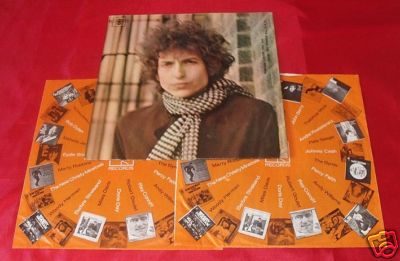
THE COVER :- Laminated first press internal flipback gatefold sleeve
THE LABEL :- Rare 33 speed textured CBS orange first press labels
THE VINYL VISUALLY :- These are the original earliest thick and chunky type of vinyls with deeper grooves (only found like this on the original 1st UK mono pressings) The vinyls lay perfectly flat on the turntable and is free of any warping! It is quite obvious that these vinyls have been played but not overplayed. There are a number of light superficial paper scuffs and light hairlines but nothing that would cause any jumps whilst playing and no other major areas of concern.
THE VINYL PLAY GRADED :- On play grading this fantastic record I have found it to be an extremely clear and vibrant sound that hasn't lost any of it's magic over the past 44 years!. They certainly haven't been over played, there are only signs of static and crackle as to be expected, but generally only heard inbetween tracks and quiet areas, these will more than likely improve significantly once the album has been played and cleaned a couple of times by its new owner. Overall I would say the vinyl plays to an Very Good Plus condition
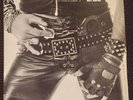
THE SLEEVE FRONT CONDITION :- This is the 1st issue Garrod & Lofthouse internal flipback gatefold cover! laminated front & back only! Absolutely stunning super super glossy appearance!.Showing Bob's top half in his infamous heavy button up winter coat which was to be seen again on his next two albums John Wesley Harding and Nasville Skyline. This is in stunning condition for a cover 44 years of age. There are barely any defects worth mentioning, very near pristine. If being super critical there is some very light storage wear shown in the four corners but apart from that easily one of the best front covers of this album i have seen. I would easily rate this front cover as Excellent Plus in condition.
THE SLEEVE REAR CONDITION :- The rear of the cover pretty much follows the front of the cover as regards condition, still retaining it's glossy appearence with only the same very light storage wear to the four corners. The rear features the bottom half of Bob's body to make the whole picture as seen in one of my photos of the cover. Again I would rate the rear of the sleeve as Excellent Plus in condition.
THE INNER GATEFOLD CONDITION :- The inner gatefold part of the cover is non laminated which in itself shows an earliest ever first pressing. Generally white laminated and non laminated sleeves are extremely difficult to keep clean for obvious reasons but this one has been extremely well looked after and retains all of its original crisp and clean feel, there is barely any discolourment at all. The original inside gatefold featured a photograph of the Italian Tunisian-born actress Claudia Cardinale that was used without her permission. Some critics at the time questioned if the photo was of Dylan himself in drag. From 1968 onward, Cardinale's photo was removed from all American pressings of the album, making copies of the record sleeve featuring the actress an out-of-print collector's item. However, some non-U.S. pressings of the album continue to use Cardinale's picture!!. This part of the cover also rates as Excellent Plus in condition.
THE LABEL SIDE ONE & TWO CONDITION :- These are the 1st issue CBS (TEXTURED ) mono labels! These are awesome! Please note only 1st issue l;abels feature ''33'' on the labels (later issues feature 331/3) and only 1st issue labels are textured!. They are free from stickers and writing and display only a few signs of play around the spindle hole. Excellent Condition.
THE LABEL SIDE TWO CONDITION :- These are the 1st issue CBS (TEXTURED ) mono labels! These are awesome! Please note only 1st issue l;abels feature ''33'' on the labels (later issues feature 331/3) and only 1st issue labels are textured!. They are free from stickers and writing and display only a few signs of play around the spindle hole. Excellent Condition.
THE SPINE CONDITION :- The writing on the spine is amazingly crystal clear!, no spine splits at all just signs of shelfwear in the corners. Most of these over the years show significant damage and the writing becomes unreadable but this one apart from the light corner storage wear is immaculate!. Excellent Plus in condition
THE INNER SLEEVE CONDITION :- These are the original Orange CBS advertising serpier sleeves (no) splits or tares just very light creasings. Rare to find like this totally original!
THE EXTRAS :- No extras were given with this album
THE CATALOGUE NUMBER :- 66012
THE YEAR OF RELEASE :- MAY 1966
THE COUNTRY OF ORIGIN :- UK
THE MATRIX NUMBERS :- DDP-66012-A1//B1//C1//D1
TRACK LISTING :-
SIDE ONE :-
- RAINY DAY WOMEN #12 & 35
- PLEDGING MY TIME
- VISIONS OF JOHANNA
- ONE OF US MUST KNOW (SOONER OR LATER)
SIDE TWO :-
- I WANT YOU
- STUCK INSIDE OF MOBILE WITH THE MEMPHIS BLUES AGAIN
- LEOPARD-SKIN PILL-BOX HAT
- JUST LIKE A WOMAN
SIDE THREE :-
- MOST LIKELY YOU GO YOUR WAY (AND I'LL GO MINE)
- TEMPORARY LIKE ACHILLIES
- ABSOLUTELY SWEET MARIE
- 4TH TIME AROUND
- OBVIOUSLY 5 BELIEVERS
SIDE FOUR :-
- SAD EYED LADY OF THE LOWLANDS
WHAT WE PLAY THE RECORD ON :-
We use a Project 6 Perspex Turntable to play grade our records which delivers a rich authoritative sound and achieves a rich and weighty vibrancy unrivalled by the majority of decks within its price range
HOW WE CLEAN YOUR RECORD :-
We use a V.P.I. HW-16.5 record cleaning machine to clean your vinyl. "A highly recommended machine" as quoted by Stereophile magazine. This removes any excess dirt before playing
HOW WE PACKAGE YOUR RECORD :-
Your record will be package very securely to minimise any risk of damage during transit. We remove the record from the outer sleeve unless asked not to do so. This helps to minimise the risk of seam spliting. We use a high quality record mailer which is designed to give superior protection for your vinyl record. We place stiffeners either side of the record for added protection. The album will also be placed in a 450 gram Poly outer sleeve for even extra added protection
POSTAGE AND PACKAGING CHARGES FOR UK CUSTOMERS :-
We advise that items reaching over £39.00 in price to be insured and sent by Special Delivery. This protects both of us and ensures better handling of the parcel during transit.We are in no way out to make money from postage. The postage price includes the record mailer, stiffeners and plastic sleeve. We just want your item to reach you in the best possible condition. A breakdown of insured postal services are listed below. Please choose to use the relevant postal service for your own protection as once these rare records are lost they can quite often seldom be replaced
FIRST CLASS RECORDED FOR RECORDS INSURED UP TO £39 :- £3.75
SPECIAL DELVIVERY FOR RECORDS INSURED UP TO £500 :- £6.40
POSTAGE AND PACKAGING FOR THE EUROPEAN UNION :-
All parcels sent to the European Union are sent by Registered Mail. We will not ship abroad without insured post
INTERNATIONAL SIGNED FOR SMALL PACKETS INSURED UP TO £500 :- £11.99
POSTAGE AND PACKAGING FOR THE USA AND CANADA :-
All parcels sent to the USA & Canada are sent by Registered Mail. We will not ship abroad without insured post
INTERNATIONAL SIGNED FOR INSURED UP TO £500 :- £16.00
POSTAGE AND PACKAGING FOR THE AUSTRALIA AND JAPAN :-
All parcels sent to the Australia & Japan are sent by Registered Mail. We will not ship abroad without insured post
INTERNATIONAL SIGNED FOR INSURED UP TO £500 :- £16.00
BUYERS OF MULTIPLE ITEMS :-
Postage prices and courier methods for multiple purchases will be calculated after the auction end. It is impossible for us at the pre auction stage to determine these prices as the final weight is unknown.If you are the winner of multiple items the please await contact from us or alternately contact us yourself for a breakdown of the shipping costs.You will only pay the stamp price + relevant packaging charges so there are big savings to be made with multiple purchases
HOW TO PAY FOR YOUR RECORD :-
We can accept the following payment methods
UK BUYERS :-
- PayPal
- Personal cheque (Please allow to clear)
- Bankers Draft
- Postal Order
OVERSEAS BUYERS :-
- Paypal only
TERMS AND CONDITIONS :-
We always try to appraise the record for sale as openly and honestly as possible and provide plenty of pictures for you to look at but please be aware that errors however rare do occur and not everyone has the same audio equipment. There is no problem that cannot be worked out in a civilised manner. We urge you to contact us so that we can discuss any small problems that may occur. We offer a refund of the purchase price for returned items within 7 days of purchase and are happy to help you with any questions or concerns you may have during the auction
SAVE US TO YOUR FAVOURITES LIST AS WE INTEND TO LIST MANY MORE RARE VINYL TREATS OVER THE COMING MONTHS AND YEARS
price rating