Bundervoët: Bach-Busoni Chaconne + Toccatas - Ducretet Thomson DTL 93051 (EX/EX)
$
845

Favourite Auctions
To save auctions to your favourites, please login
If you don't have an account, please register
Description
ITEM DESCRIPTION:
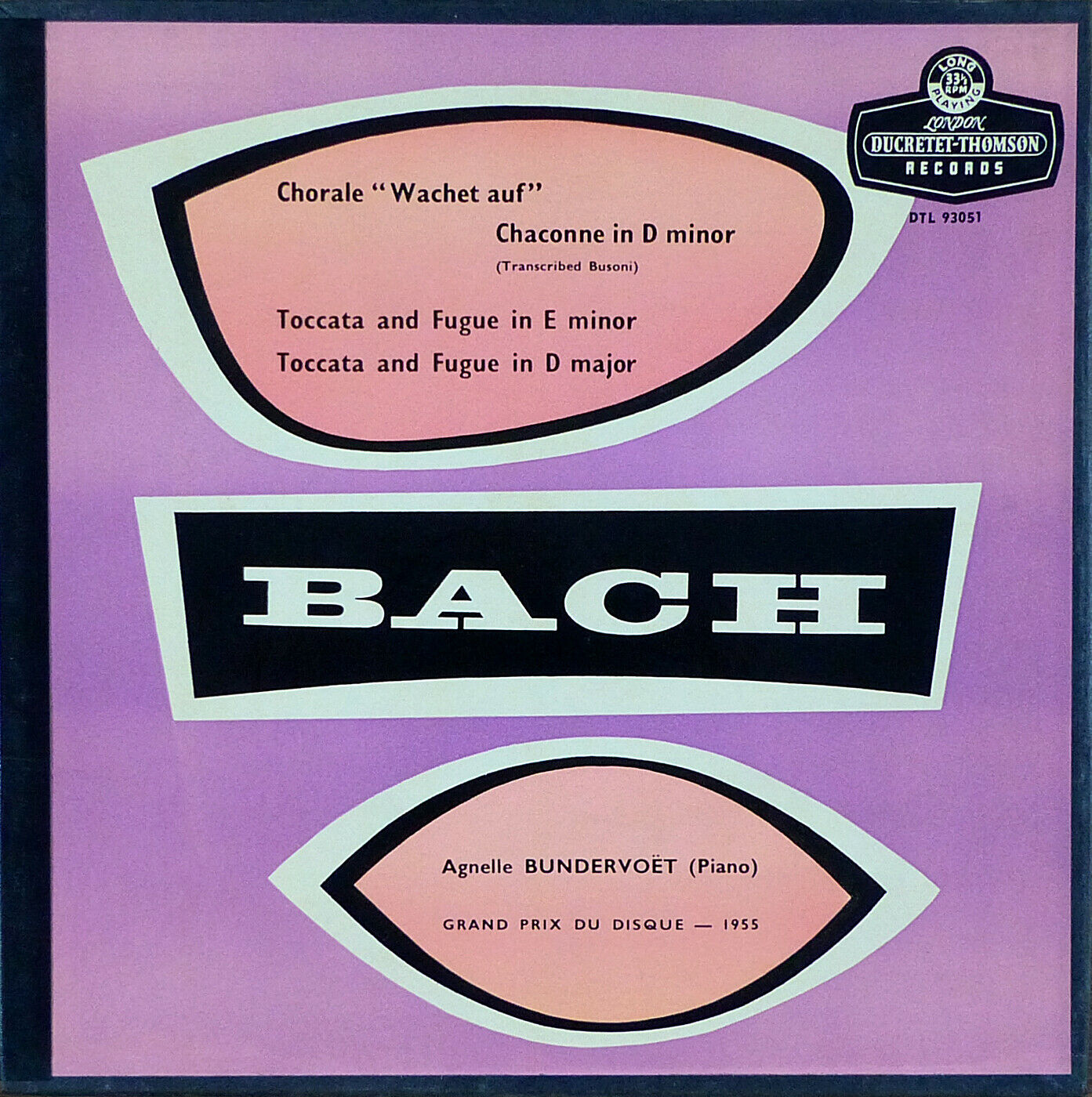
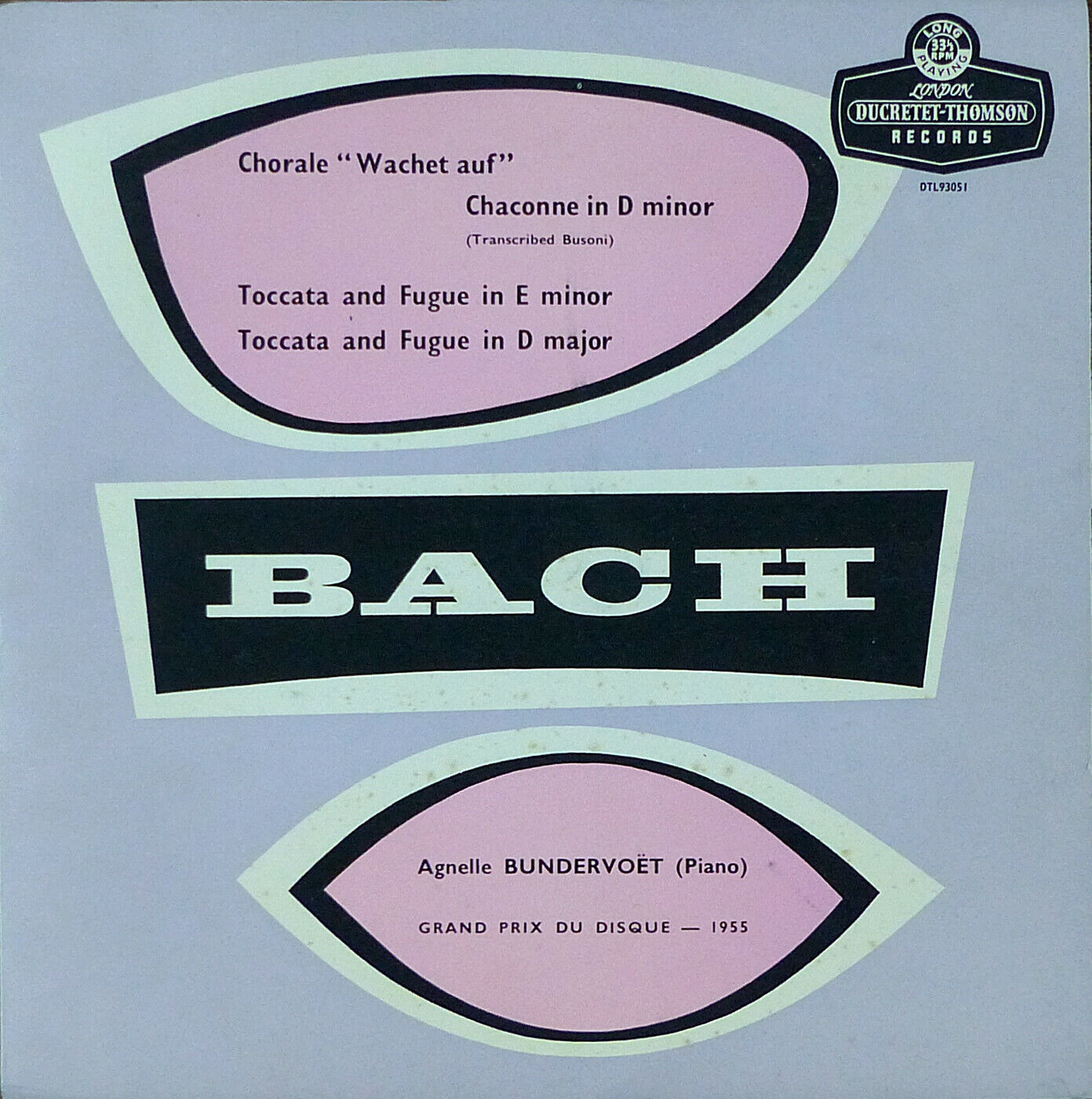
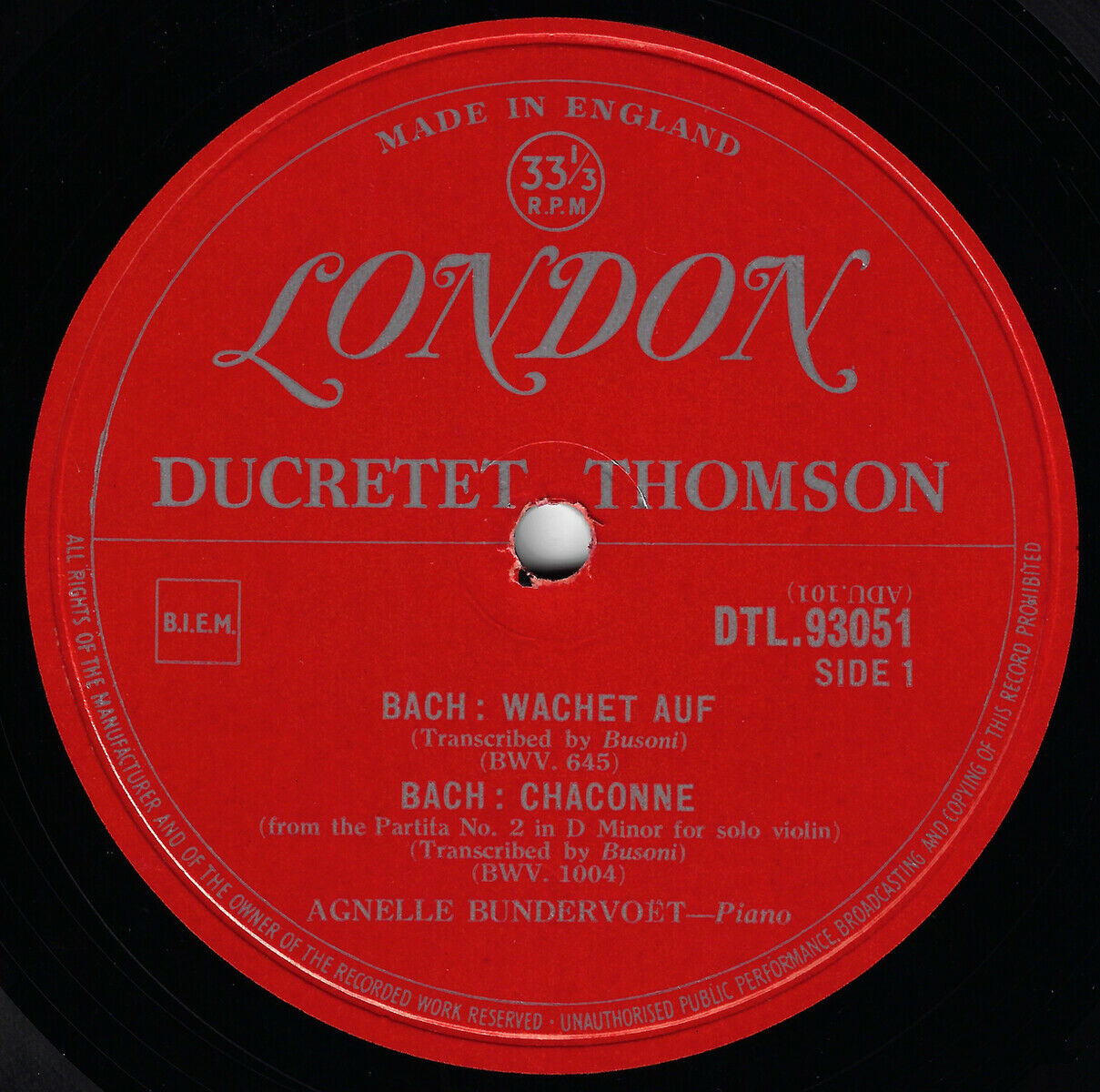
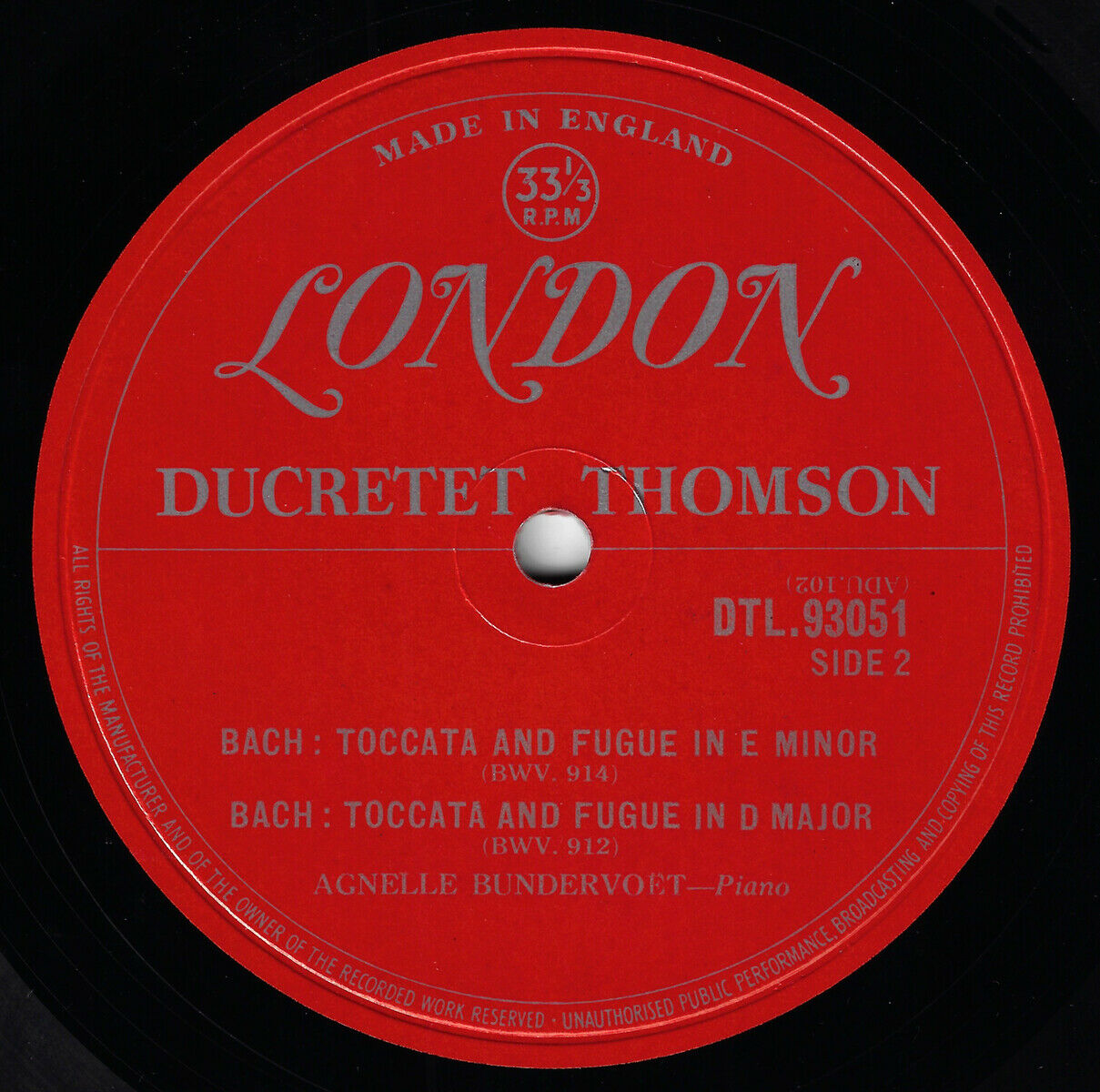
This beautiful and extremely rare LP from London · Ducretet Thomson (DTL 93051, English pressing, red/silver London Ducretet Thomson label, mono, box issue with interior jacket) features the enigmatic Agnelle Bundervoët playing Bach and Bach-Busoni in extraordinary performances recorded in Paris on 15 July 1954. This is one album that lives up to the hype – extraordinary playing by any measure and of the great piano discs of the LP era.
Included are the following works:
Bach: Toccata & Fugue in E minor BWV 914:
Bach: Toccata & Fugue in D Major BWV 912:
Bach (arr. Busoni): Chorale Prelude “Wachet auf, ruft uns die Stimme” BWV 645
Bach (arr. Busoni): Chaconne, from the Partita No. 2 for Solo Violin in D minor BWV 1004
At the indispensible website Bach-Cantatas, one can find this superb biography of Bundervoet by Jean-Marc Harari and Glenn Armstrong:
Agnelle Bundervoët
Born: 1922 - Puy de Dôme, Ambert, France
“The French pianist, Agnelle Bundervoët, was born in Puy de Dôme, Ambert, in the centre of France. Her father was of Belgian descent - the name comes from Gand. As he had made his career in the French Army, the family were always moving from city to city. When she was 4, Agnelle began to learn the piano with her mother, placing her ear against it to listen to the sound. At the age of 7 she was enrolled in the Conservatoire National de Marseilles where three years later she won a Grand Prix. Realizing the child needed special attention her mother took Agnelle to visit the great pedagogue Lazare-Levy in Paris. The result of this meeting was that the 10-year-old Agnelle immediately entered the music theory class at the Paris Conservatoire - while receiving free private tuition from the Master himself, in preparation for the higher piano class. She was to be admitted at 13, but finding there was no place for her in Lazare-Levy’s class, it was decided she should wait a year - all the while resisting Marguerite Long's attempts to get Agnelle into her class. She finally entered Levy's class in 1936. She was later to recall, “I created my own technique from watching him because he wasn’t much interested in technical problems for their own sake. His main concern at the piano was music.” Despite a difficult relationship with Lelia Gousseau, his assistant and former pupil, Agnelle was a brilliant student.
“When Lazare-Levy was dismissed from the Conservatoire by the Vichy government in 1940, Agnelle Bundervoët continued her studies with his assistant Madame Giraud-Latarse. In June 1942 she was awarded her Premier Prix. It has been suggested that Marcel Ciampi taught Agnelle, as he was eventually appointed to Levy's position some weeks before the competition, but this was not the case. Still in contact by mail, she asked her beloved Master if he would write a piece for her first Paris recital. He accepted and dedicated his Thèmes et Variations to her. At the same recital she was also to premier works by Jacques de la Presle and the musicologist Marc Pincherle. The critics were amazed: ‘One doesn’t believe one’s ears…a top class international tone, possessed only by artists of great renown’. It was particularly courageous in the years of occupation to play the work of a Jewish composer. The reviews mentioned all the works played except that by Lazare-Levy. The last year of the war was especially tragic for the Bundervoët family. Her father died just after Agnelle was married in June 1944, having never recovered from a long captivity in Germany as a prisoner of war. The following spring her elder brother Henri, also a fine musician, was lost in his airplane over the English Channel. Agnelle cared for her mother while they grieved the loss of the two men of the family.
“The war over, Agnelle Bundervoët continued her studies until 1948, her protracted time at the Conservatoire due to the rich and varied instruction she received - harmony with de la Presle, counterpoint, piano accompaniment, and Maurice Hewitt’s chamber music classes shared with Samson François. She received private lessons from Marcel Dupré for organ and even singing lessons for her coloratura voice. At eighteen she enjoyed the opportunity of acting as choirmaster, rehearsing Fauré's Requiem. This broad musical foundation proved essential to her deep understanding of the piano scores she was to perform and enabled her to play contemporary works with the same insight as the classical romantic repertoire. She possessed an extremely analytical mind, an awesome grasp of the overall architecture of a work, flaming expression and a piano technique that transcended to orchestral dimensions.
“By the time she left the Conservatoire Agnelle Bundervoët had accumulated six Prix Premiers and now married and with a child, she decided it was time to make a living and embark on a career. It developed quickly through the early fifties. She was chosen to premier Elsa Barraine's Piano Concerto at the International Music Festival in 1954 by the musicologist Roland-Manuel. While Barraine does not rank highly in the pantheon now, she was well regarded then, particularly by the conductor Roger Désormière. This important event established Agnelle as one of the top pianists in France. Pierre Capdeville dedicated his piano concerto ‘Del Dispetto’ to her, an extremely difficult serial work both technically and musically. This she premiered with the Orchestre Conservatoire directed by Manuel Rosenthal. The composer Thomas Stubbs also owes her a clear debt. Dedicatee of his Piano Concerto she also actively promoted his Pièces Concertantes for Piano and Trumpet and ‘Danses à Travers les Ages’.
“Agnelle Bundervoët's ability to perform the piano repertoire from Bach to the most difficult contemporary works equally brilliantly earned her the admiration of the critics and also pianists as eminent as Yvonne Lefébure. She played with Paul Paray, Eugène Bigot, Pierre-Michel Le Conte, Charles Brück. Each concert was a triumph. After one, a critic who never had anything good to say about anyone raved about her in the press and arranged to meet her. He introduced himself as the director of Ducretet-Thomson and expressed his deep admiration. ‘Well’, she asked, ‘why don’t you make a recording of me’? Due to the simple reason that Bach was lacking in the D-T catalogue, the resulting disc was a Bach recital. Agnelle herself made the choice of works - Bach-Busoni transcription of Wachet Auf and the Chaccone and two Toccatas and Fugues. Uniquely and justifiably, she was awarded a ‘Grand Prix du Disque’ for her first recording, her playing displaying an extraordinary musical maturity. However, she was not invited to record again for Ducretet-Thomson. Neither was she paid.
“From the mid 1950's Agnelle Bundervoët had begun to suffer from rheumatism, which forced her to limit her playing to shorter works, or pieces already perfectly known. A further setback came in 1956 when she divorced her husband and had to provide for now three children. As a consequence she decided to devote more of her time to teaching. Against heavy competition of over one hundred applicants (including Monique Haas), and before a jury presided over by Jeanne-Marie Darré, she successfully entered the faculty of Le Conservatoire National de Versailles, where she would continue to teach piano for the next thirty years.
“Ironically it was by turning away from the concert platform that Agnelle Bundervoët actually ensured more people would be able to hear her. She discovered that she could take rest periods during her programmes and between the movements of longer works when recording for radio broadcast. Radio gave her a greater audience without exhaustion or pain. To her further advantage was her range of interests and versatility, which put her ahead of many of her more specialist peers. Who else could play Bach, Beethoven or Johannes Brahms with the same assured conviction and intensity as works by Ravel, Debussy or Shostakovitch?
“Between 1958 and 1960 Agnelle Bundervoët produced three LP's for French Decca. In the first, a J. Brahms recital, she pits her strength against the Variations on a Theme by Handel, a veritable Everest before which no pianist can cheat. Her playing is powerful and while overcoming all obstacles is positively ablaze with invention, exposing here an unusual phrase, there a detail in the bass line. In the French pantheon there is only Yves Nat who can share her understanding of Brahms. The second is a dense, dark Schumann recital, revealing the tortured poetry of the Fantasiestücke by entering into the imagination of the composer with passion and rigour, without a trace of sentimentalism. Her performance of the Toccata transcends mechanical exercise and is lit from within like a string of paper lanterns. The disc also holthe world’s first recording of the Intermezzi op. 4, Bundervoët again proving herself the unassuming pioneer. The 3rd Decca recording was a Franz Liszt recital, which again only makes one wonder from where, as the case with Yvonne Lefébure, can such a small woman draw such strength? We know that balance of the body is important and an active role of the shoulders, and Agnelle has another secret - ping-pong, a sport she recommends to all her students! Incredibly these were to prove her last records until today.
“In the late 1950's, Agnelle Bundervoët met the love of her life, Maurice Braun, a great resistant during the war and a famous Egyptologist. Together they shared the joys of international travel and Agnelle discovered the beauty of Egypt. Throughout the sixties and seventies she continued to teach at the Versailles Conservatoire, totally devoted to her students. She has also composed for piano and chamber ensemble, displaying a fabulous ear for melody, which sometimes betrays the influence of her beloved Fauré. In fact if there was but one work she would choose to sum up her own moral and religious convictions, it would be his Requiem.
“Still very active, Agnelle Bundervoët, without doubt one of the greatest French pianists of the 20th Century, now divides her time between gardening, some private tuition and her grandchildren.
“‘I have never heard Gaspard de la Nuit played so perfectly in all my life’ - Jeanne-Marie Darré”
Incidentally, there are fine liner notes on the reverse side of the jacket, in English (translated from the French) by Jean Cotte.
CONDITION – PLEASE READ VERY CAREFULLY:
The gradations of condition I use are as follows: MINT, Near-Mint, Excellent, Very Good, Good, Fair, Poor.
The condition of the box is EXCELLENT. The only real flaw is that the lower-right corner of the box top is split and the box is very slightly flattened. Otherwise, it rates as NM-. Viewed from the front, the box appears excellent, close to near-MINT even. However, the other 3 corners are perfectly intact, there are no splits or owners' marking, the spine is perfectly legible and the whole remains solid and very handsome.
The condition of the jacket is VERY GOOD-. There is a 2” seamsplit to the middle of the top edge and some discoloration (spotting) to the front panel, but that is all. The flipback portions of the jacket are fine and there are no markings or other defects. Overall, a very solid VG jacket.
The condition of the LP itself is EXCELLENT. The only real flaw consists of a pressing bubble on Side 2 that causes a low "thump" sound for about 10 revolutions (in the Toccata & Fugue in D Major BWV 912) – no skips, jumps; the sound is quite low, but audible. Otherwise, the LP would rate as NM-. Visually, there are some light hairline / paper sleeve marks. If you must have perfectly silent or flawless surfaces, then please do not buy this LP. Overall, this rates as an excellent collector's copy.
PLEASE NOTE:
All LPs are provided with a new Nagaoka (or Nagaoka-style) inner sleeve. The images I've provided are of the actual item you are potentially bidding on - these are not stock images or images I've taken from other sites. Bid with confidence!
PAYMENT:
Payment should be made within 3 days.
SHIPPING:
Shipping is free to anywhere in the world; this is true regardless of the number of LPs you buy, be it 1 or a 100. All LPs will be sent via standard economy airmail (10-20 days delivery). Note: There is no tracking number provided with standard airmail. Should you wish to have your item(s) sent via certified airmail (i.e., with a tracking number), please let me know.
FEEDBACK:
I will promptly leave feedback for all buyers. Please do not leave negative, or even neutral, feedback without first giving me an opportunity to resolve any dissatisfaction you might have with an item or transaction. I do understand that, on occasion, a buyer might believe the item description to be inaccurate or that a buyer may be disappointed in some other way regarding the sale. I promise I will do my very best to resolve any unhappiness you've experienced in your buying experience with me to your complete satisfaction. Thank you.
REFUNDS:
Returns are honored, and any buyer you makes a return will be refunded in full. Please let me know before making a return.
Please see my other classical LP and CD auctions, and feel free to write with any questions, I'll be glad to help.
price rating