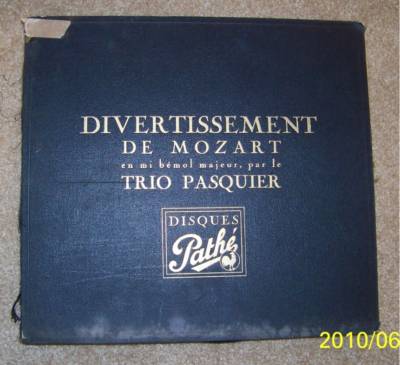
Trio Pasquier: Divertimento in E Flat Major (Mozart)
$
50


Favourite Auctions
To save auctions to your favourites, please login
If you don't have an account, please register
Description
Trio Pasquier: Divertimento in E Flat Major (Mozart) 1936 Pathe 12-inch 5-record Set (France)
Pathe 12-inch, 78 RPM, 5-record Set, includes PAT 38 thru PAT 42.
Trio Pasquier: Divertimento in E Flat Major K. 563 (Mozart) .
1936 issue.
Records are in E / E- condition. Labels are good. Binder is in Good Minus Condition, shelf wear, missing back cover, sleeves have partial seam splits. Includes Ultra RARE Booklet, in French. Photo of Pasquier Trio inside front cover.
"It is perhaps academic to protest that the Divertimento in E Flat (K563), composed in 1788, is not Mozart's only string trio, as the leaflet which accompanies the recording informs us, for there exists another string trio for two violins and 'cello which exhibits a curious diversity of styles and is dated by musicologists 1776.
The Divertimento in E flat (violin-viola-'cello), a much more important work, is divided up into six movements grouped as follows : (1) Allegro, (2) Adagio, (3) Minuet No. 1, (4) Andante, (5) Minuet No. 2 (with two Trios), (6) Allegro.
The string trio has not been a form greatly favoured by composers, perhaps because, as Mr. Dunhill has suggested, the average musical mind finds it easier to think in four parts than in three and also because the string quartet, with its two violins, has proved itself to be a perfectly adjusted piece of musical machinery.
Mozart, needless to say, solves the difficult technical problems the form presents with effortless mastery. His is real three-part writing, without reliance on double-stopping, which is destructive of the clear outline of the parts and apt to turn the trio into the simulation of a quartet, and he contrives a wonderful variety of sound-effects within the limits of his medium.
For a description of the music I must send the reader (as is apparently desired by readers) to the excellent analytical notes provided.
The performance, rather over-amplified, like all recordings nowadays, would be a good one if given, as Serenades, Cassations, and Divertimenti often were, in the open air. The players are evidently in love with their task and there is much of the gracious shaping and turning of phrases that this aristocratic music requires. Occasionally, however, they seem to lose grip and allow the music to meander (about half-way through Part II of the First Movement is a case in point). Mozart's delicate linedrawing needs the finest pointing and cannot support smudginess in any of the parts. The 'cellist is a rather frequent offender in these respects. His tone lacks richness and his playing definition, with hurt to the balance of parts. The tone levels are curiously various. Thus the viola comes out with excessive strength at the end of the Andante (Fourth Movement : variations) almost leading one to suspect the addition of another instrument (and that a saxophone !) ; and the first violin is often too prominent. The opening chords of the second Minuet need just that extra pointing to give them the horn-like quality they should possess and the first Trio, in the form of an old German dance (lOndler), should be given with a more sensuous springiness by the viola. I do not want this review to be a mass of qualifications, but will leave the remarks above to indicate that if the performance is not of the finest it will give much enjoyment to those who will take it in an open-air holiday spirit and who are eager to get the first recording of a lovely work certainly well and musically played, and, if toned down, well recorded in point of tone and clarity.
It is a great pity that the two Minuets were not recorded on one disc and the Andante on another instead of putting the first Minuet and the first part of the Andante on DX744, its conclusion and the second Minuet on DX745.
The most desirable single record for the poor man is that of the beautiful Adagio (DX743), and after that either the First• Movement (DX742) or the Finale (DX746)." (Review of the British Columbia pressing of these recordings in the September, 1936, "Gramophone". Individual records are referred to using the Columbia numbers.)
Terrific and Scarce French Import Classical Set in Very Nice Condition.
Buyer to pay calculated shipping in the USA and worldwide. PAYPAL may be used by US and most overseas bidders to pay by credit card. Don't forget to visit Really Old Records, my ebay storefront, at http://stores.ebay.com/Really-Old-Records?RefID=store for a look at over 500 fine 78s, 45s, LPs, CDs and other items at reasonable fixed prices. If you purchase more than one item please wait for my combined invoice with savings on combined shipping.
price rating