Tito Puente,Tambo,LP,RCA Victor,LPM-2257,1960,SEALED,UNOPENED,Latin Jazz,RARE
$
125


Favourite Auctions
To save auctions to your favourites, please login
If you don't have an account, please register
Description
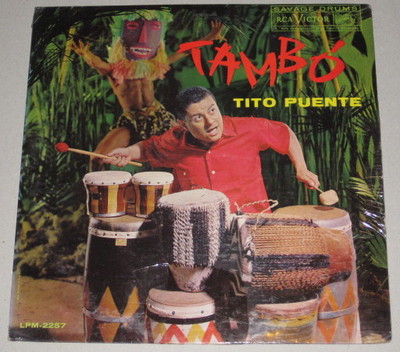
Offered for sale is an original first printing Tito Puente entitled "Tambo" (RCA Victor, LPM-2257 (Mono), 1960), featuring a fantastic cover image, and is still SEALED / UNOPENED / UNPLAYED (see bio info below). The record is in MINT condition (still sealed; unopened; unplayed; shrink wrapping is missing a small piece on the lower front center area, and is partially split on the side opening to the record; extremely rare to find condition!!!), and has an asking price of $124.99 with FREE shipping and handling, and is the only one currently offered on eBay or other websites! Overseas bidders please add for additional S/H costs, and CA State Residents please add 9% sales tax. Thanks for visiting my auction listing, and feel free to contact me with further questions or comments!
Review:
Tito Puente - Tambo [RCA Victor, 1960]
Tito Puente was a hugely successful band leader with an infectiously captivating Latin sound. Apparently, from how the liner notes present this particular album, Tambo was really a departure from what fans of Puente would expect to hear. The writer hints at this different direction, noting that the LP “opens a new vista of sound for lovers of Latin music.” Well, not only does this recording take you to a new vista, it hurls you off of it with a whollop of wild voodoo drums!
Mentioning a “thrilling array of savage, passionate rhythm,” the liner notes implore would-be purchasers that “if your taste runs toward the torrid and tropical, then Tambo by Tito Puente should suit you to a T.” This record really doesn’t need any liner notes to make you aware of what’s in store. The front cover is a great shot of Tito bent over an array of bongo/conga drums; he holds a mallet in each hand and stares out with wild eyes, his mouth wide open as though he’s in the midst of hammering out a jungle rhythm for the masked native who dances wildly in the dense jungle behind him.
Unlike the tropical fantasies of genre great Martin Denny, Tito places emphasis on driving drums and supports his rhythms, not with an array of necessarily “exotic” instruments, but with more “standard” sounds provided by piano, flute, and brass. Puente succeeds immensely with Tambo where other percussion albums like Les Baxter’s Skins (although, to be fair, there are a couple of good cuts on Baxter’s LP as well) lose listener interest with lengthy drumming and even MORE lengthy drumming. Tito manages to heat-up his percussive fireworks with brief flourishes of melody that push the arrangements ahead, never allowing the drumming to get too stale or repetitive.
Pieces like Guaguanco feature a simple arrangement of bells and drums that rise in intensity to create a complex rhythm punched along by blaring trumpets which frame the beats with a flourish of melody. The cut Voodoo Drums at Midnight hits the mark dead-on, as a huge fanfare of brass and percussion introduces a fast and penetrating conga drum rhythm that perfectly creates an image of whirling voodoo priestesses flailing and spinning with wild abandon in front of a huge bon fire deep within the confines of the jungle.
The recording job on Tambo is top-notch, the various drums pounding away at the same time are all discernable from one another and have a deep, resonating presence that creates a feeling of cavernous depth. All of the tracks feature excellent percussive shenanigans along with thumping bass, and a brass section that clambers over the top of this percussive wall of sound to punch up the intense rhythms to an even greater degree.
Occasionally, the bongo fury resides to make way for a few cuts like Call of the Jungle Birds, and Velorio, which conjure up sunny skies and cascading waterfalls. Both of these cuts are arranged along the lines of a more “rudimentary” song structure, and feature flute or piano while the rhythm section is notched down a few levels to back the featured instruments. However, the majority of Tambo is all about the power of drums, and Tito creates an entirely engaging album from beginning to end with a mixture that includes these more quiet melodies.
Imagine a vintage Hawaiian backyard luau; things are wrapping up after Webley Edwards and Don Ho pay their audio respects to the fiftieth state, the sun begins to set, the food has all been eaten, and it’s time for marshmallows over the barbeque pit (“Like it?” “I built it myself!”). Someone drops Tambo onto the turntable. There’s passion in the air as savage drums incite beautiful maidens to enthusiastically twirl and dance. The torch-lit backyard becomes overgrown with vegetation as you race along what was once a sidewalk, but now appears as a jungle trail to your rum soaked noggin’. Ahead of you a giggling female laughs over her shoulder as you attempt to catch her. Your chase leads up carpeted stairs where you finally seize your prize in a blue lagoon of bed sheets and pillows. Jungle drums continue pounding with a primitive fury long into the night……such is the power of Tambo.
Tito Puente
From Wikipedia, the free encyclopedia Jump to: navigation, search Tito Puente Background information Birth name Ernesto Antonio Puente Also known as Tito Puente"El Rey de los Timbales"
The King of Latin Music Born April 20, 1923(1923-04-20) Origin New York City Died June 1, 2000(2000-06-01) (aged 77) Genres Afro-Cuban jazz, mambo, salsa Occupations Musician, producer Instruments Timbales, Vibraphone Years active 1946 - 2000 Labels Fania Records, Sony Discos, RMM Records Associated acts La Lupe
Tito Puente, (April 20, 1923 – June 1, 2000)[1], born Ernesto Antonio Puente, was a Latin jazz and Salsa musician. The son of native Puerto Ricans Ernest and Ercilia Puente, of Spanish Harlem in New York City, Puente is often credited as "El Rey de los Timbales" (The King of the timbales) and "The King of Latin Music". He is best known for dance-oriented mambo and Latin jazz compositions that helped keep his career going for 50 years. He and his music appear in many films such as The Mambo Kings and Fernando Trueba's Calle 54. He guest starred on several television shows including Sesame Street, The Cosby Show and The Simpsons.
Contents
[hide]- 1 Career
- 2 Awards and recognition
- 3 Discography
- 3.1 As leader
- 3.2 As sideman
- 4 Filmography
- 4.1 Selected Feature Films
- 4.2 Documentaries
- 4.3 Concert films
- 5 Quotation
- 6 References
- 7 Further reading
- 8 External links
[edit] Career
Tito Puente Sr. served in the Navy for three years during World War II after being drafted in 1942. He was discharged with a Presidential Unit Citation for serving in nine battles on the escort carrier USS Santee (CVE-29). The GI Bill allowed him to study music at Juilliard School of Music, where he completed a formal education in conducting, orchestration and theory. In 1969, he received the key to the City of New York from former Mayor John Lindsay. In 1992, he was inducted into the National Congressional Record, and in 1993 he received the James Smithson Bicentennial Medal from the Smithsonian.[2]
During the 1950s, Puente was at the height of his popularity, and helped to bring Afro-Cuban and Caribbean sounds, like mambo, son, and cha-cha-cha, to mainstream audiences (he was so successful playing popular Afro-Cuban rhythms that many people mistakenly identify him as Cuban). Dance Mania, possibly Puente's most well known album was released in 1958.[3] Later, he moved into more diverse sounds, including pop music, bossa nova and others, eventually settling down with a fusion of Afro-Cuban and Latin jazz genres that became known as "salsa" (a term that he disliked). In 1979, Puente won the first of five Grammy Awards for the albums A Tribute to Benny Moré, On Broadway, Mambo Diablo, and Goza Mi Timbal. In 1990, Puente was awarded the James Smithson Bicentennial Medal. He was also awarded a Grammy at the first Latin Grammy Awards, winning Best Traditional Tropical Album for Mambo Birdland. In 1995, he appeared as himself on the Simpsons episode "Who Shot Mr. Burns?" In early 2000, he shot the music documentary Calle 54, wearing an all-white outfit with his band.[4] After a show in Puerto Rico on May 31, he suffered a massive heart attack and was flown to New York City for surgery to repair a heart valve, but complications developed and he died during the night of May 31 – June 1, 2000.[5] He was posthumously awarded the Grammy Lifetime Achievement Award in 2003.
Tito Puente's name is often mentioned in a television production called La Epoca, a film about the Palladium era in New York, Afro-Cuban music and rhythms, Mambo and Salsa as dances and music and much more. The film discusses many of Tito Puente's as well as Arsenio Rodriguez's contributions, and features interviews with some of the musicians Puente recorded with such as Alfonso "El Panameno" Joseph, Luis Mangual, Julian Lianos and others.
Puente's youngest son, Tito Puente, Jr., has continued his father's legacy by presenting many of the same songs in his performances and recordings, while daughter Audrey Puente is a television meteorologist for WNYW and WWOR-TV in New York City.
[edit] Awards and recognition
Timbales on display at the Smithsonian- During the presidency of Sen. Roberto Rexach Benítez, Tito Puente received the unique honor of having both a special session of the Senate of Puerto Rico dedicated to him, and being allowed to perform in his unique style on the floor of the Senate while it was in session.
- On September 10, 2007, a United States Post Office in Spanish Harlem was named after him at a ceremony presided by House Ways and Means Committee Chairman Charles Rangel (D-NY) and Rep. José Serrano (D-NY).
- An amphitheatre was named in his honor at Luis Muñoz Marín Park, next to the Roberto Clemente Coliseum, in San Juan, Puerto Rico.
- Puente performed at the closing ceremonies at the 1996 Summer Olympics in Atlanta, Georgia. The timbales he used there are on display at the National Museum of American History in Washington D.C.
- In 1997, he was awarded the National Medal of Arts.[6]
- In 1990 he received a Star on the Hollywood Walk Of Fame. (ref Hollywood Chamber Of Commerce)
- In 1984 he received an honorary Decree from the Los Angeles City Council.
- On June 5, 2005, Puente was honored by Union City, New Jersey with a star on the Walk of Fame at Union City's Celia Cruz Park.[7]
[edit] Discography
[edit] As leader
- Puente In Percussion (1956)
- Dance Mania (1958)
- El Rey: Bravo (1963)
- El Rey: Tito Puente & His Latin Ensemble (1984)
- Percussion's King (1997)
- Selection of Mambo & Cha Cha Cha (1997)
- 50 Years of Swing (1997)
- Tito Meets Machito: Mambo Kings (1997)
- Cha Cha Cha Rumba Beguine (1998)
- Dance Mania '98: Live at Birdland (1998)
- The Very Best of Tito Puente (1998)
- Timbalero Tropical (1998)
- Yambeque (1998)
- Absolute Best (1999)
- Carnival (1999)
- Colección original (1999)
- Golden Latin Jazz All Stars: In Session (1999)
- Latin Flight (1999)
- Latin Kings (1999)
- Lo mejor de lo mejor (1999)
- Mambo Birdland (1999)
- Special Delivery featuring Maynard Ferguson (1999)
- Rey (2000)
- His Vibes & Orchestra (2000)
- Cha Cha Cha for Lovers (2000)
- Homenaje a Beny Moré. Vol. 3 (2000)
- Dos ídolos. Su música (2000)
- Tito Puente y su Orquesta Mambo (2000)
- The Complete RCA Recordings. Vol. 1 (2000)
- The Best of the Concord Years (2000)
- Por fin (Finally) (2000)
- Party with Puente! (2000)
- Obra maestra (2000)
- Mambo Mambo (2000)
- Mambo King Meets the Queen of Salsa (2000)
- Latin Abstract (2000)
- Kings of Mambo (2000)
- Cha Cha Cha for Lovers (2000)
- The Legends Collection: Tito Puente & Celia Cruz (2001)
- The Complete RCA Recordings, Vol. 2 (2001)
- RCA Recordings (2001)
- Puente caliente (2001)
- The Best of... (2001)
- King of Mambo (2001)
- El Rey: Pa'lante! Straight! (2001)
- Cocktail Hour (2001)
- Selection. King of Mambo (2001)
- Herman Meets Puente (2001)
- Undisputed (2001)
- Fiesta (2002)
- Colección Diamante (2002)
- Tito Puente y Celia Cruz (2002)
- Live at the Playboy Jazz Festival (2002)
- King of Kings: The Very Best of Tito Puente (2002)
- Hot Timbales! (2002)
- Dr. Feelgood (2002)
- Carnaval de éxitos (2002)
- Caravan Mambo (2002)
- We Love Salsa (2006)
[edit] As sideman
With Dizzy Gillespie
- Rhythmstick (1990)
[edit] Filmography
[edit] Selected Feature Films
- Radio Days (1987)
- Armed and Dangerous (1986)
[edit] Documentaries
- Tito Puente: The King of Latin Music (2000)[8]
- PROFILES featuring Tito Puente Jr. (2007)
- Latin Knights (2005)
- Calle 54 (2000)[9]
[edit] Concert films
- Tito Puente - Live in Montreal (Montreal Jazz Festival) (1983) (2003)
[edit] Quotation
“ We play jazz with the Latin touch, that's all, you know. ”price rating