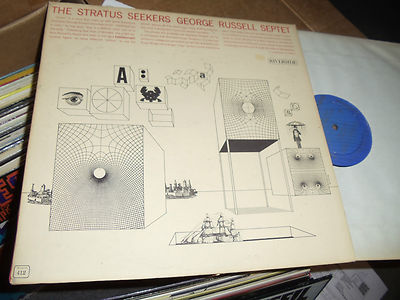
The Stratus Seekers - George Russell LP MONO don ellis dave baker steve swallow
$
29


Favourite Auctions
To save auctions to your favourites, please login
If you don't have an account, please register
Description
LP NM
Jacket VG+
Biography
While George Russell was very active as a free-thinking composer, arranger, and bandleader, his biggest effect upon jazz was in the quieter role of theorist. His great contribution, apparently the first by a jazz musician to general music theory, was a book with the intimidating title The Lydian Chromatic Concept of Tonal Organization, where he concocted a concept of playing jazz based on scales rather than chord changes. Published in 1953, Russell's theories directly paved the way for the modal revolutions of Miles Davis and John Coltrane -- and Russell even took credit for the theory behind Michael Jackson's huge hit "Wanna Be Startin' Somethin'," which uses the Lydian scale (no, he didn't ask for royalties). Russell's stylistic reach in his own compositions eventually became omnivorous, embracing bop, gospel, blues, rock, funk, contemporary classical elements, electronic music, and African rhythms in his ambitious extended works -- most apparent in his large-scale 1983 suite for an enlarged big band, The African Game. Like his colleague Gil Evans, Russell never stopped growing, but his work is not nearly as well-known as that of Evans, being more difficult to grasp and, in any case, not as well documented by U.S. record labels.
Russell's first instrument was the drums, which he played in the Boy Scout Drum and Bugle Corps and at local clubs when he was in high school. At 19, he was hospitalized with tuberculosis, but he used the enforced inactivity to learn the craft of arranging from a fellow patient. Once back on his feet, he played with Benny Carter, but after being replaced on drums by Max Roach, Russell began to zero in on composing and arranging. He moved to New York to join the crowd of young firebrands who gathered in Gil Evans' "salon," and he was actually invited to play drums in Charlie Parker's band. But once again, he fell ill, finding himself in a Bronx hospital for 16 months (1945-1946), where he began to formulate the ideas for the Lydian Concept. Upon his recovery, Russell leaped into the embryonic fusion of bebop and Afro-Cuban rhythms by writing "Cubana Be" and "Cubana Bop," which the Dizzy Gillespie big band recorded in 1947. He contributed arrangements to Claude Thornhill and Artie Shaw in the late '40s and wrote the first (and not the last) speculative scenario of a meeting between Charlie Parker and Igor Stravinsky, "A Bird in Igor's Yard," recorded by Buddy De Franco.
While working on his Lydian theories, Russell dropped out of active music-making for a while, working at a sales counter in Macy's when his book was published. But when he resumed composing in 1956, he had established himself as an influential force in jazz. Russell's connection with Gunther Schuller resulted in the commission of "All About Rosie" for the 1957 Brandeis University jazz festival, and he also taught at the Lenox School of Jazz that Schuller co-founded. He formed a rehearsal sextet in the mid-'50s that became known as the George Russell Smalltet, with Art Farmer, Bill Evans, Hal McKusick, Barry Galbraith, and various drummers and bassists. Their 1956 recording Jazz Workshop (RCA Victor) became a landmark of its time, and Russell continued to record intriguing LPs for Decca in the late '50s and Riverside in the early '60s. Another key album from this period, Ezz-Thetics, featured two important progressive players, Eric Dolphy and Don Ellis.
Finding the American jazz scene too confining for his music, Russell left for Europe in 1963, living in Sweden for five years. From his new base, he toured Scandinavia with a new sextet of European players and received numerous commissions -- including a ballet based on Othello, a mass, and the orchestral suite Electronic Sonata for Souls Loved by Nature: 1980. Upon his return to the U.S. in 1969, he joined the faculty of the New England Conservatory of Music, where Schuller had started a jazz department, and this gave him a secure base from which to tour occasionally with his own groups. Russell stopped composing from 1972 to 1978 in order to finish a second volume on the Lydian Chromatic Concept. He led a 19-piece big band at the Village Vanguard for six weeks in 1978, played the Newport Jazz Festival when it was based in New York City, and made tours of Italy, the U.S. West Coast, and England in the '80s.
Russell's most imposing latter-day commissions included "An American Trilogy" and the monumental three-hour work "Time Line" for symphony orchestra, jazz ensembles, rock groups, choir, and dancers. In addition to The African Game and So What on Blue Note, Russell made recordings for Soul Note in the '70s and '80s and Label Bleu in the '90s, while continuing to teach at the New England Conservatory and leading his Living Time Orchestra big band into the 21st century. In 2005 George Russell & the Living Time Orchestra's The 80th Birthday Concert, released on the Concept label, celebrated the legendary octogenarian's contributions to the art of jazz with performances of some of his most groundbreaking extended compositions and arrangements. George Russell died in Boston on July 27, 2009 of complications from Alzheimer's disease; he was 86 years old.
All Lps are sight graded
Note: I Do Not Grade inner sleeves, If these are Important to you then you may e-mail me)
RECORD GRADING Based On Goldmine Grading Standards:
Near Mint (NM): A nearly perfect record. There may be one or two small inaudible defects. The record should show no obvious signs of wear. A 45 RPM or EP sleeve should have no more than the most minor defects, such as almost invisible ring wear or other sights of slight handling. An LP jacket should have no creases, folds, seam splits or any other noticeable similar defect. No cut-out holes, either.
Near Mint Minus (NM-): A record that should play mint but has a few slight visible marks. The album will have as much luster as an NM, there just may be some superficial scuffs from the sleeve or very light hairlines that shouldn't be audible. An NM- album cover subjectively fits somewhere in between VG+ and NM.
Very Good Plus (VG+): A Very Good Plus record will show some signs that it was played and otherwise handled by a previous owner who took good care of it. Record surfaces may show some slight signs of wear and may have slight scuffs or very light scratches that don t significantly affect play. Slight warps that do not affect the sound are OK. The label may have some ring wear or discoloration, but it should be barely noticeable. The center hole will not have been misshapen by repeated play. 45 Picture sleeves will have some slight wear, lightly turned-up corners, or a slight seam-split. An LP jacket may have slight signs of wear also and may be marred by a cut-out hole, indentation or corner indicating it was taken out of print and sold at a discount.
Very Good (VG): Many of the defects found in a VG+ record will be more pronounced in a VG disc. Surface noise will be evident upon playing, especially in soft passages and during a song s intro and fade, but will not overpower the music otherwise. Groove wear will start to be noticeable, as will light scratches (deep enough to feel with a fingernail) that will affect the sound. Labels may be marred by writing, or have tape or stickers (or their residue) attached. The same will be true of picture sleeves or LP covers. However, it will not have all of these problems at the same time, just two or three of them.
Good (G), Good Plus (G+): Good does not mean Bad! A record in Good or Good Plus condition can be put onto a turntable and will play though without skipping. But it will have significant surface noise and scratches and visible groove wear. A jacket or sleeve will have seam splits, especially at the bottom or on the spine. Tape, writing, ring wear or other defects will start to overwhelm the subject.
Poor (P), Fair (F): Below good. imperfections will be described.
Please check out my other items for sale. (I offer shipping discounts) I'll Be adding More Daily except for Friday and Saturday.
ALL SHIPPING PRICES ARE FINAL
additional items are 1.50 per item up to 6 within USA (if you are bidding on multiple items lots I have in one listing. you pay each shipping total added together)
Priorty shipping is available e-mail for total
NOTE: Gatefold Lps Count as 2 Lps when shipping out of the country
CANADA Multiple LP Shipping Rates In USD
1 LP 8.25
2. Lps 9.75
3 Lps 13.00
4 Lps 16.50
5 Lps 17.50
6 Lps 18.50
Multiple Shipping Rates Rest Of The World Outside USA in USD
Note: Gatefold Lps Count as 2 Lps
1 LP 15.00
2 LP 18.00
3. Lps 23.50
4 Lps 26.25
5 Lps 29.00
6 Lps 34.00
7 Lps 40.00
8 LPs 43.00
9 Lps 46.00
10 Lps 49.00
11 Lps 52.00
12 Lps 55.00
The MAN has to get his cut so Texas residents must add 8.25 % Sales Tax
If you are unsure about shipping costs please do not hesitate to e-mail me.
QUESTIONS:? Please ask. That is what I am here for. (I may not get to them if you wait close to an item's ending.)
MORE PICTURES? Just ask and I'll send them to you
MEDIA MAIL: is not recommended for rare items. Priority mail is faster and safer.
I leave feedback after item arrives and it is left for me. (It's easier to keep up with that way) Please limit your feedback comments to things within the realm of my responsibility.
Thank you for reading all of this :-)
price rating