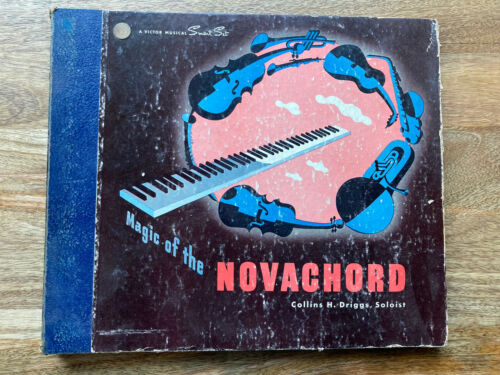
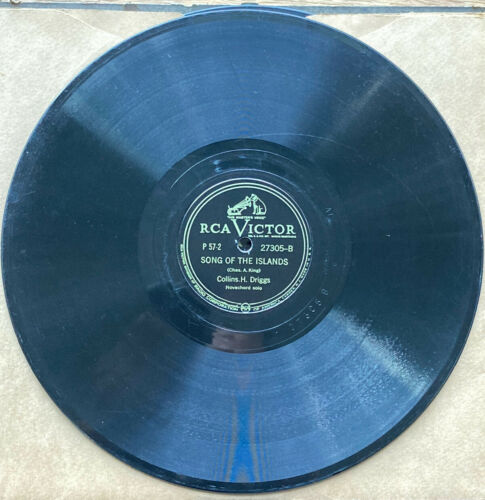
THE MAGIC OF THE NOVACHORD Collins H Driggs 3 10" 78 RPM Very Early Synthesizer
$
23

Favourite Auctions
To save auctions to your favourites, please login
If you don't have an account, please register
Description
description:
Crazy rare recording of this short lived vacuum tube proto-synthesizer! The Novachord was manufactured by Hammond from 1939-42 and is generally considered the first mass produced polyphonic synthesizer, introduced at the 1939 New York World's Fair by composer Ferde Grofé. It was capable of creating an infinite variety of sounds by subtractive synthesis (like Oskar Sala's Trautonium) and was decades ahead of its time, met with mainly bafflement by the classically trained organists it was marketed to (and often incorrectly referred to as an organ). It even had what was probably the first ever implementation of ADSR controls, along with bandpass filters and vibrato. This set of early electronic pop includes 6 tracks of solo Novachord renditions of pop tunes of the era: Parade Of The Wooden Soldiers; Song Of The Islands; In A Chinese Temple Garden; Londonderry Air; When Day Is Done; Estudiantina.
artist info from album notes etc.:
The Novachord has been used in several sci fi and horror film soundtracks as well as classical compositions by James Bernard, Jerry Goldsmith, and Heitor Villa-Lobos, and ranks among the great early electronic instruments like the Theremin, the ondes Martenot and the Trautonium. This album will be of interest to fans of other early electronic musicians and instruments like Edgard Varese, Tom Dissevelt, Bernard Herrmann, John Eaton and the Syn-Ket, Robert Moog, Donald Buchla, Morton Subotnick, Dr. Samuel J. Hoffman, Clara Rockmore, Harry Revel, Les Baxter, Miklos Rosza, the Ondioline, Raymond Scott, the ARP synthesizer, Jean-Jacques Perrey, Gershon Kingsley, Paul Beaver, Bernie Krause, Hugh Le Caine, Ferrante and Teicher, Pierre Henry, Olivier Messiaen, and Dick Hyman.
The Magic Of The Novachord Played by Collins H. Driggs (1941)
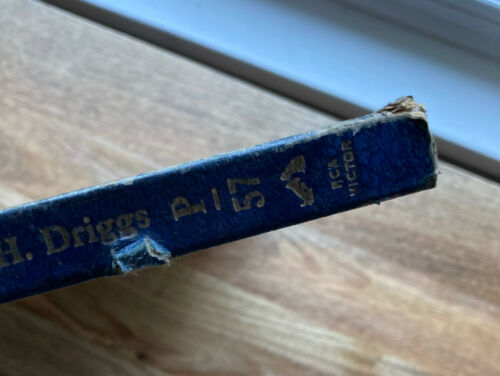
[]label & cat. no.:Victor P-57pressed in:USAdate:1941format:3x10" 78rpm bound
RECORD CONDITIONS between VG and VG+ some light scuffs,plays with some occasional background sounds
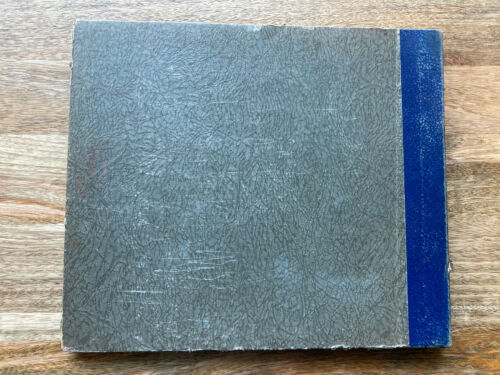
LABEL CONDITION:VG+ some light wear BOOK CONDITION:VG wear to the front cover,wear to edges,wear to corners,small paper chip on spine
I DO COMBINE SHIPPING
FOR INTERNATIONAL ORDERS:
IF THE RECORDS SELLS FOR OVER $100 IT WILL NEED
TO BE REGISTERED FOR AN ADDITIONAL $16 PLUS
SHIPPING OR SENT EXPRESS MAIL.
PLEASE EMAIL ME WITH QUESTIONS,CHEERS!
Mint (M) Perfect Condition, which basically means that it is as good as new, literally. The vinyl has to look new and sound as though it was never played, and the cover has to look untouched. Some argue that the only mint records are brand new unopened ones still in their original packing.
Near Mint (NM) Vinyl is near perfect. At most, a light scuff appears on the record, but it should play without any noise or skips. The record sleeve should also be near perfect with only minor signs of wear. There should be no" outline sleeve.)
Excellent (EX or VG++) Vinyl should still play with no skips of any kind. There can be some very minor surface scuffs, but they should not affect the sound quality. The record sleeve can have some minor ring wear but it should be mostly in good shape. Also, there can be some minor creases in the corners but no splits in the seams.
Very Good+
(VG+) This is the grading category where the quality of the sound is affected -- there will be some surface noise -- and the vinyl will show wear, including surface scuffs and some light scratches. However, the record is still very listenable as there are no deep scratches that cause skips. On the cover, the corners may be slightly bent, but not broken. There may be wear to the seams but not tears or holes.
Very Good
(VG) Vinyl doesn't necessarily look good, but still plays well enough. Surface noise will probably be present, including pops and clicks. At higher volume levels, the music should overpower any pops and clicks present. There may be seam splitting, but not complete separation of the sleeve panels from each other. There will be noticeable ring wear on the cover, but the cover should for the most part still be in good condition.
Good (VG-) Vinyl is well played and looks it. However, the record should still play without skipping. It will have substantial surface noise, pops and clicks. Loss of various parts of the dynamic range will occur due to worn grooves. This grade depends a lot on the owner and the type of records he or she collects. A rock record may still sound ok at a high volume, but quieter styles of music will be practically unlistenable. The record cover may have many problems including seam splits, tears, and writing on it.
Fair/Poor F)
Using the word good for this quality of record is, in the opinion of JRS, too generous and not recommended since it may be misleading. Records described as fair are ones that are basically unlistenable. Surface noise, skips and pops make hearing what's on the record nearly impossible, if not completely impossible. The cover is falling apart, torn, and has writing all over it. The only reason to keep it would be if the record is extremely rare or you want to eventually melt the vinyl and shape it into an ashtray.
price rating





![Outkast - Stankonia [Vinyl New] same day fast free shipping](https://www.popsike.info/php/thumbnail.php?url=https://www.popsike.pics/pix/20180704/283040480003.jpg)