Super Analogue Disc Beethoven symphony No.9 "Choral"/No.8 Isserstedt 2LP
$
200


Favourite Auctions
To save auctions to your favourites, please login
If you don't have an account, please register
Description
Label: London / King Records (original recording by Decca Record Co. Ltd.) Title: Symphony No.9 “Choral” / Symphony No.8 Composer: Ludwig van Beethoven Performer: Hans Schmidt-Isserstedt (conductor) Recording Year: No.9 “Choral” (recorded December 1965) / No.8 (recorded September 1968) Country of Manufacture: Japan Year of Issue: 1989 Disc Manufacturer: Victor Japan Sound Format: Stereo LP Disc Size: 12 inch Disc Weight: 180 grams Speed: 33 RPM Catalogue Number: 310R-56001/2
Condition by item part
Jacket: The jacket presents the product name, country of manufacture, year of manufacture, work titles, performer, and composer in English, with release and rights information printed in Japanese. There are only very slight corner wrinkles from storage/handling; printing is sharp with good color, and the overall appearance remains clean. This is a 2-LP book-style (gatefold booklet) jacket; when opened it shows the track list and work notes, plus performer biography and anecdotes in Japanese. Light aging-related discoloration and soiling are visible on the left and right pages, but overall the condition remains good.
Obi strip: The obi carries the work titles and performer, detailed disc information, and promotional text in Japanese. There is no print wear; readability and color are excellent. No sun fading or discoloration is seen on the printed areas, and no stains are present. Physical damage such as creases or folds is minimal, and the overall condition remains excellent.
Jacket cover: An acrylic-resin jacket cover is included, a specification seen in the early sales period of the “SUPER ANALOGUE DISC” series. Only storage/handling scuffs and small marks are present. Sun discoloration is minimal and transparency is well maintained. There is a partial lift at a bonded corner, but this does not materially affect function as a cover. There are no major damages or holes on the surfaces.
Inner sleeve 1: A dual-layer type with a paper outer and vinyl inner that provides excellent disc protection. The paper sleeve has a center hole for viewing the center label, and the “Super Analogue Disc” logo is sharply printed above it. There are almost no folds or wrinkles, and no corner rub or tears. Overall the condition remains very good.
Inner sleeve 2: A vinyl inner sleeve designed to pair with the outer paper sleeve as a double-layer structure. The curved profile following the circular record and the open-mouth design allow smooth handling while minimizing contact area. Transparency is high with excellent visibility of the center label. Wrinkles from storage/use are present, but there are no tears; only slight scuffing is noted on the Side 1/2 side. There are no stains or holes, and overall condition remains good.
Label: The British DECCA export “LONDON” label is adopted; the label face bears “FULL FREQUENCY STEREOPHONIC SOUND (FFSS),” DECCA’s designation for its high-fidelity stereo recording system, with the same design as original issues. Production and rights credits for King Records and DECCA, rotation speed, side numbers, catalogue numbers, and contents are clearly printed. There is no print wear; readability and color are excellent. There are no cracks in the spindle area, wear marks are minimal, no dimples or lifts are observed, and almost no lifting is seen; overall condition is extremely good.
Record surface: Both records show very good preservation. No noticeable scuffs or scratches are seen on the playing surfaces, and groove wear is kept to a minimum. Playback tests revealed no skipping or distortion, and only very slight noise is perceived. Overall groove condition remains stable, enabling comfortable playback.
Matrix: King Records inscriptions are confirmed in the matrix area. Side 1: “V 310R-56001A H111 + Ⅱ” Side 2: “310R-56001B” Side 3: “V 310R-56002A H111 + Ⅱ J” Side 4: “310R-56002B H111 +” In addition, the cursive “Makuno” inscription appears on Sides 2 and 3. All inscriptions remain clear, indicating cutting work independently performed by King Records in Japan.
Sound quality: Full test listening revealed no major playback problems. The sound is very clear, and the recorded content is well preserved. There are a few spots with very slight noise, but overall the groove condition is stable and playback is comfortable.
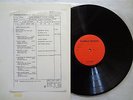
Insert: A Japanese-language sheet explaining the Super Analogue Disc manufacturing method and concept is included. The reverse side prints a release list of the period in a simple catalogue format, illustrating the series rollout of the time. Because the jacket itself is a 2-LP booklet-type, the track list, work notes, and performer biography/anecdotes are printed on the inside of the jacket; this copy corresponds to that special specification. Multiple specifications of Super Analogue Disc inserts are known, including an early type that enclosed separate sheets for manufacturing/concept and for performer introduction, and later revised versions that added English translation on the reverse.
Further details on the record
The Super Analogue Disc is a high-quality record specially produced to draw out the musical appeal inherently possessed by analog records to the utmost. Around 1986, as compact discs (CDs) became the mainstream music medium and records were regarded as a thing of the past, there were listeners who believed in a musical world that even advanced technology could not fully convey, attainable only through the long accumulation of analog technique. Guided by that conviction, King Records further explored the possibilities of analog audio and continued to challenge the limits of sound quality. The Super Analogue Disc was born for enthusiasts who seek the “true sound.”
Multiple discs were released with each sales batch of the Super Analogue Disc.
In the classical category, recordings by DECCA UK are used, and the center label bears the designation of DECCA’s export label, the “London” label. Japanese London records produced by King Records exist in two lines: (1) pressings using imported metal parts from DECCA UK, and (2) pressings newly cut in Japan. These can be identified by the matrix numbers inscribed in the runout area: imported-master types carry DECCA’s “ZAL” numbers, while domestically cut types carry catalogue-based numbers assigned by King Records. All titles released as Super Analogue Discs are domestic-cut specifications, and proprietary high-precision methods dramatically increase the purity and density of the sound. In other words, this series is not a simple reissue but a high-level remaster that reconstructs the artistic essence of the original sources with 1980s craftsmanship.
This disc has the following notable characteristics. ① Wide frequency range (10 Hz–50 kHz) — Reproduces the master tape information without omission, with rich extension from deep bass to ultra-high frequencies. ② Transient response — Clear attack and sense of speed that balance impact and resolution. ③ Dynamic range — Faithfully conveys the volume span from pianissimo to fortissimo, letting you experience the taut analog energy. ④ Low distortion — Highly transparent sound that remains easy on the ear even at higher volume, achieving pure playback. ⑤ Information density — Smooth texture that conveys grain and air, allowing subtle expressive detail to be perceived.
Meticulous craftsmanship is also devoted to the manufacturing process. ① Direct-connecting — Minimizes the signal path from tape to cutter to prevent degradation, capturing even minute on-site noise as part of the live presence. ② Half-speed cutting — Precision cutting at 1/2 speed to maximize information. ③ Valve amplifiers — In-house vacuum-tube amplifiers ensure rich musicality. ④ Extra-heavy pressing (approx. 180 g) — About 60% heavier than standard records, suppressing resonance for stable playback. ⑤ High-quality materials — Selected metal parts and pressing compounds reproduce sound extremely close to the master.
Thus, the Super Analogue Disc is a supreme record produced on a dedicated manufacturing line, created through skilled craftsmanship distinct from ordinary records.
On Schmidt-Isserstedt’s conducting Schmidt-Isserstedt’s conducting is characterized by architecturally built music grounded in precise control. Eschewing impulsive, forceful gestures and improvisatory flow, he constructs the performance with a calm, panoramic view—an ideal of the conductor’s craft. Yet this is not mere literalism: without sacrificing detail, he relentlessly pursues beautiful sonority, keeping a calculated contrast from ff to pp and drawing from the orchestra a warm, clear sound that fills the hall. Especially where violins or horns carry the melody, the careful, clear tone stands out. The Vienna Philharmonic accurately grasps the conductor’s intentions and unfolds a dignified performance imbued with Viennese sweetness and refinement. Through this renowned partnership, Beethoven’s symphonies reveal both grandeur and meticulous artistry.
On the recording of Symphony No.9 “Choral” In the fourth movement, the highlight of this recording, the music begins with a restrained introduction and, following the score’s progression, grows steadily in scale and power. In the choral section, the baritone announces the opening with a strong yet transparent tone, followed by bright, clear solos from the tenor and soprano, to which a rationally controlled chorus is added. These elements combine organically with the orchestra, and under the conductor’s meticulous architecture, lead to a majestic climax. At the climax the previously held-back expression is released at once, yielding a grand explosive force and deep emotion.
On the recording of Symphony No.8 This performance maintains high completeness and consistency through all movements. The strings play with lively articulation while restraining sweetness; flute and clarinet likewise pursue a poised, clear timbre. Trumpets and horns avoid excessive adornment, fully supporting the lines of strings and woodwinds. This unified stance gives the work a consistent flow and poise. Yet it is never monotonous: under Schmidt-Isserstedt’s detailed direction, subtle shifts of nuance, beautiful legato, and momentary softened inflections appear throughout, lending the music rich expression.
This album contains Schmidt-Isserstedt’s highly regarded recordings of Symphony No.9 “Choral” and Symphony No.8. Reproduced with late-1980s expert workmanship in sound very close to the master tapes, audio quality is excellent. Originally produced in the late 1960s, these recordings also hold lasting value as cultural documents in recording history. With both sound and condition in excellent shape, this is an ideal addition to a collection. Please consider it.
Payment
- Please make payment within five days of purchasing the item.
Shipping
- All shipped items include tracking services, although tracking permissions may vary by destination.
- This item will be shipped via Japan Post’s EMS (International Express Mail Service) or parcel service.
- Shipping is available from Monday to Friday.
Returns and Refunds
- Returns are possible if the shipped item differs from the description.
price rating