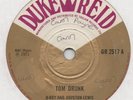
SIGNED 1913 OLIVE FREMSTAD TRISTAN Isolde's LIEBESTOD/ Don Carlos O DON FATALE
$
26


Favourite Auctions
To save auctions to your favourites, please login
If you don't have an account, please register
Description
Welcome to my new auctions of 2020. This is the FINAL WEEK of great auctions,
running until February 9th.
I will pack and bill your items after close of Feb 9th to combine them in one economical package.
Please wait for me to send you an invoice. DO NOT USE EBAY CHECKOUT if you want the lowest possible postage.
Pls shoot me a short email to request an invoice with the correct shipping charge
I am currently selling a series of great Richard Wagner and classic European 78 rpm orchestral recordings on all the great European labels:
Great Wagnerian OLIVE FREMSTAD is of course best remembered in San Francisco of singing the Carmen opposite Caruso on that fateful night in April 1906 before the earthquake
SIGNED IN THE DEAD WAX
Olive Fremstad sings Isolde "Mild und leise wie er lächelt" - Liebestod/ Don Carlos O Don Fatale
Recorded 5 November 1913
unidentified orchestra and conductor
Thick orig pressing w raised rim 12" 78 rpm record.
Excellent Minus, unworn faint scuffs, lam crack plays very quiet lightest crackle at start
Swedish-American soprano (mezzo-soprano), 1871 (1868?) - 1951
Biographical notes: The New York critic Algernon St. John Brenon once wrote of Olive Fremstad: ôShe was always an epic sort of creature, moving most comfortably somewhere between heaven and earth... If she were to come on the scene wearing an old dressing-gown and reading The Ladies Home Journal, you would still rise in your seat and exclaim æHa, now something important is going to happen!ö By most accounts an actress and tragTdienne of Shakespearean proportions, Olive Fremstad was also highly skilled in the art of intelligently and carefully using what was basically a mezzo-soprano voice to become one of the most critically and publicly acclaimed Wagnerian dramatic sopranos of her day. And her day, it must be remembered, included Ternina, Nordica, Brema, Bahr-Mildenburg and Lilli Lehmann, to name but a few.
She was born out of wedlock in Stockholm, given the name Anna Olivia Rundquist, and was then adopted by a Scandinavian-American couple named Fremstad. She was raised in Minneapolis, Minnesota, where as a child she studied piano. In 1890 she began her vocal training in New York after singing in church choirs, then studied in Berlin with Lilli Lehmann (this association came to an abrupt end when Lehmann got wind of her husbandÆs romantic interest in the young American singer) before making her operatic debut as Azucena in VerdiÆs Il Trovatore at the Cologne Opera in 1895. During the next three seasons, Fremstad sang in Cologne, Vienna, Antwerp, Amsterdam and Munich, and was engaged for contralto parts in BayreuthÆs 1896 Ring cycles. Fremstad continued her vocal training in Italy, gradually learning and performing roles from the soprano repertoire, but when she was engaged for the Munich Court Opera (1900 û 1903), her most sensational role there was without doubt BizetÆs Carmen.
It was in New York, at the Metropolitan, however, that Fremstad joined the ranks of the truly legendary singers of the so-called "Golden Age." She debuted with the company in November 1903 as Sieglinde in WagnerÆs Die Walknre (a performance which included Johanna GadskiÆs first Brnnnhilde), and Fremstad was to be a mainstay at the Met for eleven seasons. Her prowess as a singing actress was apparently so awe-inspiring that we may, these many decades later, be considering an artist on a par with the likes of Maria Callas, based on critical and contemporary accounts of her performances. Fremstad appeared before the public 351 times as a member of the MetÆs stellar roster, most frequently as Venus in TannhSuser (63 performances), Kundry in Parsifal (50), Sieglinde (47), Isolde (28) and Elsa in Lohengrin (27), but her repertoire there also included Selika in LÆAfricaine, GluckÆs Armide, Santuzza (ôhe little opera positively groaned under the weight of her interpretation,ö one critic complained), Giulietta in Les Contes dÆHoffmann , all three incarnations of Brnnnhilde, Tosca, Fricka in Das Rheingold, Elisabeth in TannhSuser, BrangSne and a single performance of Salome. American audiences never warmed much to her Carmen, but she had sung the role opposite Caruso in San Francisco the night before the city was practically leveled by the infamous earthquake and fire of 1906. Her interpretation of Isolde seems to have been especially electrifying, and she made her Met dTbut in the role New YearÆs Day 1908 under the baton of Gustav Mahler. Critics frequently remarked, however, that some of the music lay just a bit too high for her comfort, but she always managed to distract attention from this small matter with extraordinary displays of histrionic skill. Olive Fremstad was truly a prima donna û she lived for her art alone, sulked in a gloomy world occupied by herself only when not on stage, avoiding her public and compatriots, but rarely the press. ôI spring into life when the curtain rises, and when it falls I might well die,ö was the lament she paraphrased for reporters on numerous occasions. ôThe world I exist in between performances is the strange one, alien, dark, confused!ö Unfortunately, with the close of the 1913 û 1914 season at the Met, Olive Fremstad found herself spending more and more time in her ôstrangeö world, as manager Giulio Gatti-Casazza unwisely allowed her contract to lapse at the height of her popularity. He had tired of her grandiose manner, frequent cancellations, high salary and, by that time, limited repertoire, and engaged the more versatile and less expensive Melanie Kurt to take FremstadÆs place. She then toured in recitals for a couple of years, and made appearances occasionally with the Chicago, Boston and Manhattan Opera companies. There was talk of her re-engagement at the Met when the United States entered World War I, but nothing became of it, and she made her final operatic appearance as Tosca with the Chicago company on tour in Minneapolis in 1918. She gave what proved to be her final professional appearance, a recital in New York, on January 19, 1920, then asked Gatti-Casazza if he was still interested in her services. She had learned a new role, Leonora in La Forza del Destino, but that role at the Met now belonged to the youthful Rosa Ponselle. Gatti-Casazza made no response to her inquiry, and Olive Fremstad never sang in public again. Married to her art, she professed to have no interest in romantic entanglements, although she did foray twice into marital bliss with short-lived results on both counts. Fascinated by men, Fremstad seemed more at ease moving about in the sapphic circles of her friend Willa Cather, or those of the Misses De Forest and Callendar, for many years New York societyÆs answer to Gertrude Stein and Alice B. Toklas while the latter couple held court in Paris. Fremstad briefly attempted teaching, but had little patience with anything short of perfection, and one ôlessonö for her unfortunate students required the close examination of a dissected human head preserved in a jar. She was mystified when, now few and far between, her students fled in horror, unwilling to learn that much about the workings of the human larynx. For Fremstad herself this was but a small matter; when studying the role of Salome she had gone to the morgue in New York to find out just how much she should stagger under the weight of the head of John the Baptist. On stage, she then staggered a lot. Recordings: Of Olive Fremstad ôon recordö we are left with but a handful of souvenirs; the diva herself would have preferred that we were left with none. ôWhen people play those things in years to come,ö she once complained of her recordings, ôthey will say æOh ho, so thatÆs the great Fremstad! Well, I guess she wasnÆt so much after all!Æö ColumbiaÆs ledgers show that she made approximately 40 records between 1911 and 1915, but only 15 ever saw the light of day. Despite the fact that Columbia seems to have been especially inept when it came to capturing operatic voices in the acoustical era, most of FremstadÆs records somehow manage to satisfy. The recorded evidence arguably dispels the controversy as to whether FremstadÆs natural range was that of a soprano or mezzo-soprano. The highest notes, as demonstrated in BrnnnhildeÆs ôBattle Cryö or ElsaÆs ôTraum,ö are frequently taken with audible effort. Deprived of her histrionic hypnotism, unable to see but only hear, we are today presented with what seems to have been a very warm, firm mezzo-soprano of uncommon loveliness and a distinctively unique timbre. Listeners even remotely familiar with FremstadÆs voice will most likely be able to identify her singing at once. She is thrilling in an excerpt from Don Carlo (a mezzo-soprano role) despite the daunting tempo necessitated by a four-minute 78, and lovely to listen to in MignonÆs "Connais-tu les pays." A pattern develops when one considers that the latter work was also a mezzo-soprano piece, then compares the purity and security of the voice to a couple of her excerpts from Tosca and TannhSuser, where occasionally her top sounds somewhat pinched and not always securely supported. And considering her limited recorded legacy, it is difficult not to resent song titles such as ôAnnie Laurieö or ôLong, Long Agoö for being on the list of her surviving recordings. Olive FremstadÆs recording of ôMild und leiseö from Tristan und Isolde (on Pearl), while one of the better early attempts at the piece, demonstrates no more but no less than any of her contemporariesÆ records that the acoustic recording techniques made it virtually impossible to capture the true magic of IsoldeÆs transfiguration. The orchestra plays such an integral part of the drama, and so little of an orchestra sound could be captured; Columbia in particular seems to have employed what sounds like an underwater, one-man band. Add the usual time restrictions, then be amazed at how Fremstad manages to rise above it all, leaving behind a truly precious souvenir to be cherished.
More Great Records on sale right now:
https://www.ebay.com/sch/m.html?_ssn=carsten_sf&_from=R40&_nkw=&_sacat=0&_sop=1
http://shop.ebay.com/carsten_sf/m.html
====
A Quick NOTE ON GRADING AND SHIPPING:
As you can see from my feedback, I try hard to earn your POSITIVE FEEDBACK and FIVE STAR RATINGS.
If for any reason your transaction was NOT SATISFACTORY, pls contact me and I will work something out with you. YOU WILL NEVER HAVE A REASON TO GIVE ME A NEGATIVE RATING or a LOW STAR RATING.
Quick note on grading:
The Grade (Excellent to Poor, I don't give Mint) refers to the WEAR of the record. Any other defects are stated separately
When I listen to a record, I may also give it an aural grade (again E to P), and make a SUBJECTIVE judgment of the pressing quality for hiss and surface noise.
"SUPERQUIET" is basically noiseless, like a vinyl pressing.
"VERY QUIET" is an exceptionally quiet record for a given pressing.
"Quiet" is a record that is a great example without undue noise for a give pressing.
These judgments are SUBJECTIVE and will depend one the styli, phonograph etc. you use on your own equipment.
Multiple item shipping: I am happy to combine items for shipment in one parcel.
If you win multiple items, pls send me an INVOICE REQUEST to calculate the correct postage. Ebay check out will not give you the correct multiple item discount!
Records will be packed safely between corrugated cardboard in a sturdy box with plenty of padding for safe shipment.
Shipment is usually Media Mail, unless you request another service. Shipping is at your risk, I will be happy to insure items at your cost.
I charge actual postage plus a small fee for packing materials
As always, I guarantee your satisfaction. If you don't like the item, just return it, and I will refund the full purchase price.
If you are in the San Francisco area, I encourage pick-up in person.
US Domestic Shipping:
Here is a guideline for US Media Mail Shipping:
Prices below are for regular 78 rpm records. Up to about 5 records, I will ship Edison Discs for the same rates. Albums from Album Sets count as 1 record. Above that and for international shipments, it will be actual weight plus a small packing charge (1-3$ depending on size of shipment)
1 record: 4.85 – 5.75$
2 records: 6.75$
5 records: 9.00$
10 records: 12.00$
MANY MORE RECORDS: Don't worry. I safely ship 40 - 50 pounds of records double boxed in moving boxes, and even then Media Mail will probably not exceed 35$.
Please send me a message if you would like to get an estimate for you shipping rates!
I am very happy to ship records worldwide.
Please use the EBAY shipping cost only as a guideline. My actual charges are usually lower
One record usually ships for 25$ for 10" 25-35$ for most 12" records (Less for Canada).
As always, I would appreciate any suggestions and corrections from you, pls contact me with any question.
Thank you very much, and good luck bidding !!!
price rating