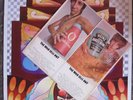
Patricia Barber COMPANION Mobile Fidelity MFSL 45 rpm LP # Box Set Still SEALED
$
420


Favourite Auctions
To save auctions to your favourites, please login
If you don't have an account, please register
Description
Patricia Barber
C o m p a n i o n
MFSL 2-45003
Low Serial Number # 224
RECORDED L I V E at The Green Mill, Uptown Chicago, July 17-19, 1999
Musicians:
Patricia Barber - vocals, piano, Hammond B-3 Michael Arnopol - bass John McLean - guitar
Eric Montzka - drums, percussion
Ruben P.Alvarez - percussion
Jason Narducy - guest vocalist on "Touch of Trash"
RECORDED L I V E at The Green Mill, Uptown Chicago, July 17-19, 1999
Track Listing:
1. The Beat Goes On
2. Use Me
3. Like JT
4. Let It Rain
5. Touch of Trash
6. If This Isn't Jazz
7. Black Magic Woman
Credits?
Producer: Patricia Barber
Executive Producer: Michael Friedman
Artwork By [Graphic Design, Art Direction] – Mare Earley
Artwork By [Liner Notes] – Michael Fremer
Engineer [Assistant] – John Larson, Tom Reinholdt
Mastered By – Allan Tucker, Shawn R. Britton
Photography – Valerie Booth
Photography [Cover] – Paul Natkin
Recorded By, Mixed By – Jim Anderson
Album notesBarber’s band includes guitarist Neal Alger, who has been performing with her the past six years, and bassist Michael Arnopol, who has worked with her since 1980. “We’re like brother and sister,” she says. “We learned jazz together and played all those gigs in Chicago together when I was coming up.” Drum duties are shared by Eric Montzka and Nate Smith, who is in Dave Holland’s bands. Another Holland sideman and formidable leader in his own right, tenor saxophonist Chris Potter guests on five tracks. Barber plays piano throughout as well as contributes melodica colors to some tunes, including her gem, “The New Year’s Eve Song,” that closes the album.
For more than two decades, Barber, based in Chicago, has led her own band and released a series of highly acclaimed, strikingly singular albums, dating back to 1992’s breakout major label album Distortion of Love. It featured her rendition of Smokey Robinson’s pop hit, “My Girl,” predating by a year Cassandra Wilson’s similarly groundbreaking Blue Light Til Dawn. “At the time, no one else was recording contemporary pop tunes in a jazz vein,” Barber said in an interview a decade later. “I do feel like a postmodern pioneer. Soon after, all music began to be viewed as viable material for jazz vocalists and instrumentalists. The old repertoire distinctions between popular music and jazz were falling away.”
She added that a key hurdle was convincing listeners that there was life after the era of iconic singers that included Sarah Vaughan, Peggy Lee, Carmen McRae and Ella Fitzgerald. “Many jazz fans have lost the ability to imagine the future, yet anything innovative in jazz vocals has taken place in spite of people lamenting the loss of Sarah, Peggy, Carmen, and Ella,” she said. “People try to appropriate, copyright and own the music, but it refuses to be contained. In spite of the people who don’t want to see music change, it finds its way like water coursing through rocks.”
Barber continued to be a jazz agent for change, exhibiting her prowess as a jazz vocalist with the releases of Café Blue (1994), Modern Cool (1998) and Nightclub (2000), all of which garnered her an avid international following. Her 2002 album Verse earned a steady flow of critical plaudits. Stereophile magazine celebrated Barber as “more than a poet, more than a singer, more than a songwriter. None of these categories alone can do justice to the fullness of her artistic presentation” while W Magazine wrote that she “has the voice of a cabaret chanteuse, the soul of a beat poet and the mind of an English professor, and they come together here with remarkably spooky results.”
This biography was provided by the artist or their representative. ReviewsCompanion was recorded in a special three-night series of shows in July, 1999 at Chicago's famed Green Mill jazz club -- an unusually short amount of time to produce a live album. To mine as much material as possible from those nights the performances were run more like recording sessions than live shows, with the crowd reverently hushed. Patricia Barber is in her element and the only thing that seems to have suffered for the recording circumstances is the album's length -- at seven songs and 40 minutes, it walks the line between standard EP and full-length size. One surmises that it might have been longer had there been more album-quality material from the performances.
Recalling the energy that was present on her critically worshipped Café Blue album, there is an ease and creativity on Companion which makes her fans' devotion understandable. Barber has been criticized for being a jazz singer in the loosest sense -- her style borrows heavily from R&B and she often covers pop songs (Sonny Bono's "The Beat Goes On" is a sheer stylish delight), and her song "If This Isn't Jazz" answers that criticism with a thumb to the nose. What many critics fail to notice, however, is the strength of her musicianship. Sexism within the industry keeps many from seeing female jazz performers playing roles other than those of vocalists -- Barber's warm, breathy voice and creative phrasing are wonderful, for sure, but what really shines are her arrangements. With a talented band behind her, on Companion Barber has made magic with her compositions, her piano playing, and yes, her voice. Intended to be a companion to Modern Cool, this album of mostly previously unrecorded material serves as an excellent introduction to all of her work. Review by Stacia Proefrock
Patricia Barber’s familiar, well-loved live album Companion (so designated because Barber conceived of it as a “companion” to her previous studio album Modern Cool) Three evenings worth of performances at Chicago’s famed Green Mill nightspot captured to high resolution by famed jazz engineer Jim Anderson were distilled down by Ms. Barber to create the original album.
As for Ms. Barber’s smoky, sultry vocals and playful arrangements, they are here to be enjoyed repeatedly on this always-enjoyable recording. Barber chose to make her homecoming to the club where she developed her musical persona, a fun experience. That can be heard throughout the set, which includes reworked pop and rock tunes like Sonny Bono’s “The Beat Goes On,” Bill Withers’s “Use Me,” and Peter Green’s “Black Magic Woman,” along with Barber originals like “Touch of Trash,” and “If This Isn’t Jazz,” her scathing indictment of “strict constructionist” jazz critics in general and The New York Times specifically. Musically and sonically Mo-Fi’s Companion is a winner. by Dr. Flamboid S. Squeeziasky
Professionally stored in temperature controlled, smoke-free environment.
Rare, Out-of-Print, Ltd. #'d Edition, Mint Sealed Value: $ 600
On Sale for a limited time only !
Payment via PayPal within 48 hours of auction close. Immediate payment via Paypal with Buy It Now.
All Sales Final No Returns accepted.
Out-of-Print sealed vinyl cannot be replaced; and therefore, is not returnable.
Once a factory sealed collectible is opened, it cannot be returned, as sealed LP's hold a much higher value.
Buyer must be in good standing and excellent scores / feedback. Serious bidders only, please!
Professionally packaged extra well, with tracking number, insurance and adult signature required!
Check out my
other items!