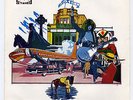
PINK FLOYD THE WALL LP SEALED ORIGINAL COPY PERFECT NOT REISSUE 1979
$
170


Favourite Auctions
To save auctions to your favourites, please login
If you don't have an account, please register
Description
This is an ORIGINAL Vinyl still factory sealed. 1979
Side one No. Title Writer(s) Lead vocals Length 1. "In the Flesh?" Waters 3:16 2. "The Thin Ice" Gilmour, Waters 2:27 3. "Another Brick in the Wall Part 1" Waters 3:21 4. "The Happiest Days of Our Lives" Waters 1:46 5. "Another Brick in the Wall Part 2" Gilmour, Waters 3:59 6. "Mother" Waters, Gilmour 5:32 Side two No. Title Writer(s) Lead vocals Length 1. "Goodbye Blue Sky" Gilmour 2:45 2. "Empty Spaces" Waters 2:10 3. "Young Lust" Waters, Gilmour Gilmour 3:25 4. "One of My Turns" Waters 3:41 5. "Don't Leave Me Now" Waters 4:08 6. "Another Brick in the Wall Part 3" Waters 1:48 7. "Goodbye Cruel World" Waters 0:48 Side three No. Title Writer(s) Lead vocals Length 1. "Hey You" Gilmour, Waters 4:40 2. "Is There Anybody Out There?" Waters 2:44 3. "Nobody Home" Waters 3:26 4. "Vera" Waters 1:35 5. "Bring the Boys Back Home" Waters 1:21 6. "Comfortably Numb" Gilmour, Waters Waters, Gilmour 6:23 Side four No. Title Writer(s) Lead vocals Length 1. "The Show Must Go On" Gilmour 1:36 2. "In the Flesh" Waters 4:15 3. "Run Like Hell" Gilmour, Waters Waters 4:20 4. "Waiting for the Worms" Waters, Gilmour 4:04 5. "Stop" Waters 0:39 6. "The Trial" Waters, Ezrin Waters 5:13 7. "Outside the Wall" Waters 1:41
The Wall
From Wikipedia, the free encyclopedia For Vietnam Veterans Memorial, see Vietnam Veterans Memorial. For the film, see Pink Floyd – The Wall. For other things named "Wall" or "The Wall", see Wall (disambiguation). The Wall Studio album by Pink Floyd Released 30 November 1979 Recorded January – July 1979 atSuper Bear Studios and Studio Miraval
(Correns, France)
September 1979 at
CBS 30th Street Studio
(New York, United States)
October – November 1979 at
Cherokee Studios, Producers Workshop and The Village
(Los Angeles, United States) Genre Progressive rock Length 1:21:09 Label Harvest Records/EMI Records (UK)
Columbia Records (US) Producer Bob Ezrin, David Gilmour, James Guthrie and Roger Waters Pink Floyd chronology Animals
(1977) The Wall
(1979) The Final Cut
(1983) 2012 Immersion Re-issue Singles from The Wall
- "Another Brick in the Wall, Part 2"
Released: 23 November 1979 - "Run Like Hell"
Released: 17 April 1980 - "Comfortably Numb"
Released: 23 June 1980
The Wall is the eleventh studio album by the English progressive rock group Pink Floyd. Released as a double album on 30 November 1979, it was subsequently performed live with elaborate theatrical effects, and adapted into a feature film, Pink Floyd – The Wall.
As with the band's previous three LPs, The Wall is a concept album and deals largely with themes of abandonment and personal isolation. It was first conceived during their 1977 In the Flesh Tour, when bassist and lyricist Roger Waters's frustration with the spectators' perceived boorishness became so acute that he imagined building a wall between the performers and audience. The album is a rock opera that centres on Pink, a character Waters modelled after himself, with some aspects based on the band's original leader,Syd Barrett. Pink's life experiences begin with the loss of his father during the Second World War, and continue with ridicule and abuse from his schoolteachers, an overprotective mother and finally, the breakdown of his marriage. All contribute to his eventual self-imposed isolation from society, represented by a metaphorical wall.
The Wall features a notably harsher and more theatrical style than Pink Floyd's previous releases. Keyboardist Richard Wright left the band during the album's production but remained as a salaried musician, performing with Pink Floyd during The Wall Tour. Commercially successful upon its release, the album was one of the best selling of 1980, and as of 1999, it had sold over 23 million RIAA certified units (11.5 million albums) in the United States. Rolling Stone magazine placed The Wall at number 87 on its list of The 500 Greatest Albums of All Time.
Contents
[hide]- 1 Background
- 2 Concept and storyline
- 3 Recording
- 3.1 Instrumentation
- 3.2 Sound effects and voices
- 4 Packaging
- 5 Release
- 5.1 Reissues
- 5.2 Covers
- 5.3 Tour
- 6 Track listing
- 7 Personnel
- 8 Sales chart performance
- 9 Selected album sales
- 10 References
Background[edit]
Pink Floyd's In the Flesh Tour was their first playing in large stadiums, and in July 1977—on the final date at the Montreal Olympic Stadium—a small group of noisy and excited fans near the stage irritated Waters to such an extent that he spat at one of them.[1] He was not the only band member who felt disaffected at the show, as guitarist David Gilmourrefused to perform the band's usual encores ("Money" and "Us and Them"),[2] leaving the rest of the band, with backup guitarist Snowy White, to improvise a slow, sad twelve-bar blues, which Waters described as "some music to go home to".[3][4] Later that night, while returning from hospital to treat an injury sustained to his foot while play-fighting backstage with manager Steve O'Rourke, Waters spoke with music producer Bob Ezrin, and a friend of Ezrin's, a psychiatrist sharing their car, about the feelings of alienation he was experiencing on the tour. He articulated his desire to isolate himself by constructing a wall across the stage between the performers and the audience.[5] He later said, "I loathed playing in stadiums ... I kept saying to people on that tour, 'I'm not really enjoying this ... there is something very wrong with this.'"[6] While Gilmour and Wright were in Francerecording solo albums, and Nick Mason was busy producing Steve Hillage's Green, Waters began to write new material.[7] The spitting incident became the starting point for a new concept, which explored the protagonist's self-imposed isolation after years of traumatic interactions with authority figures and the loss of his father as a young child. To execute The Wall concept was to attempt to analyse the performer's psychological separation from the audience, using a physical structure as a metaphorical and theatrical device.[4]
In July 1978 the band reconvened at Britannia Row Studios, where Waters presented two new ideas for concept albums. The first was a 90-minute demo with the working title Bricks in the Wall.[8] The second, a project about a man's dreams across one night that dealt with marriage, sex, and the pros and cons of monogamy and family life versus promiscuity.[9] The first option was chosen by the group for the new Pink Floyd project and the second idea eventually became Waters's first solo effort, a concept album titled, The Pros and Cons of Hitch Hiking.[8]
By September, the band were experiencing financial difficulties.[10] Financial planners Norton Warburg Group (NWG) had invested £1.3–3.3 million (up to £16 million in contemporary value[11]) of the group's money in high-risk venture capital to reduce their tax liabilities. The strategy failed as many of the businesses NWG invested in lost money, leaving the band facing tax rates potentially as high as 83 per cent. Pink Floyd terminated their relationship with NWG, demanding the return of uninvested funds.[12][nb 1] The band thus urgently needed to produce an album to make money. Because the project's 26 tracks presented a challenge greater than the band's previous albums, "Waters decided to bring in an outside producer and collaborator."[8] He later said, "I needed a collaborator who was musically and intellectually in a similar place to where I was." [13]
At the suggestion of Waters's then-girlfriend, Lady Carolyne Christie, who had worked as Ezrin's secretary, the band hired him to co-produce the album.[10] He had worked with Alice Cooper, Lou Reed and Kiss and he produced Peter Gabriel's debut solo album.[14]From the start, Waters left Ezrin in no doubt as to who was in charge: "You can write anything you want. Just don't expect any credit".[15] Ezrin, Waters, and Gilmour read Waters's concept, keeping what they liked, and discarding what they thought was not good enough. Waters and Ezrin worked mostly on the story, improving the concept.[16] His 40-page script was presented to the rest of the band, with positive results: "The next day at the studio, we had a table read, like you would with a play, but with the whole of the band, and their eyes all twinkled, because then they could see the album."[13] He broadened the storyline, distancing it from the autobiographical work Waters had written, and instead basing it on a composite, or gestalt character named Pink.[17] Engineer Nick Griffiths later said of the Canadian producer: "Ezrin was very good in The Wall, because he did manage to pull the whole thing together. He's a very forceful guy. There was a lot of argument about how it should sound between Roger and Dave, and he bridged the gap between them."[18] Waters wrote most of the album's material, with Gilmour sharing credit on "Comfortably Numb", "Run Like Hell", and "Young Lust",[19] and Ezrin co-writing "The Trial".[16]
Concept and storyline[edit]
The Wall is a rock opera[20] that explores abandonment and isolation, symbolised by a metaphorical wall. The songs create an approximate storyline of events in the life of the protagonist, Pink, a character based on Waters,[21] whose father was killed during the Second World War, and Barrett.[22] Pink is oppressed by his overprotective mother, and tormented at school by tyrannical, abusive teachers. All of these traumas become metaphorical "bricks in the wall". The protagonist eventually becomes a rock star, his relationships marred by infidelity, drug use, and outbursts of violence. As his marriage crumbles, he finishes building his wall, completing his isolation from human contact.[17][23]
Hidden behind his wall, Pink's crisis escalates, culminating in a hallucinatory on-stage performance where he believes that he is afascist dictator performing at concerts similar to Neo-Nazi rallies, at which he sets men on fans he considers unworthy.[23] Tormented with guilt, he places himself on trial, his inner judge ordering him to "tear down the wall", opening Pink to the outside world. The album turns full circle with its closing words "Isn't this where...", the first words of the phrase that begins the album, "...we came in?", with a continuation of the melody of the last song hinting at the cyclical nature of Waters' theme.[24]
The album includes several references to former band member Syd Barrett, including "Nobody Home", which hints at his condition during Pink Floyd's abortive US tour of 1967, with lyrics such as "wild, staring eyes", "the obligatory Hendrix perm" and "elastic bands keeping my shoes on". "Comfortably Numb" was inspired by Waters's injection with a muscle relaxant to combat the effects of hepatitisduring the In the Flesh Tour, while in Philadelphia.[25]
Recording[edit]
The album was recorded in several locations. In France, Super Bear Studios was used between January and July 1979, with Waters recording his vocals at the nearby Studio Miraval. Michael Kamen supervised the orchestral arrangements at CBS Studios in New York, in September. Over the next two months the band used Cherokee Studios and The Village Recorder in Los Angeles. A plan to work with the Beach Boys at the Sundance Productions studio in Los Angeles was cancelled. For a week in November they worked at the Producers Workshop, also in Los Angeles.[26]
James Guthrie, recommended by previous Floyd collaborator Alan Parsons, arrived early in the production process.[27] He replacedengineer Brian Humphries, emotionally drained by his five years with the band.[28] Guthrie was hired as a co-producer, but was initially unaware of Ezrin's role: "I saw myself as a hot young producer ... When we arrived, I think we both felt we'd been booked to do the same job."[29] The early sessions at Britannia Row were emotionally charged, as Ezrin, Guthrie and Waters each had strong ideas about the direction the album would take. Relations within the band were at a low ebb, and Ezrin's role expanded to that of an intermediary between Waters and the rest of the band.[30] As Britannia Row was initially regarded as inadequate for The Wall the band upgraded much of its equipment,[31] and by March another set of demos were complete. However, their former relationship with NWG placed them at risk of bankruptcy, and they were advised to leave the UK by no later than 6 April 1979, for a minimum of one year. Asnon-residents they would pay no UK taxes during that time, and within a month all four members and their families had left. Waters moved to Switzerland, Mason to France, and Gilmour and Wright to the Greek Islands. Some equipment from Britannia Row was relocated in Super Bear Studios near Nice.[18][32] Gilmour and Wright were each familiar with the studio and enjoyed its atmosphere, having recorded there during the production of their solo albums. While Wright and Mason lived at the studio, Waters and Gilmour stayed in nearby houses. Mason later moved into Waters's villa near Vence, while Ezrin stayed in Nice.[33]
The rest of the band's children were young enough to stay with them in France but mine were older and had to go to school. I was missing my children terribly.
“ ” Richard Wright[34]Ezrin's poor punctuality caused problems with the tight schedule dictated by Waters.[35] Mason found the producer's behaviour "erratic", but used his elaborate and unlikely excuses for his lateness as ammunition for "tongue-in-cheek resentment".[33] Ezrin's share of the royalties was less than the rest of the band and he viewed Waters as a "bully", especially when the bassist mocked him by having badges made that read NOPE (No Points Ezrin), alluding to his lesser share of the album's royalties.[35] Ezrin later admitted that he had marital problems and was not "in the best shape emotionally".[35]
More problems became apparent when Waters's relationship with Wright broke down. The band were rarely in the studio together. Ezrin and Guthrie spliced Mason's previously recorded drum tracks together, and Guthrie also worked with Waters and Gilmour during the day, returning at night to record Wright's contributions. Wright, worried about the effect that the introduction of Ezrin would have on the band's internal relationships, was keen to have a producer's credit on the album (their albums up to that point had always stated "Produced by Pink Floyd").[36] Waters agreed to a trial period with Wright producing, after which he was to be given a producer's credit, but after a few weeks he and Ezrin expressed dissatisfaction with the keyboardist's methods. A confrontation with Ezrin led to Wright working only at nights. Gilmour also expressed his annoyance, complaining that Wright's lack of input was "driving us all mad",[37] and Ezrin later reflected "… it sometimes felt that Roger was setting him up to fail. Rick gets performance anxiety. You have to leave him alone to freeform, to create …"[37] Wright had his own problems, a failing marriage and the onset of depression, exacerbated by his non-residency. The band's holidays were booked for August, after which they were to reconvene at Cherokee Studios in Los Angeles, but Columbia offered the band a better deal in exchange for a Christmas release of the album. Waters therefore increased the band's workload accordingly; booking time at the nearby Studio Miraval.[38] He also suggested recording in Los Angeles ten days earlier than agreed, and hiring another keyboardist to work alongside Wright, whose keyboard parts had not yet been recorded. Wright, however, refused to cut short his family holiday in Rhodes.[39]
Accounts of Wright's subsequent departure from the band differ. In his autobiography, Inside Out, Mason says that Waters called O'Rourke, who was travelling to the US on the QE2, and told him to have Wright out of the band by the time Waters arrived in LA to mix the album.[40] In another version recorded by a later historian of the band, Waters called O'Rourke and asked him to tell Wright about the new recording arrangements, to which Wright allegedly responded "Tell Roger to fuck off …".[34] Wright disagreed with this recollection, stating that the band had agreed to record only through the spring and early summer, and that he had no idea they were so far behind schedule. Mason later wrote that Waters was "stunned and furious",[38] and felt that Wright was not doing enough to help complete the album.[38] Gilmour was on holiday in Dublin when he learnt of Waters's ultimatum, and tried to calm the situation. He later spoke with Wright and gave him his support, but reminded him about his minimal contribution to the album.[41] Waters, however, insisted that Wright leave, else he would refuse to release The Wall. Several days later, worried about their financial situation, and the failing interpersonal relationships within the band, Wright quit. News of his departure was kept from the music press.[42] Although his name did not appear anywhere on the original album,[43][44] he was employed as a session musician on the band's subsequent The Wall tour.[45]
By August 1979 the running order was largely complete. Wright completed his duties at Cherokee Studios aided by session musiciansPeter Wood and Fred Mandel, and Jeff Porcaro played drums in Mason's stead on "Mother".[44] His duties complete, Mason left the final mix to Waters, Gilmour, Ezrin and Guthrie, and travelled to New York to record his début solo album, Nick Mason's Fictitious Sports.[46] In advance of its release, technical constraints led to some changes being made to the running order and content of The Wall, with "What Shall We Do Now?" being replaced by the similar but shorter "Empty Spaces", and "Hey You" being moved from its original place at the end of side three, to the beginning. With the November 1979 deadline approaching, the band left the now-incorrect inner sleeves of the album unchanged.[47]
Instrumentation[edit]
Comfortably Numb MENU 0:00 Planet Rock listeners voted "Comfortably Numb"'s two guitar solos the greatest of all time.[48] Problems playing this file? See media help.Mason's early drum sessions were performed in an open space on the top floor of Britannia Row Studios. The 16-track recordings from these sessions were mixed down and copied onto a 24-track master, as guide tracks for the rest of the band to play to. This gave the engineers greater flexibility,[nb 2] but also improved the audio quality of the final mix as the original 16-track drum recordings were finally synced to the 24-track master, and the duplicated guide tracks removed.[49] Ezrin later related the band's alarm at this method of working—they apparently viewed the erasure of material from the 24-track master as "witchcraft".[30]
While at Super Bear studios Waters had agreed to Ezrin's suggestion that several tracks, including "Nobody Home", "The Trial" and "Comfortably Numb", should have an orchestral accompaniment. Michael Kamen, who had previously worked with David Bowie, was booked to oversee these arrangements, which were performed by musicians from the New York Philharmonic and New York SymphonyOrchestras, and a choir from the New York City Opera.[50] Their sessions were recorded at CBS Studios in New York, although Pink Floyd were not present. Kamen eventually met the band once recording was complete.[51]
I think things like "Comfortably Numb" were the last embers of mine and Roger's ability to work collaboratively together.
“ ” David Gilmour[52]"Comfortably Numb" has its origins in Gilmour's debut solo album, and was the source of much argument between Waters and Gilmour.[18] Ezrin claimed that the song initially started life as "…Roger's record, about Roger, for Roger", although he thought that it needed further work. Waters re-wrote the song and added more lyrics for the chorus, but his "stripped-down and harder" recording was not to Gilmour's liking. The guitarist preferred Ezrin's "…grander Technicolor, orchestral version", although Ezrin preferred Waters's version. Following a full-scale argument in a North Hollywood restaurant, the two compromised; the song's body eventually included the orchestral arrangement, with Gilmour's second and final guitar solo standing alone.[52]
Sound effects and voices[edit]
Ezrin and Waters oversaw the capture of the various sound effects used on the album. Waters recorded the phone call used on the original demo for "Young Lust", but neglected to inform its recipient; Mason assumed it was a prank call and replaced the receiver in anger.[53] The call is a direct reference to an incident on the band's In The Flesh Tour, when Waters's call to his wife Judy was answered by a man's voice. Waters also recorded ambient sounds along Hollywood Boulevard, by hanging a microphone from a studio window. Engineer Phil Taylor recorded some of the screeching tyre noises on "Run Like Hell" from a studio car park, and a television set being destroyed was used on "One of My Turns". Back in the UK at Britannia Row Studios, Nick Griffiths recorded the smashing of crockery for the same song.[54] Various television broadcasts were used on the album and one actor, recognising his own voice, accepted a financial settlement from the group in lieu of legal action against them.[55]
Another Brick in the Wall Part 2 MENU 0:00 The disco beat used in "Another Brick in the Wall Part 2" presented a marked change from Pink Floyd's previous releases.The maniacal schoolmaster present throughout the album was voiced by Waters, and actress Trudy Young supplied the groupie's voice.[54] Backing vocals were performed by a range of artists, although a planned appearance by the Beach Boys on "The Show Must Go On" and "Waiting for the Worms" was cancelled by Waters, who instead settled for Bruce Johnston and Toni Tennille.[56] Ezrin's suggestion of releasing "Another Brick in the Wall part II" as a single with a disco-style beat did not initially find favour with Gilmour, although Mason and Waters were more enthusiastic. The bassist was originally opposed to the idea of releasing a single at all, but became more receptive once he listened to Ezrin and Guthrie's mix of the song. With two identical verses the song was felt to be lacking, and so a copy was sent to Griffiths in London, along with a request for him to find groups of children to perform several versions of the lyrics.[50] Griffiths contacted Alun Renshaw, head of music at the nearby Islington Green school, who was more than enthusiastic about the idea:
I wanted to make music relevant to the kids—not just sitting around listening to Tchaikovsky. I thought the lyrics were great—"We don't need no education, we don't need no thought control …" I just thought it would be a wonderful experience for the kids.[57]
Griffiths at first recorded small groups of pupils and then invited more in, telling them to affect a Cockney accent, and to shout rather than sing. He multitracked the voices, making the groups sound much larger than they were, before sending his recordings back to Los Angeles. The result was that Waters was "beaming", and the song was released, becoming a Christmas number one hit.[58] There was some controversy when the British press reported that the children had not been paid for their efforts; they were eventually given copies of the album, and the school received a £1,000 donation (£4,000 in contemporary value[11]).[59]
Packaging[edit]
The cover design is one of Pink Floyd's most minimal—a white brick wall and no text (the logo and band name is presented on a sticker). Waters had fallen out with Hipgnosis designer Storm Thorgerson several years earlier, when the latter had included the cover ofAnimals in his book Walk Away Rene, and The Wall is therefore the first Pink Floyd album cover since The Piper at the Gates of Dawnnot created by the design group.[60] The LP's sleeve art and custom picture labels by cartoonist Gerald Scarfe tied in with the album's concept, with each of the four sides showing the eponymous wall in various stages of construction, accompanied by characters from the story.[61]
price rating