PHILIPS 2-LPs 835-182/83-AY: BEETHOVEN Sonatas for Piano & Cello, Rostropowitsch
$
200


$ 200
Sold For
Dec 4, 2020
Sold Date
Jun 6, 2019
Start Date
1
Number Of Bids
USA
Country Of Seller
eBay
Sold at
Favourite Auctions
To save auctions to your favourites, please login
If you don't have an account, please register
Description
****Welcome to our listing, thanks very much for looking!
****See our own website! We have lots of out of print LPs and CDs! Find us on the web at -
hearthedifference.net
****Shipping cost is only an estimate - it depends on the actual weight and size of the package as well as the service required. We do not profit from shipping costs, so if we overcharge, we will refund the difference back to you. It's always best to wait for our invoice before paying for your item. We will combine shipping for multiple items purchased.
****Please see our other listings - new items added daily!
****To access our eBay store click on the little red door at the top right section of any of our eBay listings or, click on -
http://stores.ebay.com/Hear-The-Difference
Background -
This set has long been considered THE reference performance of these works! The 2 LPs are very early pressings, with almost the same vintage as the "Hi-Fi Stereo" record labels. The LPs are thick and heavy and in terrific condition. The cloth bound box is also in near mint condition. Comes complete with the large format booklet, 2 corrugated cardboard liners and a note indicating that the set is in stereo - see pictures with this listing as they are of the actual item.One of the great cellists as well as one of the leading conductors of the 20th century, Mstislav Rostropovich's passionate and virtuosic performance style sometimes seemed to reflect the turbulent events in his life, including his exile from his native Soviet Union. In addition to his ability to project with notable fullness in all registers of his instrument, he had complete command of the styles of all the musical eras and national schools in the standard cello repertoire of the time. A strong supporter of new works, he premiered over 100 pieces as a performer, including Sergey Prokofiev's Cello Sonata in C, Op. 119 in 1950, which was composed for him. In 1959 and 1966, respectively, Dmitry Shostakovich's first and second cello concertos were written for and premiered by the esteemed cellist. In the meantime, he made his conducting debut in Gorky in 1962, and five years later, he made his Bolshoi premiere conducting Tchaikovsky's Eugene Onegin. In 1970, Rostropovich's open letter in support of dissident writer Aleksandr Solzhenitsyn led to canceled concerts and, eventually, his exile from the Soviet Union. His citizenship was revoked while abroad in 1974. That same year, he was honored with an International League of Human Rights medal. A cover story in Time magazine followed in 1977. In November of 1989, when he heard that demonstrators were gathering at the Berlin Wall, he had a friend fly him from Paris to Berlin and performed one of his signature pieces, the Sarabande from Bach's Cello Suite No.2, at Checkpoint Charlie as parts of the wall came down (his Soviet citizenship was restored a year later). His benchmark recording of the complete Bach Cello Suites followed in 1995. Rostropovich appeared at his 80th birthday celebration at the Kremlin a month before his death in April of 2007.
Mstislav Leopoldovich Rostropovich, known familiarly as Slava, was born to professional musicians in Baku in Soviet Azerbaijan on March 27, 1927. His father, Leopold, was a cellist, and his mother was an accomplished pianist. The family moved to Moscow in 1931 when Slava's father took a position as teacher at the city's Gnessin Institute. Four years old at the time, Slava had already begun studying cello with his father. He gave his first recital at the age of eight. He enrolled at the Central Music School in 1939, remaining there until 1941. Two years later, he entered the Moscow Conservatory, where he studied cello with Semyon Kozolupov and composition with Vissaryon Shebalin and Dmitry Shostakovich.
After leaving the conservatory in 1948, he secured a position as Sergey Prokofiev's music secretary. Rostropovich's presence prompted Prokofiev to rewrite his earlier Cello Concerto in E Minor, transforming it into a much more imposing work, the Symphony-Concerto for cello and orchestra, Op. 125. Rostropovich went on to win the International Competition for Cellists in Prague in 1950 and began to perform throughout Russia. His first appearance in the West was in Florence, Italy in 1951. Following Prokofiev's death in 1953, Rostropovich and Dmitri Kabalevsky completed his unfinished Cello Concertino in G minor, Op. 132.
He married Galina Vishnevskaya, the star soprano of the Bolshoi Opera, in 1955. The couple found themselves at odds with the authorities when Soviet President Nikolai Bulganin, who had been romantically pursuing Vishnevskaya, canceled their long-planned 1956 tour of the West. Party Secretary Nikita Khrushchev soon got the edge in a political power struggle and reinstated the tour, allowing Rostropovich to debut in London at the Festival Hall in March and at Carnegie Hall in New York in April. The cellist was immediately celebrated as a great international star. Upon returning to the U.S.S.R., Rostropovich found composers clamoring to write for him, including Shostakovich, who composed both of his cello concertos for him. The first one made its Western premiere via a recording of Rostropovich with Eugene Ormandy and the Philadelphia Orchestra, beginning a seminal discography of Western releases. On the same tour, English composer Benjamin Britten attended the London premiere of the concerto, initiating another musical friendship with Rostropovich that led to Britten writing five works for the cello (three solo suites, a sonata, and the Cello Symphony) as well as a song cycle for Vishnevskaya.
In 1970, Rostropovich protested the government's treatment of the writer Aleksandr Solzhenitsyn in a letter that circulated in the West, embarrassing Soviet officials. Rostropovich and Vishnevskaya saw their scheduled concerts suddenly canceled, and the soprano was expelled from the Bolshoi roster. In 1974, the government granted their request to visit the West for two years, then revoked their Soviet citizenship. Rostropovich became invisible at home but a major star in the West. He bought the famous "Duport" Stradivarius. In July, he premiered Soviet composer Aram Khachaturian's cello concerto in Monte Carlo, with Khachaturian conducting. That September, he made his London conducting debut with the New Philharmonic Orchestra, and in March 1975, his American conducting debut took place with the National Symphony Orchestra of Washington, D.C. He was appointed its music director and principal conductor in 1977, a position he held for the next 17 years.
After Rostropovich's impromptu performance at Checkpoint Charlie during the fall of the Berlin Wall in 1989, a moment that was filmed and widely reported, Soviet President Mikhail Gorbachev reversed Rostropovich's expulsion. His emotional return home was documented in the film Soldiers of Music (1991). When Russian President Boris Yeltsin stood up to Soviet military power, Rostropovich stood beside him in the events that led to the collapse of Soviet power. He stepped down from his leadership of the Washington Orchestra in 1994 but continued to make appearances around the world as a cellist and as a conductor.
Regarded as the culmination of a lifetime of studying and performing the masterpieces, his 1991 recordings of Bach's six cello suites -- his first recordings of the pieces -- were released by Warner Classics and EMI Classics in 1995. That same year, he was awarded the Polar Music Prize. The Rostropovich Home Museum opened in his hometown of Baku in 2002. Though his health was declining, he attended an 80th birthday celebration at the Kremlin in March of 2007. Rostropovich died of intestinal cancer a month later. A statue of him playing the cello was unveiled in Moscow in 2012, on what would have been his 85th birthday. - Marcy Donelson
Having learned the fundamentals of music from his father, Sviatoslav Teofilovich Richter taught himself the piano and had already given public concerts before entering the Moscow Conservatory in 1937. While still a student, Richter won first prize at the All-Union Contest of Performers of 1945. His playing earned him considerable renown, and by the time of his graduation in 1947 he had devoted fans. In 1949 he garnered the coveted Stalin Prize.
Richter gave the 1942 premiere of Sergei Prokofiev's Piano Sonata No. 6 -- the composer's first work in that form for years, and the first one he did not premiere himself. This resulted in wild acclaim for both performer and composer. Thereafter, Richter was a great proponent of Prokofiev's music, premiering also the Seventh and the Ninth Sonatas, the latter of which is dedicated to him.
Though word of Richter's excellence (and occasional poor-quality recordings) had spread outside of Russia, his foreign engagements were limited to Eastern Bloc countries (and, in one case, China) where Soviet officials felt there was reduced risk of defection. However, his 1958 performance of Prokofiev's Fifth Piano Concerto with the Philadelphia Orchestra (on tour in Leningrad) generated such excitement that he was finally permitted to tour the United States, further bolstering his reputation as a virtuoso. Engagements in all of world's musical centers followed. Richter was known as a pianist of transcendent abilities, particularly adept at highlighting the nuances of different styles. Though his interests focused primarily on music of Beethoven, and Prokofiev, he was also highly regarded for his Schubert, Schumann, Bach, Debussy, and Ravel; and in the early 1960s he made a memorable recording of Benjamin Britten's Piano Concerto with the composer conducting.
Richter did not favor studio recordings; therefore, most of his recordings are from live performances. Many of them, particularly those from Soviet concerts, suffer from indifferent sound quality and excessive audience noise, but his playing had an electric quality that transcended these handicaps.
The pianist earned a reputation for being difficult and aloof. He was notoriously apt to cancel performances on whims, or arrive late without explanation or apology. However, those who heard him were rarely disappointed. He preferred intimate concert settings over big auditoriums, and thus returned many times to the Aldeburgh and Spoleto Festivals. He was the centerpiece of the Fêtes Musicales, held annually beginning in 1964 at Grange de Meslay, near Tours.
Among his greatest recordings are his Schubert sonatas, Rachmaninov and Prokofiev concertos, Liszt concertos (these have the benefits of first-rate sound), and his Schumann. He has also served as a chamber musician and accompanist, playing piano duets with Britten, and accompanying Elisabeth Schwarzkopf and Dietrich Fischer-Dieskau, among others. - Rovi Staff
-
LP made by PHILIPS Records, in the NETHERLANDS / HOLLAND / DUTCH
-
LP released in 1963
-
LP is recorded in STEREO
-
Record Catalog Number: 835 182/83 AY
-
Record Labels are primarily deep RED with SILVER lettering (early version) - featuring the PHILIPS records logo.
Beethoven // Rostropowitsch / Richter
Samtliche Sonaten Fur Klavier und Violoncello
(The Complete Sonatas for Piano & Cello)
Tracks - Beethoven: Sonate For Piano And Violoncello N°1 In F Major Op.5 N°1
A1 Adagio Sostenuto - Allegro
A2 Rondo Allegro Vivace
Sonate For Piano And Violoncello N°4 In C Major Op.102 N°1
A3 Andante Allegro vivace
B1 Adagio - Tempo D'Andante - Allegro Vivace
Sonate For Piano And Violoncello N°5 In D Major Op.102 N°2
B2 Allegro Con Brio
B3 Adagio Con Molto Sentimento D'Affetto
B4 Allegro - Allegro Fugato
Sonate For Piano And Violoncello N°2 In G Minor Op.5 N°2
C1 Adagio Sostenuto Ed Espressivo
C2 Allegro Molto Più Tosto Presto
C3 Rondo (Allegro)
Sonate For Piano And Violoncello N°3 In A Major Op.69
D1 Allegro Ma Non Tanto
D2 Scherzo (Allegro Molto)
D3 Adagio Cantabile - Allegro Vivace
Performers / Credits -
• Lacquer Cut At – Phonodisc B.V. • Pressed By – Phonodisc B.V.
• Cello – Mstislav Rostropovich
• Composed By – Ludwig van Beethoven
• Liner Notes [English, Trans. French] – Derek Jole
• Liner Notes [German] – Helmut Wirth
• Photography By – Arjé Plas
• Piano – Sviatoslav Richter
Contains Full Sized, 12-page black & white Booklet with Liner Notes.
12-page LP sized booklet in German, French and English.
Black textured (cloth bound) box, spine printed with title in golden color: Beethoven-Cellosonaten-Rostropowitsch
Originally released in 1963. Sonatas #s 1, 2 and 5 were recorded in June 1962. Sonata #4 was recorded in March 1963, and sonata #3 was recorded in July 1961.
CONDITION Details:
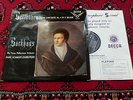
The 2-LP CLOTH COVERED outer box is in near mint minus condition! The box has NO splits or crushed corners! The corners and seams are solid with just some light shelf wear. Inside the box there are 2 corrugated cardboards sheets, used to protect the LPs. The colors on the box are sharp and clean (see pictures with this listing as they are of the actual item).
The set comes complete with a large format paper insert / libretto and a smaller card indicating that the set is recorded in stereo.
The 2-LPs are in near mint minus condition! We found that the vinyl looked superb on this vintage LP set. There are no significant marks and the LPs retain much of the original gloss and sheen! They do have a bit of dust and perhaps a finger print or two on them so they should be cleaned before playing. There are NO serious spindle marks on the record labels either.
A Short Note About LP GRADING -
- Mint = Only used for sealed items.
- Near Mint = Virtually flawless in every way.
- Near Mint Minus = Item has some minor imperfections, some audible.
- Excellent = Item obviously played and enjoyed with some noise.
- Very Good Plus = Many more imperfections which are noticeable and obtrusive.
For best results, always thoroughly clean your LPs before playing them.
LPs can be audiophile quality pressings (any collector of fine MFSL, half speeds, direct to discs, Japanese/UK pressings etc., can attest to the difference a quality pressing can make to an audio system).
Don't let this rarity slip by!!!price rating