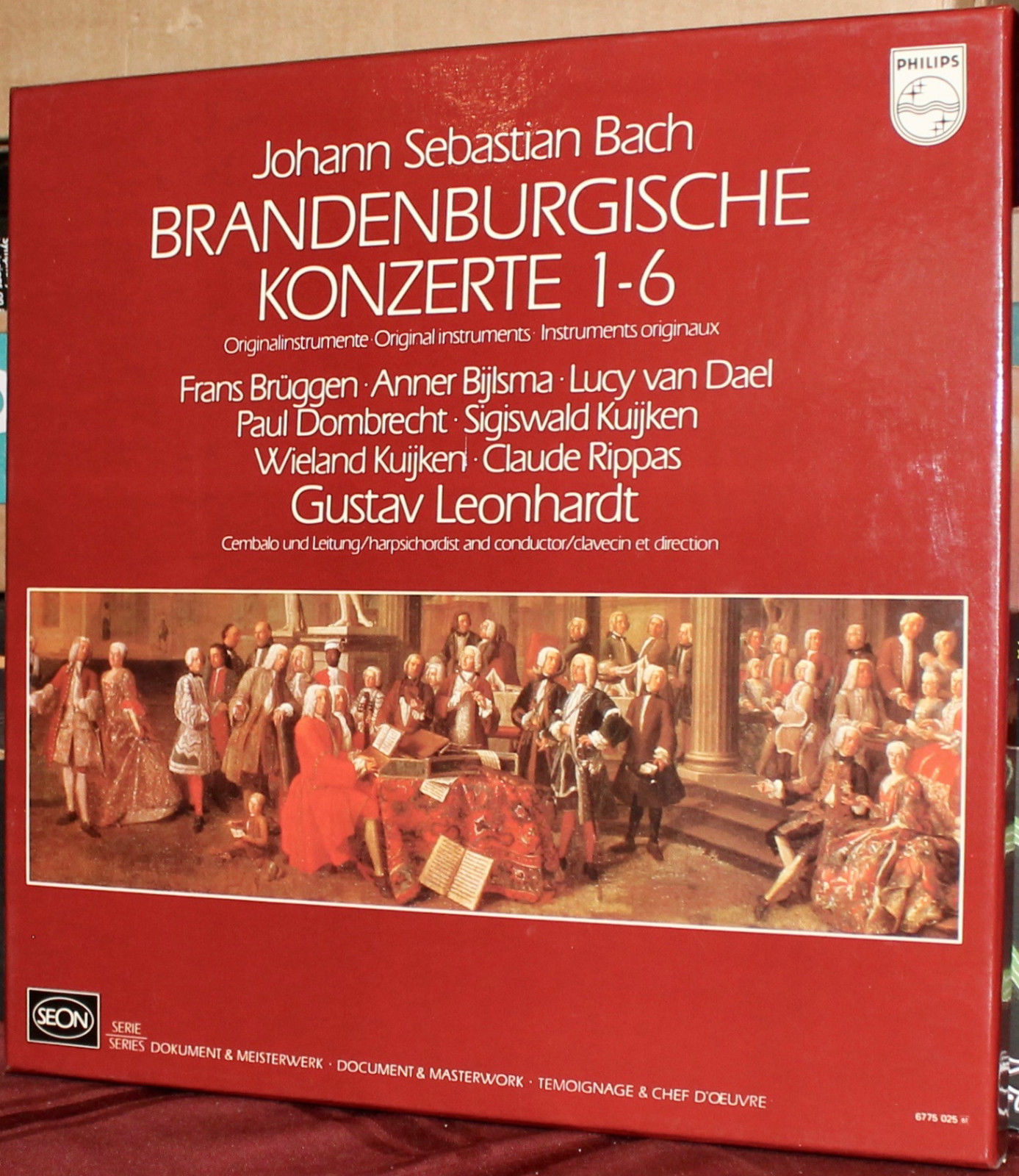
PHILIPS 2-LPs 6775-025: J.S. BACH - Brandenburg Concertos Nos 1-6 LEONHARDT 1977
C$
60
$
43


C$ 60
Sold For
Apr 11, 2018
Sold Date
Jan 2, 2018
Start Date
1
Number Of Bids
Canada
Country Of Seller
eBay
Sold at
Favourite Auctions
To save auctions to your favourites, please login
If you don't have an account, please register
Description
****Welcome to our listing, thanks very much for looking!
****See our own website! We have lots of out of print LPs and CDs! You can find us on the world wide web at -
hearthedifference.net
****Shipping cost is only an estimate - it depends on the actual weight and size of the package as well as the service required. We do not profit from shipping costs, so if we overcharge, we will refund the difference back to you. It's always best to wait for our invoice before paying for your item. We will combine shipping for multiple items purchased.
****Please see our other listings for more great LPs and CDs - new items added daily!
****To access our eBay store click on the little red door at the top right section of any of our eBay listings or, click on -
http://stores.ebay.com/Hear-The-Difference
Background -
Gustav Leonhardt (30 May 1928 – 16 January 2012) was a renowned Dutch keyboard player, conductor, musicologist, teacher and editor. He was a leading figure in the movement to perform music on period instruments. Leonhardt professionally played many instruments, including the harpsichord, pipe organ, claviorganum (a combination of harpsichord and organ), clavichord and fortepiano. He also conducted orchestras and choruses.Gustav Leonhardt was born in 's-Graveland, North Holland and studied organ and harpsichord from 1947 to 1950 with Eduard Müller at the Schola Cantorum Basiliensis in Basel. In 1950, he made his debut as a harpsichordist in Vienna, where he studied musicology. He was professor of harpsichord at the Academy of Music from 1952 to 1955 and at the Amsterdam Conservatory from 1954. He was also a church organist.
Leonhardt performed and conducted a variety of solo, chamber, orchestral, operatic, and choral music from the Renaissance, Baroque and Classical periods. The many composers whose music he recorded as a harpsichordist, organist, clavichordist, fortepianist, chamber musician or conductor included Johann Sebastian Bach, Carl Philipp Emanuel Bach, Wilhelm Friedemann Bach, Heinrich Biber, John Blow, Georg Böhm, William Byrd, André Campra, François Couperin, Louis Couperin, John Dowland, Jacques Duphly, Antoine Forqueray, Girolamo Frescobaldi, Johann Jakob Froberger, Orlando Gibbons, André Grétry, George Frideric Handel, Jacques-Martin Hotteterre, Jean-Baptiste Lully, Claudio Monteverdi, Wolfgang Amadeus Mozart, Georg Muffat, Johann Pachelbel, Henry Purcell, Jean-Philippe Rameau, Christian Ritter, Johann Rosenmüller, Domenico Scarlatti, Agostino Steffani, Jan Pieterszoon Sweelinck, Georg Philipp Telemann, Francisco Valls, Antonio Vivaldi, and Matthias Weckmann.
Central to Leonhardt's career was Johann Sebastian Bach. Leonhardt first recorded music of the composer in the early 1950s, with recordings in 1953 of the Goldberg Variations and The Art of Fugue. The latter embodies the thesis he had published the previous year arguing that the work was intended for the keyboard, a conclusion now widely accepted. The recordings helped establish his reputation as a distinguished harpsichordist and Bach interpreter. In 1954 he led the Leonhardt Baroque Ensemble with the English countertenor Alfred Deller in a pioneering recording of two Bach cantatas. The Ensemble included his wife Marie Leonhardt (born 1928), Eduard Melkus (violins), Alice Harnoncourt-Hoffelner (violin, viola), Nikolaus Harnoncourt (cello) and Michel Piguet (oboe).
In 1971, Leonhardt and Harnoncourt undertook the project of recording the complete Bach cantatas; the two conductors divided up the cantatas and recorded their assigned cantatas with their own ensembles. The project, the first cycle on period instruments, ended up taking nineteen years, from 1971 to 1990. In addition, Leonhardt recorded Bach's St Matthew Passion, Mass in B minor, Magnificat, and the complete secular cantatas, as well as the harpsichord concertos, Brandenburg concertos, and most of his chamber and keyboard music; he recorded Bach's Goldberg Variations (three times), Partitas (twice), The Art of Fugue (twice), The Well-Tempered Clavier, French Suites, English Suites (twice), Inventions and Sinfonias, and many other individual works for the harpsichord, clavichord, or organ. To the surprise of some of his associates, Leonhardt accepted the role of Johann Sebastian Bach (played in a wig) in The Chronicle of Anna Magdalena Bach, a 1968 film by Jean-Marie Straub and Danièle Huillet.
Though participants in the "authentic performance practice" movement might insist otherwise, the search for the old is really a search for the new. This statement certainly captures the spirit that Dutch keyboardist Gustav Leonhardt brought to his early music performances in the 1950s. His style was characterized not by a rigorous observance of rules, but by the intuitive, almost spiritual connection it tried to establish with the music -- a kind of authenticity that sought validation not so much from a rigorously academic accuracy (though Leonhardt is by no means historically careless) as from its having an "authentic" effect on the listener.
Born in Amsterdam in 1928, Leonhardt learned cello and piano before entering the Schola Cantorum in Basel to study organ and harpsichord with Eduard Müller. After graduating in 1950, he undertook a year of musicological studies before accepting a position at the Vienna Academy. Shortly thereafter, he returned to his home town, where he assumed a position at the Amsterdam Conservatory that he would keep for decades thereafter.
His first public performance took place in 1950, when he performed J.S. Bach's The Art of the Fugue for a Viennese audience. This marked the beginning of a legendary and influential career that would take him to performance venues all over the world, setting stylistic and interpretive standards for keyboard music dating from the early 1500s to the late 1700s. His treatment of the works of Couperin, Froberger, and Frescobaldi were pivotal in affecting a shift in Baroque performance practice from the motoric to the malleable.
Beginning in the 1950s, he also established the Leonhardt Consort, a group applying his same performance ideals to chamber works; during his career he also demonstrated great skill in conducting early choral and operatic works. Along the way, he tutored an entire generation of the most vibrant and stylistically varied early music figures, including Christopher Hogwood, Pierre Hantaï, and Ton Koopman.
When Leonhardt spoke of "correct" style, certain parameters were clear, while others left much to be read between the lines. The use of the proper instrument, for example, was crucial to Leonhardt: one should not play a piece from a particular country and a particular time on an instrument from a different region and century (and of course it goes without saying what problems he might have had with playing 18th century music on a 20th century Steinway). His discussion of style, however, was quite flexible -- or at least elusive: "I cannot say it's a secret, but it's almost impossible to describe in words....Essentially, it must be based on a dynamic wish." Though he did consult primary sources to justify his sound, which fell somewhere between the rubato sound of Landowska and the robotic sound of her immediate successors, he insisted that the truest "rules" about the music he played were to be discovered through the playing itself. - Jeremy Grimshaw
The Brandenburg Concertos by Johann Sebastian Bach (BWV 1046–1051, original title: Six Concerts à plusieurs instruments) are a collection of six instrumental works presented by Bach to Christian Ludwig, Margrave of Brandenburg-Schwedt, in 1721 (though probably composed earlier). They are widely regarded as some of the best orchestral compositions of the Baroque era.
Bach wrote out the music himself for presentation to the Margrave rather than leaving it to a copyist. While he took the opportunity to revise the music, most likely, it was not freshly composed. He appears to have selected the six pieces from concertos he had composed over a number of years while Kapellmeister at Köthen, and possibly extending back to his employment at Weimar (1708–17).
Bach's dedication to the Margrave was dated 24 March 1721. Translated from the original French, the first sentence of Bach's dedication reads: "As I had the good fortune a few years ago to be heard by Your Royal Highness, at Your Highness's commands, and as I noticed then that Your Highness took some pleasure in the little talents which Heaven has given me for Music, and as in taking Leave of Your Royal Highness, Your Highness deigned to honour me with the command to send Your Highness some pieces of my Composition: I have in accordance with Your Highness's most gracious orders taken the liberty of rendering my most humble duty to Your Royal Highness with the present Concertos, which I have adapted to several instruments; begging Your Highness most humbly not to judge their imperfection with the rigor of that discriminating and sensitive taste, which everyone knows Him to have for musical works, but rather to take into benign Consideration the profound respect and the most humble obedience which I thus attempt to show Him."
Bach's reference to his scoring the concertos for "several instruments" (Concerts avec plusieurs instruments) is an understatement. Bach used the "widest spectrum of orchestral instruments … in daring combinations," as Christoph Wolff has commented. "Every one of the six concertos set a precedent in scoring, and every one was to remain without parallel." Heinrich Besseler has noted that the overall forces required (leaving aside the first concerto, which was rewritten for a special occasion) tallies exactly with the 17 players Bach had at his disposal in Köthen.
The British magazine International Record Review recounted and reviewed every recording of the Brandenburg concertos made through December 2000 during the Bach celebration that year. They listed and reviewed about 140 recordings with the first made by Alfred Cortot and a French group during 1931-33.
Seems like I owned at least 100 of those recordings in my lifetime, trying to ferret out the one that best promotes Bach's intentions and gives me satisfaction. This is the one I have chosen to live with for reasons that are not hard to explain: musical simplicity, execution of the score as written, style and sympathy to Bach's intentions.
While these are period performances they eschew the wearisome antics of poor period performance -- no wiry strings, no speeds so fast you wonder if they are trying to squeeze all six concerti on one CD, no oblong effects with old, tired instruments, no bizarre interpretations.
In fact, I would say what makes this performance the best is its moderation in all musical areas and the players near complete lack of interpretation. These extremely well-known players let Bach do the interpreting, while they let you do the listening. I often wonder why it is so hard for other bands to do this?
This is a question I've asked since 1968, when I purchased the Collegium Aureum's then somewhat pioneering period version on Harmonia Mundi. Since that time I dabbled with recordings led by Richter, Britten, Casals, Karajan (ugh!), Munchinger, Leppard, Zukerman, Baumgartner, Harnoncourt (double ugh!!), Pinnock, Pommer, Hogwood, Ledger, Goebel, Parrot, Halstead, Pickett, Kuijken and Muller-Bruhl, as well as the leaderless Acadamie fur Alte Musik Berlin, with varying degrees of satisfaction.
It wasn't until I happened onto this set in 2003 that I found a group that matched the selfless determination to uncover Bach's creation the 1965 Collegium Aureum set espoused. The well-known soloists on this set -- Sigiswald Kuijken, Claude Rippas, Gustav Leonhardt, Frans Bruggen, Anner Bylsma and Lucy van Dael -- perform their roles admirably, in tune, with never a lick of interference between their playing and the score.
So along with the other sparkling reviews of this set, I too give it five stars and urge you to buy it at your earliest convenience. - Larry VanDeSande
Previously, during my discussion of Raymond Leppard's modern readings, I mentioned I was evaluating a number of authentic instruments versions of Bach's Brandenburg Concertos. I indicated also that I found the authentic style of presentation preferable to the modern. A good deal of listening to both styles has put things in more balanced perspective for me. While I do enjoy the authentic approach, I realize it is not necessarily more fulfilling than the modern. Clearly, what matters most is the quality of the performance that is given. It seems a good deal not only has to do with instrumental colors and textures but also tempos and nuances. I still stand by my favorite modern version of the Brandenburgs with Leppard and the English Chamber Orchestra, however choosing a favorite for the earlier instruments has not been a simple matter. I have managed to whittle things down to Koopman and Leonhardt. The level of play offered by both is excellent. In some individual instances, I prefer one over the other, however on balance I lean slightly toward Koopman. First, though the sound given by the recording crews is fine for both conductors, that given to Koopman and his Amsterdam players is more open and ambient, therefore helping to illuminate various kinds of nuances which Koopman seems a bit better at revealing. In general, I also find he and his group play with more flair than Leonhardt's ensemble. There seems to be a greater sense of liveliness, especially in most of the allegros, though Koopman could have offered more sparkle in the allegro assai of Brandenburg 2, and he seems outdone by Leonhardt in the third movement allegro of Brandenburg 5 when it comes to color and spirit. Additionally, I find Koopman usually more expressive in the adagios, though in Brandenburg 6 Leonhardt reveals more sentiment than Koopman, who tends to be a little heavy here....If you are searching for an authentic instruments version I recommend you try listening at least to these two accounts by Koopman and Leonhardt, both which I consider to be top notch. Of course, which performance lands in your collection will depend on your own taste or aesthetic preferences. You may even not settle for less than owning both of these fine presentations. - Jeffrey Lee
-
LPs made by PHILIPS Records, in the NETHERLANDS / DUTCH / HOLLAND
-
LPs released in 1977
-
LPs are recorded in STEREO
-
Record Catalog Number: 6775 025
-
Record Labels are primarily RED with WHITE lettering with the Record Co. logo on all the record labels.
J.S. Bach // Gustav Leonhardt
Brandenburg Concertos Nos. 1-6 (Brandenburgische Konzerte 1-6)
Tracks -
Konzert No. 1 In F-Dur, BWV 1046 21:37A1 (Ohne Satzbezeichnung) 4:21
A2 Adagio 3:45
A3 Allegro 4:40
A4 Menuetto - Trio - Menuetto - Polacca (Poloinesse) - Menuetto - Trio 8:44
Konzert No. 2 In F-Dur, BWV 1047 12:02
B1 (Ohne Satzbezeichnung) 5:20
B2 Andante 3:32
B3 Allegro - Assai
Konzert No. 4 In G-Dur, BWV 1049 15:32
B4 Andante 6:50
B5 Allegro 3:56
B6 Presto 4:40
Konzert No. 5 In D-Dur, BWV 1050 21:15
C1 Allegro 10:03
C2 Affetuoso 5:53
C3 Allegro 5:09
Konzert No. 3 In G-Dur, BWV 1048 10:35
D1 (Ohne Satzbezeichnung)
D2 Adagio 6:08
D3 Allegro 4:27
Konzert No. 6 In B-dur, BWV 1051 17:42
D4 (Ohne Satzbezeichnung) 6:43
D5 Adagio, Ma Non Tanto 5:03
D6 Allegro 5:53
Performers / Credits -
• Bassoon [Barockfagott] – Brian Pollard (tracks: A1 to A4)
• Cello [Barock Violoncello] – Anner Bylsma (tracks: A1 to B3, C1 to D6), Wieland Kuijken (tracks: A1 to B6, D)
• Cello [Barockvioloncello, 2] – Richte Van Der Meer (tracks: D1, D2)
• Composed By – Johann Sebastian Bach
• Conductor, Harpsichord – Gustav Leonhardt
• Engineer – Dieter Thomsen
• Flute [Block, 2] – Kees Boeke (tracks: B4 to B6)
• Flute [Block, German] – Frans Brüggen (tracks: B1 to C3)
• Harpsichord – Bob Van Asperen (tracks: A1 to B3)
• Horns [Naturhorn , 2] – Jos Konings (tracks: A1 to A4)
• Horns [Naturhorn, 1] – Ab Koster (tracks: A1 to A4)
• Oboe [Barockoboe, 1] – Paul Dombrecht (tracks: A1 to B3,)
• Oboe [Barockoboe, 2] – Ku Ebbinge (tracks: A1 to A4)
• Oboe [Barockoboe, 3] – Pieter Dhont (tracks: A1 to A4)
• Producer, Recorded By – Wolf Erichson
• Trumpet [Barock] – Claude Rippas (tracks: B1 to B6)
• Viol [Viola Da Gamba] – Adelheid Glatt (tracks: C3 to C5)
• Viola – Wiel Peeters (tracks: A1 to D2)
• Violin [Barock] – Lucy Van Dael
• Violin [Barock], Viola – Sigiswald Kuijken
• Violin [Barockvioline, 1] – Alda Stuurop (tracks: A1 to B3), Janneke Van Der Meer (tracks: A1 to B6), Marléen Thiers (tracks: A1 to B3, D1 to D3)
• Violin [Barockvioline, 2] – Ruth Hesseling (tracks: A1 to B3)
• Violin [Violone] – Anthony Woodrow
Other Information -
Philips Stereo, 2 LP set.
Red Labels, White lettering.
Performed on original instruments.
Comes with complete scores (facsimile - very large).
Recorded in Doopsgezinde Kerk, Haalem, Holland: No. 5 - January 1976; Nos. 3 & 6 - July 1976; No. 1 - December 1976. Recorded in Lutherse Kerk, Haalem, Holland: No. 2 - June 1977; No. 4 - March 1977.
CONDITION Details:
The 2-LP box is in near mint minus condition! The box has NO splits or crushed corners! The corners and seams are solid with some very light shelf wear. The colors on the box are sharp and clean (see pictures with this listing as they are of the actual item).
The set comes complete with a large format paper insert/libretto.
The 2-LPs are in near mint minus condition! We found that the vinyl looked superb on this vintage LP set. There are no significant marks and the LPs retain much of the original gloss and sheen - obviously well taken care of! They do have a bit of dust and perhaps a finger print or two on them so they should be cleaned before playing. There are NO serious spindle marks on the record labels either. Just beautifully made vinyl! That said, acquiring a vintage LP like this is for the performance and rarity of the LP, not necessarily for the sound quality. A Short Note About LP GRADING -- Mint = Only used for sealed items.
- Near Mint = Virtually flawless in every way.
- Near Mint Minus = Item has some minor imperfections, some audible.
- Excellent = Item obviously played and enjoyed with some noise.
- Very Good Plus = Many more imperfections which are noticeable and obtrusive.
For best results, always properly clean your LPs before playing them.
The LP is an audiophile quality pressing (any collector of fine MFSL, half speeds, direct to discs, Japanese/UK pressings etc., can attest to the difference a quality pressing can make to an audio system).
Don't let this rarity slip by!!!
price rating