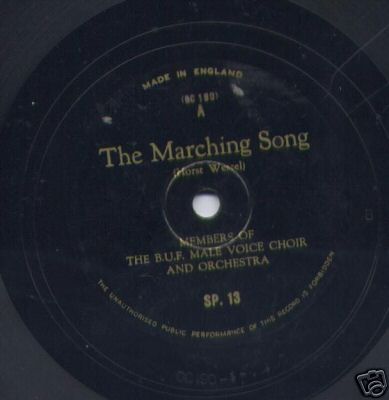
Oswald Mosley BUF Male Voice Choir Marching Song 78RPM
£
172
$
228


Favourite Auctions
To save auctions to your favourites, please login
If you don't have an account, please register
Description
The B.U.F. Male Voice Choir and Orchestra. "The Marching Song" (Horst Wessel Lied in English) recorded 20th November 1935. OC190-1 & "Britain Awake!" (Welsh) recorded 20th November 1935. First advertised in the Blackshirt of 31st January 1936. There were THREE different issues of this record. What is presumed to be the first is the plain black labelled SP13 (SP is a Decca Special series. The record has Decca "B" stamper letter in the wax) by the "B.U.F. Male Voice Choir and Orchestra" The second version (still with the "B" stamper letter) is SP13 by the "British Union Male Voice Choir" & the 3rd is the June 1938 re-issue by the "British Union Male Voice Choir", with the lightening flash label (still with the "B" stamper letter). This is obviously incredibly rare & a must for all collectors of unusual records. Plays very well with the usual crackle, some surface marks. WILL BE POSTED WITH GREAT CARE!
The British Union of Fascists (BUF) was a political party of the 1930s in the United Kingdom. The party was formed in 1932 by ex-Conservative Party MP, and Labour government minister Sir Oswald Mosley. The party was a union, composed of several smaller Fascist parties, such as the British Fascisti.
Character
Mosley modelled himself on another fascist leader, Benito Mussolini. He also modeled his party along the lines of fascist movements in other countries, primarily Italy.
He instituted a black uniform, gaining the party the nickname Blackshirts. The BUF was anti-communist and protectionist. It supported the replacement of parliamentary democracy with a system of elected executives with jurisdiction over their own industries - something similar to the corporatism of the Italian fascists. Although unlike Italy the British Fascist Corporatism would remain a democracy, replacing the House of Lords with elected executives drawn from major industries, clergy and representatives of the colonies. The House of Commons was to be reduced in size to allow for a faster, less 'factionist democracy'.[1]
The BUF had the most developed political programme and ideology of any fascist movement, laid out in such publications as Tomorrow We Live, and The Coming Corporate State.
Most of the BUFs policies were based around isolationism, an economic policy whereby Britain would trade only within the British empire as would the nations within the empire in a similar manner to the United States of America, the main attraction to this is that it would separate the British economy from the falls and fluxes of the world market Great Depression and prevent the loss of industrial production within Britain from the influence of "... labour the east, paid a third of our wages and working for ten hours a day.", and "Cheap slave competition from abroad." These were referring to the rise of western backed mass production in Indo-China similar to what is said about Chinese labour today. [2]
Many of the BUF's members were drawn from aristocratic and military families and included celebrated military scientist J.F.C. Fuller. Its official policy throughout the 1930s was not anti-Semitic; however, some ranking members during this period were vehement proponents of it, and so the BUF was often represented as such.
The listeners heard Sir O.Mosley refer to his would-be interrupters as "sweeping of the Continental ghettoes, hired by Jewish financiers": "and alien gang imported from all quarters of Britain by Jewish money to prevent Englishmen putting their case" [3] In answer to a question about the Blackshirt attitude towards Jews, Sir Oswald Mosley said:- "We will not tolerate within the State a minority organized against the interests of the State. Jews must either put the interests of Britain before the interests of Jewry or they will be deported from Britain." [4]Prominence
This does not cite any references or sources.Please help improve this article by adding citations to reliable sources. (help, get involved!)
Unverifiable material may be challenged and removed.
This article has been tagged since January 2007.
The BUF claimed a membership as high as 50,000 at one point, and the Daily Mail was an early supporter, famously running the headline "Hurrah for the Blackshirts!".
Opinion was divided in response to the BUF's black-shirted followers; in some quarters, their unified appearance, and the vision of militant Britishness they presented, won the party supporters[citation needed]. Others found in them something absurd. P.G. Wodehouse, for example, based the "amateur dictator" Roderick Spode and his Black Shorts, which appear in his Jeeves and Wooster stories, on Mosley and the BUF.
Despite considerable - and sometimes violent - resistance from Jewish people, the Labour Party, assorted democrats and the Communist Party of Great Britain, the BUF still found a following in the East End of London, where in the London County Council elections of 1937 they obtained good results in their strongholds of Bethnal Green, Shoreditch and Limehouse[citation needed]. However, the BUF never faced a General Election - feeling unready[citation needed] in 1935, they urged voters to abstain, offering the promise of "Fascism Next Time". There never was a "next time", as the next General Election was not held until July 1945, by which time World War II in Europe had ended and Fascism had been discredited.
Towards the middle of the 1930s, the BUF's increasingly violent activities, and a growing discomfort at its perceived alignment with the German Nazi party, began to alienate some of its middle-class supporters. Membership accordingly decreased. At a rally in London, in 1934, BUF stewards became involved in a violent confrontation with militant communists, and this bad publicity caused the Daily Mail to withdraw its support from the party.
Final years and legacy
With its lack of electoral success, the party was drawn away from mainstream politics and further toward extreme anti-Semitism during 1934-1935 (which saw the resignation of leading members such as Dr. Robert Forgan). They organised several anti-Semitic marches and protests in London (recalling the earlier tactics of predecessors such as the British Brothers League), such as the one that resulted in the famous Battle of Cable Street in October 1936. Nonetheless, membership fell to below 8,000 by the end of 1935. The government was sufficiently concerned, however, to pass the Public Order Act of 1936, which banned the wearing of political uniforms during marches, required police consent for political marches to go ahead, and effectively destroyed the movement. The BUF was completely banned in May 1940, and Mosley and 740 other senior fascists were interned for much of World War II. Mosley made several unsuccessful attempts at a political comeback after the war, most notably in the Union Movement.
The BUF in popular culture
In Harry Turtledove's alternative history novel, In the Presence of Mine Enemies, which is set in 2009 in a world where the Nazis were triumphant, the BUF governs Britain — and the first stirrings of the reform movement come from there.
British humorous writer P.G. Wodehouse extensively satirized the BUF and their leader in a number of books and short stories. The BUF was satirized as "The Black shorts" for their wearing of black shorts, and their leader was Roderick Spode who was eventually revealed as the owner of a ladies' underwear shop.
BUF Anthem
The BUF Anthem strongly resembles the German Horst-Wessel-Lied (anthem of the NSDAP), and was set to the same tune.
The lyrics are as follows:
Comrades, the voices of the dead battalions, Of those who fell that Britain might be great, Join in our song, for they still march in spirit with us, And urge us on to gain the fascist state! (Repeat Last Two Lines) We're of their blood, and spirit of their spirit, Sprung from that soil for whose dear sake they bled, Against vested powers, Red Front, and massed ranks of reaction, We lead the fight for freedom and for bread! (Repeat Last Two Lines) The streets are still, the final struggle's ended; Flushed with the fight we proudly hail the dawn! See, over all the streets the fascist banners waving, Triumphant standards of our race reborn! (Repeat Last Two Lines)Prominent members
Despite their relatively short period of operation the BUF attracted a number of prominent members and supporters. These included:
- William Edward David Allen
- John Beckett
- A. K. Chesterton
- Robert Forgan
- Neil Francis Hawkins
- J.F.C. Fuller
- Reginald Goodall
- Jeffrey Hamm
- Harold Sidney Harmsworth, 1st Viscount Rothermere
- William Joyce
- Tommy Moran
- Alliott Verdon Roe
- Alexander Raven Thomson
- Henry Williamson
Post WW2
The Union Movement was a political party founded in Britain by Oswald Mosley. Where Mosely had previously been associated with a peculiarly British form of fascism, the Union Movement attempted to redefine the concept by stressing the importance of European unity rather than narrower country-based nationalisms. The UM has therefore, been characterized as an attempt by Mosley to start again in his political life by embracing more democratic and international policies than he had previously been associated with. [1] Contents [hide] 1 Mosley's post-War activity 2 Europe a Nation 3 Formation of the Union Movement 4 Racial tensions and the return of the Union Movement 5 European dimension 6 Final days of the Union Movement 7 Union Movement post-Mosley 8 References 9 See also 9.1 Well known members 9.2 Related groups and concepts 10 External link [edit] Mosley's post-War activity Having been the leader of the British Union of Fascists (BUF) before the Second World War, it was expected that Mosley would return to lead the far right afterwards. However Mosley initially remained out of the post-War political arena, instead turning to writing, publishing his first work, My Answer (1946), in which he argued that he had been a patriot who had been unjustly punished by his internment under Defence Regulation 18B. In this and his 1947 follow up, The Alternative, Mosley began to argue for a much closer integration between the states of Europe, the beginning of his 'Europe a Nation' campaign that sought a strong united Europe as a counterbalance to the growing power of the US and USSR. [edit] Europe a Nation Mosley detected a linear growth within British history and he saw Europe a Nation as the culmination of this destiny. Therefore he argued that it was "part of an organic process of British history" with the UK having grown from the old Anglo-Saxon kingdoms into England, then England and Wales, then Scotland and Ireland added and it now further expanding to form a united Europe.[2] He further envisaged a three-tiered system of government headed by an elected European government to organise defence and the corporatist economy, the continuation of national governments and a collection of local governments for the sake of independent identities. Mosley’s ideas were not as such new, as concepts of a Nation Europa and Eurafrika (the same idea only with parts of north Africa included as natural sectors of Europe’s traditional sphere of influence, an idea that Mosley himself felt had some merit) were already growing in Germany’s post-War underground, whilst Mussolini’s 1944 Italian Social Republic had returned to fascism’s roots with an attempt at a corporatist economic system during its brief run. Nonetheless Mosley was the first to express the ideas in English and it came as no surprise when he returned to proper political activism in 1948. These plans were to form the basis for the policy programme of the Union Movement. [edit] Formation of the Union Movement Mosley would return to the leadership of the British far right by founding the Union Movement (UM) in 1948 at a meeting in London's Farringdon Hall, where as many as fifty one separate groups came under the new umbrella, including Jeffrey Hamm's League of Ex-Servicemen and the Sons of St. George under Tommy Moran, both veterans of the BUF. Another early member was Francis Parker Yockey, who had come to England to seek Mosley's help with publishing his written work. Yockey briefly headed up the UM European Contact Section, although he was gone fairly quickly after a fall-out with Mosley. Mosley remained a critic of liberal democracy, and the UM instead extolled a strong executive that people could endorse or reject through regular referenda, with an independent judiciary in place to appoint replacements in the event of a rejection. The party marched 1500 members through Camden that same year and went on to contest the following year's local elections in London. However outside of Stepney and Bethnal Green, where reasonable results were secured, the UM performed very poorly at the polls and secured no representation. Disillusioned by the stern opposition that the UM faced, and with his style of street politics being exposed as somewhat passé, Mosley went into self-imposed exile in Ireland, leaving the UM to languish. [edit] Racial tensions and the return of the Union Movement After the British Nationalities Act 1948 there was a great increase in immigration, particularly from the newly independent Commonwealth states, as well as, to a lesser extent, from the colonies. In the early 1950s immigration was estimated at 8-10,000 per year, but this had grown to 35,000 per year by 1957. Perceptions of the new migrant workers were frequently oppositional and stereotypical, although the Conservative Party, despite the private opinions of some of its members, were loathe to make a political issue out of it, for fear of being seen as gutter politicians. Minor disturbances occurred in 1958 in Notting Hill (following a Mosley rally) and Nottingham with clashes between racial groups, a new phenomenon in Britain. The new uncertainties revitalised the UM and Mosley re-emerged to stand as a candidate in the 1959 election in North Kensington (which included Notting Hill), a first parliamentary election for him since 1931. Mosley made immigration his campaign issue, combining calls for assisted repatriation with scare stories regarding the criminality and sexual deviance of blacks, a common theme in racial scare-mongering at that time.[3] The 8.1% share of the vote he secured was a personal humiliation for a man who still hoped that he would be called to serve as Prime Minister some day, although the UM as a whole was buoyed by the immigration issue, which it saw as the next big issue in British politics. [edit] European dimension Alongside his domestic politics Mosley continued to work towards his goal of 'Europe-a-Nation' and in 1962 attended a conference in Venice where he helped to form a National Party of Europe along with Germany's Reichspartei, the Mouvement d’Action Civique and Jeune Europe of Belgium and the Movimento Sociale Italiano. Adopting the slogan "Progress - Solidarity - Unity", the movement aimed to work closely for a closer unity of European states, although in the end little came of it as only the Italian constituent member enjoyed any success domestically. This group replaced the earlier European Social Movement in which Mosley had also been involved. The Union Movement itself did not play an active role on the European stage, although it did help to set in motion co-operation between like-minded groups across Europe, which continues to this day with the European National Front. [edit] Final days of the Union Movement Membership of the UM grew in the early 1960s and Mosley breifly considered the possibility of allowing the smaller British National Party to merge into his group. However Mosley was largely unimpressed by what he saw as John Bean's over-emphasis on race and especially by Colin Jordan's 'racialist twaddle' and the UM continued alone. [4] With talk of mergers dispelled, Mosley stood again in the 1966 election, this time in the Shoreditch and Finsbury constituency. However capturing only 4.6% of the vote, Mosley lost interest thereafter and effectively departed the scene, despite still officially being UM leader until 1973. The increasingly marginalised UM carried on into the 1970s, still advocating 'Europe-a-Nation', but had no real influence and failed to capture support with their fairly unusual policies. [edit] Union Movement post-Mosley A brief revival looked possible after they were renamed the Action Party in 1973, under which name they fought six seats at the Greater London Council election. Under the leadership of Jeffrey Hamm, the party hoped for something of a revival, although they were damaged severely in 1974 when leading member Keith Thompson and his followers split to form the League of Saint George, a non-party movement which they claimed was the true continuation of Mosley's ideas. Having lost a sizeable chunk of their membership and finding the far right vote had long since been lost to the National Front, the Action Party gave up electoral politics and, in 1978, became the Action Society which acted as a publishing house rather than a political party. The group continued until the death of Hamm in 1994, after which the funding of Mosley's widow Diana Mitford was withdrawn. The Action Society was quietly wound up, representing the end of the Union Movement as a force in British politics. [edit] References ^ R. Thurlow, Fascism in Britain, London: IB Tauris, 1998, p. 214 ^ R Row, Oswald Mosley, Briton, Fascist, European ^ O. Mosley, My Life, London: Nelson, 1970, 447-452 ^ R. Thurlow, Fascism in Britain, London: IB Tauris, 1998, p. 238 R. Eatwell (2003), Fascism: A History, Pimlico O. Mosley (1970), My Life, Nelson Press R. Skidelsky (1975), Oswald Mosley, Macmillan R. Thurlow (1998), Fascism in Britain, I.B. Tauris. See also Well known members John Bean Terry Flynn Neil Francis Hawkins Jeffrey Hamm Diana Mitford Oswald Mosley Tommy Moran Keith Thompson Alexander Raven Thomson John G. Wood [edit] Related groups and concepts British Union of Fascists Europe a Nation League of Saint George British Union of Fascists, Nordic League, Imperial Fascist League, British Vigil, Nordic Patriots, National Socialist league, Nationalist Anti-Masonic League, Gentile Protection League, White Knights of Britain, British Array, English Mistery, League of Loyalists, Militant Chritian patriotsFrom Wikipedia, the free encyclopedia Jump to: navigation, search The flag of the Union Movement showing the "Flash and Circle" symbolic of "action within unity", carried on from the British Union of FascistsThis article is part of the Neo-fascism series. This series is linked to the Politics and Elections series Definition Definitions of fascism -------------------------------------------------------------------------------- Varieties of Neo-fascism Neo-Nazism Neo-Nazi groups of the United States Origins of Neo-fascism Nazism Clerical fascism - Neo-Nazi political parties and movements American Nazi Party Aryan Nations British Movement British National Front Creativity Movement Deutsche Reichspartei Hrisi Avgi (Greece) International Third Position Italian Social Movement National Alliance National Renaissance Party National Social Front National Socialist Front National Socialist Japanese Workers and Welfare Party National Socialist Movement (United States) National Socialist Party of America Noua Dreapt? (Romania) November 9th Society Official National Front Russian National Unity Social Action Socialist Reich Party Union Movement World Union of National Socialists . Related Subjects Bolshevism Holocaust denial Nazism Nazi punk Nazi-Skinheads Political Soldier Roman salute Stalinism Strasserism Third Position White nationalism White Power Fascism Portal Politics Portal . SOLD AS A SCARCE POLITICAL DOCUMENT, NOT A PROMOTION OF ANY POLITICAL IDEAS.
price rating
![Royksopp - Melody A.M. [2xLP, 2021] Limited Edition Numbered 3626/4000 NM / VG++](https://www.popsike.info/php/thumbnail.php?url=https://www.popsike.pics/pix/20220627/354131607420.jpg)