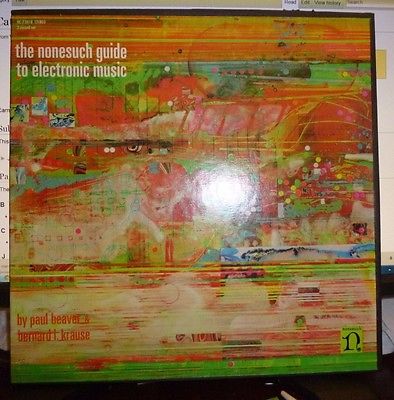
Nonesuch Guide To Electronic Music, Paul Beaver & Bernard L. Krause OG BOX NM/NM
$
25


Favourite Auctions
To save auctions to your favourites, please login
If you don't have an account, please register
Description
Condition: To my non US customers. Do not ask me to falsify or alter customs forms values of your items. I will not do so.
AMG Review by Thom Jurek [-]
It's strange in the 21st century to think of Beaver & Krause's debut album as being the Nonesuch Guide to Electronic Music -- an instructional recording on how the then-new Moog synthesizer could be used. Originally issued as a double album, it contained 68 short tracks over four sides; not bad considering the entire thing is only 48-minutes long. To hear these pieces in the current age is a bit of a wonder. The reason being of course, that it is the sound of the Moog itself without accompaniment or as an atmospheric instrument used to enhance other instruments in songs. Instead, these two pioneers demonstrated each module on the synthesizer, and selected from the four outputs of the Moog's oscillators (which in those days were unstable in terms of pitch and the machine had to be retuned): sine, triangular, continuously randomly variable, and sawtooth. They were used individually and in concert, and the sounds themselves were used as examples of what was possible. In 2006 Guide was reissued on CD by Collector's Choice CD with liner notes by Richie Unterberger; this is an exercise in ambience run amok, or turned 180-degrees. While there was no such thing as "ambient" music at the time, these pieces fold into something together, not as a random boatload of isolated sounds, but as a work, something to be engaged and considered not as historical artifact, but as music itself -- it's hard to believe that no one has used "Sequential Voltage Sources, Composition" in a dance record yet -- though many white labels sound as if they have. This piece has rhythm and crunchy high-pitched beats that seem as random as the tone generations and modes, which function as breakbeats do. Ultimately, this disc has to be heard to really be believed. It's a wonder of imagination, patience and execution.
Paul Beaver & Bernard L. Krause* ?– The Nonesuch Guide To Electronic Music
Label: Nonesuch ?– HC-73018 Format: 2 × Vinyl, LPBox Set
Country: US Released: 1968 Genre: Electronic Style: Modern Classical, Experimental
Tracklist
A1 I. Peace Three 3:08 II. Signal Generators A. Sine Waveform A2a 1. Slow-Motion Audible Example 0:05 A2b 2. Composition 0:50 A2c 3. Harmonic Synthesis 0:33 A2d 4. Non-Harmonic Synthesis 0:37 B. Sawtooth Waveform A3a 1. Slow-Motion (Negative- And Positive-Going) 0:12 A3b 2. Composition 0:34 C. Rectangular Waveform A4a 1. Slow-Motion Audible Example (1/8-1/2) 0:28 A4b 2. Composition (Using 1/8, 1/7, 1/3, 1/2) 0:35 D. Triangular Waveform A5a 1. Slow-Motion Audible Example 0:05 A5b 2. Composition 0:20 - A6 E. White Sound Composition 0:13 III. Control Generators A7a A. Transient Generator, Amplitude, Frequency And Timbre Modulating In Slow-Motion 0:08 A7b B. Sequential Voltage Sources. Composition 1:55 IV. Frequency Modulation A. Keyboard Control B1a 1. 12-Tone 0:32 B1b 2. Quarter-Tone (One Real Octave = 2 Keyboard Octaves) 0:40 B1c 3. Ditone (Four Real Octaves Played In Keyboard Range Of One Octave) 0:31 B1d 4. Portamento 0:23 - B2 B. Ribbon Control 0:30 C. Periodic B3a 1. Vibrato ? (Speed Increases As Pitch rises) 0:28 B3b 2. Sine-Higher Frequency 0:27 B3c 3. Sawtooth-Swept 0:38 B3d 4. Rectangular 1/2-Swept L2 0:32 B3e 5. Triangular-Swept 0:31 D. Periodics Combined B4a 1. 3 Square Waves At Different Frequencies 0:28 B4b 2. 3 Triangular Waves At Different Frequencies 0:37 B4c 4 Different Waveforms 2L 2N 2V 2S At Different Frequencies 0:46 - B5 E. White Sound 0:12 F. Transient B6a 1. Up An Octave, Back To Pitch 0:17 B6b 2. Up A 3rd, Back To Pitch 0:07 B6c 3. Down An Octave, Back To Pitch 0:09 B6d 4. Down A 3rd, Back To Pitch 0:13 V. Amplitude Modulation C1 A. Keybaord 0:13 C2 B. Ribbon Controller 0:10 C. Periodic C3a 1. Tremolo 0:25 C3b 2. Sine-Higher Frequencies (S Sweeping S) 0:47 C3c 3. Sawtooth (Negative- And Positive-Going Swept) 1:20 C3d 4. Rectangular-L2 Swept 0:28 C3e 5. Triangular-Swept 0:50 D. Periodics Combined C4a 1. 4 Square 0:44 C4b 2. 3 Triangular 0:23 C4c 3. 4 Different ?, ?, 2L, ? 0:23 - C5 E. White Sound 0:38 F. Transient C6a 1. Slow 0:08 C6b 2. With Rising Pitch 0:15 C6c 3. ????? 0:14 VI. Ring Modulation A. Sine Waves C7a 1. Series Of Sub-Audible Constants 2:00 C7b 2. Tune In Parallel 0:40 C7c 3. Tuned In Opposite Direction 0:30 - C8 B. Sawtooth 0:33 C9 C. Rectangular L2 0:39 VII. Filtering D1 A. White Sound - With Fixed Filters Selected 3rd Octave 0:25 B. White-Sound-Tuned Filters D2a 1. Broad 0:43 D2b 2. Sharp 0:25 - D3 C. Low-Frequency Sawtooth-Tuning Through Harmonics 1:05 D4 D. Composition-Tuning Through 2nd, 3rd, 7th And 16th Harmonics 0:50 D5 E. Swept With Ribbon Controller 0:40 F. Periodic D6a 1. Sine-Timbre Vibrato Effect 0:25 D6b 2. Sine-Variable Rate And Depth 0:36 D6c 3. Sawtooth (Descending And Ascending) 0:50 D6d 4. Rectangular G. Transient (Sawtooth With Transient Controlled Filter) D7a 1. ----------------- 0:12 D7b 2. ----------------- 0:10 D7c 3. ------------------ 0:09 D7d 4. ------------------ 0:08 VIII. Tape Delay D8 A. Single Repeat 0:13 D9 B. Multiple Repeat 2:55 - D10 IX. Peace Three (Recap)Credits
- Artwork – Gene Szafran
- Design – William S. Harvey
Notes
Introduction to and survey of electronic music.All work realised on the Moog Series III Synthesizer.
Excluding A1 and D10, each section is broken down into various examples.
Released with a 16-page book which includes the musical score of the A1 track : Peace Three
- Notes to the track titles-
Some tracks are represented by graphical symbols that are not reproducible in unicode, especially the following:
B3d: 'L2' is encircled.
B4c: '2L', '2N', '2V', '2S' are all encircled
B6a to B6d are preceded with a drawn line, all in a different shape
C3d and C4c: 'L2' is encircled
C6a is preceded by a drawn shaped line
C6b is preceded by drawn angles
C6c is approximated, but the inverted chevrons all show a different angle.
C9: 'L2' is encircled.
D7a and D7b are represented by drawn lines, slightly tilting.
D7c and D7d are represented by drawn lines with a slight anglearound the middle. See our other EBAY auctions by using search by seller and using “recordcollectormichigan"
Ferndale, Michigan 48220
Phone: 248-548-9888
Hours: Monday thru Saturday NOON to 6:00 PM (Eastern)
GOLDMINE GRADING
MINT ---- It should appear to be perfect. No scuffs or scratches, blotches or stains, labels or writing, tears or splits. Mint means perfect.
NEAR MINT ---- Otherwise mint but has one or two tiny inconsequential flaws that do not affect play. Covers should be close to perfect with minor signs of wear or age just becoming evident: slight ring-wear, minor denting to a corner, or writing on the cover should all be noted properly.
VERY GOOD PLUS ---- The record has been handled and played infrequently or very carefully. Not too far from perfect. On a disc, there may be light paper scuffs from sliding in and out of a sleeve or the vinyl or some of the original luster may be lost. A slight scratch that did not affect play would be acceptably VG+ for most collectors.
VERY GOOD ---- Record displays visible signs of handling and playing, such as loss of vinyl luster, light surface scratches, groove wear and spindle trails. Some audible surface noise, but should not overwhelm the musical experience. Usually a cover is VG when one or two of these problems are evident: ring wear, seam splits, bent corners, loss of gloss, stains, etc.
GOOD ---- Well played with little luster and significant surface noise. Despite defects, record should still play all the way through without skipping. Several cover flaws will be apparent, but should not obliterate the artwork.
POOR ---- Any record or cover that does not qualify for the above "Good" grading should be seen as Poor. Several cover flaws.
price rating