MFSL LP 1-023: THE BEATLES - Abbey Road - JAPAN 1979 MOFI VG+ Only
C$
37
$
27


C$ 37
Sold For
Jun 20, 2018
Sold Date
May 27, 2018
Start Date
C$ 50
Start price
1
Number Of Bids
Canada
Country Of Seller
eBay
Sold at
Favourite Auctions
To save auctions to your favourites, please login
If you don't have an account, please register
Description
****Welcome to our listing, thanks very much for looking!
****See our own website! We have lots of out of print LPs and CDs! You can find us on the world wide web at -
hearthedifference.net
****Shipping cost is only an estimate - it depends on the actual weight and size of the package as well as the service required. We do not profit from shipping costs, so if we overcharge, we will refund the difference back to you. It's always best to wait for our invoice before paying for your item. We will combine shipping for multiple items purchased.
****Please see our other listings for more great LPs and CDs - new items added daily!****To access our eBay store click on the little red door at the top right section of any of our eBay listings or, click on -
http://stores.ebay.com/Hear-The-Difference
Background -
So much has been said and written about the Beatles -- and their story is so mythic in its sweep -- that it's difficult to summarize their career without restating clichés that have already been digested by tens of millions of rock fans. To start with the obvious, they were the greatest and most influential act of the rock era, and introduced more innovations into popular music than any other rock band of the 20th century. Moreover, they were among the few artists of any discipline that were simultaneously the best at what they did and the most popular at what they did. Relentlessly imaginative and experimental, the Beatles grabbed hold of the international mass consciousness in 1964 and never let go for the next six years, always staying ahead of the pack in terms of creativity but never losing their ability to communicate their increasingly sophisticated ideas to a mass audience. Their supremacy as rock icons remains unchallenged to this day, decades after their breakup in 1970.It's hard to convey the scope of the Beatles' achievements in a mere paragraph or two. They synthesized all that was good about early rock & roll, and changed it into something original and even more exciting. They established the prototype for the self-contained rock group that wrote and performed its own material. As composers, their craft and melodic inventiveness were second to none, and key to the evolution of rock from its blues/R&B-based forms into a style that was far more eclectic, but equally visceral. As singers, both John Lennon and Paul McCartney were among the best and most expressive vocalists in rock; the group's harmonies were intricate and exhilarating. As performers, they were (at least until touring had ground them down) exciting and photogenic; when they retreated into the studio, they were instrumental in pioneering advanced techniques and multi-layered arrangements. They were also the first British rock group to achieve worldwide prominence, launching a British Invasion that made rock truly an international phenomenon.
More than any other top group, the Beatles' success was very much a case of the whole being greater than the sum of its parts. Their phenomenal cohesion was due in large degree to most of the group having known each other and played together in Liverpool for about five years before they began to have hit records. Guitarist and teenage rebel John Lennon got hooked on rock & roll in the mid-'50s, and formed a band, the Quarrymen, at his high school. Around mid-1957, the Quarrymen were joined by another guitarist, Paul McCartney, nearly two years Lennon's junior. A bit later they were joined by another guitarist, George Harrison, a friend of McCartney. The Quarrymen would change lineups constantly in the late '50s, eventually reducing to the core trio of guitarists, who'd proven themselves to be the best musicians and most personally compatible individuals within the band.
The Quarrymen changed their name to the Silver Beatles in 1960, quickly dropping the "Silver" to become just the Beatles. Lennon's art college friend Stuart Sutcliffe joined on bass, but finding a permanent drummer was a vexing problem until Pete Best joined in the summer of 1960. He successfully auditioned for the combo just before they left for a several-month stint in Hamburg, Germany.
Hamburg was the Beatles' baptism by fire. Playing grueling sessions for hours on end in one of the most notorious red-light districts in the world, the group was forced to expand its repertoire, tighten up its chops, and invest its show with enough manic energy to keep the rowdy crowds satisfied. When they returned to Liverpool at the end of 1960, the band -- formerly also-rans on the exploding Liverpudlian "beat" scene -- were suddenly the most exciting act on the local circuit. They consolidated their following in 1961 with constant gigging in the Merseyside area, most often at the legendary Cavern Club, the incubator of the Merseybeat sound.
They also returned for engagements in Hamburg during 1961, although Sutcliffe dropped out of the band that year to concentrate on his art school studies there. McCartney took over on bass, Harrison settled in as lead guitarist, and Lennon had rhythm guitar; everyone sang. In mid-1961, the Beatles (minus Sutcliffe) made their first recordings in Germany, as a backup group to a British rock guitarist/singer based in Hamburg, Tony Sheridan. The Beatles hadn't fully developed at this point, and these recordings -- many of which (including a couple of Sheridan-less tracks) were issued only after the band's rise to fame -- found their talents in a most embryonic state. The Hamburg stint was also notable for gaining the Beatles sophisticated, artistic fans such as Sutcliffe's girlfriend, Astrid Kirchherr, who influenced all of them (except Best) to restyle their quiffs in the moptops that gave the musicians their most distinctive visual trademark. (Sutcliffe, tragically, would die of a brain hemorrhage in April 1962).
Near the end of 1961, the Beatles' exploding local popularity caught the attention of local record store manager Brian Epstein, who was soon managing the band as well. He used his contacts to swiftly acquire a January 1, 1962, audition at Decca Records that has been heavily bootlegged (some tracks were officially released in 1995). After weeks of deliberation, Decca turned them down as did several other British labels. Epstein's perseverance was finally rewarded with an audition for producer George Martin at Parlophone, an EMI subsidiary; Martin signed the Beatles in mid-1962. By this time, Epstein was assiduously grooming his charges for national success by influencing them to smarten up their appearance, dispensing with their leather jackets and trousers in favor of tailored suits and ties.
One more major change was in the offing before the Beatles made their Parlophone debut. In August 1962, drummer Pete Best was kicked out of the group, a controversial decision that has been the cause of much speculation since. There is still no solid consensus as to whether it was because of his solitary, moody nature; the other Beatles' jealousy of his popularity with the fans; his musical shortcomings (George Martin had already told Epstein that Best wasn't good enough to drum on recordings); or his refusal to wear his hair in bangs. What seems most likely was that the Beatles simply found his personality incompatible, preferring to enlist Ringo Starr (born Richard Starkey), a drummer with another popular Merseyside outfit, Rory Storm & the Hurricanes. Starr had been in the Beatles for a few weeks when they recorded their first single, "Love Me Do"/"P.S. I Love You," in September 1962. Both sides of the 45 were Lennon-McCartney originals, and the songwriting team would be credited with most of the group's material throughout the Beatles' career.
The single, a promising but fairly rudimentary effort, hovered around the lower reaches of the British Top 20. The Beatles phenomenon didn't truly kick in until "Please Please Me," which topped the British charts in early 1963. This was the prototype British Invasion single: an infectious melody, charging guitars, and positively exuberant harmonies. The same traits were evident on their third 45, "From Me to You" (a British number one), and their debut LP, Please Please Me. Although it was mostly recorded in a single day, Please Please Me topped the British charts for an astonishing 30 weeks, establishing the group as the most popular rock & roll act ever seen in the U.K.
What the Beatles had done was take the best elements of the rock and pop they loved and make them their own. Since the Quarrymen days, they had been steeped in the classic early rock of Elvis, Buddy Holly, Chuck Berry, Little Richard, Carl Perkins, and the Everly Brothers; they'd also kept an ear open to the early-'60s sounds of Motown, Phil Spector, and the girl groups. What they added was an unmatched songwriting savvy (inspired by Brill Building teams such as Gerry Goffin and Carole King), a brash guitar-oriented attack, wildly enthusiastic vocals, and the embodiment of the youthful flair of their generation, ready to dispense with postwar austerity and claim a culture of their own. They were also unsurpassed in their eclecticism, willing to borrow from blues, popular standards, gospel, folk, or whatever seemed suitable for their musical vision. Producer George Martin was the perfect foil for the group, refining their ideas without tinkering with their cores; during the last half of their career, he was indispensable for his ability to translate their concepts into arrangements that required complex orchestration, innovative applications of recording technology, and an ever-widening array of instruments.
Just as crucially, the Beatles were never ones to stand still and milk formulas. All of their subsequent albums and singles would show remarkable artistic progression (though never at the expense of a damn catchy tune). Even on their second LP, With the Beatles (1963), it was evident that their talents as composers and instrumentalists were expanding furiously, as they devised ever more inventive melodies and harmonies, and boosted the fullness of their arrangements. "She Loves You" and "I Want to Hold Your Hand" established the group not just as a popular music act, but as a phenomenon never before seen in the British entertainment business, as each single sold over a million copies in the U.K. After some celebrated national TV appearances, Beatlemania broke out across the British Isles in late 1963, and the group generating screams and hysteria at all of their public appearances, musical or otherwise.
Capitol, which had first refusal of the Beatles' recordings in the United States, had declined to issue the group's first few singles, which ended up appearing on relatively small American independents. Capitol took up its option on "I Want to Hold Your Hand," which stormed to the top of the U.S. charts within weeks of its release on December 26, 1963. The Beatles' television appearances on The Ed Sullivan Show in February of 1964 launched Beatlemania (and the entire British Invasion) on an even bigger scale than it had reached in Britain. In the first week of April 1964, the Beatles had the Top Five best-selling singles in the U.S.; they also had the first two slots on the album charts, as well as other entries throughout the Billboard Top 100. No one had ever dominated the market for popular music so heavily; it's doubtful that anyone ever will again. The Beatles themselves would continue to reach number one with most of their singles and albums until their 1970 breakup.
Hard as it may be to believe today, the Beatles were often dismissed by cultural commentators of the time as nothing more than a fad that would vanish within months as the novelty wore off. The group ensured this wouldn't happen by making A Hard Day's Night in early 1964, a cinéma vérité-style motion picture comedy/musical that cemented their image as "the Fab Four": happy-go-lucky, individualistic, cheeky, funny lads with nonstop energy. The soundtrack was also a triumph, consisting entirely of Lennon-McCartney tunes, including such standards as the title tune, "And I Love Her," "If I Fell," "Can't Buy Me Love," and "Things We Said Today." George Harrison's resonant 12-string electric guitar leads were hugely influential; the movie helped persuade the Byrds, then folksingers, to plunge all-out into rock & roll, and the Beatles (along with Bob Dylan) would be hugely influential on the folk-rock explosion of 1965. The Beatles' success, too, had begun to open the U.S. market for fellow Brits like the Rolling Stones, the Animals, and the Kinks, and inspired young American groups like the Beau Brummels, Lovin' Spoonful, and others to mount a challenge of their own with self-penned material that owed a great debt to Lennon-McCartney.
Between riotous international tours in 1964 and 1965, the Beatles continued to squeeze out more chart-topping albums and singles. (Until 1967, the group's British albums were often truncated for release in the States; when their catalog was transferred to CD, the albums were released worldwide in their British configurations.) In retrospect, critics have judged Beatles for Sale (late 1964) and Help! (mid-1965) as the band's least impressive efforts. To some degree, that's true. Touring and an insatiable market placed heavy demands upon their songwriting, and some of the originals and covers on these records, while brilliant by many groups' standards, were filler in the context of the Beatles' best work.
But when at the top of their game, the group was continuing to push forward. "I Feel Fine" had feedback and brilliant guitar leads; "Ticket to Ride" showed the band beginning to incorporate the ringing, metallic, circular guitar lines that would be appropriated by bands like the Byrds; "Help!" was their first burst of confessional lyricism; "Yesterday" employed a string quartet. John Lennon in particular was beginning to exhibit a Dylanesque influence in his songwriting on such folky, downbeat numbers as "I'm a Loser" and "You've Got to Hide Your Love Away." And tracks like "I Don't Want to Spoil the Party" and "I've Just Seen a Face" had a strong country flavor.
Although the Beatles' second film, Help!, was a much sillier and less sophisticated affair than their first feature, it too was a huge commercial success. By this time, though, the Beatles had nothing to prove in commercial terms; the remaining frontiers were artistic challenges that could only be met in the studio. They rose to the occasion at the end of 1965 with Rubber Soul, one of the classic folk-rock records. Lyrically, Lennon, McCartney, and even Harrison (who was now writing some tunes on his own) were evolving beyond boy-girl scenarios into complex, personal feelings. They were also pushing the limits of studio rock by devising new guitar and bass textures, experimenting with distortion and multi-tracking, and using unconventional (for rock) instruments like the sitar.
As much of a progression as Rubber Soul was relative to their previous records, it was but a taster for the boundary-shattering outings of the next few years. The "Paperback Writer"/"Rain" single found the group abandoning romantic themes entirely, boosting the bass to previously unknown levels, and fooling around with psychedelic imagery and backward tapes on the B-side. Drugs (psychedelic and otherwise) were fueling their already fertile imaginations, but they felt creatively hindered by their touring obligations. Revolver, released in the summer of 1966, proved what the group could be capable of when allotted months of time in the studio. Hazy hard guitars and thicker vocal arrangements formed the bed of these increasingly imagistic, ambitious lyrics; the group's eclecticism now encompassed everything from singalong novelties ("Yellow Submarine") and string quartet-backed character sketches ("Eleanor Rigby") to Indian-influenced swirls of echo and backward tapes ("Tomorrow Never Knows"). Some would complain that the Beatles had abandoned the earthy rock of their roots for clever mannerism. But Revolver, like virtually all of the group's singles and albums from "She Loves You" on, would be a worldwide chart-topper.
For the past couple of years, live performance had become a rote exercise for the group, tired of competing with thousands of screaming fans that drowned out most of their voices and instruments. A 1966 summer worldwide tour was particularly grueling: the group's entourage was physically attacked in the Philippines after a perceived snub of the country's first lady, and a casual remark by John Lennon about the Beatles being bigger than Jesus Christ was picked up in the States, resulting in the burning of Beatles records in the Bible Belt and demands for a repentant apology. Their final concert of that American tour (in San Francisco on August 29, 1966) would be their last in front of a paying audience, as the group decided to stop playing live in order to concentrate on their studio recordings.
This was a radical (indeed, unprecedented) step in 1966, and the media was rife with speculation that the act was breaking up, especially after all four spent late 1966 engaged in separate personal and artistic pursuits. The appearance of the "Penny Lane"/"Strawberry Fields Forever" single in February 1967 squelched these concerns. Frequently cited as the strongest double A-side ever, the Beatles were now pushing forward into unabashedly psychedelic territory in their use of orchestral arrangements and Mellotron, without abandoning their grasp of memorable melody and immediately accessible lyrical messages.
Sgt. Pepper's Lonely Hearts Club Band, released in June 1967 as the Summer of Love dawned, was the definitive psychedelic soundtrack. Or, at least, so it was perceived at the time: subsequent critics have painted the album as an uneven affair, given a conceptual unity via its brilliant multi-tracked overdubs, singalong melodies, and fairy tale-ish lyrics. Others remain convinced, as millions did at the time, that it represented pop's greatest triumph, or indeed an evolution of pop into art with a capital A. In addition to mining all manner of roots influences, the musicians were also picking up vibes from Indian music, avant-garde electronics, classical, music hall, and more. When the Beatles premiered their hippie anthem "All You Need Is Love" as part of a worldwide TV broadcast, they had been truly anointed as spokespersons for their generation (a role they had not actively sought), and it seemed they could do no wrong.
Musically, that would usually continue to be the case, but the group's strength began to unravel at a surprisingly quick pace. In August 1967, Brian Epstein -- prone to suicidal depression over the past year -- died of a drug overdose, leaving them without a manager. They pressed on with their next film project, Magical Mystery Tour, directed by themselves; lacking focus or even basic professionalism, the picture bombed when it was premiered on BBC television in December 1967, giving the media the first real chance they'd ever had to roast the Beatles over a flame. (Another film, the animated feature Yellow Submarine, would appear in 1968, although the Beatles had little involvement with the project, either in terms of the movie or the soundtrack.) In early 1968, the Beatles decamped to India for a course in transcendental meditation with the Maharishi; this too became something of a media embarrassment as each of the four would eventually depart the course before its completion.
The Beatles did use their unaccustomed peace in India to compose a wealth of new material. Judged solely on musical merit, the White Album, a double LP released in late 1968, was a triumph. While largely abandoning their psychedelic instruments to return to guitar-based rock, they maintained their whimsical eclecticism, proving themselves masters of everything from blues-rock to vaudeville. As individual songwriters, too, it contains some of their finest work (as does the brilliant non-LP single from this era, "Hey Jude"/"Revolution").
The problem, at least in terms of the group's long-term health, was that these were very much individual songs, as opposed to collective ones. Lennon and McCartney had long composed most of their tunes separately (you can almost always tell the composer by the lead vocalist). But they had always fed off of each other not only to supply missing bits and pieces that would bring a song to completion, but to provide a competitive edge that would bring out the best in the other. McCartney's romantic melodicism and Lennon's more acidic, gritty wit were perfect complements for one another. By the White Album, it was clear (if only in retrospect) that each member was more concerned with his own expression than that of the collective group: a natural impulse, but one that was bound to lead to difficulties.
In addition, George Harrison was becoming a more prolific and skilled composer as well, imbuing his own melodies (which were nearly the equal of those of his more celebrated colleagues) with a cosmic lightness. Harrison was beginning to resent his junior status, and the group began to bicker more openly in the studio. Ringo Starr, whose solid drumming and good nature could usually be counted upon (as was evident in his infrequent lead vocals), actually quit for a couple of weeks in the midst of the White Album sessions (though the media was unaware of this at the time). Personal interests were coming into play as well: Lennon's devotion to romantic and artistic pursuits with his new girlfriend (and soon-to-be wife) Yoko Ono was diverting his attentions from the Beatles. Apple Records, started by the group earlier in 1968 as a sort of utopian commercial enterprise, was becoming a financial and organizational nightmare.
These weren't the ideal conditions under which to record a new album in January 1969, especially when McCartney was pushing the group to return to live performing, although none of the others seemed especially keen on the idea. They did agree to try recording a "back-to-basics," live-in-the-studio-type LP, the sessions being filmed for a television special. That plan almost blew up when Harrison, in the midst of tense arguments, left the group for a few days. Although he returned, the idea of playing live concerts was put on the back burner; Harrison enlisted American soul keyboardist Billy Preston as kind of a fifth member on the sessions, both to beef up the arrangements and to alleviate the uncomfortable atmosphere. Exacerbating the problem was that the Beatles didn't have a great deal of first-class new songs to work with, although some were excellent. In order to provide a suitable concert-like experience for the film, the group did climb the roof of their Apple headquarters in London to deliver an impromptu performance on January 30, 1969, before the police stopped it; this was their last live concert of any sort.
Generally dissatisfied with these early-1969 sessions, the album and film -- at first titled Get Back, and later to emerge as Let It Be -- remained in the can as the group tried to figure out how the projects should be mixed, packaged, and distributed. A couple of the best tracks, "Get Back"/"Don't Let Me Down," were issued as a single in the spring of 1969. By this time, the Beatles' quarrels were intensifying in a dispute over management: McCartney wanted their affairs to be handled by his new father-in-law, Lee Eastman, while the other members of the group favored a tough American businessman, Allen Klein.
It was something of a miracle, then, that the final album recorded by the group, Abbey Road, was one of their most unified efforts (even if, by this time, the musicians were recording many of their parts separately). It certainly boasted some of their most intricate melodies, harmonies, and instrumental arrangements; it also heralded the arrival of Harrison as a composer of equal talent to Lennon and McCartney, as George wrote the album's two most popular tunes, "Something" and "Here Comes the Sun." The Beatles were still progressing, but it turned out to be the end of the road, as their business disputes continued to magnify. Lennon, who had begun releasing solo singles and performing with friends as the Plastic Ono Band, threatened to resign in late 1969, although he was dissuaded from making a public announcement.
Most of the early-1969 tapes remained unreleased, partially because the footage for the planned television broadcast of these sessions was now going to be produced as a documentary movie. The accompanying soundtrack album, Let It Be, was delayed so that its release could coincide with that of the film. Lennon, Harrison, and Allen Klein decided to have celebrated American producer Phil Spector record some additional instrumentation and do some mixing. Thus the confusion that persists among most rock listeners to this day: Let It Be, although the last Beatles album to be released, was not the last one to be recorded. Abbey Road should actually be considered as the Beatles' last album; most of the material on Let It Be, including the title track (which would be the last single released while the group was still together), was recorded several months before the Abbey Road sessions began in earnest, and a good 15 months or so before its May 1970 release.
By that time, the Beatles were no more. In fact, there had been no recording done by the group as a unit since August 1969, and each member of the band had begun to pursue serious outside professional interests independently via the Plastic Ono Band, Harrison's tour with Delaney & Bonnie, Starr's starring role in the Magic Christian film, and McCartney's first solo album. The outside world for the most part remained almost wholly unaware of the seriousness of the group's friction, making it a devastating shock for much of the world's youth when McCartney announced that he was leaving the Beatles on April 10, 1970. (The "announcement" was actually contained in a press release for his new album, in which his declaration of his intention to work on his own effectively served as a notice of his departure.)
The final blow, apparently, was the conflict between the release dates of Let It Be and McCartney's debut solo album. The rest of the group asked McCartney to delay his release until after Let It Be; McCartney refused and, for good measure, was distressed by Spector's post-production work on Let It Be, particularly the string overdubs on "The Long and Winding Road," which became a posthumous Beatles single that spring. Although McCartney received much of the blame for the split, it should be remembered that he had done more than any other member to keep the group going since Epstein's death, and that each of the other Beatles had threatened to leave well before McCartney's departure. With hindsight, the breakup seemed inevitable in view of their serious business disagreements and the growth of their individual interests.
As bitter as the initial headlines were to swallow, the feuding would grow much worse over the next few years. At the end of 1970, McCartney sued the rest of the Beatles in order to dissolve their partnership; the battle dragged through the courts for years, scotching any prospects of a group reunion. In any case, each member of the band quickly established a viable solo career. In fact, at the outset it could have been argued that the artistic effects of the split were in some ways beneficial, freeing Lennon and Harrison to make their most uncompromising artistic statements (Plastic Ono Band and All Things Must Pass). George's individual talents in particular received acclaim that had always eluded him when he was overshadowed by Lennon-McCartney. Paul had a much rougher time with the critics, but continued to issue a stream of hit singles, hitting a commercial and critical jackpot at the end of 1973 with the massively successful Band on the Run. Ringo did not have the songwriting acumen to compete on the same level as the others, yet he too had quite a few big hit singles in the early '70s, often benefiting from the assistance of his former bandmates.
Yet within a short time, it became apparent both that the Beatles were not going to settle their differences and reunite, and that their solo work could not compare with what they were capable of creating together. The stereotype has it that the split allowed each of them to indulge in their worst tendencies to their extremes: Lennon in agit-prop, Harrison in holier-than-thou mysticism, McCartney in cutesy pop, Starr in easy listening rock. There's a good deal of truth in this, but it's also important to bear in mind that what was most missing was a sense of group interaction. The critical party line often champions Lennon as the angry, realist rocker and McCartney as the melodic balladeer, but this is a fallacy: each of them was capable, in roughly equal measures, of ballsy all-out rock and sweet romanticism. What is not in dispute is that they sparked each other to reach heights that they could not attain on their own.
Despite periodic rumors of reunions throughout the 1970s, no group projects came close to materializing. It should be added that the Beatles themselves continued to feud to some degree, and from all evidence weren't seriously interested in working together as a unit. Any hopes of a reunion vanished when Lennon was assassinated in New York City in December 1980. The Beatles continued their solo careers throughout the '80s, but their releases became less frequent, and their commercial success gradually diminished as listeners without first-hand memories of the combo created their own idols.
The popularity of the Beatles-as-unit, however, proved eternal. In part, this is because the group's 1970 split effectively short-circuited the prospects of artistic decline; the body of work that was preserved was uniformly strong. However, it's also because, like any great works of art, the Beatles' records carried an ageless magnificence that continues to captivate new generations of listeners. So it is that Beatles records continue to be heard on radio in heavy rotation, continue to sell in massive quantities, and continue to be covered and quoted by rock and pop artists through the present day.
Legal wrangles at Apple prevented the official issue of previously unreleased Beatles material for over two decades (although much of it was frequently bootlegged). The situation finally changed in the 1990s, after McCartney, Harrison, Starr, and Lennon's widow, Yoko Ono, settled their principal business disagreements. In 1994, this resulted in a double CD of BBC sessions from the early and mid-'60s (a second volume followed nearly two decades later). The following year, a much more ambitious project was undertaken: a multi-part film documentary, broadcast on network television in 1995, and then released (with double the length) for the home video market in 1996, with the active participation of the surviving Beatles.
To coincide with the Anthology documentary, three double-CDs of previously unreleased/rare material were issued in 1995 and 1996. Additionally, McCartney, Harrison, and Starr (with some assistance from Jeff Lynne) embellished a couple of John Lennon demos from the '70s with overdubs to create two new tracks ("Free as a Bird" and "Real Love") that were billed as actual Beatles recordings. Whether this constituted the actual long-awaited "reunion" is the subject of much debate. Certainly these cuts were hardly classics on par with the music the group made in the '60s. Some fans, even diehards, were inclined to view the whole Anthology project as a distinctly '90s marketing exercise that maximized the mileage of whatever could be squeezed from the Beatles' vaults. If nothing else, though, the massive commercial success of outtakes that had, after all, been recorded 25 to 30 years ago, spoke volumes about the unabated appeal and fascination the Beatles continue to exert worldwide.
That fascination didn't fade in the new millennium. At the dawn of the 2000s, the Beatles released 1, a compilation of the 27 number one singles the group charted in the United Kingdom and United States. 1 was a runaway success, topping the charts around the world. It remained at number one for several weeks in the U.K. and U.S. (nine and eight, respectively), and continued to be a strong catalog item for years. By the end of the 2000s, it had sold over 31 million copies worldwide, making it the biggest album of the decade.
George Harrison died of lung cancer on November 29, 2001, leaving Paul McCartney and Ringo Starr as the only surviving Beatles. The first Beatles project to arrive after Harrison's death was 2003's Let It Be... Naked, a revision of the original 1970 album that stripped away Phil Spector's string arrangements and shuffled the track order. Next up was LOVE, a collaboration with the Cirque du Soleil dance troupe. The stage revue, based in Las Vegas, was accompanied by an ambitious remix album produced by George Martin and his son Giles; the soundtrack was another significant international success, going double platinum in several countries, including the U.S. and U.K. In 2009, the Beatles reissued their original catalog in new remastered editions, highlighted by two separate box sets containing their complete works in stereo and in mono (although the latter did not contain their last two studio albums); in 2012, the stereo remasters were released on vinyl. In 2010, the Beatles catalog made its digital debut. In 2013, the Beatles released the long-awaited second volume of BBC recordings, On Air: Live at the BBC, Vol. 2. Not long afterward, the digital-only The Beatles Bootleg Recordings 1963 presented unreleased material from 1963, including studio outtakes and BBC performances. In 2014, all of the group's American Capitol albums from the '60s were released as the box set The U.S. Albums. The following year saw a reissue of 1, containing new stereo mixes by Giles Martin, along with 5.1 mixes and a DVD/Blu-ray containing the first commercial release of the Beatles' promotional films. In 2016, the Beatles' years as a touring band became the subject of a Ron Howard documentary called Eight Days a Week; its release was accompanied by the first-ever CD reissue of Live at the Hollywood Bowl. - Richie Unterberger
Abbey Road is the eleventh studio album by English rock band the Beatles, released on 26 September 1969 by Apple Records. The recording sessions for the album were the last in which all four Beatles participated. Although Let It Be was the final album that the Beatles completed before the band's dissolution in April 1970, most of the album had been recorded before the Abbey Road sessions began. A double A-side single from the album, "Something"/"Come Together", released in October, topped the Billboard chart in the US.
Abbey Road is a rock album that incorporates genres such as blues, pop, and progressive rock, and it makes prominent use of the Moog synthesizer and the Leslie speaker. Side two contains a medley of song fragments edited together to form a single piece. The album was recorded amid a more enjoyable atmosphere than the Get Back/Let It Be sessions earlier in the year, but there were still frequent disagreements within the band, particularly over Paul McCartney's song "Maxwell's Silver Hammer". John Lennon had privately left the group by the time the album was released and McCartney publicly quit the following year.
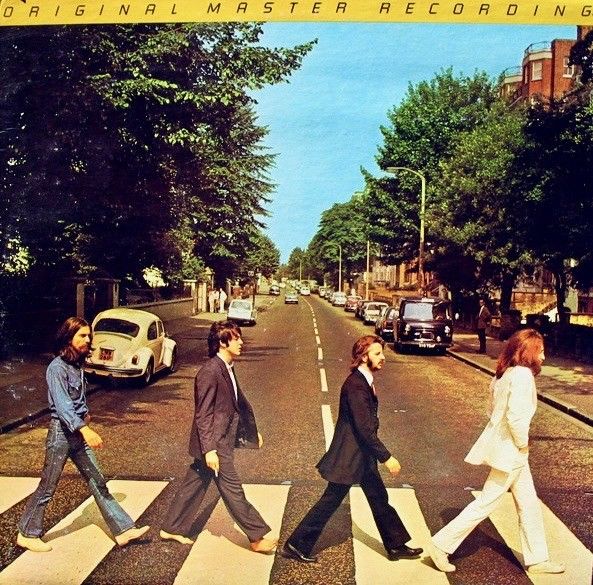
Although Abbey Road was an immediate commercial success and reached ?No.? 1 in the UK and US, it initially received mixed reviews, some critics describing its music as inauthentic and bemoaning the production's artificial effects. Many critics now view the album as the Beatles' best and rank it as one of the greatest albums of all time. In particular, George Harrison's contributions, "Something" and "Here Comes the Sun", are considered to be among the best songs he wrote for the group. The album's cover, which features the four band members walking across a zebra crossing outside Abbey Road Studios, has become one of the most famous and imitated images in the history of popular music.
After the unpleasant recording sessions for the proposed Get Back album (ultimately released in 1970 as Let It Be), Paul McCartney suggested to music producer George Martin that the group get together and make an album "the way we used to do it", free of the conflict that had begun following the death of Brian Epstein and carried over to the sessions for the White Album. Martin agreed, but on the strict condition that all the group – particularly John Lennon – allow him to produce the record in the same manner as earlier albums and that discipline would be adhered to.
The first sessions for Abbey Road began on 22 February 1969, only three weeks after the Get Back sessions, in Trident Studios. There, the group recorded a backing track to "I Want You (She's So Heavy)" with Billy Preston accompanying them on Hammond organ. No further group recording occurred until April because of Ringo Starr's commitments on the film The Magic Christian. After a small amount of work that month and a session for "You Never Give Me Your Money" on 6 May, the group took an eight-week break before recommencing on 2 July. Recording continued through July and August, with the last backing track, for "Because", being taped on 1 August. Overdubs continued through the month, with the final sequencing of the album coming together on 20 August – the last time all four Beatles were present in a studio together.
McCartney, Starr and Martin have reported positive recollections of the sessions, while George Harrison said, "we did actually perform like musicians again". Lennon and McCartney had enjoyed working together on the non-album single "The Ballad of John and Yoko" in April, contributing friendly banter between takes, and some of this camaraderie carried over to the Abbey Road sessions. Nevertheless, there was a significant amount of tension between the group members. According to author Ian MacDonald, McCartney had an acrimonious argument with Lennon during the sessions. Lennon's wife Yoko Ono had become a permanent presence at Beatles recordings and clashed with other members. Halfway through recording in June, Lennon and Ono were involved in a car accident. A doctor told Ono to rest in bed, so Lennon had one installed in the studio so she could observe the recording process from there.
The album's two halves represented a compromise; Lennon wanted a traditional release with distinct and unrelated songs while McCartney and Martin wanted to continue their thematic approach from Sgt. Pepper's Lonely Hearts Club Band by incorporating a medley. Lennon ultimately said that he disliked Abbey Road as a whole and felt that it lacked authenticity, calling McCartney's contributions "[music] for the grannies to dig" and not "real songs" and describing the medley as "junk ... just bits of songs thrown together". During the sessions, Lennon expressed a desire to have all of his songs on one side of the album, with McCartney's on the other.
Nobody was entirely sure that the work was going to be the group's last, though Harrison said "it felt as if we were reaching the end of the line". After the album was released, the Get Back/Let It Be project was re-examined, and work on it continued into 1970. Therefore, Let It Be became the last album to be finished by the Beatles, even though its recording had begun before Abbey Road.
By September 1969, after the recording of Abbey Road, Lennon had formed a new group, the Plastic Ono Band, in part because the Beatles had rejected his song "Cold Turkey". While Harrison worked with such artists as Leon Russell, Doris Troy, Preston and Delaney & Bonnie through to the end of the year, McCartney took a hiatus from the group after his daughter Mary was born on 28 August. On 20 September, Lennon formally announced his departure to the other Beatles. Abbey Road was released on 26 September 1969. The single "Something"/"Come Together" followed in October, while Lennon released the Plastic Ono Band's version of "Cold Turkey" the same month. The Beatles did not promote Abbey Road directly, and no public announcement was made of the band's split until McCartney announced he was leaving the group in April 1970, at which point they officially disbanded.
Abbey Road initially received mixed reviews from music critics, who criticised the production's artificial sounds and viewed its music as inauthentic. William Mann of the London Times said that the album will "be called gimmicky by people who want a record to sound exactly like a live performance", although he considered it to be "teem[ing] with musical invention" and added: "Nice as Come Together and Harrison's Something are – they are minor pleasures in the context of the whole disc … Side Two is marvellous …" Ed Ward of Rolling Stone called the album "complicated instead of complex" and felt that the Moog synthesizer "disembodies and artificializes" the band's sound, adding that they "create a sound that could not possibly exist outside the studio". While he found the medley on side two to be their "most impressive music" since Rubber Soul, Nik Cohn of The New York Times said that, "individually", the album's songs are "nothing special". Albert Goldman of Life magazine wrote that Abbey Road "is not one of the Beatles' great albums" and, despite some "lovely" phrases and "stirring" segues, side two's suite "seems symbolic of the Beatles' latest phase, which might be described as the round-the-clock production of disposable music effects".
Conversely, Chris Welch wrote in Melody Maker: "the truth is, their latest LP is just a natural born gas, entirely free of pretension, deep meanings or symbolism … While production is simple compared to past intricacies, it is still extremely sophisticated and inventive." Derek Jewell of The Sunday Times found the album "refreshingly terse and unpretentious", and although he lamented the band's "cod-1920s jokes (Maxwell's Silver Hammer) and … Ringo's obligatory nursery arias (Octopus's Garden)", he considered that Abbey Road "touches higher peaks than did their last album". John Mendelsohn, writing for Rolling Stone, called it "breathtakingly recorded" and praised side two especially, equating it to "the whole of Sgt. Pepper" and stating, "That the Beatles can unify seemingly countless musical fragments and lyrical doodlings into a uniformly wonderful suite ... seems potent testimony that no, they've far from lost it, and no, they haven't stopped trying."
Many critics have since cited Abbey Road as the Beatles' greatest album. In a retrospective review, Nicole Pensiero of PopMatters called it "an amazingly cohesive piece of music, innovative and timeless". Mark Kemp of Paste viewed the album as being "among The Beatles' finest works, even if it foreshadows the cigarette-lighter-waving arena rock that technically skilled but critically maligned artists from Journey to Meatloaf would belabor throughout the '70s and '80s". Neil McCormack of The Daily Telegraph dubbed it the Beatles' "last love letter to the world" and praised its "big, modern sound", calling it "lush, rich, smooth, epic, emotional and utterly gorgeous". AllMusic's Richie Unterberger felt that the album shared Sgt. Pepper's "faux-conceptual forms", but had "stronger compositions", and wrote of its standing in the band's catalogue: "Whether Abbey Road is the Beatles' best work is debatable, but it's certainly the most immaculately produced (with the possible exception of Sgt. Pepper) and most tightly constructed." Ian MacDonald gave a mixed opinion of the album, noting that several tracks had been written at least a year previously, and would possibly have been unsuitable without being integrated into the medley on side two. He did, however, praise the production, particularly the sound of Starr's bass drum.
Abbey Road received high rankings in several "best albums in history" polls by critics and publications. Time included it in their 2006 list of the All-Time 100 Albums. In 2009, readers of Rolling Stone named Abbey Road the greatest Beatles album. and in 2012, the magazine ranked it number 14 on its list of the 500 greatest albums of all time. The album was also included in the book 1001 Albums You Must Hear Before You Die.
Musicologist Walter Everett interprets that most of the lyrics on side two's medley deal with "selfishness and self-gratification – the financial complaints in 'You Never Give Me Your Money,' the miserliness of Mr. Mustard, the holding back of the pillow in 'Carry That Weight,' the desire that some second person will visit the singer's dreams – perhaps the 'one sweet dream' of 'You Never Give Me Your Money'? – in 'The End.'" Everett adds that the medley's "selfish moments" are played in the context of the tonal centre of A, while "generosity" is expressed in songs where C major is central. The medley concludes with a "great compromise in the 'negotiations'" in "The End", which serves as a structurally balanced coda. In response to the repeated A-major choruses of "love you", McCartney sings in realisation that there is as much self-gratifying love ("the love you take") as there is of the generous love ("the love you make"), in A major and C major, respectively.
-
MFSL - Mobile Fidelity Sound Lab Record LP item - WHITE record labels with BLACK lettering
-
Record Made in JAPAN
-
Pressing is in STEREO - recording is from 1969 - originally issued on the APPLE label
-
Limited Edition LP
-
Record Speed: 33 1/3 rpm
-
Record Made issued in: 1979 (one of the earliest MFSL titles made)
-
Record Catalog Number: MFSL 1-023
Featured on this item:
The Beatles
Title of this Audiophile LP -
Abbey Road
Track Listings -
A1. Come Together - Written-By – Lennon-McCartney - 4:16A2. Something - Written-By – George Harrison - 2:59
A3. Maxwell's Silver Hammer - Written-By – Lennon-McCartney - 3:24
A4. Oh! Darling - Written-By – Lennon-McCartney - 3:28
A5. Octopus's Garden - Written-By – Richard Starkey - 2:49
A6. I Want You (She's So Heavy) - Written-By – Lennon-McCartney - 7:49
B1. Here Comes The Sun - Written-By – George Harrison - 3:04
B2. Because - Written-By – Lennon-McCartney - 2:45
B3. You Never Give Me Your Money - Written-By – Lennon-McCartney - 3:57
B4. Sun King - Written-By – Lennon-McCartney - 2:31
B5. Mean Mr. Mustard - Written-By – Lennon-McCartney - 1:06
B6. Polythene Pam - Written-By – Lennon-McCartney - 1:13
B7. She Came In Through The Bathroom Window - Written-By – Lennon-McCartney - 1:58
B8. Golden Slumbers - Written-By – Lennon-McCartney - 1:31
B9. Carry That Weight - Written-By – Lennon-McCartney - 1:37
B10. The End - Written-By – Lennon-McCartney - 2:04
B11. Her Majesty - Written-By – Lennon-McCartney - 0:23
Performed By / Credits on this LP include -
The Beatles
• John Lennon – lead, harmony and background vocals; rhythm, lead and acoustic guitars; acoustic and electric pianos, Moog synthesizer; white noise generator and sound effects; percussion
• Paul McCartney – lead, harmony and background vocals; bass, rhythm, lead and acoustic guitars; acoustic and electric pianos, Moog synthesizer; sound effects; wind chimes, handclaps and percussion
• George Harrison – harmony and background vocals; lead, rhythm and acoustic guitars; bass on "Maxwell's Silver Hammer" and "Golden Slumbers/Carry That Weight"; harmonium and Moog synthesizer; handclaps and percussion; lead vocals (on "Something" and "Here Comes the Sun")
• Ringo Starr – drums and percussion; anvil on "Maxwell's Silver Hammer";[40] background vocals; lead vocals (on "Octopus's Garden")
Additional musicians
• George Martin – harpsichord, organ, percussion • Billy Preston – Hammond organ (on "Something" and "I Want You (She's So Heavy)")
Production
• "Something" and "Here Comes the Sun" orchestrated and conducted by George Martin (with George Harrison)
• "Golden Slumbers", "Carry That Weight" and "The End" orchestrated and conducted by George Martin (with Paul McCartney)
• Produced by George Martin (with the Beatles)
• Recorded by Geoff Emerick and Phil McDonald
• Assistant Engineering by Alan Parsons
• Mixed by Geoff Emerick, Phil McDonald and George Martin (with the Beatles)
• Moog programming by Mike Vickers
• Producer – George Martin • Remastered By [Half-speed Mastering] – Stan Ricker
Other Information -
Original master recording, remastered edition of the 1969 album.
Mobile Fidelity's first Beatles release.
Yellow banner at the top cover "Original Master Recording"
White Mo-Fi label has the Capitol C logo.
Early pressings came with a posterboard fold-out insert protecting the LP. On one side is a description of Mo-Fi's background called "An Audiophile's Dream Come True!" and the other side "Superdiscs Supertapes Superstars Super Quality"
Later inserts had a photo of historical-looking figures holding up Mo-Fi LPs stating "Limited Editions From the Original Masters"
The LP itself is translucent (hold it up to a bright light and you can see through it) and it comes in a paper-lined rice paper sleeve.
Pressed in Japan.
Recorded in England.
© 1979 • Manufactured By – Mobile Fidelity Sound Lab
• Distributed By – Mobile Fidelity Sound Lab
• Licensed From – Capitol Records, Inc.
• Copyright (c) – Mobile Fidelity Sound Lab
CONDITION Details:
LP Jacket:-
The jacket is in Near MINT condition - no seam splits!
-
The jacket has NO splits of any kind - it is completely solid and intact, and shows only some very minimal shelf wear.
-
It has NO drill holes or saw marks of any kind.
-
There is NO writing on the front or back of the jacket.
-
The cover has clean and sharp colors - see picture with this listing for more detail.
-
The LP is only in VG+ condition, not a perfect record I'm afraid - although it's super glossy, it does have a significant mark on side 1, affecting cuts 5 & 6 (Octopus's Garden & I Want You (She's So Heavy). Besides that one mark, there are some very light spider marks - these don't normally affect play as they are caused by sliding the LP in and out of the inner sleeves and tend to be superficial only (but that really depends on the sensitivity of your audio gear).
-
This is the near mint copy you want for your collection - any super picky audiophile would be happy with this one!
-
As for any record, even brand new, sealed ones, we always recommend a proper record cleaning before playing!
A Short Note About LP GRADING -
- Mint = Only used for sealed items.
- Near Mint = Virtually flawless in every way.
- Near Mint Minus = Item has some minor imperfections, some audible.
- Excellent = Item obviously played and enjoyed with some noise.
- Very Good Plus = Many more imperfections which are noticeable and obtrusive.
price rating