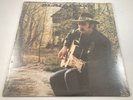
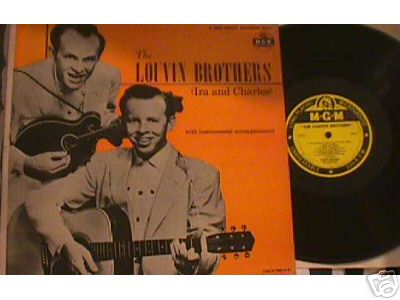
LP LOUVIN BROTHERS - rare debut on MGM VG++
$
455


Favourite Auctions
To save auctions to your favourites, please login
If you don't have an account, please register
Description
GORGEOUS COPY OF THEIR VERY SCARCE ALBUM ON MGM
The Louvin Brothers - "Ira and Charles", mono, on MGM E3426. These recording are from the very early 1950's and are excellent. Superb close harmony, simple, earthy arrangements, a lot of songs about God, salvation and life after death. Yes, I am really starting the bidding at $1.00 for this great record. The high bid should end up in the same place no matter I start.Record Grade: VG++, the record retains almost all its original gloss, there some light hairlines that do not materally effect play. This record has been playgraded and plays at least equal to the visual grade. The sonics are clear and crisp, occasional clicks or pops but nothing to seriously distract from your listening pleasure.
Cover Grade: VG++, high gloss cover has minor wear, some browning due to age on the back
Label: Original yellow and black labels are in excellent condition
Song Titles:
- The Get Acquainted Waltz
- Weapon of Prayer
- They Got the Church Outnumbered
- Do You Live What You Preach
- You'll Be Rewarded Over There
- I'll Live With God
- My Love Song
- Robe of White
- The Great Atomic Power
- Insured Beyond the Grave
- The Gospel Way
- The Sons and Daughters of God
About the Artist: From the close-harmony brother acts of the '30s evolved Charlie and Ira Louvin, ranking among the top duos in country music history. With Ira's incredibly high, pure tenor and Charlie's emotional and smooth melody tenor, they learned well from the Bolick brothers (the Blue Sky Boys), the Monroe Brothers, the Delmore Brothers, and other major family duos of the previous generation, preserving the old-time flavor while bringing this genre into the '50s, when country music moved to a newer sound. Whatever type of songs they recorded — gospel, folk, hillbilly, or '50s pop — those songs became the Louvins'. Add to the list the many Louvin compositions (for example, "If I Could Only Win Your Love," Emmylou Harris' first hit), and you have an act that is outstanding in country music history. Their career took awhile to get going, partly because of interruptions from WWII and the Korean War. In the early '50s, after making a reputation for unexcelled gospel singing, the Louvins broadened their repertoire, recording "The Get Acquainted Waltz" (with Chet Atkins adding another guitar to Charlie's and to Ira's mandolin), a fair hit that showed success was reachable with non-religious music. The electric guitar, with the duo's unique harmony and Ira's exceptional tenor, created a sound that fans asked for in increasing numbers. In 1955, after ten unsuccessful auditions, they finally joined the Opry, where they performed to great acclaim until 1963, when they broke up. They had a number of hits, including the much-covered "When I Stop Dreaming" and "Cash on the Barrel Head." Following the duo's breakup, Ira and Charlie both pursued solo careers. Born and raised in the Appalachian mountains in Alabama, both Charlie (born Charlie Elzer Loudermilk, July 7, 1927) and Ira (born Lonnie Ira Loudermilk, April 21, 1924; died June 20, 1965) were attracted to the close-harmony country brother duets of the Blue Sky Boys, the Delmore Brothers, the Callahan Brothers, and the Monroe Brothers when they reached their adolescence. Previously, they had sung gospel songs in church, and their parents encouraged them to play music, despite the family's poverty. Ira began playing mandolin while Charlie picked up the guitar, and the two began harmonizing. After a while, they began performing at a small, local radio station in Chattanooga, where they frequently played on an early-morning show. The Brothers' career was interrupted in the early '40s when Charlie joined the Army for a short while. While his brother was in the service, Ira played with Charlie Monroe. Once Charlie returned from the Army, the duo moved to Knoxville, TN, where they received a regular spot on a WROL radio show; they later moved to WNOX. Around this time, they decided to abandon their given name for Louvin, which appeared to be a better stage name. (Their cousin John D. Loudermilk retained the family name.) Following their stint in Knoxville, they moved to Memphis, where they broadcast on WMPS and cut one single for Apollo Records. After their brief stay in Memphis, they returned to Knoxville. In 1949, the Louvin Brothers recorded a single for Decca Records which failed to make much of an impact. Two years later, they signed with MGM Records and over the next year recorded 12 songs. Shortly after their MGM sessions were finished, Charlie and Ira moved back to Memphis, where they worked as postal clerks while playing concerts and radio shows at night. Eventually, they earned the attention of Acuff-Rose, who signed the duo to a publishing contract. Fred Rose, the owner of the publishing house, helped the duo sign a contract with Capitol Records. The Louvins' debut single for the label, "The Family Who Prays," was a moderate success (it would later become a gospel standard), yet they were unable to capitalize on its success because Charlie was recalled by the Army to serve in the Korean War. Upon Charlie's discharge from the Army, the Louvins relocated to Birmingham, where they planned to restart their career through appearances on the radio station WOVK. However, a duo called Rebe & Rabe had already carved out a close-harmony niche in the area, using several of the Louvins' own songs. When Charlie and Ira were reaching a point of desperation, Capitol's Ken Nelson was able to convince the Grand Ole Opry to hire the duo. Prior to joining the Opry, the duo had been marketed as a gospel artist, but they began singing secular material as soon as they landed a slot on the show, primarily because a tobacco company sponsoring its broadcast told the Opry and the Louvins "you can't sell tobacco with gospel music." While they didn't abandon gospel, the Brothers began writing and performing secular material again, starting with "When I Stop Dreaming." The single became a Top Ten hit upon its release in the fall of 1955 and would eventually become a country standard. It was followed shortly afterward by "I Don't Believe You've Met My Baby," which spent two weeks at number one early in 1956. No less than three of the duo's other singles — "Hoping That You're Hoping," "You're Running Wild," "Cash on the Barrel Head" — reached the Top Ten that year, and they also released the albums Tragic Songs of Life and Nearer My God to Thee. The Louvins' success in 1956 was particularly impressive when considering that rock & roll was breaking big that year, sapping the sales of many established country artists. However, the Louvins weren't able to escape being hurt by rock & roll. They had two relatively big hits in 1957 ("Don't Laugh" and "Plenty of Everything but You"), "My Baby's Gone" reached the Top Ten in late 1958, and their classic version of the traditional ballad "Knoxville Girl" was a moderate hit in early 1959, but those four hit singles arrived in the space of three years; they charted four songs in 1956 alone. Soon, the Louvins were receiving pressure from Capitol to update their sound. They tried to cut a couple of rockabilly numbers, but they were quite unsuccessful. Eventually, Ken Nelson suggested that the duo abandon the mandolin in order to appeal to the same audience as the Everly Brothers. The Louvins didn't accept his advice, but the remark did considerable damage to Ira's ego and he began to sink into alcoholism. The Louvin Brothers continued to record during the early '60s, turning out a number of theme albums — including tributes to the Delmore Brothers and Roy Acuff, as well as gospel records like Satan Is Real — as well as singles. "I Love You Best of All" and "How's the World Treating You" reached numbers 12 and 26 respectively in 1961, the first year they had two hit singles since 1957. However, the duo began fighting frequently, and Ira's alcoholism worsened. Following one last hit single, "Must You Throw Dirt in My Face," in the fall of 1962, the duo decided to disband in the summer of 1963. Charlie and Ira both launched solo careers on Capitol Records shortly after the breakup. Charlie was the more successful of the two, with his debut single, "I Don't Love You Anymore," reaching number four upon its summer release in 1964. For the next decade, he racked up a total of 30 hit singles, though most of the records didn't make the Top 40. Ira's luck wasn't as good as his brother's. Shortly after the Louvins disbanded, he had a raging, alcohol-fueled argument with his third wife, Faye, that resulted in a shooting that nearly killed him. He continued to perform afterward, singing with his fourth wife, Anne Young. The duo were performing a week of concerts in Kansas City in June of 1965 when they were both killed in a car crash in Williamsburg, MO. After his death, his single "Yodel, Sweet Molly" became a moderate hit. The Louvin Brothers' reputation continued to grow in the decades following their breakup, as their harmonies and hard-driving take on traditional country provided the blueprint for many generations of country and rock musicians. The Everly Brothers were clearly influenced by the duo, while country-rock pioneer Gram Parsons drew heavily from the Louvins' deep catalog of classic songs, recording "The Christian Life" with the Byrds and "Cash on the Barrelhead" as a solo artist. The Louvin Brothers and their music is truly legendary.
MY GRADING SYSTEMS: I’ve been told that I grade conservatively. My NM (near mint) is my highest grade for opened records (which would also include unplayed records). It’s a 9 or 10 on a 1-10 scale. M- would be equivalent to an 8; VG++ to a 7; VG+ to a 6; VG to a 5; VG- to a 4; G to a 3; F to a 2 and P to a 1. The same scale applies when I grade covers (jackets). Significant defects are specifically noted and taken into consideration in the grade.
GRADING DESCRIPTIONS
RECORDS:- GRADING Grading is based on the following criteria
- Sealed = store stock new
- Near Mint = like new or near new with only one or two small insignificant defects, a 9 or better on a 1-10 scale
- Mint- = extremely nice. Would be Near Mint, except for a couple of light hairlines or scuffs, which do not affect play
- VG++ = still a very nice record with all or nearly all of its original gloss but may have a few more light, surface marks, hairlines, needle tracks or the like which should not materially effect play
- VG+ = a nice, but used record that may have a series of light scuffs or scratches. It probably plays with a few pops, but has no serious problems.
- VG = a well-used record that still should sound OK when played, but may have moderate surface noise, pops, etc.
- VG- = a very well-worn record that plays through without skipping, but will do until a better copy comes along.
- Good = not actually good at all but probably will play through but with much in the way of surface noise, pops, crackles, etc. Still, will have no cracks, chips or the like
- Fair = you’re getting this record just to own but not to play
- Poor = the sky’s the limit, generally I will discard a record this bad (and sell the cover, jacket or sleeve alone) unless the label holds some particular interest
VISUAL GRADING: All records are visually graded only unless I state that they are play-graded. Some labels such as RCA, Capitol, Colpix, Atlantic, MGM were pressed on better quality vinyl and will sound better than a record which visually appears the same on labels such as Crown, Score or Design. Recording techniques also varied. The sound on live albums may be far inferior to studio recordings. There may also be defects in the pressing which are invisible. The point is that an album on RCA graded VG+ may sound far better than an album on Crown graded Near Mint. I have no problem issuing a refund if you are dissatisfied with the sound on a record as long as it’s requested as per my stated return policy below. But please don’t be shocked if a record visually graded Near Mint doesn’t sound state of the art. If I base my grade on a PLAY GRADE, I will state this specifically in my grading section.
COVERS: There are really too many possible defects regarding covers to be as specific in my definitions as I had been with my record grades. But please keep in mind these general grading guidelines:
- I will give greater weight to the condition of the front cover than back cover when assigning an overall grade
- No cover with a cut out hole or saw mark will be graded Near Mint even if it is still in factory shrink and there is no other wear
- I will not reduce the grade of a cover for stickers which are glued to the jacket by the record company (eg. Contains the hit song After Midnight); but will reduce the grade for stickers glued on the cover by stores, previous owners, etc.
- If I write that a cover has a bb hole, I’m talking about a small cut out hole
- A saw mark is a narrow cut in the perimeter of the cover, could be anywhere and vary in length from 1/2” to 2” at the most.
- The overall grade takes into consideration any stated defects. For example, if I grade a cover VG+ and then state it has 6” top and bottom seam splits - I’ve already reduced the grade because of the seam splits. If the seams weren’t split, the cover would be graded higher such as VG++ or Mint-.
Shipping Costs:
As before, the buyer pays for shipping. For one or two albums, the cost for priority mail in the United States is $6.50. for media rate postage within the U.S. the cost will be $3.00.The cost for shipping a 7” record via 1st class is $2.50 and the cost for shipping a compact disc via 1st class is $3.20. Save money when I mail 2 or more records or items in the same package.
Insurance is optional but highly recommended for “high ticket” purchases. The cost for insurance in the U.S. is $1.30 for up to $50; $2.20 for up to $100; $3.20 for up to $200 and $1.00 additional for each additional $100 of insurance. Rates are quoted in my winning bid notices. The shipping charges for box sets, multi-record sets and other items of non-standard size and weight will be quoted.
If you live in a foreign country, please provide me with your address after the auction closes and I will give you postage rates.
Please check out my other eBay auctions
. I’ve been listing all types of records - mostly LP’s - including 50’s and 60’s rock ‘n’ roll, country, folk jazz, blues, personalities, new wave and punk, surf, psych, spoken word, comedy, etc., etc....... I try to list unusual, unique or obscure records, not the ones that you see all the time. While a majority of my listings are albums, you’ll often find a nice selection of 45’s, EP’s or picture sleeves...and an occasional 78 or two.My return policy: I don’t get many returns but customers are important to me so I like to offer a relatively hassle-free return policy. However, in order to return the record or other item, you must notify me by e-mail of your intent shortly after your receipt of the record or other item and within a reasonable time after the auction’s close. Also, the item must be returned in its original condition , i.e. the way it was shipped when it left my hands. While a very high percentage of my records arrive safe and sound (I use professional mailers and a filler or two, more for 78’s), they occasionally are damaged in transit. If that happens, I won’t accept the return of the record or other item - that’s why you have the option of obtaining insurance.
Any other questions? About anything? Please e-mail me at ibuyvinyl@nc.rr.com .
On Oct-23-03 at 05:53:14 PDT, seller added the following information:
Western Union®BidPaySM - auction payments made easy.