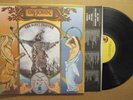
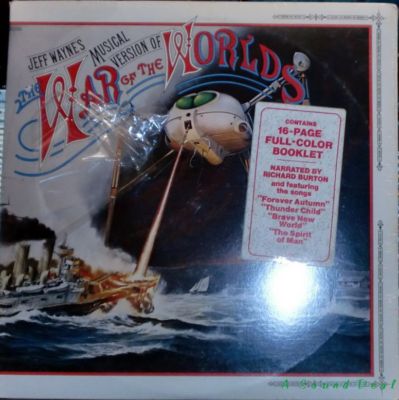
Jeff Wayne WAR of the WORLDS LP Phil Lynott SEALED
$
25


Favourite Auctions
To save auctions to your favourites, please login
If you don't have an account, please register
Description
Jeff Wayne War of the Worlds LP
Style / Moods: * Prog-Rock * Classical * Art Rock * Album ock * Experimental Electronic * Avant-Garde
[[$VALUE]] / [[$VALUEDATE]] [[$RATING]] asocc
Jeff Wayne
1978 CBS LP
War of the Worlds
CONDITION
VINYL: Still Sealed
COVER: VG+ or better Shrink torn at top left center front
Click here for info on grading and abbreviations
Factory sealed with sticker complete with book
Click the pix for a better view
Jeff Wayne - Jeff Wayne's Musical Version Of The War Of The Worlds
Label:
Columbia, Columbia
Catalog#:
PC2 35290, C 35291
Format:
2 x Vinyl, LP
Country:
US
Released:
1978
Genre:
Rock
Style:
Prog Rock
Tracklist
The Coming Of The Martians (20:52)
A1 The Eve Of The War
A2 Horsell Common And The Heat Ray
The Coming Of The Martians (24:29)
B1 The Artilleryman And The Fighting Machine
B2 Forever Autumn
B3 Thunder Child
The Earth Under The Martians (25:16)
C1 The Red Weed (Part 1)
C2 The Spirit Of Man
C3 The Red Weed (Part 2)
The Earth Under The Martians (24:45)
D1 Brave New World
D2 Dead London
D3 Epilogue
Notes
Gatefold Album with accompanying 16 page booklet.
There are no separate lengths for each track. Only the length of each side is provided and are marked on the label after the last track of each side.
Biography by
Jeff Wayne was already a well-known figure in British rock circles when he created The War of the Worlds, the piece for which he would remain known to the public for more than a quarter century after. He was born in New York, the son of actor Jerry Wayne, but he ended up being raised for four years in England, when his father was cast in the role of Sky Masterson in the original London production of Guys and Dolls. In New York, he attended Forest Hills High School and his keen interest in music, which encompassed both classical and jazz, resulted in Wayne's studying privately -- his teachers included John Mehegan. He spent the rest of his youth in California and initially attended college as a journalism student before switching to music, and he supported himself in those years playing keyboards with various bands, when he wasn't indulging in his other great passion, tennis. Eventually, he chose music as his career path, and was helped along considerably when his father produced a musical play on the West End entitled Two Cities (which starred a young Edward Woodward) -- a musical adaptation of Charles Dickens' A Tale of Two Cities; that production may well have set Wayne on the path to the creation of his magnum opus. With Two Cities to his credit, Wayne jumped into music composition and production feet first, amassing substantial professional credits in television music and commercial jingles, and then film music, during the late 1960s and early 1970s. He moved into record production in a big way in the early 1970s when he produced Rock On, the David Essex album that yielded a number one hit with its title track (which also earned a Grammy nomination). His production work on Essex's two subsequent albums, and on the movie Stardust -- starring Essex -- brought him to the attention of the rock music community in England and earned him the loyalty of such players as Chris Spedding and Jo Partridge, who would loom large in his future projects. Among the attributes that made Wayne so popular with these musicians, the most notable were his precise (and very demanding) musical sensibilities, which sometimes meant running into a large number of takes but also held his artists -- singers and musicians alike -- to a very high standard, akin to that of classical music, with very impressive results on record, and he had a great ability to work with what were then very primitive synthesizers, generating unique sounds that crossed freely between classical and pop.Wayne spent a big chunk of 1977 and a piece of 1978 working on War of the Worlds, for which he recruited some of the top musical and acting talent of the era, including Richard Burton (as narrator), singers Justin Hayward and Phil Lynott (and Essex), and actress/singer Julie Covington. Based on various accounts of the sessions, one reason that resulting album worked as well as it did was that overdubbing on the instrumental tracks was held to a minimum -- when Wayne and Spedding or Partridge crossed swords, as it were, on synthesizer and guitar, respectively, or Wayne spun an elaborate electronic keyboard line over a Herbie Flowers bass part, everyone was actually playing at once, generating the music live in the studio. The elaborately produced and packaged double-album, a strangely compelling mix of progressive rock, hard rock, classical, and literary influences, was a huge hit in England, where it rode the charts for six years and became the biggest selling English "soundtrack" (it wasn't a soundtrack, of course, or a cast album, but it usually got classified as one or the other, based on its dramatic content) in a quarter of a century. It sold well throughout Europe and most of the rest of the world -- a specific German-language adaptation, narrated by Curd Jergens, was also prepared for that market. Ironically, it had the chance to be much bigger than that in America when the single extracted from the first LP, "Forever Autumn," sung by Justin Hayward, began getting major airplay -- based on radio play alone, the 45 nudged into the top 40, but the record company was so slow getting actual copies of the single into stores so that people could buy it, that by the time the record was available for purchase, it had already started down the charts and was being returned from many retailers. As a result, the album never found more than a wide cult following in the United States. The experience of working with Wayne was so good for Justin Hayward that he chose the producer to work on his next solo LP, Night Flight, and Wayne was also the producer of the music for the movie MacVicar, starring Roger Daltrey. Following a brace of television-related projects, in 1992 he unveiled his next conceptual project, the musical version of Spartacus, which included Anthony Hopkins and singer (and future star actress) Catherine Zeta-Jones in its cast. He has also appeared as a guest conductor with the London Symphony Orchestra, leading them in the performance of highlights from his War of the Worlds
This exquisite slice of retro music history is a vinyl sound recording (not a CD). Please reference Item Specifics above for additional detail. Strict Goldmine grading -- Over 11 years on Ebay! Combine Items to Save $$$!
©A Sound Deal
price rating


![CHVRCHES - Love Is Dead [VINYL] COLOURED BLUE VINYL LP - NEW - SEALED](https://www.popsike.info/php/thumbnail.php?url=https://www.popsike.pics/pix/20200420/114193626021.jpg)






![The Beatles Sgt. Pepper's LHCB Lp 1 Box Emi [Ex+/Ex] INSANELY GOOD***](https://www.popsike.info/php/thumbnail.php?url=https://www.popsike.pics/pix/20240410/135012689851.jpg)