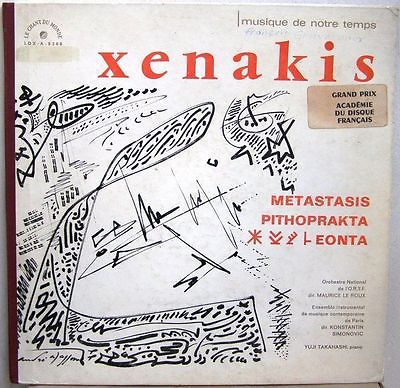
IANNIS XENAKIS METASTASIS ORIGINAL 1st ED. LP YUJI TAKAHASHI-EXPERIMENTAL-AVANT
£
16
$
21



Favourite Auctions
To save auctions to your favourites, please login
If you don't have an account, please register
Description
IANNIS XENAKIS
METASTASIS / PITHOPRAKTA / EONTA LP
Le Chant Du Monde
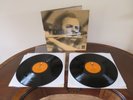
1st edition w/buckram spine
Rare original 1st edition of this masterpiece of "mathematical" music from pioneer avant-garde composer, the greek Iannis Xenakis.
Some info on the release: Bloody rare original 1st edition issue (this one comes in a heavy "book" cover with buckram spine), released in France sometime in the early 60's on the french Le Chant du Monde label (LDX 8368 / 48368).
Metastasis, also Metastaseis, is an orchestral work for 61 musicians by Iannis Xenakis. His first major work, it was written in 1953-54 after his studies with Olivier Messiaen and is 8 minutes in length. The work was premiered at the 1955 Donaueschingen Festival with Hans Rosbaud conducting. Metastasis was inspired by the combination of an Einsteinian view of time and Xenakis' memory of the sounds of warfare, and structured on mathematical ideas by Le Corbusier. Music usually consists of a set of sounds ordered in time; music played backwards is hardly recognizable. Messiaen's similar observations led to his noted uses of non-retrogradable rhythms; Xenakis wished to reconcile the linear perception of music with a relativistic view of time. In warfare, as Xenakis knew it through his musical ear, no individual bullet being fired could be distinguished among the cacophony, but taken as a whole the sound of "gunfire" was clearly identifiable. The particular sequence of shots was unimportant: the individual guns could have fired in a completely different pattern from the way they actually did, but the sound produced would still have been the same. These ideas combined to form the basis of Metastasis. The work requires an orchestra of 61 players (12 winds, 3 percussionists playing 7 instruments, 46 strings) with no two performers playing the same part. It was written using a sound mass technique in which each player is responsible for completing glissandi at different pitch levels and times. The piece is dominated by the strings, which open the piece in unison before their split into 46 separate parts.
As Newtonian views of time show it flowing linearly, Einsteinian views show it as a function of matter and energy; change one of those quantities and time too is changed. Xenakis attempted to make this distinction in his music. While most traditional compositions depend on strictly measured time for the progress of the line, using an unvarying tempo, time signature, or phrase length, Metastasis changes intensity, register, and density of scoring, as the musical analogues of mass and energy. It is by these changes that the piece propels itself forward: the first and third movements of the work do not have even a melodic theme or motive to hold them together, but rather depend on the strength of this conceptualization of time. The second movement does have some sort of melodic element. A fragment of a twelve-tone row is used, with durations based on the Fibonacci sequence. (This integer sequence is nothing new to music: it was used often by Bartók, among others.) One interesting property of the Fibonacci sequence is that the further into the infinite sequence one looks, the closer the ratio of a term to its preceding term comes to the Golden Section; it doesn't take long before the result is correct to several significant figures. This idea of the Golden Section and the Fibonacci Sequence was also a favorite of Xenakis in his architectural works; the Convent de La Tourette was built on this principle. Xenakis, an accomplished architect, saw the chief difference between music and architecture as that while space is viewable from all directions, music can only be experienced from one. The preliminary sketch for Metastasis was in graphic notation looking more like a blueprint than a musical score, showing graphs of mass motion and glissandi like structural beams of the piece, with pitch on one axis and time on the other. In fact, this design ended up being the basis for the Philips Pavilion, which had no flat surfaces but rather the hyperbolic paraboloids of his musical masses and swells. Yet unlike many avant-garde composers of this century who would take such a thing as the completed score, Xenakis notated every event in traditional notation. By the title "Metastasis," the composer meant "transformations," referring to both the glissando mass events and the permutation of the tone rows. A ballet was choreographed to Xenakis' Metastasis and Pithoprakta by George Balanchine; the work was premiered on January 18, 1968 by the New York City Ballet with Suzanne Farrell and Arthur Mitchell.
Iannis Xenakis (May 29, 1922 – February 4, 2001) was a Greek composer, music theorist and architect. He is commonly recognized as one of the most important post-war avant-garde composers. Xenakis pioneered the use of mathematical models such as applications of set theory, varied use of stochastic processes, game theory, etc., in music, and was also an important influence on the development of electronic music.
Among his most important works are Metastaseis (1953–4) for orchestra, which introduced independent parts for every musician of the orchestra; percussion works such as Psappha (1975) and Pléïades (1979); compositions that introduced spatialization by dispersing musicians among the audience, such as Terretektorh (1966); electronic works created using Xenakis' UPIC system; and the massive multimedia performances Xenakis called polytopes. Among the numerous theoretical writings he authored, the book Formalized Music: Thought and Mathematics in Composition (1971) is regarded as one of his most important. As an architect, Xenakis is primarily known for his early work under Le Corbusier: the Sainte Marie de La Tourette, on which the two architects collaborated, and the Philips Pavilion at Expo 58, which Xenakis designed alone.
Xenakis pioneered electronic, computer music, the application of mathematics, statistics, and physics to music and music theory, and the integration of sound and architecture. He used techniques related to probability theory, stochastic processes, statistics, statistical mechanics, group theory, game theory, set theory, and other branches of mathematics and physics in his compositions. He integrated music with architecture, designing music for pre-existing spaces, and designing spaces to be integrated with specific music compositions and performances. He integrated both with political commentary. He viewed compositions as reification and formal structures of abstract ideas, not as ends, to be later incorporated into families of compositions, "a form of composition which is not the object in itself, but an idea in itself, that is to say, the beginnings of a family of compositions." Specific examples of mathematics, statistics, and physics applied to music composition are the use of the statistical mechanics of gases in Pithoprakta, statistical distribution of points on a plane in Diamorphoses, minimal constraints in Achorripsis, the normal distribution in ST/10 and Atrées, Markov chains in Analogiques, game theory in Duel and Stratégie, group theory in Nomos Alpha, set theory in Herma and Eonta, and Brownian motion in N'Shima. Xenakis was a contemporary with fellow greek composers Anestis Logothetis, Jani Christou and Kyriakos Sfetsas and was creating in a time that flourished the various sound experiments of Pierre Schaeffer & Pierre Henry, Henk Badings and of course Luciano Berio, Luigi Nono, Giacinto Scelsi, Alvin Curran and Toshi Ichiyanagi. At the Shirah Arts Festival in Persepolis, he designed Polytope as a composition specific to the historic site. The following year he was commissioned by the brutal dictator, the Shah of Iran, to compose Nuits, which Xenakis dedicated to political prisoners in protest at the Shah’s atrocities. Composers who have acknowledged being influenced by Xenakis include Krzysztof Penderecki and Toru Takemitsu. On the Nurse with wound list of influences.
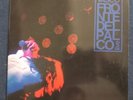
Condition: Vinyl lies in very good condition, shows to have some marks, some of which look deep and plays with surface noise for most of the time, while cover lies in very good+ shape, with small writing on front, removed sticker residue and light age wear (see picture).
Tracklist
A1 Metastasis 8:55 A2 Pithoprakta 9:45 B1 Eonta Trombone – G. Moisan, J. Toulon, M. ChapellierTrumpet – L. Longo, P. Thibaut
Piano – Yuji Takahashi
Orchestra – Ensemble Instrumental De Musique Contemporaine De Paris
Conductor – Konstantin Simonovic 19:30
Credits
- Artwork By – Andre Masson
- Conductor – Maurice Le Roux (tracks: A1, A2)
- Orchestra – Orchestre National De L'O.R.T.F (tracks: A1, A2)
SHIPPING & PAYMENT
Shipping: Shipping for this very heavy LP is 6.50 GBP airmail in Europe / 9 GBP for the rest of the world
Registered mail: +3 GBP
Insurance: optional
Combined shipping: BIG discounts
Payment: Paypal
Packaging: I am a collector too and i know
price rating