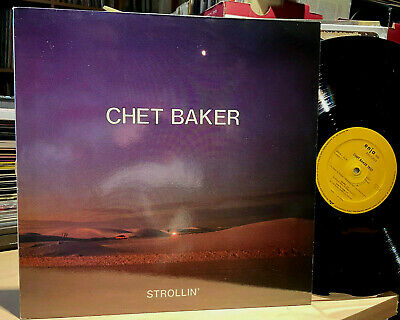
ENJA 5005 LP: Chet Baker - Strollin' - P. Catherine, J-L. Rassinfosse - 1986 DEU
$
100

Favourite Auctions
To save auctions to your favourites, please login
If you don't have an account, please register
Description
****Welcome to our listing, thanks very much for looking!
****See our own website! We have lots of out of print LPs and CDs! Find us on the web at -
hearthedifference.net
****Please see our other listings - new items added daily!
****Shipping cost is only an estimate - it depends on the actual weight and size of the package as well as the service required. We do not profit from shipping costs, so if we overcharge, we will refund the difference back to you. It's always best to wait for our invoice before paying for your item. We will combine shipping for multiple items purchased.
Background -
Baker always sounded at his best when performing in a trio with guitar and bass. Guitarist Philip Catherine and bassist Jean Louis Rassinfosse (both of whom had recorded with the trumpeter previously) are major assets to the subtle but swinging session. Each of the performances (Bob Zieff's "Sad Walk," Horace Silver's "Strollin'," "Love for Sale," "But Not for Me," and a 15-minute version of Richard Beirach's "Leaving") are extended versions but there are no rambling or wandering moments during this set of lyrical jazz. - Scott YanowChet Baker was a primary exponent of the West Coast school of cool jazz in the early and mid-'50s. As a trumpeter, he had a generally restrained, intimate playing style and he attracted attention beyond jazz for his photogenic looks and singing. But his career was marred by drug addiction.
Baker's father, Chesney Henry Baker,Sr., was a guitarist who was forced to turn to other work during the Depression; his mother, Vera (Moser) Baker, worked in a perfumery. The family moved from Oklahoma to Glendale, CA, in 1940. As a child, Baker sang at amateur competitions and in a church choir. Before his adolescence, his father brought home a trombone for him, then replaced it with a trumpet when the larger instrument proved too much for him. He had his first formal training in music in junior high and later at Glendale High School, but would play largely by ear for the rest of his life. In 1946, when he was only 16 years old, he dropped out of high school and his parents signed papers allowing him to enlist in the army; he was sent to Berlin, Germany, where he played in the 298th Army Band. After his discharge in 1948, he enrolled at El Camino College in Los Angeles, where he studied theory and harmony while playing in jazz clubs, but he quit college in the middle of his second year. He re-enlisted in the army in 1950 and became a member of the Sixth Army Band at the Presidio in San Francisco. But he also began sitting in at clubs in the city and he finally obtained a second discharge to become a professional jazz musician.
Baker initially played in Vido Musso's band, then with Stan Getz. (The first recording featuring Baker is a performance of "Out of Nowhere" that comes from a tape of a jam session made on March 24, 1952, and was released on the Fresh Sound Records LP Live at the Trade Winds.) His break came quickly, when, in the spring of 1952, he was chosen at an audition to play a series of West Coast dates with Charlie Parker, making his debut with the famed saxophonist at the Tiffany Club in Los Angeles on May 29, 1952. That summer, he began playing in the Gerry Mulligan Quartet, a group featuring only baritone sax, trumpet, bass, and drums -- no piano -- that attracted attention during an engagement at the Haig nightclub and through recordings on the newly formed Pacific Jazz Records (later known as World Pacific Records), beginning with the 10" LP Gerry Mulligan Quartet, which featured Baker's famous rendition of "My Funny Valentine.”
The Gerry Mulligan Quartet lasted for less than a year, folding when its leader went to jail on a drug charge in June 1953. Baker went solo, forming his own quartet, which initially featured Russ Freeman on piano, Red Mitchell on bass, and Bobby White on drums, and making his first recording as leader for Pacific Jazz on July 24, 1953. Baker was hailed by fans and critics and he won a number of polls in the next few years. In 1954, Pacific Jazz released Chet Baker Sings, an album that increased his popularity but alienated traditional jazz fans; he would continue to sing for the rest of his career. Acknowledging his chiseled good looks, nearby Hollywood came calling and he made his acting debut in the film Hell's Horizon, released in the fall of 1955. But he declined an offer of a studio contract and toured Europe from September 1955 to April 1956. When he returned to the U.S., he formed a quintet that featured saxophonist Phil Urso and pianist Bobby Timmons. Contrary to his reputation for relaxed, laid-back playing, Baker turned to more of a bop style with this group, which recorded the album Chet Baker & Crew for Pacific Jazz in July 1956.
Baker toured the U.S. in February 1957 with the Birdland All-Stars and took a group to Europe later that year. He returned to Europe to stay in 1959, settling in Italy, where he acted in the film Urlatori Alla Sbarra. Hollywood, meanwhile, had not entirely given up on him, at least as a source of inspiration, and in 1960, a fictionalized film biography of his life, All the Fine Young Cannibals, appeared with Robert Wagner in the starring role of Chad Bixby.
Baker had become addicted to heroin in the 1950s and had been incarcerated briefly on several occasions, but his drug habit only began to interfere with his career significantly in the 1960s. He was arrested in Italy in the summer of 1960 and spent almost a year and a half in jail. He celebrated his release by recording Chet Is Back! for RCA in February 1962. (It has since been reissued as The Italian Sessions and as Somewhere Over the Rainbow.) Later in the year, he was arrested in West Germany and expelled to Switzerland, then France, later moving to England in August 1962 to appear as himself in the film The Stolen Hours, which was released in 1963. He was deported from England to France because of a drug offense in March 1963. He lived in Paris and performed there and in Spain over the next year, but after being arrested again in West Germany, he was deported back to the U.S. He returned to America after five years in Europe on March 3, 1964, and played primarily in New York and Los Angeles during the mid-'60s, having switched temporarily from trumpet to flügelhorn. In the summer of 1966, he suffered a severe beating in San Francisco that was related to his drug addiction. The incident is usually misdated and frequently exaggerated in accounts of his life, often due to his own unreliable testimony. It is said, for example, that all his teeth were knocked out, which is not the case, though one tooth was broken and the general deterioration of his teeth led to his being fitted with dentures in the late '60s, forcing him to retrain his embouchure. The beating was not the cause of the decline in his career during this period, but it is emblematic of that decline. By the end of the '60s, he was recording and performing only infrequently and he stopped playing completely in the early ‘70s.
Regaining some control over his life by taking methadone to control his heroin addiction (though he remained an addict), Baker eventually mounted a comeback that culminated in a prominent New York club engagement in November 1973 and a reunion concert with Gerry Mulligan at Carnegie Hall in November 1974 that was recorded and released by Epic Records. By the mid-'70s, Baker was able to return to Europe and he spent the rest of his life performing there primarily, with occasional trips to Japan and periods back in the U.S., though he had no permanent residence. He attracted the attention of rock musicians, with whom he occasionally performed, for example adding trumpet to Elvis Costello's recording of his anti-Falklands War song "Shipbuilding" in 1983. In 1987, photographer and filmmaker Bruce Weber undertook a documentary film about Baker. The following year, Baker died in a fall from a hotel window in Amsterdam after taking heroin and cocaine. Weber's film, Let's Get Lost, premiered in September 1988 to critical acclaim and earned an Academy Award nomination. In 1997, Baker's unfinished autobiography was published under the title As Though I Had Wings: The Lost Memoir and the book was optioned by Miramax for a film adaptation.
Baker's drug addiction caused him to lead a disorganized and peripatetic life, his constant need for cash requiring him to accept many ill-advised recording offers, while his undependability prevented him from making long-term commitments to record labels. As a result, his discography is extensive and wildly uneven. - William Ruhlmann
An immensely gifted Belgian guitarist, Philip Catherine is a highly regarded performer known for his harmonically nuanced, deeply lyrical playing and crisply rounded fretboard touch evident in virtually any style of music he plays: Gypsy jazz, fusion, blues, post-bop, funk, swing, and more. While the jazz populace considered him a fusion player based on 1972's Stream and 1974's September Man, Catherine proved more adventurous -- evidenced by the other artists he worked with during the decade: Kenny Drew, Rolf and Joachim Kuhn, Jean-Luc Ponty, Peter Herbolzheimer, and Larry Coryell (with whom he recorded and toured as an acoustic duo. The following year he recorded with Charles Mingus, who dubbed him "Young Django" (resulting in an album of the same title with Stephane Grappelli, Coryell, and Niels-Henning Ørsted Pedersen in 1979). In the early '80s, Catherine toured with Benny Goodman and played in trios with Chet Baker and Didier Lockwood. After the acclaimed Chet's Choice in 1985, Catherine returned as a leader with the funky, charting Transparence in 1987. During the '90s, the guitarist recorded three albums with trumpeter Tom Harrell, two fine duos with Pedersen (Spanish Nights and Art of the Duo), and a pair of widely acclaimed trio dates with Serge Delaite and George Mraz (Emotionally and Teenagers). Two very electric post-bop fusion outings, Guitar Groove and Blue Prince, appeared under Catherine's name for Dreyfuss Jazz to kick off his 21st century as international hits. 2009's Culture Griot with Baba Sissoko, 2011's Plays Cole Porter, and the live La Belle Vie all registered internationally.
Born in London in 1942 to an English mother and Belgian father, Catherine moved to Brussels with his family at a young age. As a teenager, he became interested in the guitar, influenced at the time by French singer/songwriter and poet George Brassens. By age 14 he was taking lessons, and learning the basic elements of jazz improvisation when he discovered Django Reinhardt. He quickly absorbed the jazz legend's distinctive style, and eventually picked up other influences, including Belgian guitarist René Thomas. He also immersed himself in albums by such luminaries as Art Blakey, Clifford Brown, Max Roach, and others.
Catherine began playing gigs while in his teens, working in a trio with American Hammond B-3 specialist Lou Bennett and drummer Oliver Jackson. There were also stints with Belgian saxophonist Jack Sels and Philadelphia-born/Brussels-based drummer Edgar Bateman. In 1970, violinist Jean-Luc Ponty asked him to join his band and, inspired by contemporaries like John McLaughlin and Larry Coryell, Catherine stayed with Ponty for a year, dedicating himself to the progressive fusion sound. Also during this period, he attended formal music classes at Berklee College of Music in Boston.
After returning to Belgium, Catherine found himself in high demand and developed a bevy of connections, including playing with Klaus Weiss, Les McCann, Karin Krog, Dexter Gordon, and others. As a solo artist, he made his debut with 1971's Stream, a funky, inventive mix of acoustic and electric jazz. He followed up in 1975 with Guitars and September Man, both also highly inventive, fusion-influenced albums. Sessions with Herb Geller, Niels-Henning Ørsted Pedersen, and Charles Mingus followed, as did a duo tour with guitarist Coryell. Also during the '70s, he paired with close associate saxophonist Charlie Mariano for a handful of sessions, and rounded out the decade with his own Nairam, which also featured Mariano, along with trumpeter Palle Mikkelborg and others.
During the '80s, Catherine's profile continued to rise as he released several more well-regarded efforts, including Babel, End of August, and Trio with guitarist Christian Escoude and violinist Didier Lockwood. There also were dates with Aldo Romano, Stéphane Grappelli, and Kenny Drew. Also in the '80s, he gained attention for his work with legendary West Coast trumpeter / vocalist Chet Baker, touring and appearing on such albums as 1983's Mr. B and 1985's Strollin'. Although his 1986 album, Transparence, layered keyboards into his atmospheric sound, his work with Baker pointed toward a more acoustic-leaning aesthetic. It was a sound he further embraced on 1990's I Remember You. Dedicated to Baker (who died in 1989), the album also featured trumpeter/flügelhornist Tom Harrell. Throughout the '90s, Catherine released a steady stream of albums for smaller jazz labels like Enja, Criss Cross, and Dreyfus, including albums like Moods, Vol. 1, Spanish Nights, and 1999's Guitar Groove.
In 2001, he returned with Blue Prince, which found him balancing his love of acoustic jazz and electric fusion. Joining him were trumpeter Bert Joris, bassist Hein van de Geyn, and drummer Hans Van Oosterhout. Joris was also on board for 2002's Summer Night. The orchestral album Meeting Colours followed three years later. The more intimate Guitars Two appeared in 2008. He then joined bassist van de Geyn, pianist Enrico Pieranunzi, and drummer Joe La Barbera for the 2010 live album Concert in Capbreton. A year later, he delivered the trio date Plays Cole Porter, followed by 2013's warmly sophisticated Côté Jardin. The duo album New Folks with bassist Martin Wind followed a year later. He then joined the Orchestre Royal de Chambre de Wallonie for 2015's The String Project: Live in Brussels. In 2017 Catherine was a co-billed soloist with Finnish saxophone legend Eero Koivistoinen on Jazz Liisa 13, and the following year cut La Belle Vie with longtime friend and collaborator Aldo Romano on drums and organist Emmanuel Bex. In 2019, Catherine issued the trio date Manoir de Mes Rêves with upright bassist Sven Faller and acoustic guitarist Paulo Morello. The program of French standards was compiled from pop, jazz and chanson. In 2020, KTI Japan in association with Warner International remastered and reissued Stream. - Matt Collar
-
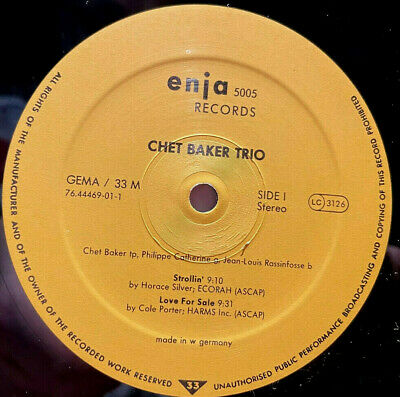
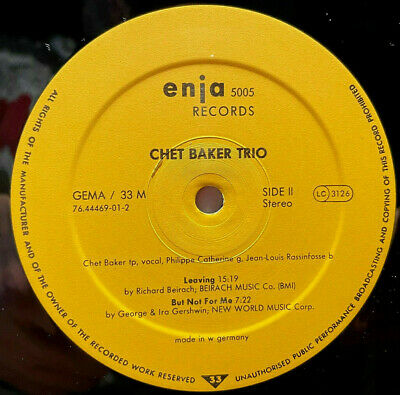
LP made by ENJA Records, in GERMANY
-
LP released in 1986
-
LP is recorded in STEREO
-
Record Catalog Number: ENJA 5005
-
Record Labels are primarily ORANGE with BLACK lettering
Chet Baker / Philip Catherine / Jean-Louis Rassinfosse
LP Title -
Strollin'
Track Listing -
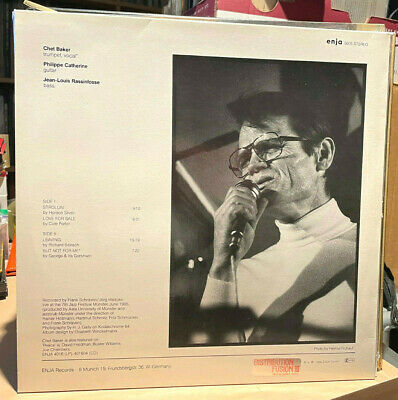
A1. Strollin’ - Written-By – Horace Silver - 9:10
A2. Love For Sale - Written-By – Cole Porter - 9:31
B1. Leaving - Written-By – Richard Beirach - 15:19
B2. But Not For Me - Vocals – Chet BakerWritten-By – George & Ira Gershwin - 7:22
Performers / Other Information -
• Phonographic Copyright (p) – ENJA GmbH
• Copyright (c) – ENJA GmbH
• Recorded At – Internationales Jazzfestival Münster
• Design [Album] – Elisabeth Winckelmann
• Directed By [Festival Director] – Frank Schraven, Fritz Schmücker, Hartmut Schmitz, Rainer Holtmann
• Double Bass – Jean-Louis Rassinfosse
• Guitar – Philip Catherine
• Photography By [Cover] – H. J. Gally
• Photography By [Liner] – Helmut Frühauf
• Recorded By – Frank Schraven, Jörg Meilicke
• Trumpet – Chet Baker
Recorded live at the 7th Jazz Festival Münster, West Germany, June 1985.
Festival produced by Asta University of Münster and jazzclub Münster.
© & ? 1986, ENJA GmbH
ENJA Records 8 Munich 19, Frundsbergstr. 36, W.-Germany
• Matrix / Runout (Side A Label): 76.44469-01-1
• Matrix / Runout (Side B Label): 76.44469-01-2
• Rights Society: GEMA
• Label Code: LC 3126
CONDITION Details:
The LP JACKET is in near mint minus overall condition! The jacket has NO seam splits, NO cutout marks and NO writing on it. The corners and seams are solid with just some light shelf wear. The colors on the jacket are sharp and clean - see our pictures with this listing as they are of the actual item offered.
The LP is in near mint minus overall condition. We found that the vinyl looked superb - there are no serious marks evident. The LP may have a spider mark or two. Spider marks may sound on some audio systems, depending on the sensitivity of your audio gear. When play tested, it performed very well for a vintage record, with no skips, with some light noise periodically, mostly during quieter passages of the music. The LP retains much of the original gloss and sheen. It does have a bit of dust and perhaps a finger print or two on the vinyl so it should be cleaned before playing for best results. There are NO serious spindle marks on the record labels - this is a fine collector's grade copy of this LP.A Short Note About LP GRADING -
- Mint = Only used for sealed items.
- Near Mint = Virtually flawless in every way.
- Near Mint Minus = Item has some minor imperfections, some audible.
- Excellent = Item obviously played and enjoyed with some noise.
- Very Good Plus = Many more imperfections which are noticeable and obtrusive.
For best results, always properly clean your LPs before playing them.
The LP is an audiophile quality pressing (any collector of fine MFSL, half speeds, direct to discs, Japanese/UK pressings etc., can attest to the difference a quality pressing can make to an audio system).
Don't let this rarity slip by!!!
price rating