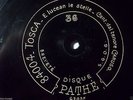
CREATOR Werther Marie DELNA Guillaume IBOS Voice Autograph TALKS 1948 AFG 9
$
85


Favourite Auctions
To save auctions to your favourites, please login
If you don't have an account, please register
Description
Shipping: All items will be packed safely in a sturdy package for safe shipping.
We ship internationally and offer combined shipping for multiple purchases.
Expedited, Priority Mail and FedEx shipping available
Once payment is received, we ship your item on the next business day.
A series of great early Opera performances: From 1902 G&Ts to 40s wartime German records:
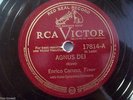
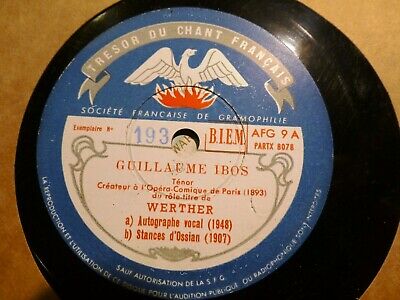
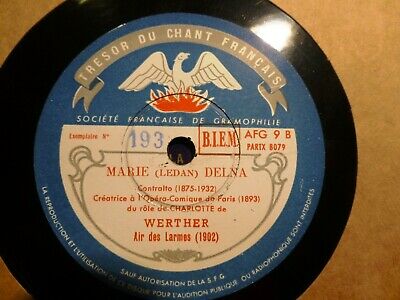
The two CREATORS of Werther and Charlotte, French Tenor Guillaume IBOS and French Contralto Marie Delna
This is the only recording by IBOS
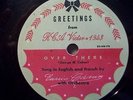
a) Autographe vocal Ibos reminisces 1948
b) Stances d'Ossian Cylinder recording
// Marie Delna
Air des Larmes 1902
Tresor du Chant Francais AFG 9
France
Issued on 12" 78 rpm record
Condition:
EXCELLENT MINUS, unworn but light rubs, plays E very quiet faint crackle
A SUPERB COPY
Ibos, Guilleaume, tenor, * July 10, 1860 Murat (department of Haute-Garonne), † 1952; he was educated at the Conservatoire National de Paris until 1885 and then immediately came to the Grand Opéra Paris. Here he made his debut in 1885 in the role of Fernand in "La Favorite" by Donizetti. His career at the Grand Opéra continued into the years after the turn of the century. There he sang roles such as the Duke in Verdi's Rigoletto, Don Ottavio in Don Giovanni, Vasco in Meyerbeer's Africaine, Raoul in his Huguenots, Roméo in Gounod's Roméo et Juliette and the Don Gomez in "Henry VIII." By Saint-Saëns. He also achieved significant success on the second major opera stage in the French metropolis, the Opéra-Comique. Here he sang the title role in the French premiere of Massenet's "Werther" on January 16, 1893 (after the world premiere of the opera in Vienna on February 16, 1892 and a first performance in French at the Grand Théâtre Geneva). He has made guest appearances in Brussels and Madrid during his career. His memoirs were published under the title "Quelques souvenirs d'Ibos".
There are only a few Gaumont cylinders of the singer's voice; then another recording was discovered that was published by Trésor du Chant Français, namely the »Stances d'Ossian« from »Werther«.
[Addendum] Ibos, Guilleaume, † September 22, 1952 Montesquieu Volvestre; he was engaged at the Grand Opéra Paris until 1889 and sang 1889-90 at the Théâtre de la Monnaie in Brussels (here in 1889 as Roland in the premiere of Massenet's »Esclarmonde«). At the Monte Carlo Opera he took part in the premiere of Noël Desjoyeux's opera »Renaud d 'Arles« in 1900 in the title role. In 1904 he appeared at the La Scala in Milan as a duke in the »Rigoletto«. He went on a large tour of the USA with appearances in New York, Chicago, Boston and Washington, where he sang several times with Nellie Melba. He made guest appearances in Madrid, Portugal and also in Russia. From 1892 he worked again at the Grand Opéra and as a concert singer (until about 1914).
Marie Jeanne LA TOUR called Jane MÉREY
Belgian soprano
(Ghent, Belgium, October 12, 1872 - after 1923)
Daughter of Henri Louis Marin LA TOUR (1908) and Marie Jeanne HORSTMANSHOFF (1908).
th. 1. in 1897 (divorce in Brussels, Belgium, July 26, 1902) Armand Philippe LEDOCTE (1859 -), Belgian industrialist.
th. 2. Paris 16th, April 28, 1908 * Arthur Saul VALABRÈGUE (Carpentras, Vaucluse, July 14, 1864 - Menton, Alpes-Maritimes, November 17, 1953), lawyer.
She studied singing in Paris with Rosine Laborde. She started at Versailles in November 1893 in Lakmé (Lakmé). In May 1894, she participated in the creation of Aréthuse de Lucy de Montgomery in Monte Carlo, and was engaged to the Monnaie de Bruxelles where she began in 1894 in Mireille (Mirelle). On December 28, 1895, she created Evangeline (Evangeline) by Xavier Leroux. On December 10, 1897, she started at the Opéra-Comique. During the 1898-1899 season, she sang in Bordeaux. In 1903, she had to return to the Monnaie de Bruxelles in Lakmé, but, hand-wounded by her ex-husband, she was replaced by Lalla Miranda. From 1906 she taught singing in Paris.
quoted from Marstonrecords.com
The life of Marie Delna is surrounded with so many legends that truth cannot easily be separated from fiction. Her real name was Marie Ledant, of which her stage name, proposed by Léon Carvalho, is a near-anagram. She was born in the Marais section of Paris on 3 August 1875 to a working-class family. Her mother died when she was 15 months old. Her father was physically handicapped. Marie was first raised by her maternal grandmother who was remarried to a Belgian stonecutter, in Longjumeau, the city Adolphe Adam’sPostillon has put on the operatic landscape. From 1881 on, Marie lived with her paternal grandparents, who ran a small restaurant, the Café du Panorama, next to the Rive-Gauche train station of Meudon, the Parisian suburb where Rodin had his atelier. Contrary to later rumors depicting her as a semi-illiterate waitress, she received a conventional education at a convent school. That she possessed an exceptional voice cannot have remained a secret for long. An habitué of the restaurant, the Montpellier-born landscape painter Eugène Baudouin, persuaded Marie’s grandmother to let her study singing. Through the intercession of his friend Paul Ferrier, the librettist of Louis Varney’s Les mousquetaires au couvent, she was accepted as a pro bono student of Rosine Laborde, one of the famous teachers of the day who also trained Emma Calvé. Launched at Laborde’s public auditions, first in the soprano repertory, Delna was also heard at various private concerts in Paris, accompanied by Chabrier among others. She was soon recruited by Carvalho for the Opéra-Comique performing in the old Théâtre-Lyrique building on the place du Châtelet following the 1887 fire of the Salle Favart where, in June 1892, she made a sensational stage debut, before her 17th birthday, as Dido in Les Troyens à Carthage. Massenet chose her as the first French Charlotte in Werther, in which she partnered Guillaume Ibos in January 1893. In November 1893, she was the old servant Marcelline in Alfred Bruneau’s L’attaque du Moulin, which became one her major roles. In April 1894, she sang the role of Quickly in the first French Falstaff, supervised by Verdi, who pronounced her “unique”. In April 1895, Delna was Marion—her other major role—in Benjamin Godard’s posthumous military opera La vivandière. In 1896, she added the role of Orphée in the Berlioz-Viardot version of Gluck’s opera, and in the same year, she sang Zerlina in Mozart’s Don Giovanni with Victor Maurel and Edmond Clément as her co-stars. Other parts she sang during her first Opéra-Comique years were the African servant Néala in Massé’s Paul et Virginie, Éros in Ambroise Thomas’s Psyché, and Jeanne in the Paris premiere of Lalo’s La Jacquerie, a role created by Blanche Deschamps-Jéhin at Monte Carlo earlier in the same year.
Having taken part in the Covent Garden premiere ofL’attaque du moulin in 1894 with Henri Albers and Zina de Nuovina, Delna made her Italian debut at the Teatro Lirico in Milan in 1897. The following year, she left the Opéra-Comique for the Opéra, where she appeared in Meyerbeer’sLe prophète opposite Albert Alvarez, in the Paris premiere of Berlioz’s La prise de Troie with Maurice Renaud as her Chorèbe, in Donizetti’s La favorite, and in Saint Saëns’sSamson et Dalila. Her last role there was as Queen Guinèvre in Victorin Joncières’s Lancelot. Yet she does not seem to have enjoyed the working atmosphere of the Palais Garnier and was happy to return to the Salle Favart in 1900, when she reprised Orphée and, in October of that year, sang her first Carmen with Adolphe Maréchal and Hector Dufranne. Along with Orphée, Carmen was the part she sang most often during the remainder of her career. In April 1901, she was Marianne in Bruneau’s L’ouragan, a part tailored for her and probably one of her greatest artistic creations. Zola and Bruneau also had her in mind for the part of Madeleine inL’enfant roi, but was eventually premiered by Claire Friché in 1905. Also in 1901, she repeated her Quickly at the revival ofFalstaff in Verdi’s memory and sang the witch in Humperdinck’s Hansel und Gretel. Her new role the following season was Margared in the revival of Le roi d’Ys, with Léon Beyle and Julia Guiraudon.
In 1903, while singing Carmen at the Théâtre de la Monnaie, Delna was courted by a rich Belgian admirer, the marquis Prier de Saône, an industrialist. She married him, putting a temporary end to her career. She returned to the stage three years later for a gala performance of La vivandière and a few concerts, before being signed by the Isola brothers for more Vivandières and new productions ofOrphée and L’attaque du moulin with a new scene composed for her, at the Théâtre-Lyrique de la Gaîté in 1907–1908. The following season, still at the Gaîté, she sang Fidès in Le prophète, again with Alvarez, and Léonore in La favorite. On 29 January 1910, she made her Met début as Gluck’s Orfeo under Toscanini, with Johanna Gadski as her Euridice. She was to have appeared in Le prophète, La favorite, Werther, and even as La Cieca in La Gioconda, a role new to her, but various obstacles intervened: Caruso was unavailable for La favorite; Slezak sang Le prophète only in German; Farrar refused to relinquish any of her Charlottes; and La Gioconda was scheduled on the same day as another of Delna’s appearances. A second performance of Orfeoturned to near-disaster over tempi disagreements with Arturo Toscanini. She did, however, premiere L’attaque du moulin, not in the old Met but at the New Theater at 61st Street and Central Park West, with Clément as Dominique and Dinh Gilly as the miller Merlier, but the work itself got mixed reviews. When the Met came to Paris in May of the same year, an article in Gil Blas, evidently inspired by her, denounced the Italian artistic direction for their treatment of French singers and the French repertory, and the opening performance of Aida with Destinn, Homer, and Caruso was disrupted by protesters, though it ended in triumph for Toscanini and his singers. This mini-scandal dashed Delna’s hopes for a return to the United States. Her career resumed only sporadically afterwards: more performances of the Bruneau opera at the Gaîté in 1910, the impressive character role of the old Tilli in Silvio Lazzari’s La lépreuse in 1912, and further performances in Brussels. During the war, she appeared at various concerts and benefit performances, including three of act 3 of L’ouragan at the Palais Garnier in 1916. Also in 1916, she appeared in the soprano role of Toinette (premiered in 1907 by Friché) in Xavier Leroux’s Le chemineau.
By the end of the war, Delna’s career was virtually over. She made occasional appearances on the concert and even cabaret stage and had her operetta début in Léo Puget’sMaurin des Maures at the Folies-Dramatiques in 1925. Financial difficulties forced her to move out of her luxurious “Villa Delna” in Montmorency into a small house in the less prosperous Villemomble. Having separated from her husband, she supported herself by teaching and was also helped by a benefit organized for her in 1928 at the initiative of Albert Carré and the journal Comœdia. Her death in 1932, following a brief illness, was not free of controversy: while the press expressed dismay at her dying in a hospital for the poor, it appears that the specialists who treated her had simply arranged for her to be where they had their residency. She was first buried in Thiais but her remains were moved to the Père Lachaise cemetery in Paris the following year.
MARIE DELNA RECORDINGS
Delna made her first recordings in the London Pathé studios in 1903, the year of her marriage and retirement from the stage, temporarily as it turned out, at the age of 28. By the time she made her last ones, in 1918, she was only 43, but her operatic career was nearly over. Vocally, she was captured at her peak by Edison in March 1910, perhaps thanks to under-employment at the Met that winter, with only nine appearances in more than two months.
Generally described as a contralto, Delna was rather, as Louis Schneider has perceptively argued, a mezzo-soprano in the 19th century sense, in the tradition of Maria Malibran and Pauline Viardot. Delna had a large voice, the size of which is apparent in these recordings, and a range of three octaves, for which we only have her testimony and that of her contemporaries. Trained by her teacher to become a soprano, she could hit a top D and did sing a low D in public (in the orchestral version of Schubert’s Tod und das Mädchen). The color, warmth, evenness of her timbre, and the eloquence of her delivery are also much in evidence in her recorded legacy.
Fidès, one of the most taxing parts of the mezzo repertory, was ideally suited to her voice and reportedly impulsive stage temperament. Of her three recordings of “Ah, mon fils,” both the Edison cylinder and 1913 Diamond disc must rank among the most impressive ever made of the aria, the voice gleaming seamlessly throughout its range with ringing, organ-like tones. The abridged version of the Prison Scene duet with Albert Alvarez, her partner at the Opéra in 1898 and at the Gaîté-Lyrique ten years later, is sung by both parties with admirable firmness.
Next to Emma Calvé, Delna was the most celebrated Carmen of her generation. The three extracts she recorded are all from her early Pathé sessions with piano accompaniment. A more serious, less flirtatious Bohemian than her rival, she does particular justice to the doom-laden “Air des cartes.”
Delna’s recording of Dido’s entrance aria in Les Troyens à Carthage, gives us the opportunity to hear an extract of her debut role in which she dazzled the Opéra-Comique audiences that included Sarah Bernhardt and Marietta Alboni; Delna’s vocal radiance and interpretive authority are both much in evidence here. Léon Glaize’s contemporary portrait of Delna as Dido is preserved at the Bibliothèque-musée de l’Opéra. Other than Félia Litvinne’s recording of the same aria, no other recordings were made until 1929 when Georgette Frozier Marrot recorded it for French HMV. In fact, this great opera was almost totally neglected during the early years of recording.
The two extracts from Werther, recorded three years apart, are invaluable testimonies of an interpretation for which Delna was coached by Massenet himself over several months. The role of Charlotte is not attached to any particular vocal type—the first edition specifies “1re chanteuse d’opéra”—and had been premiered in Vienna by Marie Renard, who sang both mezzo and light soprano parts. Incidentally, she was the first Viennese Manon, opposite Ernest Van Dyck. Delna’s recordings of both Werther arias have been aptly described by Lord Harewood as showing her exemplary “instrumental-like control.” (The “Air des lettres” is cruelly shorn of its middle section due to the time constraints of the recording.) Massenet’s “Les enfants” (1882), one of his most celebrated songs, on a text by Georges Boyer, the librettist of Le portrait de Manon, shows how effectively Delna could lighten her tone.
The part of Marion in La vivandière was written with Delna’s voice in mind, even though Godard died while the work was in rehearsal with the orchestration being completed by Paul Vidal. Henri Cain’s libretto, set during the French Revolution, had everything to appeal to the nervously nationalistic audiences of the Dreyfus Affair years. Delna’s recruiting song, “Viens avec nous, petit” (also known as the “Chanson patriotique,” with its characteristic snatches fromLa Marseillaise) is interrupted after the first verse by spontaneous applause from the studio audience. The grander “Hymne à la liberté,” which closes the work, shows her higher register to great advantage. The “Berceuse” from Godard’s 1888 opera Jocelyn, an adaptation by Victor Capoul and Armand Silvestre of Lamartine’s popular verse novel on a the life of a priest, soon acquired a popularity of its own. Of Delna’s two recordings, the 1904 Pathé is a fine example of her legato and breath control; the 1913 Edison more relaxed and tonally opulent.
La favorite remained a staple of the repertory of French opera theaters until the First World War. Delna’s appealing interpretation is preserved both in French, with the act 3 aria and the end of the act 4 duet again with the admirable Alvarez, and in Italian from the American Edison sessions, imbued with a touching femininity and capped with an exciting cabaletta.
Another souvenir of Delna’s American experience is the extract from Gluck’s Orphée, which she recorded first in French in 1907, and a second time, defiantly, for Edison, three weeks after her fiasco with Toscanini. One can see at once how her very personal tempi (the final verse almost twice as fast as the first) could have come into conflict with Toscanini’s stricter vision; yet there is much to admire in the tonal stability and dignity of utterance. The same qualities are present in the extract from Bruneau’s L’attaque du moulin, the passage at the end of act 1 where Marcelline, at the declaration of war, launches into an impassioned denunciation of warfare to a text largely written by Zola himself.
While Orfeo and Marcelline were parts particularly associated with Delna, she did not sing in Alexandre Georges’s Miarka (premiered in 1905 when she was in retirement), though the gipsy theme of Jean Richepin’s libretto calls Carmen to mind; nor did she appear inCavalleria rusticana, but the popularity of the work amply justified her recording “Voi lo sapete” (in French). In Ponchielli’s La Gioconda, which Delna learned and rehearsed for the Met but never sang, she displays her magnificent contralto in a way that would surely have brought the house down.
With her beautiful timbre and even projection, Delna was a natural Dalila and the two arias are among her most treasured, the three versions of “Mon cœur” different and admirable in their own way, her seductive lower tones used to particularly magical effect on the 1913 Edison disc.
Like most operatic stars of her day, Delna was impressive in semi-character music. Clérice’s “Vierge à la crèche,” a song on a poem by Alphonse Daudet, premiered by the tenor Albert Vaguet, and in which she is accompanied by the Argentine composer, is done with taste and charm, while “O sole mio” has irresistible vocal allure. Similarly, it would be a pity to ignore the two war songs by the obscure Rohand. “Espérance,” in particular, her last recording, is remarkable both for her undiminished expressive powers and the eerie, quasi-androgynous color of her chest tones.
Nothing can console us for the absence of mementos of Delna’s Quickly and Zerlina (to which one could addL’ouragan and Le roi d’Ys). Yet, such as it is, her recorded output conveys much of the magnetic vocal presence of a legendary artist.
More Great Records on sale right now:
https://www.ebay.com/sch/m.html?_ssn=carsten_sf&_from=R40&_nkw=&_sacat=0&_sop=1
http://shop.ebay.com/carsten_sf/m.html
====
A Quick NOTE ON GRADING AND SHIPPING:
As you can see from my feedback, I try hard to earn your POSITIVE FEEDBACK and FIVE STAR RATINGS.
If for any reason your transaction was NOT SATISFACTORY, pls contact me and I will work something out with you. YOU WILL NEVER HAVE A REASON TO GIVE ME A NEGATIVE RATING or a LOW STAR RATING.
Quick note on grading:
The Grade (Excellent to Poor, I don't give Mint) refers to the WEAR of the record. Any other defects are stated separately
When I listen to a record, I may also give it an aural grade (again E to P), and make a SUBJECTIVE judgment of the pressing quality for hiss and surface noise.
"SUPERQUIET" is basically noiseless, like a vinyl pressing.
"VERY QUIET" is an exceptionally quiet record for a given pressing.
"Quiet" is a record that is a great example without undue noise for a give pressing.
These judgments are SUBJECTIVE and will depend one the styli, phonograph etc. you use on your own equipment.
Multiple item shipping: I am happy to combine items for shipment in one parcel.
If you win multiple items, pls send me an INVOICE REQUEST to calculate the correct postage. Ebay check out will not give you the correct multiple item discount!
Records will be packed safely between corrugated cardboard in a sturdy box with plenty of padding for safe shipment.
Shipment is usually Media Mail, unless you request another service. Shipping is at your risk, I will be happy to insure items at your cost.
I charge actual postage plus a small fee for packing materials
As always, I guarantee your satisfaction. If you don't like the item, just return it, and I will refund the full purchase price.
If you are in the San Francisco area, I encourage pick-up in person.
US Domestic Shipping:
Here is a guideline for US Media Mail Shipping:
Prices below are for regular 78 rpm records. Up to about 5 records, I will ship Edison Discs for the same rates. Albums from Album Sets count as 1 record. Above that and for international shipments, it will be actual weight plus a small packing charge (1-3$ depending on size of shipment)
1 record: 4.75 – 5.50$
2 records: 6.50$
5 records: 8.00$
10 records: 12.00$
MANY MORE RECORDS: Don't worry. I safely ship 40 - 50 pounds of records double boxed in moving boxes, and even then Media Mail will probably not exceed 35$.
Please send me a message if you would like to get an estimate for you shipping rates!
I am very happy to ship records worldwide.
Please use the EBAY shipping cost only as a guideline. My actual charges are usually lower
One record usually ships for 25$ for 10" 25-35$ for most 12" records (Less for Canada).
As always, I would appreciate any suggestions and corrections from you, pls contact me with any question.
Thank you very much, and good luck bidding !!!
price rating