BOWIE "HUNKY DORY" FIRST US PRESSING 1971 LSP-4623 ORANGE DYNAFLEX MATTE COVER
$
24

Favourite Auctions
To save auctions to your favourites, please login
If you don't have an account, please register
Description
BOWIE "HUNKY DORY" FIRST US PRESSING 1971 LSP-4623 ORANGE DYNAFLEX MATTE COVER
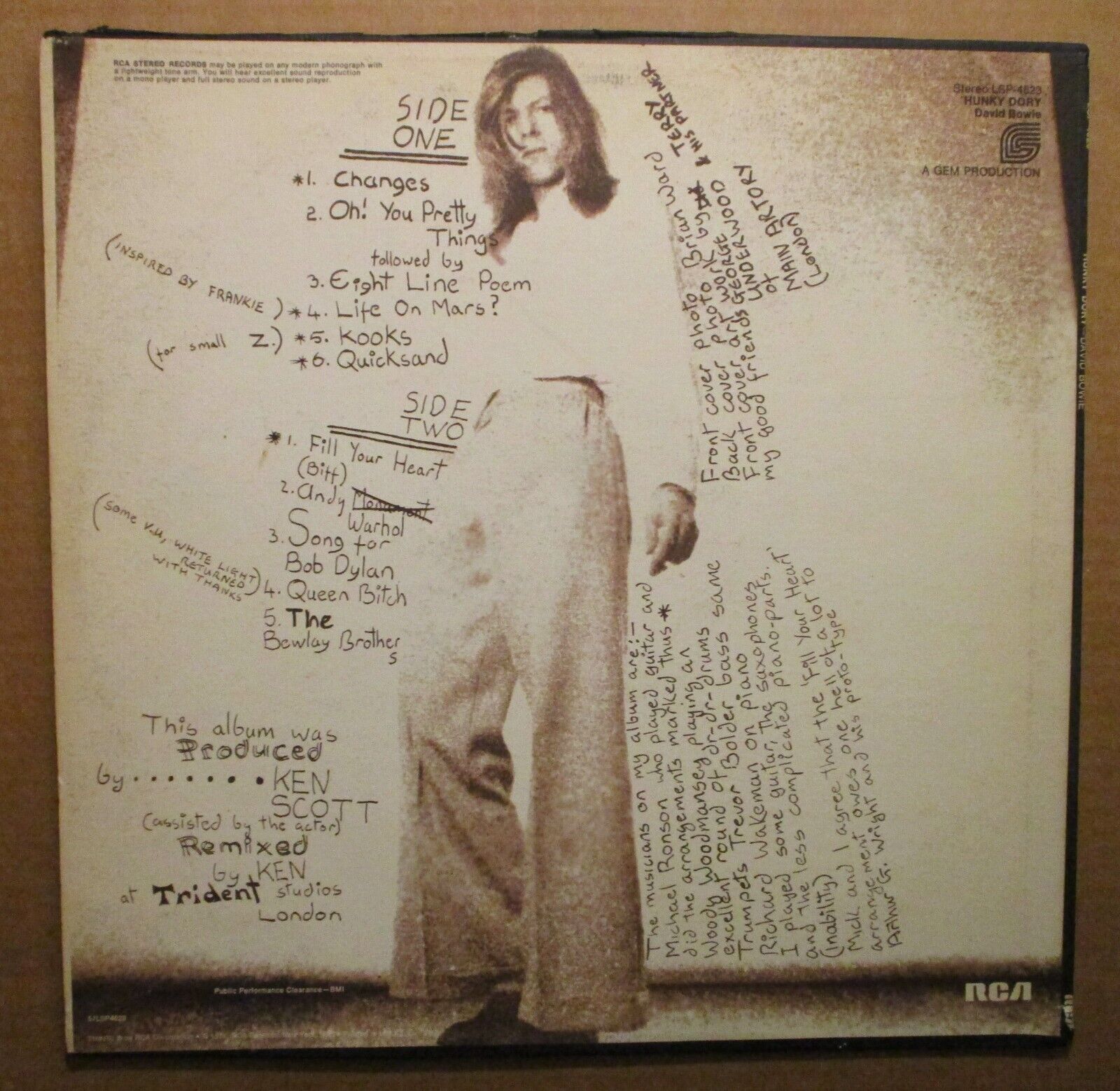
DAVID BOWIE "HUNKY DORY" LABEL: RCA VICTOR LSP-4623 (ORANGE DYNAFLEX) RELEASED: DECEMBER 17, 1971 ORIGINAL FIRST U.S. PRESSING ON ORANGE DYNAFLEX SOFT MATTE SLIGHTLY TEXTURED JACKET w/ SEPIA COLORED BACK PRESSING: RCA RECORDS PRESSING PLANT ~ HOLLYWOOD ('H' IN MATRIX) RECORDED AT: TRIDENT STUDIOS LONDON ~ JUNE-AUGUST 1971 PRODUCER: KEN SCOTT & DAVID BOWIE RECORDING ENGINEER/MIXING: KEN SCOTT ~ TRIDENT STUDIOS LONDON ARRANGEMENTS: MICHAEL ('MICK') RONSON FRONT & BACK COVER PHOTOS: BRIAN WARD FRONT COVER ARTWORK: GEORGE UNDERWOOD ~ MAIN ARTERY ALBUM JACKET DESIGN: TERRY PASTOR MATRIX (SIDE A): (stamped) : APRS-5947 1S H MATRIX (SIDE B): (stamped) : APRS-5948 1S H
CONDITION: VINYL: VG++ INNER SLEEVE: VG+ JACKET: VG (VERY NICE VG+, BUT SEAM SPLIT)
~~~~~~~~~~~~~~~~~~~~~ I've been going thru my massive vinyl record collection these past few weeks and pulling out some LPs that I thought that someone else would want for their collection. I've been collecting records for over 45 years and it's time to pass some of them on to the next generation of collectors.
This week on EBay I am offering up this original 1971 First U.S. Pressing of David Bowie's classic "Hunky Dory."
This is my original copy, purchased back in the early 70's, shortly after it's release, that I've taken great care of for many years. See details on Condition below.
This is a rare, original First pressing of this classic album with the early LSP-4623 catalog number, pressed on the classic Orange RCA Dynaflex label, original inner sleeve, and the original, thick, soft matte jacket with the sepia toned back cover. A beauty!
This 1971 RCA Dynaflex First Pressing reveals just how deeply layered, dynamic and intense Bowie's music is. The instruments are well separated, Bowie's vocals are crisp & clear, and there's a good sense of space, depth, openness and soundstage. The overall pure analog sound is warm, intimate, vibrant and dynamic.
Some of the 'dense' passages on tracks like “Life on Mars” are full, open and vibrant here, but they sound murky, compressed and muddled on digital formats and later re-pressings.
~~~~~ Shortly after these first pressings were made, the Master tape got damaged somehow, and all later pressings and reissues have tape damage and dropouts, which can be heard in various places, especially in "Changes", when the cymbals crash in the first verse. There were obvious flaws created in the tape, that show up on later pressings.
The best way to hear this album is on all-analog early first pressings like this one. It stills sounds amazing and it's hard to imagine 'Hunky Dory' sounding any better.
~~~~~ While no singular Bowie album can encapsulate his uniquely diverse and multifaceted career, 'Hunky Dory' is a great place to start.
David Bowie really found his voice on Hunky Dory and it stands as one of Bowie’s best and most fully realized albums. A remarkably pure distillation of Bowie’s genius.
No other figure in classic rock history has gone through as many varied transitions—personally, professionally and artistically—as David Bowie. Through his music, art, and fashion, Bowie constantly rebelled against societal expectations and norms. He was always in flux, bringing new ideas and new interpretations to his music.
~~~~~ THE STORY OF 'HUNKY DORY' AND THE RISE OF DAVID BOWIE
In 1970, after his first three albums became commercial flops, Bowie was worried that his 1969 song "Space Oddity" would turn out to be a one-hit wonder. Things weren't looking good for him. Bowie took some time off from recording and touring to contemplate his life, his future, his musical abilities, and his next move.
He decided that new management was the first step. He fired Tony Visconti and took on Tony DeFries as his new manager.
In 1970, broke, and with little to lose, Bowie signed on with Tony DeFries and his Gem/Mainman Company. Bowie later called that contract with DeFries the "biggest mistake of my life"
In the deal, De Fries would get 50% of all profits from Bowie's career. Not just records, but concert and songwriting sales as well. Tony continued to live a lavish lifestyle, while Bowie struggled to get by and pull himself together to continue to write music.
Meanwhile, Bowie's contract with music publisher Essex had also expired.
By late 1970, Bowie had no record label, no publisher, no recording contract, no band, and nothing left but his drive and artistic skills.
In the fall of 1970, Bowie made a demo of his song "Holy Holy", which his new manager liked, and which got him briefly signed to the Chrysalis record label, who released 'Holy Holy' as a single in January of 1971. It flopped. Bowie was back at a standstill, living off very slim royalties from his earlier albums.
Bowie's previous album 'The Man Who Sold the World' was a big flop in the UK, but had some critical and commercial success in America.
The record was released in America on the Mercury Records label in November 1970, and in order to get Bowie some income, and squeeze more sales out of the album, Mercury sent Bowie on a promotional radio tour of the States in February 1971.
The trip didn't do much to improve the sales of his earlier records, but Bowie's trip to America opened his eyes to the amazing new music happening there, inspiring him to write many new songs, including tribute songs for three American icons that inspired him: artist Andy Warhol, singer-songwriter Bob Dylan and the rock band the Velvet Underground, more specifically their charismatic singer Lou Reed.
Bowie soaked up all the new sounds, styles and influences from America and developed a whole new perspective on songwriting and success.
"America was an incredible adrenaline trip. I got very sharp and very quick. Somehow or other I became very prolific. I wanted to write things that were more...immediate.”
After Bowie returned from his trip to America, he was inspired and very prolific.
Bowie returned to his home in Haddon Hall, Beckenham, where he had written many of his early 1970s songs. He started churning out new songs. He wrote nearly 30 new songs inspired by his American trip, his recent marriage and his current situation.
~~~~~~~~~~~ In 1971, David Bowie took a pretty radical change in sound and style when he started working on his new songs.
Bowie himself would be the first to admit that he wasn't very proficient on guitar, so one of the major changes that Bowie decided to do was, unlike his previous work, many of the new songs destined for Hunky Dory were written, composed, and worked out on piano.
The piano allowed Bowie to add warmer and more melodic elements of theater, cabaret, classical, and other genres to create his piano-based pop rock and art pop songs.
Bowie composed many of the new songs on piano rather than acoustic guitar, but realized he lacked the skills to make them sound the way he envisioned them.
Bowie invited his good friend Rick Wakeman to his house in Kent, and played some of his new material for him. Wakeman had played keyboards on Bowie's early albums, and Mellotron on the 1969 hit 'Space Oddity'.
Rick Wakeman says that Bowie just started playing him these amazing songs, one after the other, on a battered old 12-string guitar. Wakeman was blown away by Bowie's new material.
Bowie asked for Wakeman's advice and for his skill to develop and transform some of the new material into piano-based demos, which they did. Adding Wakeman's piano gave the songs more theatrics, more melody and a stylish swagger.
~~~~ Bowie composed over three-dozen new songs that spring, many of which would appear on 'Hunky Dory' and his follow-up album 'The Rise and Fall of Ziggy Stardust and the Spiders from Mars'.
It's important to note that songs from both of these seminal albums were written around the same time, in the Spring of 1971.
As a huge Bowie fan, I've always felt that 'Hunky Dory' was like a 'Ziggy Stardust Part One.' Many of the songs could be interchanged and wouldn't be out of place on either album.
~~~ The first song Bowie wrote for the new, yet un-named album, was "Oh! You Pretty Things" in January 1971.
Bowie was still unsure where his career was heading at the time, so, in dire need of money, he shared a Demo of the song with Peter Noone of Herman's Hermits. Noone loved it, recorded his own pop version, and released it as his debut single in April 1971. It was a big hit and a commercial success.
The song got Bowie's name back in the UK charts and it was the first time most fans had heard anything about Bowie since 1969's "Space Oddity."
Based on the success of Noone's hit, his new manager DeFries was sure that Bowie's career was going to soon explode, so he purchased the rights to Bowie from Mercury and transferred them to his Gem/Mainman company. Doing so, he surrendered Bowie's copyright to both his 'David Bowie' and 'The Man Who Sold the World' records in the process, essentially erasing Bowie's past and starting over fresh.
That's the main reason those early records keep getting retitled, repackaged, and re-released over and over again. They are in ownership limbo.
After selling his Demo to Peter Noone, Bowie dabbled with his short-lived band 'Arnold Corns', which flopped and folded in February 1971, leaving him essentially with nothing again, but there was still a strong feeling in the London music scene that Bowie was about explode and become huge.
By this point, Bowie's songwriting skills were unquestionable, he clearly had talent, and he was starting to emerge on the music, arts and fashion scene in London at the start of the 70's.
He had drive, ambition, vision and a strong sense of himself. He had a new manager and dozens of new songs. Bowie didn't follow trends, he created them, and he was soon able to bring his skills & imagination to fruition.
His next album, 'Hunky Dory', would be where David Bowie really blossomed, and he set about making it happen.
After hooking up with Rick Wakeman, Bowie then played the demos for his old pal, engineer Ken Scott and the two picked out which ones should be recorded for the album.
Now Bowie needed a band that could flesh out his visions in the studio.
~~~~~ Bowie was pleased with the demos that he and Rick Wakeman created with his new material, but Bowie realized that he likely couldn't do the new record without a new band and his old buddy Mick Ronson helping out on guitar. Ronson had left on bad terms after making 'The Man Who Sold the World'.
Bowie called Ronson for the first time in nine months. Ronson agreed to come back, along with ''Woody" Woodmansey, the drummer on Bowie's 2nd album. Ronson suggested his acquaintance Trevor Bolder, a former hairdresser and piano tuner, for bass. Trevor had never been in a recording studio, or played on a record before, but Bowie trusted Ronson's choice.
The new band soon gelled, and they rehearsed some songs. Bowie christened the new band 'The Spiders from Mars', and they played together for the first time on a John Peel radio show, where they debuted some songs from Hunky Dory and announced the title of the album for the first time.
~~~~~ Bowie, the future Spiders From Mars, and old friend Rick Wakeman, entered London's famed Trident studios in June 1971 to start work on the new album. 'Hunky Dory' would be the first Bowie album of several to feature the great Spiders From Mars.
Trident was a small, intimate studio in Soho, hidden away from the public, but filled with the latest technology and was a perfect place for the band to record.
The album was recorded, engineered, mixed and mostly produced by Ken Scott. Scott worked very well with Bowie, having engineered and mixed his previous two records. He would soon go on to be co-producer for Bowie's next three boundary-busting records for RCA: 'Ziggy Stardust', 'Aladdin Sane' and 'Pin Ups'.
Bowie acted as co-producer for this album, but just calls himself an "actor" as a producer on the back cover of the album.
Ken Scott had worked with The Beatles, and other artists, at famed Abbey Road studios and was a master engineer. He had just finished engineering George Harrison's classic 'All Things Must Pass' at Trident studios and learned a lot of new techniques and ideas from working with Harrison. Scott's ability to capture and layer different instruments, giving each one a clear distinct voice, can be head throughout this album.
Many of the recording sessions were done quickly and spontaneously.
According to later comments by the Spiders, there were basically no rehearsals or serious preparation for the sessions. Bowie would play his version of the song on acoustic for the band, then they would just flesh them out, "go for it", with little time spent working them up.
The sessions were fresh, raw, emotional, spontaneous, which can really be heard on the album. It's not all slick, polished and produced, like some of Bowie's later material.
Rick Wakeman was an experienced, classically trained, session musician and a prior member of the UK rock band The Strawbs. He was the perfect musician to form the connection between Bowie and the fresh, new Spiders. Wakeman's fantastic, soaring but melodic piano is the glue that holds many of these songs together.
Backed by Wakeman’s fantastic piano flourishes, Mick Ronson’s fantastic guitar textures and elegant orchestration, and the solid rhythm section of bassist Trevor Bolder and drummer Mick “Woody” Woodmansey, Hunky Dory contains some amazing sounding songs.
Bowie's collaboration with guitarist Mick Ronson resulted in fantastic songs like “Life on Mars,” which contains Ronson's first ever string arrangement. Ronson would go on to arrange many songs on Bowie's next few albums.
Bowie's vocals on this album are just amazing. The passion, beauty, emotion, freshness and rawness of his voice all come through on every track. According to recording engineer Ken Scott, almost all of Bowie's vocals were done in one take.
The lyrics are simply amazing when read on their own. They are all like individual small stories or poems. The lyrics were printed out on the inner sleeve, which makes it easy to understand every word Bowie sings and deeply analyze the songs.
~~~~~ It's important to remember that Bowie did not have a record label or recording contract when he made 'Hunky Dory.' His musical career was still in limbo.
He was under no outside pressure and was making an album that was driven solely by his own thoughts, ideas, and visions. His future career was on the line, and Bowie wrote some of the best songs of his entire catalog for this album. "Changes", "Queen Bitch", "Andy Warhol", and "Life on Mars?"
Final mixing was done and a 'promotional' version of the yet unnamed 'Hunky Dory' was made.
Before the sessions ended, Bowie asked Wakeman if he wanted to join The Spiders from Mars. Wakeman declined and, as you probably know, he joined the Prog Rock band Yes instead, and recorded their classic 'Fragile' album and many others to follow.
~~~~~ DeFries, despite owning half of David Bowie, was determined to make him a super-star.
Tony Defries shopped the new David Bowie LP around to multiple labels in the US, including New York City's RCA Records.
He told RCA that they could make a fortune by signing Bowie because "David Bowie is going to remake the decade, just like the Beatles did in the sixties." DeFries didn't know it at the time, but he was right.
RCA boss Dennis Katz had never heard of David Bowie, by liked what he heard, believed Tony's hype, and signed the artist to a three-record deal in September 1971.
~~~~~ 'Hunky Dory' was released as Bowie's first RCA album in December 1971. Initial sales were poor.
'Hunky Dory' received very little promotion from RCA when it was released. RCA wasn't sure who Bowie was, what he was all about, and the strange androgynous cover art only complicated that.
RCA was afraid that Bowie, the chameleon, would shift styles again and leave them with records they couldn't sell. RCA and most record stores weren't really sure who Bowie's market was and how to promote the album.
Despite very positive reviews from critics and the music press, the album initially sold poorly and failed to chart. The album barely sold 5,000 copies in the first quarter.
The single "Changes", released on January 7, 1972, sold much better than the album did, likely due to the album's bizarre, androgynous cover art. Record buyers didn't know what to make of it.
Although the album failed to make Bowie a star, it did get him noticed by music fans and the critics. Then, after the commercial breakthrough of 1972's 'The Rise and Fall of Ziggy Stardust', many fans went back and listened to 'Hunky Dory' and realized how great it was. The album entered the top 5 in the summer of 1972, and RCA finally released "Life on Mars?" as a single on June 22, 1973, a full 18 months after the album first came out.
RCA's concerns about Bowie being a 'chameleon' and changing styles was soon confirmed. By the time 'Hunky Dory' was released in December 1971, Bowie had already mutated into Ziggy, and the 'Ziggy Stardust' album was released just 6 months later. The 2 albums are very similar; same themes, same glam approach, same band, same producer and engineer, but 'Ziggy Stardust' gets all the attention. 'Hunky Dory' didn't get the love it deserved until much later.
RCA was rightfully concerned about Bowie's changing identity, but they were gladly rewarded when 'Ziggy Stardust' was released in June 1972 and sold millions of copies.
~~~~~ THE EMERGENCE OF THE 'REAL' DAVID BOWIE IN 1971
Many fans and critics feel that 'Hunky Dory' is where the 'real' David Bowie emerges. It was Bowie's landmark, breakthru album in many ways.
It was where he transitioned from his folky singer-songwriter origins into what would become his signature sound for many years to come.
“In the early 70s it really started to all come together for me..." Bowie
Many fans consider 'Hunky Dory' to be Bowie's first true Bowie album. It's as close to the 'real' David Bowie as he would ever get, except for possibly his last album 'Blackstar'.
'Hunky Dory' shows the first signs of Bowie's sense of vision. It's a collection of songs that show him embracing his artsy, cinematic, kitschy, classy and sexually ambiguous self. It was the beginning of a new phase for Bowie and the start of his super-stardom.
Bowie's trip to America introduced him to artists like Lou Reed and Andy Warhol, who created unique, individual, 'characters' for themselves, and they showed Bowie that you could be your own unique person, be 'different', and also be a rock star.
Bowie absorbed and synthesized what he saw in America with his own visions of sexuality and super-stardom, and created his own voice, vision and style. Bowie didn't just come up with bold new ideas and visions, he lived them, and wrote songs about them.
He sings honestly about his life, his interests and his passions. He's just being himself, not hiding behind any on-stage alter ego, yet, although the roots of Ziggy, Alladin Sane, and the Thin White Duke all begin to find their voices with this album.
"Hunky Dory gave me a fabulous groundswell. I guess it provided me, for the first time in my life, with an actual audience...that hadn't happened to me before. It was like, 'Ah, I'm getting it, I'm finding my feet. I'm starting to communicate what I want to do." ~ David Bowie (1999)
On this album you can hear where David Jones starts to transform into David Bowie. The album contains a fantastic mix of pop, glam, and art rock, all wrapped in an ambisexual pose that would come to define Bowie in the 70's.
'Hunky Dory' marked the beginning of Bowie's artistic success, where he started making music to satisfy himself, not his record label.
~~~~~ One of the most obvious examples of Bowie's new change in direction and persona can be seen on the album cover for 'Hunky Dory'. It's one of Bowie's many 'odd' and controversial covers.
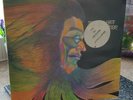
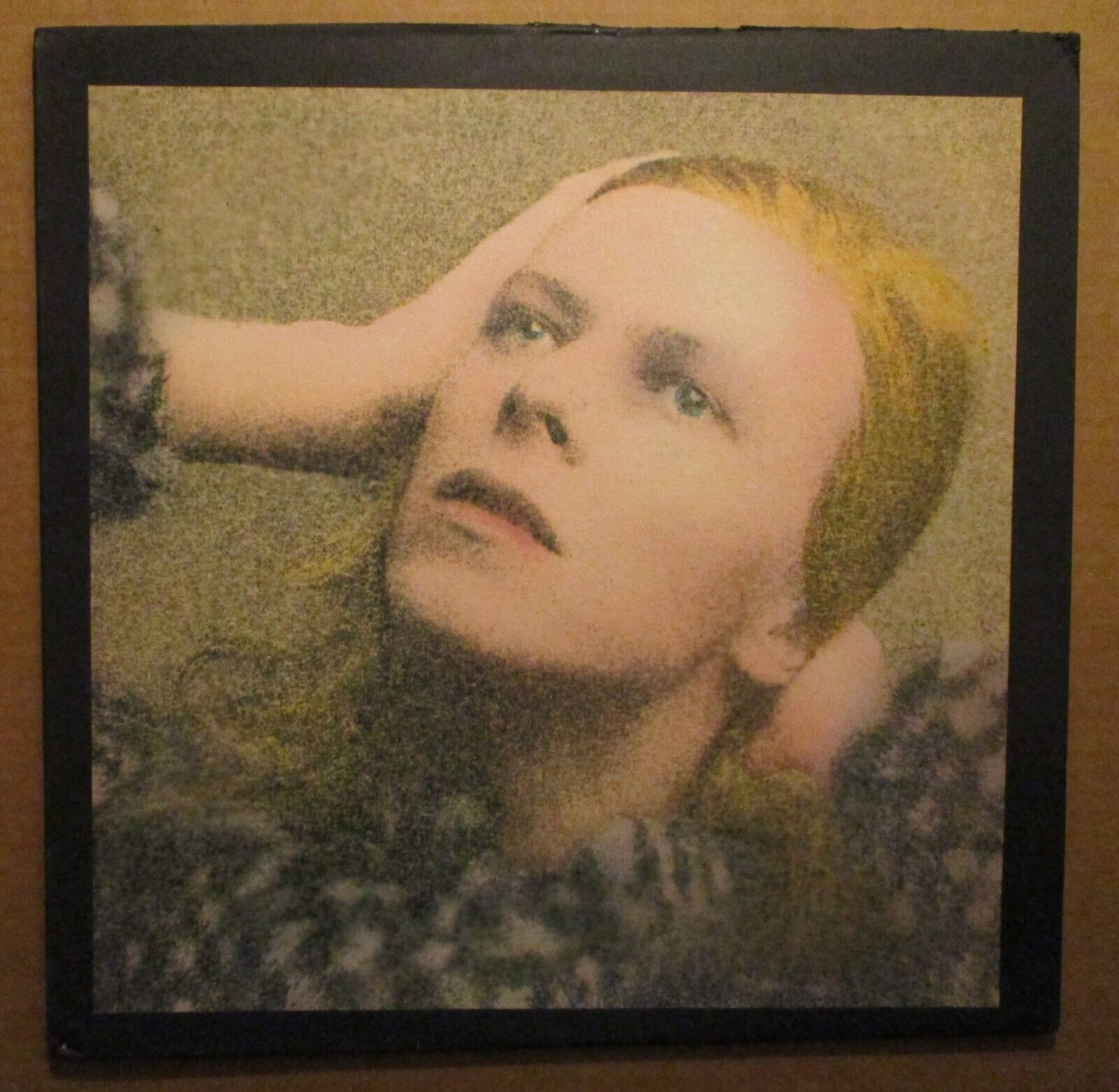
The front cover is a grainy, hand-tinted, matte-finish photo of David Bowie, inspired by vintage Hollywood screen actresses like Marlene Dietrich, Lauren Bacall, and Greta Garbo. Bowie was also inspired by Andy Warhol's colorized diptych silk-screen prints of Marilyn Monroe that he saw in New York.
The original Cover photo was taken by photographer Brian Ward at his studio on Heddon Street in London. Bowie showed up at the photoshoot with a portfolio containing multiple Marlene Dietrich prints as examples of the 'look' he was going for. Bowie wanted a pose that was inspired by the actresses of Hollywood's Golden Age.
The photo is a close-up of Bowie's face, looking past the camera, while he sweeps his long hair back from his face, in a classic Hollywood screen siren pose.
The final photograph was printed in Sepia tone on thick Matte paper. Bowie had it faithfully reproduced to 12" x 12" album cover size and then gave it to George Underwood, Bowie's childhood friend, to hand-tint.
Underwood thought that airbrush coloring would look better, so he passed it on to artist Terry Pastor who chose the colors and did the colorizing with transparent photo dyes to make it resemble a vintage 1920's theater lobby card from the days of silent movies.
Terry Pastor designed the entire album cover and sleeve for 'Hunky Dory' and would do the same for Bowie's next album, 'Ziggy Stardust'.
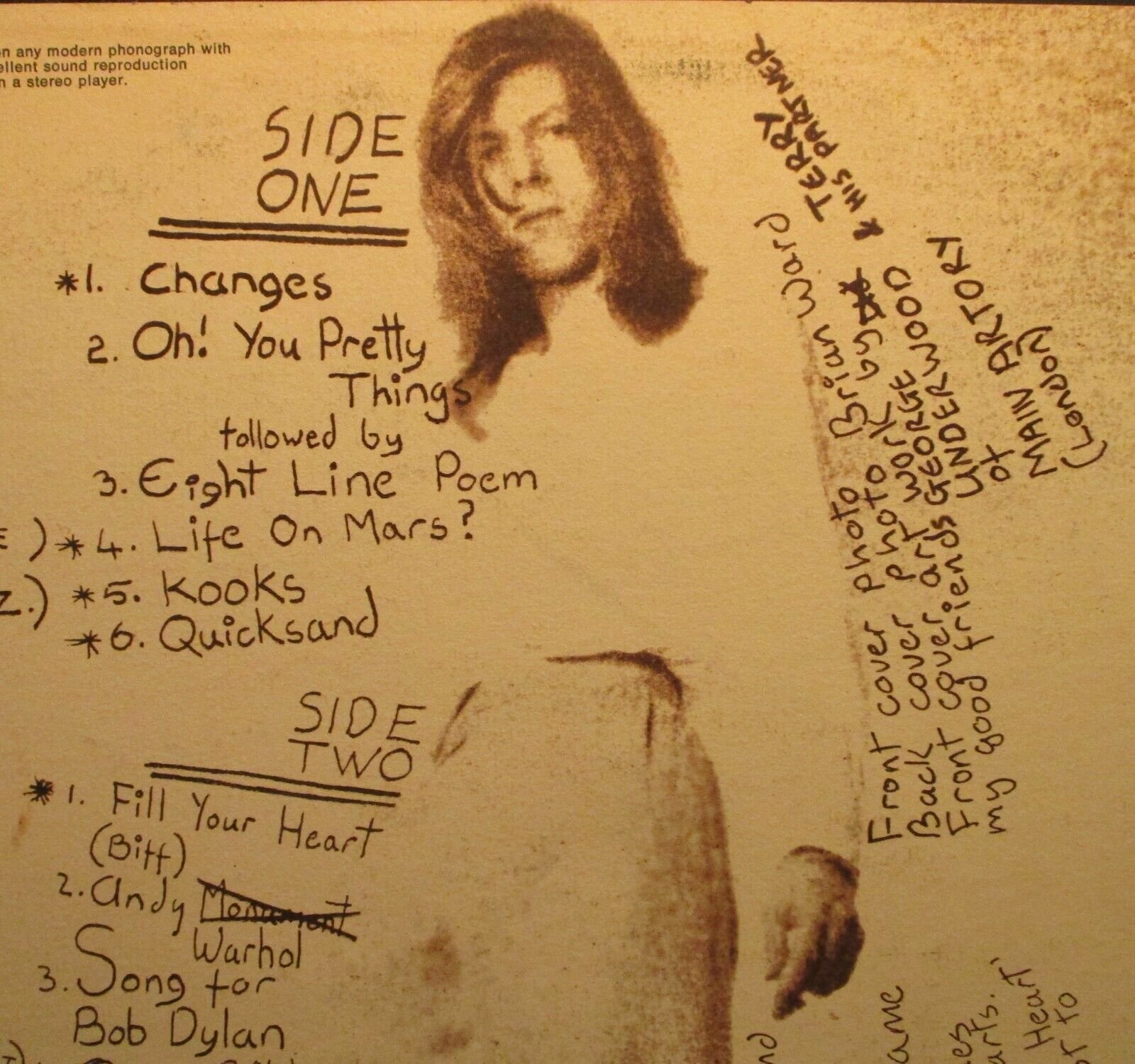
All of the artists involved with making the final artwork were loosely associated with a London art studio called 'Main Artery', which Bowie misspells on the back cover as "Artory".
Bowie later said that the album cover reflected his "preoccupation with the silver screen" and his passion for loose-fitting 'Oxford Bag' trousers, which Bowie is wearing on the back cover.
The final album cover is a beautiful replica of the original art print, on textured matte paper with fantastic colors and detail. Later non-matte pressings can't compare to the originals, like this one.
The back of the jacket is also printed on textured matte paper, in Sepia tone, like Ward's original photographs, and has Bowie's hand-written notes and comments about the songs and the band.
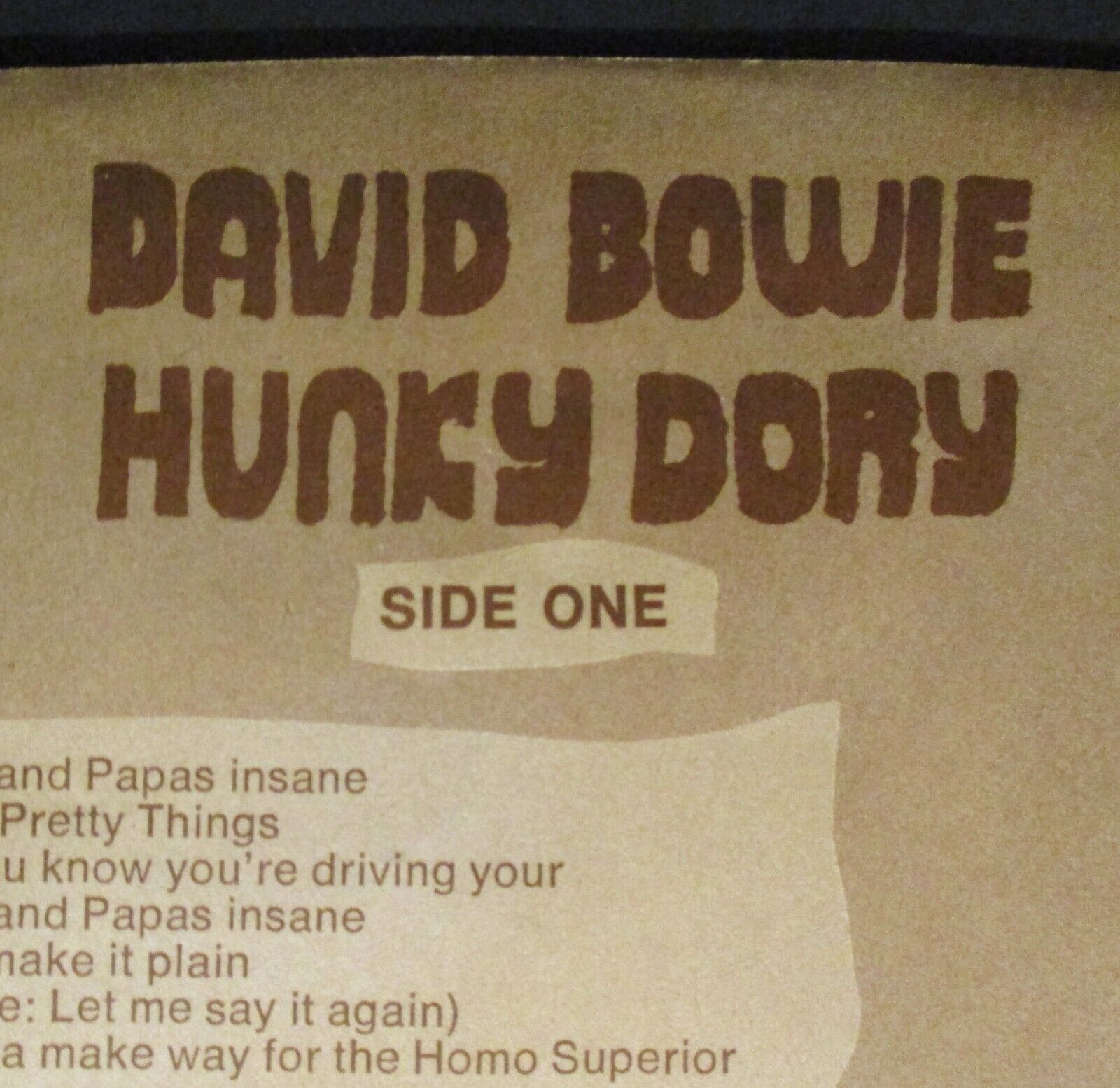
American first pressings had Bowie's name and the album title printed on a hype sticker attached to the shrink wrap, preserving the art underneath. Original UK pressings didn't come in shrink wrap and had Bowie's name and the album title printed directly onto the jacket. Unfortunately, there is no original hype sticker with this album.
The final album cover shows Bowie striking his best silent movie queen pose, reflecting his love of role playing, theatricality, and sexual ambiguity. Bowie loved it, RCA hated it. The record buying public weren't quite sure what to make of it.
~~~~~ Hunky Dory's album title came from a story that a record executive told Bowie about meeting an eccentric British Pub owner in Surrey, who would get hammered and shout out old English slang at his customers.
When asked how he was doing, the Pub owner's response was often "Hunky Dory" meaning that all was well in his world. Bowie loved the phrase, and used it as the title of the new album. Finally, after years of failure, everything seemed alright and well, 'Hunky Dory', in Bowie's world.
~~~~~~~~~~~~~~~~~~~~~~~~~~~~~~~~~~~~~~
'Hunky Dory' has some fantastic, brilliant songs. Some of Bowie’s best material can be found on this album. The presence of “Changes” and “Life on Mars?” make this an essential Bowie album for your collection.
The songwriting is unbelievably good, to the point where it almost sounds effortless.
The opening track “Changes” is just fantastic, a classic Bowie song, and one of his best compositions. It sets the theme and mood for the rest of the album.
The song makes it very clear that this album is taking him, and you, in a totally new direction.
Bowie distances himself from the rock mainstream. He warns, "look out you rock ‘n’ rollers” as well as telling his listeners to "turn and face the strange.”
'Changes' is Bowie's declaration that he's evolving, moving on, and doing something totally new. It introduces his search for the new and the bizarre.
The song sums up Bowie's quest to transition through multiple 'characters', continue to morph his androgynous stage persona, and continue with his stylistic experimentation.
Lyrics like “Strange fascination, fascinating me / Changes are taking the pace I'm going through” contributed to him being called the "chameleon of rock" and pointed to Bowie becoming one of rock's greatest artistic innovators.
"Strange Fascination" would have made a great title for this album and is the perfect term describing where Bowie's music would go over the next few albums.
'Changes' is a perfect 70s pop rock song. Bowie's unique voice and vocals are layered on top of a terrific musical backing with great melodies, a great sing along chorus, and teriffic playing by everyone involved. Quintessential Bowie.
It ticks all of the boxes, which is why it was selected as the album's first single, released in January 1972.
~~~~~~~~~~~~~~~~~~~ "Life On Mars?” is the real masterpiece on this album, and one of the best songs in Bowie's catalog.
'Mars' is about a girl who goes to the movies to escape the drabness and disappointment of her life, but it's also much more than that.
It's a soaring, cinematic, ballad with bright piano dancing across the chord changes, whistling Mellotron, and Ronson's crunchy guitar solos. The song has a rich orchestral arrangement, which was the first time Mick Ronson ever tried doing that sort of thing. The wild flute (recorder?) sounds add depth and spacey-ness.
Bowie recorded the song as a parody of Frank Sinatra's "My Way" and uses the same chord sequence for its opening bars. The handwritten notes on the back cover smugly mention that the song was “Inspired by Frankie.”
Bowie's soaring, emotional vocals are amazing and very heartfelt.
BBC 2 accurately described it as "a cross between a Broadway musical and a Salvador Dali painting.”
This song could easily have been included on the 'Ziggy Stardust' album, and by the time this song was released, Bowie was already transforming into Ziggy.
~~~~~~~~~~~~~ The first side of 'Hunky Dory' mostly features songs that describe Bowie's own, current, personna. The 2nd side contains songs that pay homage to Bowie’s recent influences.
In the middle of side two, there are a tryptic of songs about Bowie's biggest influences at the time; Andy Warhol, Bob Dylan, and Lou Reed.
The song "Andy Warhol" is a tribute to American artist, producer, and director Andy Warhol, who had inspired Bowie since the mid-1960s and was described by him as "one of the leaders" of "the media of the streets"
The song's opening has producer Ken Scott saying "This is 'Andy Warhol', and it's take one."
The song is based around a riff played on two layered acoustic guitars, a very cool sound. The lyrics emphasize Warhol's belief that life and art blur together, a belief that Bowie would soon embody and follow for the rest of his career.
His next 'tribute' song, 'Song for Bob Dylan', shows Bowie's reverence for singer-songwriter Bob Dylan, but also questions Dylan's constantly changing persona.
Bowie sings about Dylan as an interesting mythical character, very different from the true Robert Zimmerman underneath. Bowie refers to Dylan as 'Zimmerman' throughout the song.
The song reflects Bowie's own battle with who he was as a person, versus what he was becoming as an artist and performer. The song highlights Bowie's struggle with identity.
In the mid 60's, Dylan's 'character' grew quickly, beyond his own control, before Dylan famously slaughtered his own folk persona at the Newport Folk Festival by plugging in and going electric.
Bowie would do the same thing at the 1972 Santa Monica Ziggy show, committing 'Rock and Roll Suicide' and killing off his Ziggy character.
The song's melody has a real 'Dylan' feel to it, with Dylanesque chord changes. Bowie adds his own unique spin to it, with the lyrics of the chorus derived from the titles of two Velvet Underground songs, "Here She Comes Now" and "There She Goes Again".
It's another great example of Bowie's 'transition' from his old Folky persona into his new Glam approach on this album.
The final tribute song on the album, "Queen Bitch" was largely inspired by the Velvet Underground, and Lou Reed in particular.
Unlike most of the album's tracks, "Queen Bitch" is based on heavy guitar, rather than piano. It also has fantastic playing by Trevor Bolden on Bass. It's a fantastic song, with hints of both glam rock and proto-punk.
The song's glam rock sound foreshadows the direction Bowie would take on his next album, 'Ziggy Stardust'. Among all of the songs on Hunky Dory, this is the one that sounds most 'Ziggy' in style. If you listen closely, you can hear hints of “Sweet Jane.”
I'm still not sure what a 'bipperty-bopperty hat' is, but it sounds very cool and slightly raunchy, in a hip NYC sort of way.
Bowie's handwritten sleeve notes on the back cover read: "some V.U. White Light returned with thanks"
~~~~~~~~~~~~~~~~~~~~~~~~ "Oh! You Pretty Things" was the first track written for 'Hunky Dory.'
The song really demonstrates Bowie’s growth as a songwriter, compared to his earlier blander material. Bowie originally gave the song to Peter Noone, who had a hit with it, but reclaimed it as his own and put it on this album.
The song starts off as a soft, almost sinister sounding, piano-driven tune, but bursts out into a rousing, catchy, glam-rock chorus halfway through as the other instruments kick in.
The song has a cinematic feel and sounds like it could be part of a rock musical. Very theatrical.
The lyrics speak of discontent with humanity and technology in a bleak, modern Cold War environment. The sinister lyrics reference the teachings of occultist Aleister Crowley and his Golden Dawn, as well as the writings of philosopher Friedrich Nietzsche and his thoughts on superior humans.
Bowie's stark, unsettling, vocals get more intense, and more impassioned as the song progresses. His lyrics reference "the homo superior" and claim that "homo sapiens have outgrown their use."
Bowie's impending fatherhood was also an influence on this song. Bowie muses about Nietzsche's 'superman' race emerging in the form of his newborn son Zowie.
~~~~~ Bowie was undergoing major musical and career changes around this time, but he was also undergoing significant personal changes a well.
He was recently married to Angie in early 1970, and had just welcomed a son into his life.
"Kooks" is an adorable, fun, innocent tune written for his infant son, Duncan, who was better known as "Zowie".
The story is that Bowie was listening to Neil Young when he heard the news of his son's birth. A few days after Zowie was born in May, Bowie quickly finished "Kooks", written in Neil's folky acoustic style, and dedicated it to him.
“Kooks”, the shortest track on the album, is a fun innocent song. The “kooks” are Bowie and his wife Angie.
The song has a nice piano & acoustic guitar backing and there is a trumpet interlude, played by Trevor Bolden, almost like the traditional English announcement of a great event.
In the handwritten notes on the LP's back cover, Bowie writes that the song is "For Small Z".
The final song on 'Hunky Dory' is a ballad called “The Bewlay Brothers.” It was one of the last songs to be written and recorded for the album.
Bowie has since said that it was about his tense relationship with his schizophrenic half-brother Terry Burns. Bowie described it as a "vaguely anecdotal piece about my feelings about myself and my brother, or my other doppelgänger Terry"
The music starts softly, but grows in intensity as the song progresses. Multiple disconcerting voices and odd sinister sound effects suddenly break in near the end of the song.
The lyrics refer back to other tracks on Hunky Dory, and Bowie uses the word "chameleon" in the song, which became a common term used to describe Bowie's ever-changing styles.
Bowie later claimed that he wrote the song with the American record market in mind because “the Americans always like to read into things, even though the lyrics make absolutely no sense.” Many feel that the song has homoerotic undertones.
On the album's back cover, Bowie writes the title as "THE Bewlay Brothers." It's a strange, odd, conclusion to this masterpiece of an album.
~~~~~~~~~~~~~~~~~~~~~~~~~~~~~~~~~~~~~~~
David Bowie's fourth studio album, 'Hunky Dory', was a landmark album for Bowie. It was his transition between his folksy origins and his movement into what would become his signature sound for years to come. It was also Bowie's first album that showed his androgynous, glam rock leanings.
When he began recording the album in the summer of 1971, he was without a recording contract, no record label, and he had just signed away ownership of his past recordings. He was, as he put it, "washed up."
It's amazing to think about how bold, dedicated and persistent Bowie still was in 1971, despite his previous failures. It says a lot about him and his will and need to create.
Hunky Dory has been critically acclaimed as one of Bowie's best records, and is frequently on lists of the greatest albums of all time.
Melody Maker called it "the most inventive piece of song-writing to have appeared on record in a considerable time"
Rock magazine called him "the most singularly gifted artist making music today. He has the genius to be to the '70s what Lennon, McCartney, Jagger and Dylan were to the '60s."
Many feel that 'Hunky Dory' is one of his best and most significant albums, a pivotal work, and the most 'Bowie' album he has ever made.
Even Bowie himself says that the album is one of the most important of his career. The first side of Hunky Dory may be as good a side of musical excellence and fantastic songwriting that you’ll ever hear. This record belongs in any classic rock vinyl collection.
~~~~~~~~~~~~~~~~~~~~~~~~~~~~~~~~~~~~~~~~~~~~~~~ CONDITION: I tried to show good hi-resolution photos of the cover, inner sleeve, labels and vinyl in my pictures.
I purchased this copy back in the early 70's, over 50 years ago, in Greenwich Village, on one of my regular vinyl digs in those crazy teen years, and have taken great care of it since.
VINYL: The vinyl still looks great. Clean and bright. Maybe a tiny light hairline or two and some mild evidence of play, but No serious scuffs, palpable scratches, or dings. A terrific original pressing. I'll call it VG+ to keep everyone happy, but it's beautiful.
The Deadwax of this 1971 First Pressing is pretty plain, just the stamped matrix numbers and not much else. This was Bowie's first album for RCA and there wasn't much detail revealed in the Matrix.
I tried to show some close-up pictures of the vinyl to show how good it looks. I'm sure you'll be pleased with it.
I haven't messed with it or cleaned it, other than my trusty 'DiscWasher' brush, in 50 years, since Nixon was in office. It could use a good deep cleaning to make it even better looking and better sounding than it already is.
LABELS: This is pressed with the 'classic' early Orange RCA Dynaflex labels, not the much more common tan or black ones.
This record sold poorly at first and only became popular after Bowie's next record, the classic 'Ziggy Stardust' was released a short 6 months later. By the time Ziggy fans went back and purchased this album, RCA had moved on to the Tan labels, so there are very few original Orange Dynaflex ones like this out there, They were grabbed up early by his true fans, like me.
The labels are clean and bright. No marks or damage. The spindle holes are still sharp and clean, suggesting minimal playing and my careful handling over the years.
JACKET: As you can see from my pictures, this still looks very nice for a 50 year old OG copy.
Usually these soft matte jackets show significant surface scuffs, edge wear and ringwear, but this copy still looks great, at first glance.
The biggest 'FAULT' is a long seam split at the top (see pics), common with these 'soft' jackets, but when placed in a nice snug poly sleeve, you don't really even notice it.
There's some very minor shelf wear but the artwork is bold and bright, the colors are great, and the corners & spine are mostly sharp and straight.
The back of the jacket has the original sepia brownish tint, which is also notorious for wear and stains, but again, this one looks great.
I should point out that what looks like dirt, smudges, and mud on the back cover is all part of the printing, and intended. The jacket is beautiful, except for the seam split.
This First Pressing is a very nice survivor.
This early First pressing has Rick Wakeman credited on keyboards, but does not have the 'appears courtesy of..' text that was added soon afterwards. Also, this copy has Bowie's handwritten misspelling of 'Artory' not 'Artery', and no 'Re-6' on the back, like the later early pressings and repessings had.
This comes with it's original tan 2-sided inner sleeve containing all the lyrics and credits. For some reason, this is often missing. The lyrics are great, and I'm sure the sleeve was often taken out to follow along, and got misplaced. The inner sleeve is quite rare and nice to have.
Overall, I'll call the whole record VG+, but a decent, complete, and all original First pressing. A real gem. I'm sure you'll love it.
This record has been sleeved and stored properly for decades, and is still quite nice for an original pressing.
~~~~~~~~~~~~ ** NOTE: I'm selling this rare 'Collector' record "AS IS" and "NO RETURN". It's rare and as described and I'm sure you'll be very happy with it.
~~~~~~~~~~~~~~~ I’m recently retired and downsizing and letting go some gems and rarities from nearly 45 years of vinyl record collecting. Check out the many other fantastic 45s and 33s coming soon to my page!
All records have been carefully evaluated and graded by me. I visually inspect all records under bright light, personally gently clean them with a soft cloth and then, if unsure, play them on a modern high-end turntable to get a true picture of condition. Please look at all the high-resolution pictures I added. They are all my own and are of the actual record being sold. The pictures are part of the description and can show small details, label variations, and condition better than I can put into words.
My grading is fair and honest. I have had over 3,400 happy and satisfied EBay customers over the years, with 100% positive feedback, and I have been buying/selling on EBay for well over 25 years, so please bid with confidence!
I'm a 0ne-man operation, this is a hobby, not my job. I do this for fun. I do this because I love music, love collecting vinyl and want others to share in that same experience. I take my time listening, researching, grading, listing and packaging. I will NOT sell any record that I personally would not want in my collection.
As you well know, packing and shipping rare records requires special care and attention, therefore, shipping cost within the lower 48 states is $5.00 on this item. If you would like insurance, or anything faster than Media/Economy Mail, please let me know and I can arrange it for you. I’ll work with you to make sure you’re happy!
I will gladly combine multiple records, or other items on my page, and make the shipping much less for you. I don’t inflate the shipping costs; they are what they are. I strive to keep them as low as possible. See my feedback for comments on my quality packing and shipping.
All items are packaged with sturdy cardboard mailers and appropriate padding. I take pride in my packaging and shipping and package all my records as if I were sending them to myself. I refuse to use cheap flimsy packaging material when sending my vinyl. I treat them as if they were my own and mail them the same way.
All orders are processed and shipped within 2 business days of receipt. We package and ship our vinyl records with the greatest care, using proper packaging to ensure that your rare and collectible vinyl records arrive in pristine condition.
Payments can be made by any of the multiple options that Ebay offers.
I will be happy to exchange feedback with anyone I complete a transaction with.
THANK YOU for looking and reading my long description if you got this far. -- JOHN
price rating