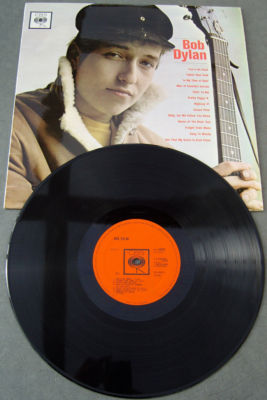
BOB DYLAN (Self-Titled) – ORIGINAL UK 1st PRESS DEBUT MONO CBS LP – 1A/1B – 1962
£
25
$
32


Favourite Auctions
To save auctions to your favourites, please login
If you don't have an account, please register
Description
BOB DYLAN (Self-Titled) – ORIGINAL UK 1st PRESS DEBUT MONO CBS LP – 1A/1B – 1962
Bob Dylan’s Debut Album – Self Titled
Original
MONO
Released on the CBS Record Label
MADE IN ENGLAND
(P) 1962
BPG 62022
(CL 1779)
Matrix:
62022 1A 1
62022 1B 1
“CBS is proud to introduce a major new figure in American folk music – Bob Dylan.
Excitement has been running high since the young man with a guitar ambled into a recording studio for two sessions in November, 1961. For at only 20, Dylan is the most unusual new talent in American folk music.
His talent takes many forms. He is one of the most compelling white blues singers ever recorded. He is a songwriter of exceptional facility and cleverness. He is an uncommonly skilful guitar player and harmonica player.
In less than one year in New York, Bob Dylan has thrown the folk crowd into an uproar. Ardent fans have been shouting his praises. Devotees have found in him the image of a singing rebel, a musical Chaplin tramp, a young Woody Guthrie, or a composite of some of the best country blues singers.
A good deal of Dylan’s steel-string guitar work runs strongly in the blues vein, although he will vary it with country configurations, Merle Travis picking and other methods. Sometimes he frets his instrument with the back of a kitchen knife or even a metal lipstick holder, giving it the clangy virility of the primitive country blues men. His pungent, driving, witty harmonica is sometimes used in the manner of Walter Jacobs, who plays with the Muddy Waters’ band in Chicago, or the evocative manner of Sonny Terry.
Another strong influence on Bob Dylan was not a musician primarily, although he has written music, but a comedian – Charlie Chaplin. After seeing many Chaplin films, Dylan found himself beginning to pick up some of the gestures of the classic tramp of silent films. Now as he appears on the stage in a humourous number, you can see Dylan nervously tapping his hat, adjusting it, using it as a prop, almost leaning on it, as the Chaplin tramp did before him.
Yet despite his comic flair, Bob Dylan has, for one so young, a curious preoccupation with songs about death. Although he is rarely inarticulate, Dylan can’t explain the attraction of these songs, beyond the power and emotional wallop they give him, and which he passes on to his listeners. It may be that three years ago, when a serious illness struck him, that he got an indelible insight into what those death-haunted blues men were singing about.
His Life and Times
Bob Dylan was born in Duluth, Minnesota, on May 24, 1941. After living briefly in Sioux Falls, South Dakota, and Gallup, New Mexico, he graduated from high school in Hibbing, Minnesota “way up by the Canadian border”.
For six troubled months, Bob attended the University of Minnesota on a scholarship. But like so many of the restless, questing students of his generation, the formal confines of college couldn’t hold him.
“I didn’t agree with school”, he says, “I flunked out. I read a lot, but not the required readings..”
He remembers staying up all night plowing through the philosophy of Kant instead of reading Living With the Birds for a science course.
“Mostly,” he summarizes his college days, “I couldn’t stay in one place long enough.”
Bob Dylan first went East in February, 1961. His destination: the Greystone Hospital in New Jersey. His purpose: to visit the long-ailing Woody Guthrie, singer, ballad-maker and poet. It was the beginning of a deep friendship between the two. Although they were separated by thirty years and two generations, they were untied by a love of music, a kindred sense of humour and a common view toward the world.
The young man from the provinces began to make friends quickly in New York, all the while continuing, as he has since he was ten, to assimilate musical ideas from everyone he met, every record he heard. He fell in with Dave Van Ronk and Jack Elliott, two of the most dedicated musicians then playing in Greenwich Village, and swapped songs, ideas and stylistic conceptions with them. He played at the Gaslight Coffee-house, and in April, 1961, appeared opposite John Lee Hooker, the blues singer, at Gerde’s Folk City. Word of Dylan’s talent began to grow, but in the surcharged atmosphere of rivalry that has crept into the folk-music world, so did envy. His Talkin’ New York is a musical comment on his reception in New York.
Recalling his first professional music job, Bob says:
“I never thought I would shoot lightning through the sky in the entertainment world.”
In 1959, in Central City, Colorado, he had that first job, in a rough and tumble striptease joint.
“I was onstage for just a few minutes with my folky songs. Then the strippers would come on. The crowd would yell for more stripping, but they went off, and I’d come bouncing back with my folky songs. As the night got longer, the air got heavier, the audience got drunker and nastier, and I got sicker and finally I got fired.”
Bob Dylan started to sing and play guitar when he was ten. Five to six years later he wrote his first song, dedicated to Brigitte Bardot. All the time, he listened to everything with both ears – Hank Williams, the late Jimmie Rodgers, Jelly Roll Morton, Woody Guthrie, Carl Perkins, early Elvis Presley. A meeting with Mance Lispscomb, Texas songster, left its mark on his work, as did the blues recordings of Rabbit Brown and Big Joe Williams. He speaks worshipfully of the sense of pace and timing the great blues men had, and it has become a trademark of his work already. His speed at assimilating new styles and digesting them is not the least startling thing about Bob Dylan.
The future:
“I just want to keep on singing and writing songs like I am doing now. I just want to get along. I don’t think about making a million dollars. If I had a lot of money what would I do?” he asked himself, closed his eyes, shifted the hat on his head and smiled:
“I would buy a couple of motorcycles, a few air-conditioners and four or five couches.”
His Songs
The number that opens this album, You’re No Good, was learned from Jesse Fuller, the West Coast singer. Its vaudeville flair and exaggeration are used to heighten the mock anger of the lyrics.
Talkin’ New York is a diary note set to music. In May, 1961, Dylan started to hitch-hike West, not overwhelmingly pleased at what he had seen and experienced in New York. At a truck stop along the highway he started to scribble down a few impressions of the city he left behind. They were comic, but tinged with a certain sarcastic bite, very much in the Guthrie vein.
Dylan had never sung In My Time of Dyin’ prior to this recording session. He does not recall where he first heard it. The guitar is fretted with the lipstick holder he borrowed from his girl, Susie Rotolo, who sat devotedly and wide-eyed through the recording session.
Man of Constant Sorrow is a traditional Southern mountain folk song of considerable popularity and age, but probably never sung quite in this fashion before.
Fixin’ to Die, which echoes the spirit and some of the words of In My Time of Dyin’, was learned from an old recording of Bukka White.
A traditional Scottish song is the bare bones on which Dylan hangs Pretty Peggy-O. But the song has lost its burr and acquired instead a Texas accent, and a few new verses and fillips by the singer.
A Diesel-tempoed Highway 51 is of a type sung by the Everly Brothers, partially rewritten by Dylan. His guitar is tunes to an open tuning and features a particularly compelling vamping figure. Similarly uptempo is his version of Gospel Plow, which turns the old spiritual into a virtually new song.
Ric Von Schmidt, a young artist and blues singer from Boston, was the source of Baby, Let Me Follow You Down. House of the Risin’ Sun is a traditional lament of a New Orleans woman driven into prostitution by poverty. Dylan learned the song from the singing of Dave Van Ronk: “I’d always known Risin’ Sun but never really knew I knew it until I heard Dave sing it.” The singer’s version of Freight Train Blues was adapted from an old disk by Roy Acuff.
Song to Woody, is another original by Bob Dylan, dedicated to one of his greatest inspirations, and written much in the musical language of his idol.
That My Grave Is Kept Clean, The poignance and passion of this simple song reveals both the country blues tradition – and its newest voice, Bob Dylan – at their very finest.”
- STACEY WILLIAMS
From the New York Times, Friday, September, 29 1961
BOB DYLAN: A DISTINCTIVE FOLK-SONG STYLIST
By ROBERT SHELTON
“A bright new face in folk music is appearing at Gerde’s Folk City. Although only 20 years old, Bob Dylan is one of the most distinctive stylists to play in a Manhattan cabaret in months.
Resembling a cross between a choir boy and a beatnik, Mr. Dylan has a cherubic look and a mop of tousled hair he partly covers with a Huck Finn black corduroy cap. His clothes may need a bit of tailoring, but when he works his guitar, harmonica or piano and composes new songs faster than he can remember them, there is no doubt that he is bursting at the seams with talent.
Mr. Dylan’s voice is anything but pretty. He is consciously trying to recapture the rude beauty of a Southern field hand musing in melody on his porch. All the “husk and bark” are left on his notes and a searing intensity pervades his songs.
Mr. Dylan is both comedian and tragedian. Like a vaudeville actor on the rural circuit, he offers a variety of droll musical monologues: Talking Bear Mountain lampoons the over-crowding of an excursion boat, Talkin’ New York satirizes his troubles in gaining recognition and Talking Havah Nagilah burlesques the folk-music craze and the singer himself.
In his serious vein, Mr. Dylan seems to be performing in a slow-motion film. Elasticized phrases are drawn out until you think they may snap. He rocks his head and body, closes his eyes in reverie and seems to be groping for a word or a mood, then resolves the tension benevolently by finding the word and the mood.
M. Dylan’s highly personalized approach toward folk song is still evolving. He has been sopping up influences like a sponge. At times, the drama he aims at is off-target melodrama and his stylization threatens to topple over as a mannered excess.
But if not for every taste, his music-making has the mask of originality and inspiration, all the more noteworthy for his youth. Mr. Dylan is vague about his antecedents and birthplace, but it matters less where he has been than where he is going, and would seem to be straight up.”
The Track List is as follows:
SIDE 1
1. SHE’S NO GOOD (J. Fuller)
2. TALKIN’ NEW YORK (B. Dylan)
3. IN MY TIME OF DYIN’
4. MAN OF CONSTANT SORROW
(Arr. Bob Dylan)
5. FIXIN’ TO DIE BLUES (B. White)
6. PRETTY PEGGY-O (arr. Bob Dylan)
7. HIGHWAY 51 BLUES (C. Jones)
SIDE 2
1. GOSPEL PLOW (arr. Bob Dylan)
2. BABY, LET ME FOLLOW YOU DOWN
(R. Von Schmidt)
3. HOUSE OF THE RISIN’ SUN (trad.)
4. FREIGHT TRAIN BLUES (trad.)
5. SONG TO WOODY (Bob Dylan)
6. SEE THAT MY GRAVE IS KEPT CLEAN
(L. Jefferson)
The LP is in Very Good Conditon with just a few surface marks and surface scatches
It plays Well
The Sleeve is in Very Good Condition having been kept in a plastic cover
On the back “32/2” is pencilled in the top left hand corner and there is a small label “The Disc Shop” stuck at the top
EVERY RECORD IS PLAYED AND FULLY CHECKED BEFORE LISTING
I am NOT a Business Seller – All my records come from my personal collection and I do my utmost to grade them to the best of my ability. What I hear and What I see is reflected in my grading of the condition of both the vinyl and the covers.
I Discount P&P when anyone buys more than one item from me
I have quoted 2 levels of postage - one is International Signed For which is insured, and the other is standard airmail which is not insured.
I highly recommend you take the first option should your bid be successful.
The prices quoted are not just for the postage, but include my packaging costs.
All Records are sent in Defenda Music Max Boxes which have been especially designed to protect Vinyl Records when posting.
I also use extra bubble wrap packing,
All parcels have printed labels - Fragile and Do Not Bend - and are sellotaped
Securely.
price rating