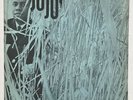
BEATLES YESTERDAY& TODAY STEREO BUTCHER COVER IN SHRINK
$
92


Favourite Auctions
To save auctions to your favourites, please login
If you don't have an account, please register
Description
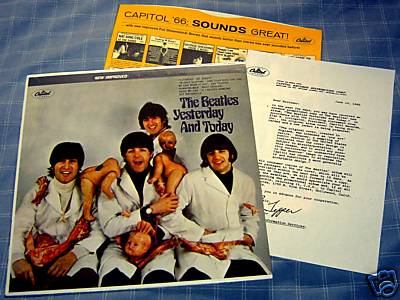
BEATLES 1993 JAPANESE ISSUED YESTERDAY AND TODAY STEREO BUTCHER COVER WITH INNER SLEEVE. THESE JAPANESE PRODUCED COVERS FROM 1993 ARE REGARDED AS THE BEST REPRODUCTION BUTCHER COVERS EVER MADE. ONLY 300 OF THESE COVERS WERE PRODUCED IN 1993. THE JAPANESE PRODUCED A SECOND BATCH OF 1500 IN 1996. BUT THE SECOND BATCH DID NOT COME NEAR THE QUALITY OF THE 1993 VERSIONS. THESE 1993 ISSUES HAVE FOOLED MANY BEATLES FANS. ONLY BEATLE EXPERTS CAN TELL THAT THESE COVERS ARE REPRODUCTIONS. ALL COLORS ARE EXACT TO THE ORIGINAL BUTCHER COVER. THIS COVER HAS THE CORRECT LETTERING AND EVEN THE MATTED FINISH JUST LIKE THE ORIGINAL COVER. ALSO HAS THE NUMBER 6 ON THE BACK OF COVER NEXT TO THE RIAA SYMBOL INDICATING A LOS ANGELES PRESSING. THIS COVER STILL RETAINS THE SHRINKWRAP. THIS COVER WOULD LOOK GREAT FRAMED. ALSO INCLUDED IS A COPY OF THE CAPITOL RECORDS BUTCHER COVER RECALL LETTER DATED JUNE 14, 1966. COVER. ORANGE INNER SLEEVE AND RECALL LETTER ARE IN MINT CONDITION. PLEASE SEE STORY OF THE BUTCHER COVER BELOW. SORRY BUT THE ORIGINAL VINYL HAS BEEN LOST. BUT THE VALUE IS IN THE COVER ANYWAY. ALSO IF YOU NEED THE VINYL. YOU CAN FIND THEM ALL THE TIME ON EBAY.
Who Butchered The Beatles?
Allow page to load before using these links Notes Livingston Interview Sources Back to Main When Capitol Records created a new Beatles album by assembling various leftover tracks and releasing them as a record entitled "Yesterday And Today" on June 15, 1966, the phenomenon was nothing new. In the 18-month period between January 1964 and June 1966, Capitol Records (and the United Artists record label) managed to release nearly twice as many Beatles albums in America as had been issued by Britain's EMI Parlophone, the Beatles' home label. Capitol (and UA) had accomplished this feat through a variety of means: issuing fewer songs per album (typically 11, as opposed to 14 on UK LPs), adding tracks released as singles (typically not included on UK albums), and padding film soundtracks with instrumental versions of songs (see footnotes for details). The "Yesterday And Today" album was typical of this practice, comprising songs excised from the American versions of three other Beatles LPs, plus both sides of an earlier 45. What was *not* typical of this album, however, was its cover. Instead of the usual photos of four happy, smiling moptops, this album's cover offered something quite different indeed: the Beatles, dressed in butchers' smocks, adorned with slabs of raw red meat, glass eyeballs, false teeth, and nude, decapitated dolls, posing with sickly, sadistic leers on their faces. When disk jockeys and others who had received advance copies of the album began to complain about its gruesome sleeve, Capitol quickly withdrew the record. All promotional material for the album was destroyed, and it was reissued five days later with a substitute cover photograph of the Beatles leaning on a steamer trunk. As most every casual Beatle fan knows, many of the 750,000 or so original "butcher cover sleeves went back into record stores with a new cover pasted over the old one, and thousands of unwitting record buyers ended up purchasing albums whose covers could be peeled or steamed off to create what would become one of most sought-after pieces of Beatles memorabilia. What possessed the Beatles to create such a hideous, repulsive album cover? Over the years, the myth developed that the Beatles, tired of the way Capitol Records had been cutting up and rearranging their albums for the American market, deliberately planned the grotesque "butcher cover" as a means of protesting Capitol's "butchery" of their records. The truth is, however, that the ghastly photograph featured on the "Yesterday and Today" sleeve was not intended as a protest against Capitol Records by the Beatles In fact, not only was the "butcher photo" never intended to be used as an album cover, it wasn't even the Beatles' idea. A single photograph from an earlier photo session, taken for entirely different reasons, was used, unfinished and out of context, for the sleeve of Capitol's new release. To understand why this tale of a Beatles protest against Capitol Records was believable, one must look at the way their music had been treated by American record companies up until then. Despite the fact that Capitol Records and the Beatle's Parlophone label were both owned by the same company (EMI), the executives at Capitol were decidedly uninterested in Beatles music from the start. As soon as the Beatles' single "Please Please Me" hit #1 in Britain, George Martin sent a copy of the record to Jay Livingstone, Capitol's senior executive in New York, Jay Livingstone. Livingstone refused the single, maintaining that Capitol didn't think the Beatles would "do anything" in the American market. As Livingstone and Capitol also declined to issue the Beatles' next single, the #1 hit "From Me To You", George Martin had no choice but to search for some other American label which would release the discs, even though that meant shopping the records around to EMI's competitors. Both singles, along with the Beatles' first LP ("Please Please Me", retitled "Introducing The Beatles" in America) were finally issued by Vee Jay, a small label based in Chicago. None of the records sold very well: "From Me To You" fared the best, briefly managing to rise to #116 on the Billboard charts. Even When the Beatles scored their third consecutive #1 single in Britain, neither Capitol (nor Vee Jay, by now) thought the Beatles had any prospects in America, so "She Loves You" was given to an even smaller New York label, Swan Records. Not until November of 1963, when Beatles manager Brian Epstein brought a demo of "I Want To Hold Your Hand" to Brown Meggs, Capitol's Director of Eastern Operations, did Capitol Records agree to release a Beatles record in America. In the crushing success that followed the American release of "I Want To Hold Your Hand" and the Beatles' appearances on "The Ed Sullivan Show", Capitol Records made up for lost time by issuing every piece of Beatles music they could get their hands on. Despite their lack of prescience in rejecting the Beatles' music in the first place, Capitol still insisted on packaging Beatles records the way they thought would best appeal (and sell records) to the American pop music market. Thus began Capitol Records' mutilation of Beatles albums. The first Beatles album released in America by Capitol Records was actually the Beatles' second British LP, "With The Beatles". Renamed "Meet The Beatles!", it was stripped of five cover versions of songs first popularized by US Motown artists, out of Capitol's fear that the songs would sound old hat to American audiences. To make up for the deletions, Capitol included "I Want To Hold Your Hand" on the album, along with its British and American B-sides. Three months later, the five cover versions deleted from "With The Beatles" were combined with "She Loves You" (now that the Swan 45 was topping the charts), three B-sides, and two newly-recorded tracks to create another record for the American market, misnamed "The Beatles' Second Album". Thus did Capitol manage to transform one UK Beatles LP into two American Beatles albums, a practice they would continue for the next few years. The Beatles' third LP was "A Hard Day's Night". In the UK, this album included all the songs used in the film of the same name, along with a second side of songs which did not appear in the film. In America, the "A Hard Day's Night" soundtrack album was issued by United Artists, and it contained only the eight songs actually used in the film, filled out with four instrumental versions performed by George Martin & Orchestra (and a single non-film song). A month later, Capitol Records put together some of the film songs with some of the non-film songs, two newly-recorded tracks, and the German language version of "I Want To Hold Your Hand" to produce yet another American LP, "Something New". Even though two American albums had again been produced from one British LP, Capitol wasn't finished milking the American market. Not even the temporary lack of new Beatles material could slow Capitol down: In November of 1964 they released "The Beatles Story'", a double album compiled from various interviews and song snippets. The running time of the two-LP set totalled less than 50 minutes, which meant the entire album could easily have fit on a single record. Four months later, Capitol put yet another album on the market by repackaging the Beatles' first album -- one which they had originally turned down -- as "The Early Beatles". (It still had three fewer songs than the original LP.) It was business as usual for Capitol when the Beatles produced their fourth LP in late 1964, "Beatles For Sale" (given the circumstances, an album title Capitol should have retained). Instead, Capitol's offering for the 1964 Christmas season was the misnamed "Beatles '65" album, which was really eight of the fourteen "Beatles For Sale" tracks, with both sides of the Beatles' latest single thrown in for good measure. Six months later, Capitol combined the remaining six "Beatles For Sale" tracks with three non-film songs from the "Help!" LP, another B-side, and an unused track to create yet another misnamed album, "Beatles VI". At this point, the Beatles themselves could no longer keep track of which songs had appeared on what albums in America. (A tape of the Beatles' August 1965 performance in Houston reveals John Lennon trying to introduce the song "Dizzy Miss Lizzy" by naming the album on which it appears: "I think the album's called Beatles . . . uh, '5' or '65' or '98' or something.") When the Beatles' second film, "Help!", was released in the summer of 1965, the accompanying British LP once again included one side of songs used in the film, and another side of non-film songs. And once again, the United Artists soundtrack album issued in America included only the seven songs used in the film, plus six more instrumental tracks, again recorded by George Martin & Orchestra. Not until December of 1965 did EMI and Capitol finally release the same Beatles album -- "Rubber Soul" -- on both sides of the Atlantic. The Capitol Records version of "Rubber Soul" was not the same as the UK version, however, as four tracks were deleted from British LP (in order to withhold the more commercial songs as potential singles), and replaced with two leftover songs from the "Help!" LP. Since the full force of Beatlemania had hit America in early 1964, Capitol Records, thanks to their continual rearrangement of Beatles LPs, had never gone as long as four months without releasing some sort of new Beatles album. In early 1966, therefore, Capitol had a problem on their hands: Their last release had been the previous December's "Rubber Soul" album, but since the Beatles were now putting more time and deliberation into their studio work, another LP wouldn't be ready until at least late summer. Capitol Records therefore faced the prospect of going a whole eight months with no new Beatles product to release, more than twice their longest previous dry spell. Capitol did have six tracks withheld from the last two Beatles albums, along with both sides of the Beatles' previous single, in the can, but eight songs weren't sufficient to comprise a whole album, even by Capitol's meager standards. It was then that Capitol took the action that was supposed to have finally enraged the Beatles to the point of protest: They gutted the Beatles' as yet unfinished "Revolver" album by rushing three of the completed tracks to America to fill out the album they released as "Yesterday and Today" on June 15, 1966. This new release was supposedly seen by the Beatles as the ultimate in Capitol's "butchery" of their albums, consisting of tracks amputated from *three* different Beatles LPs (one of which wasn't even finished), plus both sides of their previous single. As producer George Martin later elaborated, "Rubber Soul" had been "the first album to present a new, growing Beatles to the world. For the first time we began to think of albums as art on their own, as complete entities." Not only had Capitol deleted four key tracks from the US version of "Rubber Soul", they had now siphoned off three vital songs from a work still in progress. In the years that followed, the rumor was born that the original "Yesterday and Today" butcher cover was a protest against the album itself, made by a group weary of seeing LPs conceptualized as integrated works of art cut up at the whim of an American record company. The truth was quite different, however. Circumstantial evidence alone tends to indicate that the Beatles did not plan the butcher cover as a protest over the "Yesterday and Today" album. The photo session that produced the cover shot took place on March 25, 1966. As Capitol did not yet have a sufficient number of tracks on hand for a new album at that time (and the three songs eventually used to fill out the album were not recorded until a month later), it is doubtful that they had any definite release plans at that point. Even if they did, it is extremely unlikely that the Beatles -- notoriously ignorant of business affairs, especially where EMI's American subsidiary was concerned -- were aware of them. Moreover, the butcher photos appeared in several places *before* the "Yesterday and Today" album was released: in print ads for the "Paperback Writer" single, in the promotional videos made for "Paperback Writer" and "Rain" (later shown on "The Ed Sullivan Show"), and on the cover of _Disc_ magazine. If the Beatles had truly intended the photo as a protest, there would be little point to their diluting its impact by using it elsewhere, much less employing it to promote one of their own UK single releases! And, if the Beatles were genuinely upset with the way Capitol Records was handling their music, why didn't they simply speak up about it (as they already had about the Vietnam War, religion, and other controversial topics)? Even when the original "Yesterday and Today" album was recalled and re-released with a new cover, the Beatles said scarcely a word about it. There were no indignant howls of protest from the Beatles, no railing against Capitol Records and their policies. John said only that the cover was "as relevant as Vietnam", and Paul merely added that it was "very tasty meat". Much more than circumstantial evidence exists in this case, however. The notion that the butcher cover was an original idea conceived by the Beatles -- John Lennon in particular -- has generally been taken for granted. Although the Beatles were certainly keen on the idea, and willing participants in the session that produced the bizarre photographs, the man who actually came up with concept behind the pictures was photographer Robert Whitaker. Whitaker, who ran a photographic studio in Melbourne, Australia, accompanied a journalist friend to an interview with Beatles manager Brian Epstein during the the group's trip to Australia in June of 1964. Whitaker shot photos of Epstein during the interview; when Brian saw the resulting prints, he was so impressed with the young photographer's work that he asked Whitaker to come work for him. Whitaker accepted the job three months later, and he spent the next few years traveling with the Beatles and shooting them on their tours, in the recording studio, during private moments, and in arranged photo sessions. (Robert Whitaker was responsible for the steamer trunk photo that replaced the butcher cover on the "Yesterday and Today" album, as well as the back cover of the "Revolver" album.) In a 1991 interview with _Goldmine_ magazine, Whitaker quickly put to rest any notion that the butcher cover was dreamed up by the Beatles as a way of protesting Capitol Record's handling of their albums: Question Answer Q: How did that photo, featuring the Beatles among slabs of meat and decapitated dolls, come about? Was it your idea or the Beatles'? It was mine. Absolutely Q: Why meat and dolls? There's been a lot of conjecture over the years about what that photo meant. The most popular theory is that it was a protest by the Beatles against Capitol Records for supposedly "butchering" their records in the States. Rubbish, absolute nonsense Q:Were you aware when you shot it that Capitol Records was going to use it as an album cover? No- The first photograph is of the Beatles, facing a woman with her back to the camera, hanging on to a string of sausages. This picture was supposed to represent the 'birth' of the Beatles, with the sausages serving as an umbilical cord. Whitaker explained: "My own thought was how the hell do you show that they've been born out of a woman the same as anybody else? An umbilical cord was one way of doing it."
- The photograph that would have been used for the other side of the triptych is one of George Harrison standing behind a seated John Lennon, hammer in hand, pounding nails into John's head. Whitaker explained that this picture was intended to demonstrate that the Beatles were not an illusion, not something to be worshipped, but people as real and substantial as "a piece of wood".
- The center of the triptych (and the only pose taken in color) was to to have been the infamous butcher photo, showing the Beatles surrounded by slabs of red meat and dismembered dolls. This picture was actually titled "A Somnambulant Adventure", and its intent was to present a contrast, something shocking and completely out of line with the Beatles' public image. As Whitaker revealed, the picture used on the "Yesterday and Today" cover was a rough, unfinished version: "If you could imagine, the background of that picture should've all been gold. Around the heads would have gone silver halos, jeweled." The finished picture would have offered a striking contrast between the Beatles' "angelic" image and the reality of the photograph.
- A fourth picture, apparently not planned as part of the triptych (Whitaker isn't clear about this, mentioning only three pictures in his interview), is also included in "The Unseen Beatles". It features John framing Ringo's head with a cardboard box, on one of the flaps of which is written "2,000,000". Whitaker again: "I wanted to illustrate that, in a way, there was nothing more amazing about Ringo than anyone else on this earth. In this life he was just one of two million members of the human race. The idolization of fans reminded me of the story of the worship of the golden calf."
price rating