Al Jolson "Coal Black Mammy" & Shannon Four "Lindy" 78 RPM Columbia (A2973) 1923
$
25


Favourite Auctions
To save auctions to your favourites, please login
If you don't have an account, please register
Description
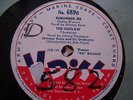
This is Al Jolson's recording of "Coal Black Mammy" on 78 RPM disk on Columbia Records (A3854). Recorded January 4, 1923, it is backed on the 'B' side with Shannon Four's recording of "Lindy Lady" recorded two months later on March 5, 1923. This disk is in excellent condition - shiny.
Al Jolson (born Asa Yoelson; May 26, c. 1886 – October 23, 1950) was an American singer, film actor, and comedian. At the peak of his career, he was dubbed "The World's Greatest Entertainer". His performing style was brash and extroverted, and he popularized a large number of songs that benefited from his "shamelessly sentimental, melodramatic approach". Numerous well-known singers were influenced by his music, including Bing Crosby David Bowie, Bob Dylan, Rod Stewart and others; Dylan once referred to him as "somebody whose life I can feel".
In the 1930s he was America's most famous and highest-paid entertainer. Between 1911 and 1928, Jolson had nine sell-out Winter Garden shows in a row, more than 80 hit records, and 16 national and international tours. Although he is best remembered today as the star of the first 'talking picture', The Jazz Singer (1927), he later starred in a series of successful musical films throughout the 1930s. After the attack on Pearl Harbor, he was the first star to entertain troops overseas during World War II.
According to the St. James Encyclopedia of Popular Culture, "Jolson was to jazz, blues, and ragtime what Elvis Presley was to rock 'n' roll." Being the first popular singer to make a spectacular "event" out of singing a song, he became a "rock star" before the dawn of rock music. His specialty was performing on stage runways extending out into the audience. He would run up and down the runway and across the stage, "teasing, cajoling, and thrilling the audience," often stopping to sing to individual members; all the while the "perspiration would be pouring from his face, and the entire audience would get caught up in the ecstasy of his performance." According to music historian Larry Stempel, "No one had heard anything quite like it before on Broadway." Author Stephen Banfield agreed, writing that Jolson's style was "arguably the single most important factor in defining the modern musical...."
The Shannon Four, later called The Revelers, were an American quintet (four close harmony singers and a pianist) popular in the late 1920s and early 1930s. The Revelers' recordings of "Dinah", "Old Man River", "Valencia", "Baby Face", "Blue Room", "The Birth of the Blues", "When Yuba Plays the Rumba on the Tuba", and many more, became popular in the United States and then Europe in the late 1920s. In August 1929, they appeared in the Netherlands with Richard Tauber at the Kurhaus, Scheveningen and the Concertgebouw, Amsterdam.
All of the members had recorded individually or in various combinations. The quartet, organized in 1918, performed under the name The Shannon Four before changing their name to The Revelers in 1925. The original Revelers were tenors Franklyn Baur and Lewis James, baritone Elliot Shaw, bass Wilfred Glenn, and pianist Ed Smalle. Smalle was replaced by Frank Black in 1926. The group (with Black at the piano) appeared in a short movie musical, The Revelers (1927), filmed in the sound-on-disc Vitaphone process. This one-reel short film, recently restored by "The Vitaphone Project," shows the group performing "Mine", "Dinah", and "No Foolin'". A second short, filmed the same day with another three songs, awaits restoration.
We gladly combine shipping!price rating