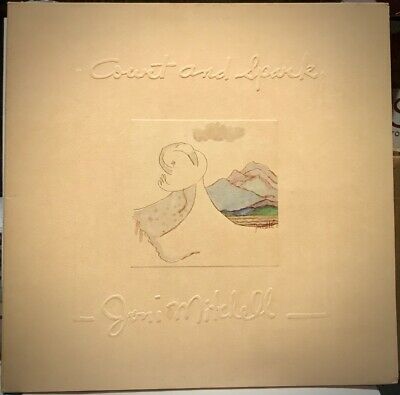
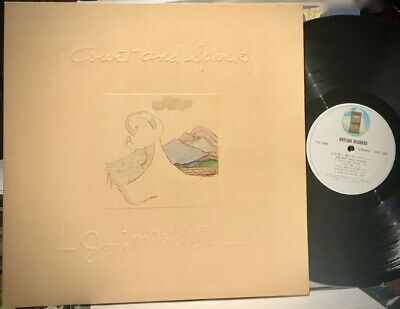
ASYLUM LP 7E-1001: Joni Mitchell ?– Court And Spark - 1974 CANADA embossed NM
$
35
$ 35
Sold For
Feb 10, 2021
Sold Date
Feb 24, 2020
Start Date
1
Number Of Bids
USA
Country Of Seller
eBay
Sold at
Favourite Auctions
To save auctions to your favourites, please login
If you don't have an account, please register
Description
****Welcome to our listing, thanks very much for looking!
****See our own website! We have lots of out of print LPs and CDs! Find us on the web at -
hearthedifference.net
****Shipping cost is only an estimate - it depends on the actual weight and size of the package as well as the service required. We do not profit from shipping costs, so if we overcharge, we will refund the difference back to you. It's always best to wait for our invoice before paying for your item. We will combine shipping for multiple items purchased.
****Please see our other listings - new items added daily!
****To access our eBay store click on the little red door at the top right section of any of our eBay listings or, click on -
http://stores.ebay.com/Hear-The-Difference
Background -
Joni Mitchell reached her commercial high point with Court and Spark, a remarkably deft fusion of folk, pop, and jazz which stands as her best-selling work to date. While as unified and insightful as Blue, the album -- a concept record exploring the roles of honesty and trust in relationships, romantic and otherwise -- moves away from confessional songwriting into evocative character studies: the hit "Free Man in Paris," written about David Geffen, is a not-so-subtle dig at the machinations of the music industry, while "Raised on Robbery" offers an acutely funny look at the predatory environment of the singles bar scene. Much of Court and Spark is devoted to wary love songs: both the title cut and "Help Me," the record's most successful single, carefully measure the risks of romance, while "People's Parties" and "The Same Situation" are fraught with worry and self-doubt (standing in direct opposition to the music, which is smart, smooth, and assured from the first note to the last). - Jason AnkenyNo female artist better typified the singer/songwriter movement of the '70s than Joni Mitchell, though her public image as the serious, sensitive woman with a guitar shortchanged her abilities, ambitions, and accomplishments. Mitchell's gift for writing personal, folk-inspired songs about the thorny side of life and love was inarguable (particularly on albums like 1970's Ladies of the Canyon and 1971's Blue), but Mitchell also brought the same smarts and eloquence to glossy pop on her commercial breakthrough, 1974's Court & Spark, and she was incorporating jazz and world music into her work long before either was fashionable in American pop music (and she also collaborated with respected jazz artists such as Charles Mingus, Pat Metheny, and Jaco Pastorius, something none of her peers accomplished). At her best, Mitchell was one of the finest and most adventurous artists of her generation, and a key inspiration to many women in music as a talent who refused to be hemmed in by boundaries of genre or gender.
Born Roberta Joan Anderson in Fort McLeod, Alberta, Canada, on November 7, 1943, she was stricken with polio at the age of nine; while recovering in a children's hospital, she began her performing career by singing to the other patients. After later teaching herself to play guitar with the aid of a Pete Seeger instruction book, she went off to art college, and became a fixture on the folk music scene around Alberta. After relocating to Toronto, she married folksinger Chuck Mitchell in 1965, and began performing under the name Joni Mitchell.
A year later the couple moved to Detroit, Michigan, but separated soon after; Joni remained in the Motor City, however, and won significant press acclaim for her burgeoning songwriting skills and smoky, distinctive vocals, leading to a string of high-profile performances in New York City. There she became a cause célèbre among the media and other performers; after she signed to Reprise in 1967, David Crosby offered to produce her debut record, a self-titled acoustic effort that appeared the following year. Her songs also found great success with other singers: in 1968, Judy Collins scored a major hit with the Mitchell-penned "Both Sides Now," while Fairport Convention covered "Eastern Rain" and Tom Rush recorded "The Circle Game.”
Thanks to all of the outside exposure, Mitchell began to earn a strong cult following; her 1969 sophomore effort, Clouds, reached the Top 40, while 1970's Ladies of the Canyon sold even better on the strength of the single "Big Yellow Taxi." It also included her anthemic composition "Woodstock," a major hit for Crosby, Stills, Nash & Young. Still, the commercial and critical approval awarded her landmark 1971 record Blue was unprecedented: a luminous, starkly confessional set written primarily during a European vacation, the album firmly established Mitchell as one of pop music's most remarkable and insightful talents.
Predictably, she turned away from Blue's incandescent folk with 1972's For the Roses, the first of the many major stylistic turns she would take over the course of her daring career. Backed by rock-jazz performer Tom Scott, Mitchell's music began moving into more pop-oriented territory, a change typified by the single "You Turn Me On (I'm a Radio)," her first significant hit. The follow-up, 1974's classic Court and Spark, was her most commercially successful outing: a sparkling, jazz-accented set, it reached the number two spot on the U.S. album charts and launched three hit singles -- "Help Me," "Free Man in Paris," and "Raised on Robbery.”
After the 1974 live collection Miles of Aisles, Mitchell emerged in 1975 with The Hissing of Summer Lawns, a bold, almost avant-garde record that housed her increasingly complex songs in experimental, jazz-inspired settings; "The Jungle Line" introduced the rhythms of African Burundi drums, placing her far ahead of the pop world's mid-'80s fascination with world music. 1976's Hejira, recorded with Weather Report bassist Jaco Pastorius, smoothed out the music's more difficult edges while employing minimalist techniques; Mitchell later performed the album's first single, "Coyote," at the Band's Last Waltz concert that Thanksgiving.
Her next effort, 1977's two-record set Don Juan's Reckless Daughter, was another ambitious move, a collection of long, largely improvisational pieces recorded with jazz players Larry Carlton and Wayne Shorter, Chaka Khan, and a battery of Latin percussionists. Shortly after the record's release, Mitchell was contacted by the legendary jazz bassist Charles Mingus, who invited her to work with him on a musical interpretation of T.S. Eliot's Four Quartets. Mingus, who was suffering from Lou Gehrig's disease, sketched out a series of melodies to which Mitchell added lyrics; however, Mingus died on January 5, 1979, before the record was completed. After Mitchell finished their collaboration on her own, she recorded the songs under the title Mingus, which was released the summer after the jazz titan's passing.
Following her second live collection, 1980's Shadows and Light, Mitchell returned to pop territory for 1982's Wild Things Run Fast; the first single, a cover of the Elvis Presley hit "(You're So Square) Baby I Don't Care," became her first chart single in eight years. Shortly after the album's release, she married bassist/sound engineer Larry Klein, who became a frequent collaborator on much of her subsequent material, including 1985's synth-driven Dog Eat Dog, co-produced by Thomas Dolby. Mitchell's move into electronics continued with 1988's Chalk Mark in a Rain Storm, featuring guests Peter Gabriel, Willie Nelson, Tom Petty, and Billy Idol.
Mitchell returned to her roots with 1991's Night Ride Home, a spare, stripped-down collection spotlighting little more than her voice and acoustic guitar. Prior to recording 1994's Turbulent Indigo, she and Klein separated, although he still co-produced the record, which was her most acclaimed work in years. In 1996, she compiled a pair of anthologies, Hits and Misses, which collected her chart successes as well as underappreciated favorites. A new studio album, Taming the Tiger, followed in 1998. Both Sides Now, a collection of standards, followed in early 2000.
Two years later, Mitchell resurfaced with the double-disc release Travelogue. She announced in October 2002 that this would be her last album ever, for she'd grown tired of the industry. She told W magazine that she intended to retire. She also claimed she would never sign another corporate label deal, and in Rolling Stone blasted the recording industry for being "a cesspool." By the time Travelogue appeared a month later, Mitchell had simmered down and her plans to call it quits had been axed. Numerous compilations and remasters appeared between 2002 and 2006, culminating in the release of the independent Shine in 2007. In 2014, Mitchell helped compile her first box set anthology, Love Has Many Faces: A Quartet, A Ballet, Waiting to Be Danced, which featured remastered versions of 53 songs from her back catalog, all dealing with some aspect of love and relationships. - Jason Ankeny
-
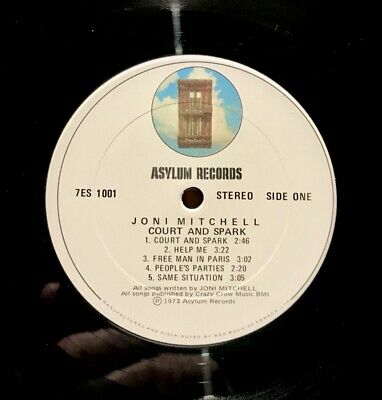
LP made by ASYLUM Records, in CANADA
-
LP released in 1974
-
LP recorded in STEREO
-
Record Catalog Number: 7E-1001
Joni Mitchell
Title -
Court and Spark
Music on this item -
A1. Court And Spark - Chimes – Milt Holland - 2:46
A2. Help Me - 3:22
A3. Free Man In Paris - Backing Vocals – David Crosby, Graham Nash, Joni Mitchell Electric Guitar – Jose Feliciano - 3:02
A4. People's Parties - 2:20
A5. The Same Situation - Arranged By [Strings] – Tom Scott - 3:05
B1. Car On A Hill - Arranged By [Strings] – Joni Mitchell Electric Guitar – Wayne Perkins - 2:58
B2. Down To You - Arranged By [Strings] – Joni Mitchell, Tom Scott Backing Vocals – David Crosby, Susan Webb Clavinet – Joni Mitchell - 5:36
B3. Just Like This Train - 4:23
B4. Raised On Robbery - Electric Guitar – Robbie Robertson - 3:05
B5. Trouble Child - Electric Guitar – Dennis Budimir Trumpet – Chuck Findley - 3:57
B6. Twisted - Backing Vocals – Cheech & Chong Trumpet – Chuck Findley - 2:18
Performers / Other Information -
• Record Company – Warner Communications Inc.
• Manufactured By – WEA Music Of Canada, Ltd.
• Phonographic Copyright (p) – Asylum Records
• Copyright (c) – Asylum Records
• Published By – Crazy Crow Music
• Published By – Prestige Music Co.
• Art Direction, Design – Anthony Hudson
• Bass – Jim Hughart (tracks: B5), Max Bennett (tracks: A1, A2, A5 to B4, B6), Wilton Felder (tracks: A3, A4)
• Composed By – Ross* (tracks: B6), Joni Mitchell (tracks: A1 to B5), Grey* (tracks: B6)
• Drums, Percussion – John Guerin
• Electric Guitar – Larry Carlton (tracks: A1 to A5, B2, B3, B6)
• Electric Piano – Joe Sample
• Engineer [Sound Engineer] – Henry Lewy
• Mastered By [Mastering Engineer] – Bernie Grundman
• Painting [Cover Painting] – Joni Mitchell
• Photography By – Norman Seeff
• Piano, Vocals [Uncredited] – Joni Mitchell
• Woodwind [Woodwinds], Reeds – Tom Scott
? 1973 Asylum Records - labels
? © 1974 Asylum Records. - back cover
All songs by Joni Mitchell, © 1973 Crazy Crow Music / BMI,
Except 'Twisted', © 1965 Prestige Music / BMI.
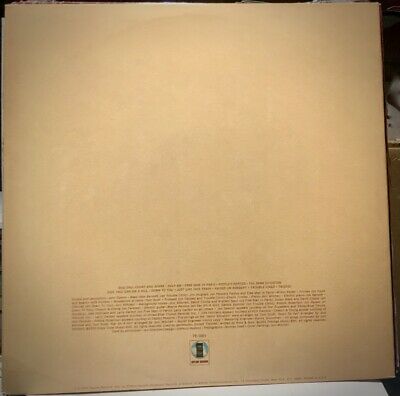
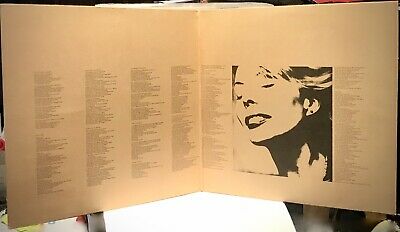
Packaged in an embossed gatefold cover, printed in USA as the lower line on back cover says.
Song Title Discrepancy
A5 title is "Same Situation" on the label
A5 title is "The Same Situation" on the sleeve
catalog number on spine and sleeve is 7E-1001
catalog number on label is 7ES 1001
CONDITION Details:
The GATE-FOLD LP JACKET is in near mint minus overall condition! The cover is textured/embossed. The jacket has NO seam splits or writing on it. The corners and seams are solid with just some light shelf wear. The colors on the jacket are sharp and clean.
The LP is in near mint minus overall condition! There are NO serious marks on the vinyl. But the LP may have some very light spider marks (these are caused by sliding the LP in and out of the inner sleeve), and the vinyl may have a finger print or two. Most of the time, spider marks are not audible, but it really depends on the sensitivity of your audio gear. Considering the vintage of this LP title, the vinyl looks near mint minus overall. However, this is not a new audiophile LP....some extraneous noise is inevitable and should be expected for a vintage LP. This LP retains much of the original gloss and sheen! There are NO serious spindle marks on the record labels either - these are terrific collector's grade examples of this recording.A Short Note About LP GRADING -
- Mint = Only used for sealed items.
- Near Mint = Virtually flawless in every way.
- Near Mint Minus = Item has some minor imperfections, some audible.
- Excellent = Item obviously played and enjoyed with some noise.
- Very Good Plus = Many more imperfections which are noticeable and obtrusive.
For best results, always properly clean your LPs before playing them.
The LP is an audiophile quality pressing (any collector of fine MFSL, half speeds, direct to discs, Japanese/UK pressings etc., can attest to the difference a quality pressing can make to an audio system).
Don't let this rarity slip by!!!
price rating