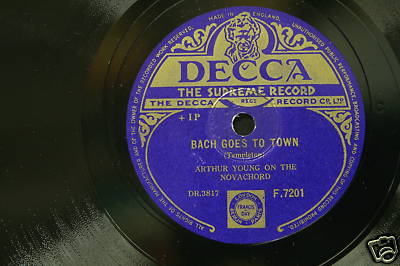
ARTHUR YOUNG ON THE NOVACHORD, BACH GOES TO TOWN, MINT-
$
25


Favourite Auctions
To save auctions to your favourites, please login
If you don't have an account, please register
Description
WE WILL BE LISTING A LOT OF 78 RPM RECORDS. PLEASE TAKE A LOOK AT ALL SO YOU CAN RECEIVE A DISCOUNT ON COMBINED SHIPPING FOR MULTIPLE BUYS.
COMBINED SHIPPING WILL GIVE YOU A $1.00 OFF FOR EVERY 78 AFTER THE FIRST ONE !!!
(please wait for invoice for multiple buys, let me know when you are done)
(international shipping for 1 single is usually $15.00)
THE ARTIST AND RECORD COMPANY ARE NOTED IN THE TITLE. THE CONDITION DESCRIPTION IS BELOW. WE WILL TRY OUR BEST TO GIVE YOU A GOOD DESCRIPTION BUT WE ARE NEW WITH RECORDS. WE DID NO CLEANING AT ALL, WE ARE NOT PROFESSIONALS, SO WE WILL LET YOU DO IT, THERE WILL BE OUR FINGER PRINTS AND HOW WE FOUND THEM. ALL PURCHASES ARE AS IS.
GOOD COLLECTING, LISTENING AND BIDDING!!!!
CONDITION IS: M- / FLIP SIDE, PRELUDE IN D, FROM "THE SECOND ENGLISH SUITE" BACH
Novachord
From Wikipedia, the free encyclopedia
The Novachord is generally considered to be the world's first commercial polyphonic synthesizer featuring subtractive synthesis manufactured by Hammond. Designed by John Hanert, Laurens Hammond and C.N.Williams, only some 1069 examples were built over a period from 1939 to 1942. It was one of very few electronic products released by Hammond that was not intended to emulate the sound of an organ.
Comprising of 163 vacuum tubes and over 1000 custom capacitors it weighed nearly 500 pounds and was roughly the size of two spinet pianos. The unique divide down oscillator architecture permitted all 72 notes to be played in unison. This was achieved through the use of vacuum tube monostable circuits permitting several octaves of like notes to be master tuned from one of 12 top octave oscillators. A very similar concept was adopted in polysynths released more than 30 years later by Robert Moog and A.R.P.
The Novachord featured an early implementation of ADSR, with attack/decay/sustain on switches and the release controlled via a pedal. It also utilised a resonant low pass filter and an electromechanical 6 channel vibrato unit operating on pairs of adjacent oscillators to further modify the timbre. The resulting sonic palette ranged from sustained string or vocal like timbres to the sharp attack transients of a harpsichord or piano.
Despite its historical importance the Novachord didn't enjoy commercial success due to instability issues and the onset of World War II. Reliability issues were caused in the main by the design's over reliance on the operating parameters of hundreds of custom components found within the instrument requiring to stay within surprisingly tight tolerances. Hammond must have realised this was an issue very early on and they offered a special upgrade to improve stability which was no more than a low power heater which bolted inside the enclosure to reduce the effects of high humidity.
Somewhat surprisingly, despite the large quantity utilised, the instrument was not known for vacuum tube failure. This was probably mainly thanks to the heater voltage being reduced from the normal 6.3 volts to 5 volts.
Like its contemporaries, the Theremin, the Ondes Martenot and the Trautonium, it can be heard occasionally in horror and science fiction film scores, including many genre films from Universal Studios and James Bernard's ethereal music for Hammer's The Gorgon (1964). It was also used for the entr'acte music in Gone With the Wind (1939).
The Novachord can be heard on many recordings of the era. Many songs sung by Vera Lynn, including We'll Meet Again, were accompanied by Arthur Young on the Novachord.
It is estimated that less than 200 Novachords are still in existence and considerably less than this are still in operation. The vast majority of survivng examples are in North America.
Mint Perfect, flawless. Legitimate sellers seldom use this grade. When a record is truly
Mint, it deserves (and receives) a large premium over other grades.
M- or NRMT (Mint Minus or Near Mint) – Usually the highest grade. Records from the
1950s & 60s in this condition are truly rare.
VG++ (Very Good Plus Plus) – Beautiful collectible condition. Only the slightest of
wear, certainly no deep scratches.
VG+ (Very Good Plus) - Great condition. Well cared for.
VG (Very Good) – Still good condition, but more wear than VG+.
VG- (Very Good Minus) - Generally not collectible condition, unless it’s a super rare
record. Most dealers avoid records in this shape or below.
G (Good) – Lots of wear, but still playable. The most confusing grade! Good really does
not mean good. It is actually quite poor condition.
WBR (Wrecked But Rare) – Otherwise known as a Starter Copy. Not cracked, but a
starter copy.
70R
price rating