AMADEO 4-LPs AVRS-6462-65: MOZART Piano Works - BADURA-SKODA, DEMUS 1970 AUSTRIA
$
48


$ 48
Sold For
Nov 11, 2019
Sold Date
May 13, 2019
Start Date
1
Number Of Bids
USA
Country Of Seller
eBay
Sold at
Favourite Auctions
To save auctions to your favourites, please login
If you don't have an account, please register
Description
****Welcome to our listing, thanks very much for looking!
****See our own website! We have lots of out of print LPs and CDs! Find us on the web at -
hearthedifference.net
****Shipping cost is only an estimate - it depends on the actual weight and size of the package as well as the service required. We do not profit from shipping costs, so if we overcharge, we will refund the difference back to you. It's always best to wait for our invoice before paying for your item. We will combine shipping for multiple items purchased.
****Please see our other listings - new items added daily!
****To access our eBay store click on the little red door at the top right section of any of our eBay listings or, click on -
http://stores.ebay.com/Hear-The-Difference
Background -
Paul Badura-Skoda (born 6 October 1927, Vienna) is an Austrian pianist, prolific recording artist, scholar and keyboard instrument collector.Austrian pianist Paul Badura-Skoda is one of the most honored and frequently recorded concert artists of the second half of the twentieth century. Badura-Skoda studied in the master class of Edwin Fischer in Lucerne and made his debut in Vienna in 1948. Word quickly spread about Badura-Skoda's artistry, and in 1949 he appeared in concertos partnered by conductors Herbert von Karajan and Wilhelm Furtwängler. Badura-Skoda has seldom been idle since, and his concert tours have taken him around the world many times. Badura-Skoda made his New York debut in 1953.
Badura-Skoda has performed a wide range of piano music and was a close friend to Swiss composer Frank Martin, who dedicated his Piano Concerto No. 2 to Badura-Skoda, in addition to some smaller works. But Badura-Skoda's name is most closely related to the Viennese classicists, Mozart, Beethoven, and Schubert, whose keyboard works, including whole cycles of sonatas, he has recorded, in some cases multiple times. Beginning in the 1950s, Badura-Skoda began to quietly make the case for the use of late eighteenth and early nineteenth century keyboards in the interpretation of this literature, anticipating the period instrument boom by decades. In this respect, Badura-Skoda was helped and to some degree influenced by the work of his wife, musicologist Eva Badura-Skoda. Paul Badura-Skoda has also played in a four-hand piano duet with fellow countryman Jörg Demus, and the pair collaborated on a book, Die Klaviersonaten von Ludwig van Beethoven, which was published in 1970.
Badura-Skoda's recording career encompasses an enormous number of recordings. He began with a justly famous series of discs on the Westminster label in the early 1950s and since then has recorded for Deutsche Grammophon, Astreé, Arcana, Music & Arts, Sanctuary Classics, Jecklin-Disc, Harmonia Mundi, and many others. In 2003 Badura-Skoda embarked on a world tour to celebrate the occasion of his 75th birthday. Badura-Skoda also composes; among his works are a Mass in D. - Uncle Dave Lewis
Jörg Demus (born 2 December 1928, in St. Pölten) is an Austrian pianist.
Jörg Demus is a highly regarded pianist and one of the finest of accompanists. He is noted for combining a basically Romantic sound and in line with an interest in historic keyboard interpretation and early model pianos.
He entered the Vienna Academy of Music at the age of 11, where he studied piano and conducting, graduating in 1945. He continued to study conducting with Josef Krips and Hans Swarowsky, while also taking composition classes. He made his debut as a pianist at the age of 14, while still a student at the Conservatory.
From 1951-1953, he was a pupil of Yves Nat in Paris. In 1953, he attended master classes with Gieseking in Saarbrücken, and studied interpretation further with Wilhelm Kempff, Arturo Benedetti Michelangeli, and Edwin Fischer.
He made his debut as a mature artist in Vienna in 1953. In 1956, he won the Busoni Prize of the International Competition for Pianists. He maintained a notable solo career, especially for personal interpretations of Bach and flexible, colorful renditions of Debussy. He was also well regarded for the main line of German piano music from Mozart to Schumann, and for his performances of the piano music of César Franck. He was a recipient of the Beethoven Ring and the Mozart Medal of Vienna.
He was a sensitive accompanist and worked with singers of the highest caliber, including Elisabeth Schwarzkopf and Dietrich Fischer-Diskau. His version of Schubert's Winterreise, with Fischer-Dieskau, is perhaps the most critically acclaimed of all recordings of this great song cycle.
He also accompanied violinists (Josef Suk, for instance) and cellists (Antonio Janigro). He sometimes appears in piano duet and two-piano concerts with Paul Badura-Skoda, who shares Demus' interest in older keyboard instruments. Demus acquired several notable examples of early instruments, including harpsichords and pianos by Broadwood, Clements, and Conrad Graf, and has recorded appropriate music on them. He has also authored several essays, a book on interpretation, and, as co-author with Badura-Skoda, an analysis of the Beethoven piano sonatas. - Joseph Stevenson
Austrian pianists Jörg Demus and Paul Badura-Skoda were pioneers in the use of historical instruments in the music of Mozart and Beethoven, undertaking their experiments with little institutional support. There was no market for fortepiano recordings in the 1960s and 1970s. The entire project has a relaxed, satisfied feel, as if Demus and Badura-Skoda were looking at the rise of historical piano performance and showing the world that they still have a thing or two to contribute. They play works for both one and two pianos. The highlight of the program is probably the opening Sonata for two pianos in D major, K. 448, where there is deep coordination between the two masters: the music twists and turns through plenty of slight tempo variations and individual points of expression but seems to breathe as a single organism. One of the other duo works is a genuine Mozart rarity; the Larghetto and Allegro for two pianos in E flat major, K. deest, was apparently left unfinished by Mozart and completed later. That work and the Andante con variazioni in G major for piano four hands, K. 501, seem to hint at mysteries. To round out the program, Demus and Badura-Skoda divide up Mozart's minor-key fantasias and give each of them sharp, percussive readings that capture the dark, improvisatory quality of the music. With fine engineering accomplished at Salzburg's Irnberger Foundation, this is a satisfying Mozart romp with some past masters. - James Manheim
Here Badura-Skoda joins his longtime and likewise estimable partner Jörg Demus in an album devoted mostly to works of Mozart requiring two pianists (for two pianos or one piano with four hands)—though each also takes one solo turn as well—and the results are equally superlative. Badura-Skoda and Demus have now performed duo piano recitals together for a half-century, and it would be well-nigh impossible to name any other instrumental duo whose two members are so absolutely simpatico. Here they perform on fortepianos—a practice in which both were early exponents—instead of modern instruments. However, if you are someone who is partial to the latter, fear not; both artists draw from their instruments rich, robust sounds that, while not mistakable for Steinways, have not the slightest trace of tinniness. Instead, these technically immaculate performances ring out with vibrant color and energy, a clarity and delicacy without any trace of wanness, and a full panoply of emotional expressiveness from unbridled ebullience through stormy passion to ruminative reflection. The recorded sound captures both instruments in a very natural perspective. Once again, this is simply what great Mozart playing is all about; hence, an unqualified rave recommendation. FANFARE: James A. Altena
-
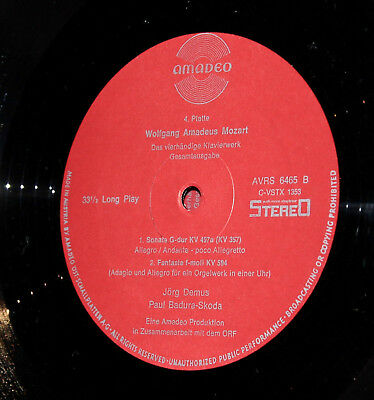
LP made by AMADEO Records, in AUSTRIA
-
LP released in 1970
-
LP is recorded in STEREO
-
Record Catalog Number: AVRS 6462/65
-
Record Labels are primarily RED with SILVER lettering - featuring the AMADEO records logo.
Mozart // Demus // Badura-Skoda
Mozart - Piano Works for Four Hands - Complete Edition
Tracks - Sonate D-dur Für 2 Klaviere, KV 448
A1 Allegro Con Spirito
A2 Andante
A3 Molto Allegro
B1 Larghetto Und Allegro Es-Dur
B2 Grave Und Presto B-Dur KV Anh. 42 (375b)
B3 Adagio KV 546 + Fuge C-Moll KV 426
Sonate F-Dur Für Klavier Zu Vier Händen, KV 497
A1 Adagio - Allegro Di Molto
A2 Andante
A3 Allegro
Sonate C-Dur KV 521
B1 Allegro
B2 Andante
B3 Allegretto
Sonate B-Dur KB 186c (KV 358)
A1 Allegro
A2 Adagio
A3 Molto Presto
A4 Andante Mit Variationen KV 501
B1 Fantasie F-Moll KV 608
Sonate C-Dur KV 19d
B2 Allegro
B3 Menuetto
B4 Rondo: Allegretto - Adagio - Allegro
Sonate D-Dur KV 123a (KV 381)
A1 Allegro
A2 Andante
A3 Allegro Molto
A4 Fuge G-Moll KV 375
Sonate G-Dur KV 497a
B1 Allegro
B2 Andante - Poco Allegretto
B3 Fantasie F-Moll KV 594
Performers / Credits -
• Liner Notes [On players] – Françoise Knaeps
• Liner Notes [On works] – Harry Halbreich
• Piano – Joerg Demus, Paul Badura-Skoda
• Transcription By – Paul Badura-Skoda (tracks: B1)
• Composed By – Wolfgang Amadeus Mozart
• Engineer – Kurt Kindl
• Layout – Mark & Nevosad
• Production Manager – Rudolf Mraz
• Recording Supervisor – Gerhard Schuller
Other Information -
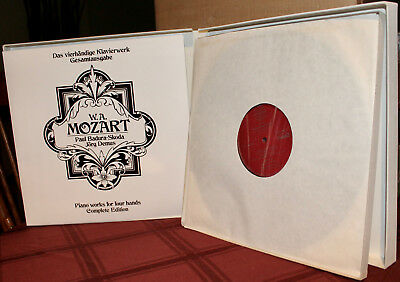
Includes a full size booklet / insert
Complete Edition " Piano works for four hands"
Eine Amadeo - Produktion in Zusammenarbeit mit dem ORF
Aufnahmeort : Studio Wien des ORF
Comes with a 12 page discography booklet in German + English
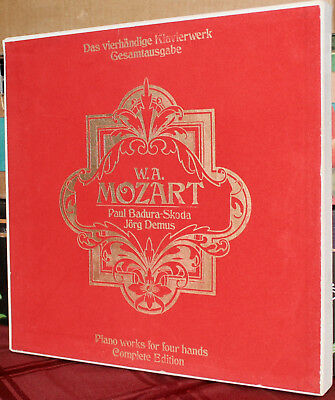
Red, felt covered box
• Matrix / Runout (Runout stamped Vinyl 1 Side A): C11 -B C -VSTX 1346
• Matrix / Runout (Runout stamped Vinyl 1 Side B): C11 -B C -VSTX 1347
• Matrix / Runout (Runout stamped Vinyl 2 Side A): C11 -B C -VSTX 1348
• Matrix / Runout (Runout stamped Vinyl 2 Side B): C11 -E C -VSTX 1349
• Matrix / Runout (Runout stamped Vinyl 3 Side A): C11 -B C -VSTX 1350 Made in Austria
• Matrix / Runout (Runout stamped Vinyl 3 Side B): C11 -B C -VSTX 1351 Made in Austria
• Matrix / Runout (Runout stamped Vinyl 4 Side A): C11 -B C -VSTX 1352 - 1
• Matrix / Runout (Runout stamped Vinyl 4 Side B): C11 -B C -VSTX 1353
• Record Company – Amadeo Österreichische Schallplatten Aktiengesellschaft Made in Austria
CONDITION Details:
The 4-LP RED VELVET COVERED box is in near mint minus condition! The box has NO splits or crushed corners - just gorgeous! The corners and seams are solid with just some light shelf wear. There is a bit of script worn away on the spine of the box. The colors on the box are sharp and clean (see pictures with this listing as they are of the actual item).
The set comes complete with a large format paper insert / libretto.
The 4-LPs are in near mint minus condition! We found that the vinyl looked superb on this vintage LP set. There are no significant marks and the LPs retain much of the original gloss and sheen - obviously well taken care of! They do have a bit of dust and perhaps a finger print or two on them so they should be cleaned before playing. There are NO serious spindle marks on the record labels either. Just beautifully made vinyl! That said, acquiring a vintage LP like this is for the performance and rarity of the LP, not necessarily for the sound quality.
A Short Note About LP GRADING -
- Mint = Only used for sealed items.
- Near Mint = Virtually flawless in every way.
- Near Mint Minus = Item has some minor imperfections, some audible.
- Excellent = Item obviously played and enjoyed with some noise.
- Very Good Plus = Many more imperfections which are noticeable and obtrusive.
For best results, always thoroughly clean your LPs before playing them.
LPs can be audiophile quality pressings (any collector of fine MFSL, half speeds, direct to discs, Japanese/UK pressings etc., can attest to the difference a quality pressing can make to an audio system).
Don't let this rarity slip by!!!price rating





![[EX 3 LP BOX SET] The Complete Rachmaninoff Vol. 2 RCA Victrola,AVM3 0261, Piano](https://www.popsike.info/php/thumbnail.php?url=https://www.popsike.pics/pix/20190728/283563380074.jpg)