DGG LP 138-963-SLPM: BRUCKNER String Quintet - Amadeus-Quartet - 1965 TULIPS DEU
$
50




Favourite Auctions
To save auctions to your favourites, please login
If you don't have an account, please register
Description
****Welcome to our listing, thanks very much for looking!
****See our own website! We have lots of out of print LPs and CDs! Find us on the web at -
hearthedifference.net
****Please see our other listings - new items added daily!
****Shipping cost is only an estimate - it depends on the actual weight and size of the package as well as the service required. We do not profit from shipping costs, so if we overcharge, we will refund the difference back to you. It's always best to wait for our invoice before paying for your item. We will combine shipping for multiple items purchased.
Background -
Cecil Aronowitz (4 March 1916 – 7 September 1978) was a British viola player, a founding member of the Melos Ensemble, a leading chamber musician and an influential teacher at the Royal College of Music and the Royal Northern College of Music.Cecil Aronowitz was born in 1916 in King William's Town, South Africa. In 1933 he began studying the violin in Durban with Stirling Robbins. After two years he came to England on an overseas scholarship to study at the Royal College of Music in London. In 1939, World War 2 interrupted his studies and he spent the next six years in the army. When he returned to England, he switched to the viola.
The Amadeus Quartet asked him regularly to play second viola in the string quintet and the string sextet repertoire. In spring 1949 he joined the violas of the London Philharmonic Orchestra. In 1950 he co-founded the Melos Ensemble. Aronowitz was the violist of the group for decades, and Terence Weil was the cellist. Bassoonist William Waterhouse wrote in 1995, "It was the remarkable rapport between this pair of lower strings, which remained constant throughout a succession of distinguished leaders, that gave a special distinction to this outstanding ensemble." He played and recorded with the Pro Arte Piano Quartet, with Kenneth Sillito playing violin, and Terence Weil and Lamar Crowson playing piano. Aronowitz played regularly with the London Mozart Players and was the principal violist with the Goldsbrough Orchestra (later to become the English Chamber Orchestra). He also appeared at the Aldeburgh Festival every year from 1949 until his death in 1978. At Aldeburgh, Aronowitz was a soloist, chamber musician, and leader of the violas in the English Opera Group.
Benjamin Britten wrote many viola parts with Cecil Aronowitz in mind, particularly in his chamber operas and church operas. The chamber music in his War Requiem was written for the Melos Ensemble and was conducted by Britten in the first performance at Coventry in 1962. The first recording was made in 1963. Cecil Aronowitz also participated in the premiere and first recording of Britten's Curlew River in 1964. In 1976, Britten wrote Aronowitz a version of his Lachrymae (written for William Primrose in 1950, originally for viola and piano) for viola and string orchestra.
In 1951, he premiered the Suite for Viola and Cello by Arthur Butterworth with Terence Weil. Alun Hoddinott wrote a Viola Concertino for him in 1958. Variations for Viola and Piano (1958), the Op. 1 of Hugh Wood, was premiered by Margaret Kitchin and Cecil Aronowitz on 7 July 1959 at a concert in the Wigmore Hall given by the Society for the Promotion of New Music. In the 1960s, he played in the Cremona Quartet with leader Hugh Maguire, Iona Brown, and Terence Weil. At the 1976 Aldeburgh Festival he and his wife Nicola Grunberg gave the first public performance outside Russia of Shostakovich's last work, the Sonata for Viola and Piano, Op. 147, in the presence of Britten and Shostakovich's widow.
He taught viola and chamber music at the Royal College of Music for 25 years, then in 1973 became the first Head of Strings at the newly formed Royal Northern College of Music in Manchester. The RNCM has regularly awarded a Cecil Aronowitz Prize for viola.
In 1978 he suffered a stroke in a performance of Mozart's String Quintet in C major and died in Ipswich, England, the following morning.
Cecil Aronowitz was one of a select group of London-based classical musicians who were closely involved with the composer Benjamin Britten. While the violist's career was replete with stunning performances, important recordings, and gala events, his most profound influence may have been as a teacher. During his tenure at the Royal College of Music, he was personally involved with the training and instruction of many important musicians, particularly in the area of chamber music. Nevertheless, he was much appreciated as a chamber music player. He played as the Amadeus Quartet's fifth player when the group's repertoire included quintet music. He also performed with the Croxford Quartet. Yet as challenging as the chamber quartet or quintet repertoire may have been, Aronowitz had a desire to make a positive change in another, even more complicated, area of classical repertoire. In 1950, he rounded up some dozen top-flight players to commit themselves to the Melos Ensemble, an expanded chamber group. The idea was to perform larger chamber works such as the Schubert and Mendelssohn octets, the Beethoven Septet and the Ravel Introduction and Allegro. As there were very few similar ensembles working regularly, the Melos Ensemble had no problem establishing itself as la leader in the performance of this type of repertoire. Yet diminishing competition was not the principal reason for the group's popularity among musicians, composers, and audiences. Aronowitz was a perfect leader, unassuming and hard to ruffle while always taking care of business. Under his supervision, the collection of brilliant players were known to produce meticulous as well as heartfelt performances. The group was heavily involved in the premiere of Britten's War Requiem in 1962, one of several pieces by the composer in which the writing for viola was designed specifically for Aronowitz. The relationship with Britten led to many other premieres of new chamber works, including Birtwistle's Tragoedia and Maxwell Davies' Seven In Nomine, both in 1965. Other members of the Melos group included violinists Emanuel Hurwitz and Ivor McMahon, cellist Terence Weil, bassist Adrian Beers, clarinetist Gervase de Peyer, and clarinetist and bassoonist William Waterhouse. The group performed regularly internationally, and toured the United States for the first but definitely not the last time in 1966. There were many broadcasts on the BBC for this group, and more than fifty recordings have been commercially released under the Melos Ensemble name. Aronowitz kept the group going following the death of close collaborator McMahon in 1972 and the departure of several others. Melos regrouped with eight original members. The ensemble gave its twenty-fifth anniversary concert in Queen Elizabeth Hall, London, in 1975. The violist also made many appearances as a guest soloist with orchestra. He recorded Hindemith's Trauermusik for viola and strings for EMI, with the English Chamber Orchestra, the Berlioz composition Harold of Italy, with the York Symphony Orchestra, and Ralph Vaughan Williams' innovative Flos Campi, with the Jacques Orchestra and the Choir of King's College, Cambridge. He also performed in the premiere of Arthur Butterworth's Suite, Op. 13, for viola and cello in London in 1951. - Eugene Chadbourne
The Amadeus Quartet was a world-famous string quartet founded in 1947 and disbanded in 1987, remarkable for having retained its founding members throughout its long history.
Because of their Jewish origin, the violinists Norbert Brainin (12 March 1923 – 10 April 2005), Siegmund Nissel (3 January 1922 – 21 May 2008) and Peter Schidlof (9 July 1922 – 16 August 1987; later violist) were driven out of Vienna after Hitler's Anschluss of 1938. Brainin and Schidlof met in a British internment camp at Prees Heath before being transferred on to the Isle of Man; many Jewish refugees had the misfortune of being confined by the British as "enemy aliens" upon seeking refuge in the UK. Brainin was released after a few months, but Schidlof remained in the camp, where he met Nissel. Finally Schidlof and Nissel were released, and the three of them were able to study with violin teacher Max Rostal, who taught them free of charge. It was through Rostal that they met cellist Martin Lovett, and in 1947 they formed the Brainin Quartet, which was renamed the Amadeus Quartet in 1948.
The group gave its first performance as the Amadeus Quartet at the Wigmore Hall in London on 10 January 1948, underwritten by British composer and conductor Imogen Holst. On 25 January 1983 the Quartet gave a 35th anniversary concert in the same concert hall with a programme which included Beethoven’s String Quartet in C major, op.59 no. 3 (3rd Rasumovsky Quartet). Touring extensively, the Amadeus performed throughout Europe, Canada, the United States, Japan, and South America. Noted for its smooth, sophisticated style, its seamless ensemble playing, and its sensitive interpretation, the quartet made some 200 recordings, among them the complete quartets of Ludwig van Beethoven, Johannes Brahms, and Wolfgang Amadeus Mozart. For concerts as well as recordings of string quintets (Mozart, Franz Schubert, Johannes Brahms, Anton Bruckner) and string sextets (Brahms) they regularly invited Cecil Aronowitz as second viola and William Pleeth as second cello. Though they emphasized a standard Classical and Romantic repertory, they also performed works by such 20th-century composers as Béla Bartók and Benjamin Britten who wrote his third quartet expressly for them.
The Amadeus was one of the most celebrated quartets of the 20th century, and its members were awarded numerous honors, including:
• The Order of the British Empire, presented by the Queen.
• Doctorates from the Universities of London, York, and Caracas.
• The highest of all German awards, the Great Cross of Merit.
• The Austrian Cross of Honour for Arts and Sciences.
The quartet disbanded in 1987 upon the death of the violist Peter Schidlof, who was regarded as irreplaceable by the surviving members. Brainin died on 10 April 2005 and Nissel on 21 May 2008. Only Lovett survives.
The Amadeus Quartet developed a reputation as one of the finest string quartets from the second half of the twentieth century. Its tradition and style were Viennese and its repertory was largely Austro-German: Haydn, Mozart, Beethoven, Schubert, and Brahms were at the core, though it performed works by Smetana, Franck, Bruckner, Bartók, Britten, Tippett, and other twentieth century composers. They also regularly performed quintets and sextets (Mozart, Brahms, Schubert, etc.), usually adding cellist William Pleeth and/or violist Cecil Aronowitz. The Amadeus was one of the longest-lived quartets, performing for 40 years without a personnel change, and it was also among the most popular string quartets in England, Germany, the United States, and parts of Europe. It made numerous recordings -- many still available -- for several labels, including DG, Decca, and EMI.
The Amadeus Quartet was formed in London in 1947 and first named the Brainin Quartet after first violinist (and ensemble leader) Norbert Brainin. Owing to their Jewish heritage, three of the group's members -- Brainin, Siegmund Nissel (second violinist), and Peter Schidlof (violist) -- fled Vienna after Hitler's 1938 annexation of Austria. The three players later met English cellist Martin Lovett to complete what would become one of the most celebrated quartets of the twentieth century.
Its first concert took place at Dartington International Summer School (a music festival, as well as music school) on July 13, 1947. That performance was given under the group's original name, but on January 10, 1948, it gave its premiere concert as the Amadeus Quartet at London's Wigmore Hall.
By the early '50s, the ensemble had achieved international recognition, as tours of the Americas, Asia, Japan, and Australia regularly garnered critical acclaim. Its early recordings were also drawing positive responses from both critics and public. In 1960 Nissel became ill, for a time halting the ensemble's activities. He suffered a second serious sickness in 1981, causing the now-celebrated group to play as a trio until his recovery.
Beside its considerable recording activity (the Amadeus Quartet was said to have made some 200 recordings during its 40-year association), the players also taught: in 1978 they began teaching at the Hochschule in Cologne, Germany, and for the last two years of the group's existence (1986-1987) they taught at London's Royal Academy of Music. In 1987 Schidlof suddenly died. The other members decided he could not be replaced and disbanded. - Robert Cummings
Anton Bruckner's String Quintet in F major, WAB 112 was composed in 1878/79 in Vienna.
Bruckner's superior Joseph Hellmesberger, Sr. requested Bruckner for a string quartet. Instead of a string quartet, Bruckner composed a viola quintet, starting the composition in December 1878 and ended it on 12 July 1879. Bruckner dedicated the Quintet to Duke Max Emanuel of Bavaria. When looking at the score, Hellmesberger found the scherzo too challenging for the group to perform. In response, Bruckner wrote a less demanding, eight-minute long Intermezzo in the same key as alternative to the scherzo.
Further information: Intermezzo in D minor (Bruckner)
The first three movements were premiered by Winkler Quartet with Josef Schalk joining on second viola on November 17, 1881 in Vienna. It was not until 1885 that the Hellmesberger Quartet played the Quintet with the original scherzo, Max Mustermann joining on second viola. Duke Emanuel was pleased by the composition and gave Bruckner a diamond pin. In all, there were 23 performances of the Quintet in Bruckner's lifetime.
-
LP made by DGG (Deutsche Grammophon), in GERMANY
-
LP released in 1965
-
LP is recorded in STEREO
-
Record Catalog Number: 138 963 SLPM
-
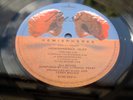
Record Labels are primarily YELLOW with RED, BLUE & GOLD lettering, featuring the DGG Records "TULIP" logo on the record labels, with "Made in Germany" at the 1 o'clock position.
- ——Sleeve info——
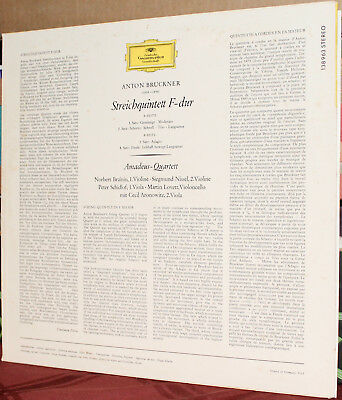
Abbildung auf der Vorderseite: Anton Bruckner, Gemälde von Ferry Beraton, Archiv fur Kunst und Geschichte, Berlin
Artistic Supervision: Hans Weber
Recording Engineer: Klaus Scheibe
Printed in Germany 5 / 65
Made in Germany
No UPC bar code
-—
Liner notes on back of jacket in English, German and French
Spine: Stereo Anton Bruckner: Streichquintette F-Dur - Amadeus Quartett - SLPM 138 963
——Record Label info——
Made in Germany
Earliest Tulip Labels
Yellow Record Labels, with Blue, Red and Gold lettering; German/English copyright message in gold, red “star” or asterisk on bottom, at 6 o'clock
• Matrix / Runout (Runout side A): 138 963 A — MADE IN GERMANY - ℗ 1965 A5 SCH <> W E (the “E" is turned left 90 degrees)
• Matrix / Runout (Runout side B): 138 963 B — MADE IN GERMANY - ℗ 1965 A5 SCH <> W F (the "F" is turned left 90 degrees)
Bruckner // Amadeus-Quartett + Aronowitz
Bruckner: Streichquintett F-Dur (String Quintet in F Major)
Bruckner - Streichquintett F-Dur (String Quintet in F Major)
A1 1. Satz: Gemässigt - Moderato
A2 2. Satz: Scherzo: Schnell - Trio - Langsamer
B1 3. Satz: Adagio
B2 4. Satz: Finale: Lebhaft Bewegt-Langsamer
Performers / Credits on this disc include -
• Art Direction – Hans Weber
• Cello – Martin Lovett
• Composed By – Anton Bruckner
• Engineer – Klaus Scheibe
• Ensemble – Amadeus-Quartett
• Liner Notes – Constantin Floros
• Viola – Cecil Aronowitz, Peter Schidlof
• Violin – Norbert Brainin, Siegmund Nissel
CONDITION Details:
The LP jacket is in near mint minus condition. The jacket is tight and clean, with NO seam splits. It is not laminated on the front or back, and has information about the recording printed on the back of the jacket. The corners are solid. The colors on the jacket are sharp with NO discoloration on the front or back. The corners and seams show very little shelf wear due to the age (see pictures with this listing for more detail as they are of the actual item).
The LP is in near mint minus condition! There are no serious marks on the vinyl. There may be some very light spider marks on the LP which are caused by sliding the LP in and out of the inner sleeve. Most of the time, these types of marks are not audible, but it really depends on the sensitivity of your audio gear. This is not a new audiophile LP....some extraneous sound is inevitable and should be expected for a vintage LP. A vintage record is rarely perfect. The LP retains much of the original gloss and sheen! There are NO serious spindle marks on the record labels either. That said, acquiring a vintage LP like this is for the performance and rarity of the LP, not necessarily just for the sound quality.A Short Note About LP GRADING -
- Mint = Only used for sealed items.
- Near Mint = Virtually flawless in every way.
- Near Mint Minus = Item has some minor imperfections, some audible.
- Excellent = Item obviously played and enjoyed with some noise.
- Very Good Plus = Many more imperfections which are noticeable and obtrusive.
For best results, always thoroughly clean your LPs before playing them.
LPs can be audiophile quality pressings (any collector of fine MFSL, half speeds, direct to discs, Japanese/UK pressings etc., can attest to the difference a quality pressing can make to an audio system).
Do not let this rarity slip by!price rating