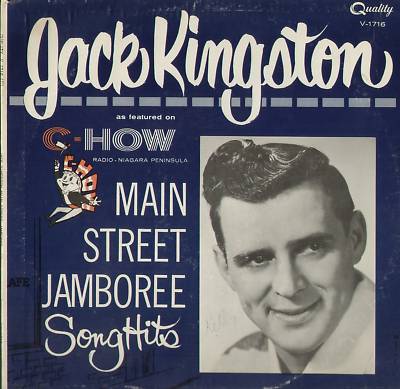
'50s Rockin Country/Rockabilly Jack Kingston LP Hear
$
26


Favourite Auctions
To save auctions to your favourites, please login
If you don't have an account, please register
Description
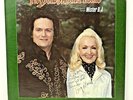
Jacket Condition: VG , stains on the back, pen residue on front Record Condition: VG to VG+, a few light marks Comments: From a Website In that spirit, then: Jack Kingston was born October 4, 1925 and first sang in a church choir. He performed on local radio while still a child, completed secondary school and reportedly worked for the 'N.S. & T.' Railway. His earliest group, the Kingston Brothers, had Jack on vocals and guitar, brother Art on bass and friend Alex Dalgleish on steel guitar and fiddle. This band's brief career ended with Dalgleish's sudden death in 1946. Brother Art became a skilled maker of fiddles, guitars and mandolins. In 1949, Kingston joined 'Canada's Largest Travelling Barn Dance' on radio station CKNX, Wingham, Ontario. He either auditioned for a vacant spot as bass player and vocalist or won an amateur contest -- both stories appear in print. Vocalist Earl Heywood was the established star at CKNX, along with champion fiddler Ward Allen. Within a year, Kingston was being featured on CKNX as 'the Yodeling Cowboy' and in 1950 became the first Canadian country artist to sign with Capitol Records. His first release was his theme-song,'Yodeling Cowboy' (which has said 'cowboy' "roamin' 'neath the Ontario sky" while he yodels); Kingston does a virtuoso demonstration of this trademark vocal technique, especially on the coda. Throughout the fifties, he released a steady stream of 78 rpm records, most of which he wrote or co-wrote. These discs document a strong, warm and versatile voice, with accomplished playing in various idioms of country. The songs' lyrics engage conventional themes, evident in their titles. They include 'A Love That's True' and 'Two Hearts, One Love' for Capitol before he moved to the Arrow label for 'Road of Broken Hearts', 'Dear Mother' and 'CNR Special'. In 1952, with new billing as 'The Canadian Playboy', (publicity photos show a strikingly handsome man), Kingston came to Hamilton's CHML to inaugurate a new country show. 'Main Street Jamboree' had its homebase in Delta Collegiate's auditorium and travelled to other venues throughout southern Ontario; Kingston was its 'jack-of-all-trades'. Star vocalist and ad-lib jokester, he shared the Jamboree stage several times weekly with other regulars, the Hillbilly Jewels and, later on, the Lincoln County Peach Pickers. He also was 'caller' for the square-dancing segments. An American country music fan magazine of this period describes 'Yodeling Jack Kingston' in the terminology of the time as "easily among the outstanding folk music personalities in the Dominion of Canada." Another c&w 'fanzine' notes his appearance as guest on "the famed WLS National Barn Dance in Chicago" where he earned "a great ovation." Gordie Tapp, of subsequent 'Country Hoedown' and 'Hee Haw' fame, was on-air host of the Jamboree. Tapp credits Kingston for his start in the country music business, wherein Kingston's skills went beyond performer and composer. He oversaw a complex operation: booking halls, hiring visiting stars as guests and promoting new talent: a teenage Tommy Hunter made his radio debut on the show. He arranged transportation of the Jamboree's extensive cast and equipment to its remote locales. Kingston later employed expertise so gained while acting as advance man for tours by both Wilf Carter and Hank Snow, and also playing as opening act. Kingston was a pioneer of telecast country music when the Jamboree came to screens on CHCH-TV in 1954. Now with Sparton Records, Kingston had hits with topical songs: One upbeat example, 'How Far Is She Now?', celebrates Marilyn Bell's swimming of Lake Ontario, September 8, 1954. Set on the night and day of her triumph, the song places the question of its title on everyone's lips as they cheer on the "little champ's" progress. Kingston's former colleague at CKNX, Ward Allen, had a hit with his fiddle tune 'Maple Sugar' in 1957; shortly thereafter, Kingston recorded a version with his lyrics added. 'Maple Sugar Sweetheart' is a wedding song that has its happy couple hitched while fiddle plays a blessing. The most distinctive and compelling of Kingston's recordings, however, are those that find their themes in calamitous Canadian current events -- his disaster songs. An early example tells of the Noronic, a Great Lakes steamer that on September 17, 1949 caught fire while docked at Toronto. A delay in summoning the fire department resulted in the death of more than a hundred people. Kingston's song, with 'honky-tonk' arrangement, brief solos by fiddle and steel guitar, characteristically interprets the events as if they were the "wrath of god descending on this wicked world". He sings in conclusion of the survivors as "saved" in more than one sense, turning to Jesus in joy. Coalmine accidents in Springhill, Nova Scotia are twice Kingston's subject. "Springhill Mine Explosion" recounts events of 1956; a second song presents the 'Miracle of Colliery Two' in 1958. With virtually the same musical setting, both songs conjoin religious themes to disastrous happenings, asserting prayer's power to rescue survivors; the lyrics also fittingly acclaim the human spirit of the 'dreggers', those men who volunteered to go back underground in search of their fellows. Kingston's recordings of songs by other composers share with his topical songs an explicit Canadian-ness. On his 1971 album, 'Springhill Mine Explosion' (on Birchmount – a compilation of earlier singles, with overdubs and false stereo mixes), he sings the standard 'Blue Canadian Rockies' and concludes with a Maritime pan-regional trilogy: an exile's lament for Newfoundland, a song that celebrates PEI as "heaven to me" and another that promises a return to "dear old Nova Scotia." Cultural nationalism did not, however, preclude Kingston's 1959 departure for the States. It may have been a factor in his return home, four years later, taking a pass on American success, putatively within his grasp. With wife Barbara and a young family, he took up residence in the country music capital of Nashville, was several times a guest on its 'Grand Ole Opry', and appeared on top American shows: 'Louisiana Hayride' and the 'Big D Jamboree' in Dallas, among others. Recordings from this era include the singles 'Don't Trade', 'It Never Rains', 'Cajun Cutie' and a 'cover' of the Everly Brothers' 'Bye Bye Love', along with the album 'Main Street Jamboree'. By one account, Kingston was offered the star vocalist regular spot on Wheeling's WWVA Jamboree, but he turned it down. Several who knew Kingston stress that he rejected -- rather than was rejected by -- his American ventures. Suggestions are that he returned to Canada for the sake of family life, to have his sons Harvey, Michael and Robert be raised and educated in their home country. ('Bobby' Kingston now pursues his own country music career in Las Vegas.) Kingston toured with a mid-60s trio, did tv shows and also worked in radio (locally, on CHOW in Welland and on St Catharines' then-new station, CHSC, where he DJ'd an all- night show). He was still recording as late as the 1974 album 'Happy Birthday Darling'. Eddie Legere is a St Catharines country artist who had a four album contract with Arc Records in the 1960s (and now has an indie CD out called 'Proud To Be Canadian'). Although Legere was a guest on the Main Street Jamboree, he and Kingston only became close friends in latter days, swapping stories on Legere's back porch. Legere remembers with fondness Kingston's gift for telling stories and his generous assistance when Legere was a transplanted Nova Scotian just starting out as a performer. He uses words like 'charisma' to describe Kingston's stage presence and commends his sincerity and integrity. In an ultimate compliment, he compares Kingston to Wilf Carter, as gentlemen both, off stage as on. Legere hints that others may know a darker side to Kingston, of all-but-inevitable drinking done in a career where bars were frequently his workplace. He speaks from his own experience of 'treachery' in a 'nasty' business, of various temptations a man might fail to fend off. He tells of the physical and spiritual toil of performing, offering these as possible reasons for Kingston's withdrawal from the limelight, especially as it takes a man away from his family. Murray Hunt, long-time associate and friend, suggests that Kingston gave Canadian country music credibility in its 'primitive' days, notably as he never 'imitated' American stars. Hunt, who plays Kingston's music regularly on his 'Vintage Country' radio show (Sundays, noon till 2, on CHSC), recalls a conversation with Tommy Hunter about Jack Kingston's belonging in the Canadian Country Music Hall of Fame -- that it was high time something be done about it. That seems an understatement. Shipping Worldwide!!! Any three 12" LP format records to ship for the single LP rate, Canadian rate is $7.50 USD All pictures are scans of actual item in listing and sound samples are MP3's converted from the actual item in listing Please Note: There is a volumne control in the MP3 application and you can use the slide bar to scroll through the several songs that I include in the sound file.
price rating







![LOS JOHNNY JETS [ES LUPE GET OFF OF MY CLOUD] MEXICO LATIN GARAGE EP 45 Orfeon](https://www.popsike.info/php/thumbnail.php?url=https://www.popsike.pics/pix/20240501/226123533855.jpg)