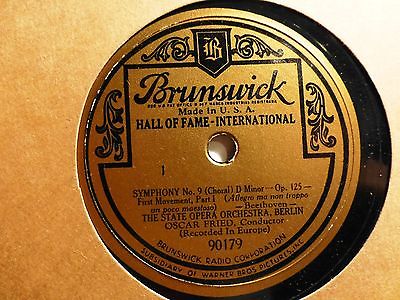
1928 OSKAR FRIED BEETHOVEN 9th CHORAL SYMPHONY LAMINATED Leonard Eug Transky78
$
28


Favourite Auctions
To save auctions to your favourites, please login
If you don't have an account, please register
Description
Please wait for me to send you an invoice. DO NOT USE EBAY CHECKOUT if you want the lowest possible postage.
Welcome to my auctions of great records
This is my FINAL WEEK of 2 weeks of great auctions – I WILL PACK AND BILL YOUR RECORDS after the close of these auctions on MARCH 12. KINDLY ALLOW UP TO 48hrs for packing and billing to get you the exact postage.
PLEASE DO NOT PAY before I send you an invoice. It will take me up to 48 hours to pack your records, but this is the ONLY WAY to get you the LOWEST POSTAGE. If you pay before I sent you an invoice, the EBAY system will charge you a HIGHER POSTAGE for shipping.
I am currently selling a series of great classic European 78 rpm orchestral recordings on all the great European labels:
The Great Beethoven Centenary - instigated by British Columbia - culminated in a week of worldwide Beethoven celebrations in the last week of March 1927.
This also lead to an unprecedented recording effort by Columbia - the symphonies, concertos and many quartets, and by DEUTSCHE Gramophone with the symphonies and concertos, and a large part of the piano sonatas by Wilhelm Kempff.
Part of the Beethoven Centenary is Deutsche Grammophon's first electric recording of Beethovens 9th symphony in early 1928 by the great conductor Oskar Fried and some of the finest singers in Berlin:
Berlin State Opera Orchestra and the
Bruno Kittel Choir
Bass Wilhelm Guttmann,
Soprano Lotte Leonard,
Contralto Jenny Sonnenberg,
Tenor Eugen Transky
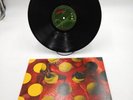
7x exquisite quiet US BRUNSWICK 12" direct pressings from the Deutsche Grammophon Matrices78 rpm , NO ALBUM
All but 1/2 5/6 are late COLUMBIA VIVATONAL LAMINATED PRESSINGS
Condition Records: 1/2 EXCELLENT but halfmoon crack on 2 first 7 mm causes light clicks, plays very quiet
3/4 EXCELLENT MINUS< faint needle run, but deep scratch on 4, very quiet some clicks
5/6 Excellent rare tiny blister, plays very quiet
7/8 EXCELLENT MINUS, light short scratches on 8 very quiet rare ticks
9 to 12 Excellent , scuffs plays very quiet
13/14 EXCELLENT MINUS, scuffed plays very quiet rare ticks
Oskar Fried (1871-1941) had already inscribed his name among the immortals of the recording industry with his first inscriptions of the Mahler Second and Bruckner Seventh for the acoustic process. Fried’s style conjoins an uncompromising sense of directional tempo coupled with an exquisite sensitivity to inner lines, even at the expense of the continuity of melodic flow. The nervous energy of Fried’s performances has been well documented; perhaps the most famous among them are his Liszt Mazeppa and Saint-Saens’ Danse Macabre, not to mention his 1937 Symphonie Fantastique from Russia. Fried’s reminiscence of Mahler mirrors a degree of self-confession, of messianic character, Fried’s calling him “superhumanly pure. A redeemer of his profession.”
Careful attention to string articulation permeates the two opening movements of Fried‘s Ninth, whether to accentuate the melodic pulse or to hone the effects of syncopations. The tremolandi of the first movement bring chills up our auditory spines. Fried foregoes the repeat of the Scherzo’s opening material, but his flute, oboe, and horn contributions, abetted by inflamed strings, carry the propulsion forward with delicate but resilient resolve. The Fried sense of rubato I find thoroughly unique and consistently mysterious. His elastic rhythmic sense makes him electrifying as a musical artist, but impossible to predict. That he could compel the BSOO and Berlin Philharmonic to follow him argues for a loyalty and musical affinity that cannot easily be reduced to any single element.
The Adagio movement permits Fried an expanse for whatever “mystical” visions he could project; one might consider his generous feelings for Scriabin in this respect. The shifting rhythms in the evolution of the movement would seem to argue against any “consistent,” exalted vision, but the double-theme-and-variations arch Fried erects has its inimitable and inexorable logic. The sheer plastic intensity of the woodwind and French horn parts must have demanded considerable preparation to achieve their sustaining power and breath control. The occasional slides and portamento connect Fried to his Nineteenth Century roots, the very heart of the Romantic sensibility, despite his modernist sympathies. Listen to the last two minutes of the Adagio several times and savor the string pizzicati and tympanic beats.
A vigorous, even savage, Presto opens the fourth movement, followed by its musical retrospective past thematic materials. Fried molds the orchestral recitative phrase by phrase, searching for the musical five-note phrase that will culminate in the shedding of instrumental music for “more human tones.” The brass section shines particularly bright in the full throttle of the main theme; then, bass Wilhelm Guttmann enters with an articulate statement of Schiller’s credo. The vocal quartet emanates clear brilliance, with the two top voices, those of Leonard and Transky, bright and soaring. The Bruno Kittel Choir, which would assume more fame in its work with Wilhelm Furtwangler, responds with resonant, authoritative power. Janissary wit marches its way via tenor Eugen Transky, his diction pungent. Fried’s ensuing counterpoint speaks volumes for his control over the bass parts, virtually the formerScherzo in miniature.
At “Seid umschlungen millionen. . .” we reach the dramatic “slow” movement of the Finale, with Fried’s imposing a dirge-like weight upon the mass of sound, the horns seeming to intone a Tuba mirum below the plaintive voices. The “organ” pedal in the bass bestows an even more antique or motet sensibility upon the proceedings, breaking out as they do into a massive polyphony of lachrymose humanity’s beseeching for “Paradise Regained.” The spirited recollection of “Joy, Daughter of Elysium” fused with that “magic” of men’s transfigured hearts rouses us to a secular, if not religious, faith in the power of song. Given the context of political Germany in 1928, we can well appreciate the act of contrition this performance represents for the conductor and his Orphic vision ofmusic as a moral force. Splendid restoration makes the impact of this Ninth rendition quite sensational.
Oskar Fried was an important German conductor in the pre-war years of the twentieth century, and a composer of interest. Being from a poor family, he was unable to complete his Gymnasium studies as a young man. He supported himself as a violinist and horn player in a town band in a Berlin suburb. In 1889, he went to Frankfurt and became horn player in the opera orchestra there. After that, he had a succession of other orchestral jobs and
in the meantime, his interest in composition grew.
In 1904, he had a major premiere when Karl Muck conducted the Berlin Philharmonic Orchestra and the chorus of the Wagnerverein in Fried's Das trunkene Lied. This favorable premiere attracted a great deal of notice. He set the poem VerklSrte Nacht for solo voices and orchestra (the same poem being the inspiration for a famous work for string instruments by Arnold Schoenberg). As a composer, his major field was the lied. He showed a progress from solid tonality to a more unstable harmonic organization, but then shifted toward a newer sort of use of diatonic triads over long-held pedals. Fried's initial successes as a composer led to him being invited to conduct. In 1905, he led the Neuen Konzerte in Berlin, in 1907 he became conductor of the Gesellschaft der Musikfreunde, and in 1908 he led the Blnthnerorchester. In 1913, he gave up composition in favor of conducting.
Fried was known for championing the music of Gustav Mahler, who was a friend, and was said to have retained Mahler's interpretive style. He was one of the few conductors who retained all of Mahler's completed symphonies in his repertory. He also was interested in the new music of his time, including the works of Debussy, Sibelius, Delius, Richard Strauss, and Stravinsky. In 1934, after the Nazis took power in Germany, he emigrated to the Soviet Union where he was appointed conductor of the Tbilisi Opera House in Soviet Georgia. Later, he became chief conductor of the All-Union Radio Orchestra in Moscow. He took Soviet citizenship in 1940 but died the next year.
More Great Records on sale right now:
http://shop.ebay.com/carsten_sf/m.html
http://shop.ebay.com/carsten_sf/m.html
====
A Quick NOTE ON GRADING AND SHIPPING:
As you can see from my feedback, I try hard to earn your POSITIVE FEEDBACK and FIVE STAR RATINGS.
If for any reason your transaction was NOT SATISFACTORY, pls contact me and I will work something out with you. YOU WILL NEVER HAVE A REASON TO GIVE ME A NEGATIVE RATING or a LOW STAR RATING.
Quick note on grading:
The Grade (Excellent to Fair, I don't give Mint) refers to the WEAR of the record. Any other defects are stated separately
When I listen to a record, I may also give it an aural grade (again E to F), and make a SUBJECTIVE judgment of the pressing quality for hiss and surface noise.
"SUPERQUIET" is basically noiseless, like a vinyl pressing.
"VERY QUIET" is an quiet record for a given pressing.
"Quiet" is a record that is a great example without undue noise for a give pressing.
These judgments are SUBJECTIVE and will depend one the styli, phonograph etc. you use on your own equipment.
If you win multiple items, pls send me an INVOICE REQUEST to calculate the correct postage. Ebay check out will not give you the multiple item discount!
Records will be packed safely between corrugated cardboard in a sturdy box with plenty of padding for safe shipment.
Shipment is usually Media Mail, unless another service is requested. Shipping is at your risk, I will be happy to insure items at your cost.
I charge actual postage plus a small fee for packing materials
As always, I guarantee your satisfaction. If you don't like the item, just return it, and I will refund the full purchase price.
If you are in the San Francisco area, I encourage pick-up in person.
US Domestic Shipping:
Here is a guideline for US Media Mail Shipping:
Prices below are for regular 78 rpm records. Up to about 5 records, I will ship Edison Discs for the same rates. Albums from Album Sets count as 1 record. Above that and for international shipments, it will be actual weight plus a small packing charge (1-3$ depending on size of shipment)
1 record: 4.50 – 5.00$
2 records: 5.75$
5 records: 7.50$
10 records: 9.50$
MANY MORE RECORDS: Don't worry. I safely ship 40 - 50 pounds of records double boxed in moving boxes, and even then Media Mail will probably not exceed 30$.
Please send me a message if you would like to lower your shipping rates!
International Buyers:
I am very happy to ship records worldwide.
Please use the EBAY shipping cost only as a guideline. My actual charges are usually lower
International shipping: approx postage 1x10"=$25: 1x12"=$35: 10"Album 4 Rec=50$: 12" Album 2 Rec=50$
HOWEVER in most cases I can get you SIGNIFICANT savings by using other services. Pls contact me for a quote.
About 30% less to Canada.
Pls contact me for a shipping estimate, or send me an invoice request after close of auction.
AND AGAIN -THANK YOU FOR YOUR INTEREST
As you can see from my feedback, I take great care in presenting, grading and shipping your items. I really want you to be happy with the purchase. If you feel that anything is wrong with the item or the shipping, contact me and we will work it out !!!
As always, I would appreciate any suggestions and corrections from you, pls contact me with any question.
Thank you very much, and good luck bidding !!!
price rating