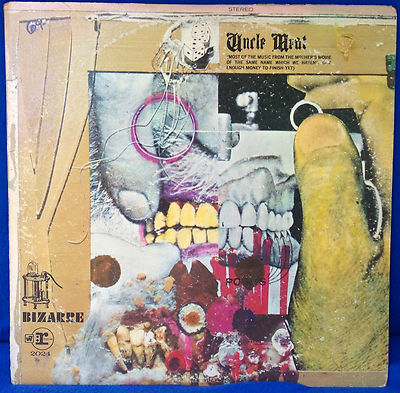
MOTHERS OF INVENTION ZAPPA UNCLE MEAT ORIG 1A 1A... GATEFOLD W. BOOKLET SOME SPL
$
28


Favourite Auctions
To save auctions to your favourites, please login
If you don't have an account, please register
Description
Be sure to add me to your favorites list! Check out my other items!;Check me out on YouTube
Kevin's Live Music Video Vault!
Combined payment/shipping discount: Pay standard USPS Media Mail rate for largest item, and then pay only $1.00 for each additional LP/CD within 3 days. Free shipping on comined orders of $30.00 or more for single packed box within 3 days.
J The Psychedelic Artwork is not for sale!! Just for fun!! J Artist Mothers of Invention - Frank Zappa Album Uncle Meat Cover Condition VG Gatefold Seam Splits Yes, both covers about half, but basically the only thing wrong with the record Writing small "69" marker in top left corner Discoloration minimal Ring Wear Barely visable Stickers No Vinyl Condition VG Scratches very clean, minor visual Writing on label No Warped No Experimental Rock, Avant-Prog, Jazz-Rock, Spoken Word, Musique concrète, Third Stream, Satire, Experimental, Film Soundtrack, Soundtracks I always rate my records down one level than I feel they should be, due to opinion differences. Please note that I can not possibly play test every LP. If there are any problems, please let me know, as my return policy is fair. CDs are rated NM if opened but played no more than once. J Jmore images
Mothers Of Invention, The* ?– Uncle Meat
Label: Bizarre Records – 2MS 2024, Bizarre Records – 2024 Format: 2 × Vinyl, LP, AlbumCountry: US Released: 1969 Genre: Jazz, Rock Style: Alternative Rock, Musique Concrète, Avantgarde, Fusion, Doo Wop, Experimental, Parody
Tracklist?
A1 Uncle Meat: Main Title Theme 1:54 A2 The Voice Of Cheese 0:27 A3 Nine Types Of Industrial Pollution 5:56 A4 Zolar Czakl 0:57 A5 Dog Breath, In The Year Of The Plague 5:51 A6 The Legend Of The Golden Arches 1:24 A7 Louie Louie (At The Royal Albert Hall In London) 2:28 A8 The Dog Breath Variations 1:36 B1 Sleeping In A Jar 0:49 B2 Our Bizarre Relationship 1:05 B3 The Uncle Meat Variations 4:40 B4 Electric Aunt Jemima 1:53 B5 Prelude To King Kong 3:24 B6 God Bless America (Live At The Whisky A Go Go) 1:22 B7 A Pound For A Brown On The Bus 1:29 B8 Ian Underwood Whips It Out (Live On Stage In Copenhagen) 5:08 C1 Mr. Green Genes 3:10 C2 We Can Shoot You 1:48 C3 "If We'd All Been Living In California . . . " 1:29 C4 The Air 2:57 C5 Project X 4:47 C6 Cruising For Burgers 2:19 D1 King Kong Itself (As Played By The Mothers In A Studio) 0:53 D2 King Kong (Its Magnificence As Interpreted By Dom DeWild) 1:15 D3 King Kong (As Motorhead Explains It) 1:44 D4 King Kong (The Gardner Varieties) 6:17 D5 King Kong (As Played By 3 Deranged Good Humor Trucks) 0:29 D6 King Kong (Live On A Flat Bed Diesel In The Middle Of A Race Track At A Miami Pop Festival . . . The Underwood Ramifications) 7:25Credits?
- Design [Package Designed By] – Cal Schenkel
- Drums – Jimmy Carl Black
- Drums [Some Tracks] – Billy Mundi
- Drums, Timpani, Vibraphone, Marimba, Xylophone, Wood Block, Bells, Chimes [Small] – Art Tripp
- Electric Bass – Roy Estrada
- Electric Piano – Don Preston
- Engineer – Richard Kunc*, Jerry Hansen
- Guitar, Vocals [Low Grade], Percussion – Frank Zappa
- Marimba, Vibraphone [Many Tracks] – Ruth Komanoff
- Organ [Electric], Piano, Harpsichord, Celesta, Flute, Clarinet, Alto Saxophone, Baritone Saxophone – Ian Underwood
- Percussion [Effects] – Jerry Hansen
- Piccolo Flute, Clarinet, Flute, Bass Clarinet, Soprano Saxophone, Alto Saxophone, Tenor Saxophone, Bassoon – Bunk Gardner
- Producer – Frank Zappa
- Soprano Vocals – Nelcy Walker (tracks: A5, B3), Ray* (tracks: A5, B3), Roy* (tracks: A5, B3)
- Tenor Saxophone, Tambourine – Motorhead Sherwood
- Vocals – Ray Collins
- Written-By – Frank Zappa
- Written-by [Uncredited] – Irving Berlin (tracks: B6), Richard Berry (tracks: A7)
Notes?
Original Bizarre/Reprise Records release.
Issued with gatefold jacket, 12 page color booklet (drawings, photos, paintings), and Bizarre label inner sleeve's.
First cat.nr. on labels and spine, second on front cover and inside the gatefold.
Recorded at Apostolic Studios, NYC
October 1967-February 1968
Percussion overdubs at Sunset Sound, LA
March-April, 1968
__________________________________________________
Original liner notes read...
THE MOTHERS at the time of this recording were:
FRANK ZAPPA - guitar, low grade vocals, percussion
RAY COLLINS - swell vocals
JIMMY CARL BLACK - drums, droll humor, poverty
ROY ESTRADA - electric bass, chesseburgers, Pachuco falsetto
DON (Dom De Wild) PRESTON - electric piano, tarot cards, brown rice
BILLY (The Oozer) MUNDI - drums on some pieces before he quit to join RHINOCEROS
BUNK (Sweetpants) GARDNER - piccolo, flute, clarinet, bass clarinet, soprano sax, alto sax, tenor sax, bassoon (all of these electric and/or non-electric depending)
IAN UNDERWOOD - electric organ, piano, harpsichord, celeste, flute, clarinet, alto sax, baritone sax, special assistance, copyist, industrial relations & teen appeal
ARTIE (With the Green Mustache) TRIPP - drums, timpani, vibes, marimba, xylophone, wood blocks, bells, small chimes, cheerful outlook & specific enquiries
EUCLID JAMES (Motorhead/Motorishi) SHERWOOD - pop star, frenetic tenor sax stylings, tambourine, choreography, obstinance & equipment setter-upper when he's not hustling local groupies
The music on this album was recorded over a period of about 5 months from October 1967 to February 1968. Things that sound like a full orchestra were carefully assembled, track by track through a procedure known as over-dubbing. The weird middle section of DOG BREATH (after the line , "Ready to attack") has forty tracks built into it. Things that sound like trumpets are actually clarinets played through an electric device made by Maestro with a setting labeled Oboe D'Amore and sped up a minor third with a V.S.O. (variable speed oscillator). Other peculiar sounds were made on a Kalamazoo electric organ. The only equipment at our disposal for the modification of these primary sounds was a pair of Pultec Filters, two Lan Equalizers, and three Melchor Compressors built into the board at Apostolic Studios in New York. The board itself is exceptionally quiet and efficient (the only thing that allowed us to pile up so many tracks) and is the product of Mr Lou Lindauer's imagination & workmanship. The material was recorded on a prototype Scully 12 track machine at 30 ips. The whole project was engineered by Richard Kunc or Dynamite Dick, as he is known to the trade. Special engineering credits go to Jerry Hansen for the percussion effects added later at Sunset Sound in L.A., and to our friend Mike in Copenhagen for the tapes he sent us.
Special thanks to:
Ruth Komanoff who plays marimba and vibes with Artie on many of the tracks, and
Nelcy Walker the soprano voice with Ray & Roy on Dog Breath & The Uncle Meat Variations
__________________________________________________
Uncredited:
Pamela Zarubica as Suzy Creamcheese
Barcode and Other Identifiers?
- Other (Runout, Side I): 30871 MS2024A -1A
- Other (Runout, Side IV): 30874 MS2024D -1A
- Other (Runout, Side II): 30872 MS2024B -1A
- Other (Runout, Side III): 30873 MS2024C -1A
- Other (Runout, all sides): T
- Other (Runout, all sides): 1
review
[-]by Steve HueyJust three years into their recording career, the Mothers of Invention released their second double album,Uncle Meat, which began life as the largely instrumental soundtrack to an unfinished film. It's essentially a transitional work, but it's a fascinating one, showcasing Frank Zappa's ever-increasing compositional dexterity and the Mothers' emerging instrumental prowess. It was potentially easy to overlook Zappa's melodic gifts on albums past, but on Uncle Meat, he thrusts them firmly into the spotlight; what few lyrics there are, Zappa says in the liner notes, are in-jokes relevant only to the band. Thus, Uncle Meatbecame the point at which Zappa began to establish himself as a composer and he would return to many of these pieces repeatedly over the course of his career. Taken as a whole, Uncle Meat comes off as a hodgepodge, with centerpieces scattered between variations on previous pieces, short concert excerpts, less-realized experiments, doo wop tunes, and comedy bits; the programming often feels as random as the abrupt transitions and tape experiments held over from Zappa's last few projects. But despite the absence of a conceptual framework, the unfocused sprawl of Uncle Meat is actually a big part of its appeal. It's exciting to hear one of the most creatively fertile minds in rock pushing restlessly into new territory, even if he isn't always quite sure where he's going. However, several tracks hint at the jazz-rock fusion soon to come, especially the extended album closer "King Kong"; it's his first unequivocal success in that area, with its odd time signature helping turn it into a rhythmically kinetic blowing vehicle. Though some might miss the gleeful satire of Zappa's previous work with the Mothers, Uncle Meat's continued abundance of musical ideas places it among his most intriguing works.
Billboard Albums
Year Album Chart Peak 1969 Uncle Meat The Billboard 200 43biography
[-]by Rovi This celebrated band was formed in 1964 when guitarist Frank Zappa (b. Frank Vincent Zappa, 21 December 1940, Baltimore, Maryland, USA, d. 4 December 1993, Los Angeles, California, USA) replaced Ray Hunt in the Soul Giants, a struggling R&B-based bar band. Ray Collins (b. 19 November 1937, USA; vocals), Dave Coronado (saxophone), Roy Estrada (b. 17 April 1943, Santa Ana, California, USA; bass) and Jimmy Carl Black (b. 1 February 1938, El Paso, Texas, USA; drums) completed their early line-up, but Coronado abandoned the outfit when the newcomer unveiled his musical strategy. Now renamed the Mothers, the quartet was relocated from Orange County to Los Angeles where they were briefly augmented by several individuals, including Alice Stuart and Henry Vestine, later guitarist in Canned Heat. Jim Fielder was another bass player who passed through the ranks. He actually joined Buffalo Springfield before he had officially handed in his notice. These temporary additions found Zappa’s vision daunting as the Mothers embarked on a disarming mélange of 50s pop, Chicago R&B and avant garde music. They were embraced by the city’s nascent Underground before an appearance at the famed Whiskey A Go-Go resulted in a recording contract when producer Tom Wilson caught the end of one of their sets. Now dubbed the Mothers Of Invention, owing to pressure from the record company, the band added guitarist Elliott Ingber (Winged Eel Fingerling) before commencing Freak Out!, rock music’s first double album. This revolutionary set featured several exceptional pieces including ‘Trouble Every Day’, ‘Hungry Freaks, Daddy’ and ‘The Return Of The Son Of Monster Magnet’, each of which showed different facets of Zappa’s evolving tableau. The Mothers second album, Absolutely Free, featured a radically reshaped line-up. Ingber was fired at the end of 1966 while Zappa added a second drummer, Billy Mundi, plus Don Preston (b. Donald Ward Preston, 21 September 1932, Flint, Michigan, USA; keyboards), Bunk Gardner (horns) and Jim ‘Motorhead’ Sherwood (saxophone) to the original nucleus. A six-month residency at New York’s Garrick Theater combined spirited interplay with excellent material and the set showed growing confidence. Satire flourished on ‘Plastic People’, ‘America Drinks & Goes Home’ and ‘Brown Shoes Don’t Make It’, much of which was inspired by the ‘cocktail-bar’ drudgery the band suffered in its earliest incarnation. However, Zappa’s ire was more fully flexed on We’re Only In It For The Money, which featured several barbed attacks on the trappings of ‘flower-power’. Housed in a sleeve which cleverly mocked the Beatles’ Sgt. Peppers Lonely Hearts Club Band, the set included ‘The Idiot Bastard Son’ (‘The father’s a Nazi in Congress today, the mother’s a hooker somewhere in LA’) and ‘Who Needs The Peace Corps’ (‘I’ll stay a week and get the crabs and take a bus back home’) and indicated Zappa’s growing fascination with technology. The album also introduced new member Ian Underwood (saxophone/keyboards), who became an integral part of the band’s future work. Cruising With Ruben & The Jets was, to quote the liner notes, ‘an album of greasy love songs and cretin simplicity’. Despite such cynicism, the band displayed an obvious affection for the 50s doo-wop material on offer, all of which was self-penned and included re-recordings of three songs, ‘How Could I Be Such A Fool’, ‘Any Way The Wind Blows’ and ‘You Didn’t Try To Call Me’, first aired on Freak Out! However, the album was the last wholly new set committed by the ‘original’ line-up. Later releases, Uncle Meat (a soundtrack to the then unmade movie), Burnt Weeny Sandwich and Weasels Ripped My Flesh, were all compiled from existing live and studio tapes as tension within the band pulled it apart. The musicians enjoyed mixed fortunes. Estrada joined newcomer Lowell George (b. Lowell Thomas George, 13 April 1945, Hollywood, California, USA, d. 29 June 1979, Arlington, Virginia, USA) in Little Feat, third drummer Arthur Dyre Tripp III switched allegiance to Captain Beefheart, while Jimmy Carl Black formed Geronimo Black with brothers Buzz and Bunk Gardner. A new Mothers was formed in 1970 from the musicians contributing to Zappa’s third solo album, Chunga’s Revenge, and the scatological ‘on the road’ documentary, 200 Motels. Three former Turtles, Mark Volman (b. 19 April 1947, Los Angeles, California, USA), Howard Kaylan (b. Howard Kaplan, 22 June 1947, the Bronx, New York City, New York, USA) and Jim Pons (b. 14 March 1943, Santa Monica, California, USA; bass) joined Aynsley Dunbar (b. 10 January 1946, Liverpool, England; drums) and long-standing affiliates Ian Underwood and Don Preston in the band responsible for Live At The Fillmore East, June 1971. Here, however, the early potpourri of Stravinsky, John Coltrane, doo-wop and ‘Louie Louie’ gave way to condescending innuendo as Zappa threatened to become the person once the subject of his ire. Paradoxically, it became the band’s bestselling album to date, setting the tone for future releases and reinforcing the guitarist’s jaundiced view of his audience. This period was brought to a sudden end at London’s Rainbow Theatre. A ‘jealous’ member of the audience attacked the hapless Zappa onstage, pushing him into the orchestra pit where he sustained multiple back injuries and a compound leg fracture. His slow recuperation was undermined when the entire new Mothers, bar Underwood, quit en masse to form what became known as Flo And Eddie. Confined to the studio, Zappa compiled Just Another Band From L.A. and used the Mothers epithet for the jazz big band on The Grand Wazoo. Reverting to rock music, the Mothers’ name was re-established with a new, tighter line-up in 1973. However subsequent albums, Over-Nite Sensation, Roxy & Elsewhere and One Size Fits All, were indistinguishable from projects bearing Zappa’s name and this now superfluous title was abandoned in 1975, following the release of Bongo Fury, a collaboration with Captain Beefheart. Since Zappa’s death a number of biographies have appeared; Neil Slaven’s Electric Don Quixote is particularly noteworthy. Zappa’s entire catalogue has been expertly remastered and reissued with the advent of the compact disc. Rykodisc Records are to be congratulated for their efforts, having purchased the whole catalogue from Gail Zappa for a large, undisclosed sum. The quality of those early Mothers Of Invention recordings is by today’s standards quite outstanding.biography
[-]by William Ruhlmann Composer, guitarist, singer, and bandleader Frank Zappa was a singular musical figure during a performing and recording career that lasted from the 1960s to the '90s. His disparate influences included doo wop music and avant-garde classical music; although he led groups that could be called rock & roll bands for much of his career, he used them to create a hybrid style that bordered on jazz and complicated, modern serious music, sometimes inducing orchestras to play along. As if his music were not challenging enough, he overlay it with highly satirical and sometimes abstractly humorous lyrics and song titles that marked him as coming out of a provocative literary tradition that included Beat poets likeAllen Ginsberg and edgy comedians like Lenny Bruce. Nominally, he was a popular musician, but his recordings rarely earned significant airplay or sales, yet he was able to gain control of his recorded work and issue it successfully through his own labels while also touring internationally, in part because of the respect he earned from a dedicated cult of fans and many serious musicians, and also because he was an articulate spokesman who promoted himself into a media star through extensive interviews he considered to be a part of his creative effort just like his music. The Mothers of Invention, the '60s group he led, often seemed to offer a parody of popular music and the counterculture (although he affected long hair and jeans, Zappa was openly scornful of hippies and drug use). By the '80s, he was testifying before Congress in opposition to censorship (and editing his testimony into one of his albums). But these comic and serious sides were complementary, not contradictory. In statement and in practice, Zappa was an iconoclastic defender of the freest possible expression of ideas. And most of all, he was a composer far more ambitious than any other rock musician of his time and most classical musicians, as well. Zappa was born Frank Vincent Zappa in Baltimore, MD, on December 21, 1940. For most of his life, he was under the mistaken impression that he had been named exactly after his father, a Sicilian immigrant who was a high school teacher at the time of his son's birth, that he was "Francis Vincent Zappa, Jr." That was what he told interviewers, and it was extensively reported. It was only many years later thatZappa examined his birth certificate and discovered that, in fact, his first name was Frank, not Francis. The real Francis Zappa took a job with the Navy during World War II, and he spent the rest of his career working in one capacity or another for the government or in the defense industry, resulting in many family moves. Zappa's mother, Rose Marie (Colimore) Zappa, was a former librarian and typist. During his early childhood, the family lived in Baltimore, Opa-Locka, FL, and Edgewood, MD. In December 1951, they moved to California when Zappa's father took a job teaching metallurgy at the Naval Post-Graduate School in Monterey. The same year, Zappa had first shown an interest in becoming a musician, joining the school band and playing the snare drum. Although the Zappa family continued to live in California for the rest of Zappa's childhood, they still moved frequently; by the time Zappa graduated from Antelope Valley Joint Union High School in Lancaster in June 1958, it was the seventh high school he had attended. Meanwhile, his interest in music had grown. He had become particularly attracted to R&B, joining a band as a drummer in 1955. Simultaneously, he had become a fan of avant-garde classical music, particularly the work of Edgard Varèse. After his high school graduation, Zappa studied music at several local colleges off and on. He also switched to playing the guitar. Zappa married Kathryn J. Sherman on December 28, 1960; the marriage ended in divorce in 1964. Meanwhile, he played in bands and worked on the scores of low-budget films. It was in seeking to record his score for one of these films, The World's Greatest Sinner, that he began working at the tiny Pal recording studio in Cucamonga, CA, run by Paul Buff, in November 1961. He and Buff began writing and recording pop music with studio groups and licensing the results to such labels as Del-Fi Records and Original Sound Records. On August 1, 1964, Zappa bought the studio from Buff and renamed it Studio Z. On March 26, 1965, he was arrested by a local undercover police officer who had entrapped him by asking him to record a pornographic audiotape. Convicted of a misdemeanor, he spent ten days in jail, an experience that embittered him. After completing his sentence, he closed the studio, moved into Los Angeles, and joined a band called the Soul Giants that featured his friend, singer Ray Collins, along with bass player Roy Estrada and drummer Jimmy Carl Black. In short order, he induced the group to play his original compositions instead of covers, and to change their name to the Mothers (reportedly on Mother's Day, May 10, 1965). In Los Angeles, the Mothers were able to obtain a manager, Herb Cohen, and audition successfully to appear in popular nightclubs such as the Whiskey Go-Go by the fall of 1965. There they were seen by record executive Tom Wilson, who signed them to the Verve Records subsidiary of MGM Records on March 1, 1966. (Verve required that the suggestive name "The Mothers" be modified to "The Mothers of Invention.") The contract called for the group to submit five albums in two years, and they immediately went into the studio to record the first of those albums, Freak Out! By this time, Elliot Ingber had joined the group on guitar, making it a quintet. An excess of material and Zappa's agreement to accept a reduced publishing royalty led to the highly unusual decision to release it as a double-LP, an unprecedented indulgence for a debut act that was practically unheard, much less for an established one. (Bob Dylan's Blonde on Blonde appeared during the same period, but it was his seventh album.) Freak Out! was released on June 27, 1966. It was not an immediate success commercially, but it entered the Billboard chart for the week ending February 11, 1967, and eventually spent 23 weeks in the charts. In July 1966, Zappa met Adelaide Gail Sloatman; they married in September 1967, prior to the birth, on September 28, 1967, of their first child, a daughter named Moon Unit Zappa who would record with her father. She was followed by a son, Dweezil, on September 5, 1969. He, too, would become a recording artist, as would Ahmet Zappa, born May 15, 1974. A fourth child, Diva, was born in August 1979. During the summer of 1966, Zappa hired drummer Denny Bruce and keyboardist Don Preston, making theMothers of Invention a septet, but by November 1966, when the Mothers of Invention went back into the studio to record their second album, Absolutely Free, Bruce had been replaced by Billy Mundi; Ingberhad been replaced by Jim Fielder; and Zappa had hired two horn players, Bunk Gardner on wind instruments and Jim "Motorhead" Sherwood on saxophone, bringing the band up to a nine-piece unit. The album was recorded in four days and released in June 1967. It entered the charts in July and reached the Top 50. The Mothers of Invention moved to New York City in November 1966 for a booking at a Greenwich Village club called the Balloon Farm that began on Thanksgiving Day and ran through New Year's Day, 1967. After a two-week stint in Montreal, they returned to California, whereFielder left the group in February. In March, Zappa began recording his first solo album, Lumpy Gravy, having signed to Capitol Records under the impression that he was not signed as an individual to Verve, a position Verve would dispute. Later that month, the Mothers of Invention returned to New York City for another extended engagement at the Garrick Theater in Greenwich Village that ran during Easter week and was sufficiently successful that Herb Cohen booked the theater for the summer. That run began on May 24, 1967, and ran off and on through September 5. During this period, Ian Underwoodjoined the band, playing saxophone and piano. In August, the group began recording its third album,We're Only in It for the Money. In September 1967, the Mothers of Invention toured Europe for the first time, playing in the U.K., Sweden, and Denmark. On October 1, Verve failed to exercise its option to extend the band's contract, although they still owed the label three more LPs. They finished recording We're Only in It for the Money in October, but its release was held up because of legal concerns about its proposed cover photograph, an elaborate parody of the Beatles' Sgt. Pepper's Lonely Hearts Club Band, which was finally resolved by putting the picture on the inside of the fold-out LP sleeve. We're Only in It for the Money was released on March 4, 1968, and it reached the Top 30. Another legal dispute was resolved when Verve purchased the tapes of Lumpy Gravy from Capitol. Zappa then finished recording this orchestral work, and Verve released it under his name (and that of "the Abnuceals Emuukha Electric Symphony Orchestra and Chorus") on May 13, 1968; it spent five weeks in the charts. Although the Mothers of Invention still owed one more LP to Verve,Zappa already was thinking ahead. In the fall of 1967, he began recording Uncle Meat, the soundtrack for a proposed film, with work continuing through February 1968. During this period, Billy Mundi left the band and was replaced on drums by Arthur Dyer Tripp III. In March, Zappa and Herb Cohen announced that they were setting up their own record label, Bizarre Records, to be distributed by the Reprise Records subsidiary of Warner Bros. Records. The label was intended to record not only the Mothers of Invention, but also acts Zappadiscovered. Early in the summer, Ray Collins quit the Mothers of Invention, who continued to tour. Their performance at the Royal Festival Hall in London on October 25, 1968, was released in 1991 as the album Ahead of Their Time. That month, Bizarre was formally launched with the release of the single "The Circle," by Los Angeles street singer Wild Man Fischer. In November, guitarist Lowell George joined the Mothers of Invention. In December, Verve released the band's final album on its contract, Cruisin' with Ruben & the Jets, on which Zappa for once played it straight, leading the group through a set of apparently sincere doo wop and R&B material. The LP spent 12 weeks in the charts. (Zappa was then free of Verve, although his disputes with the company were not over. Verve put out a compilation, Mothermania: The Best of the Mothers, in March 1969, and it spent nine weeks in the charts.) The ambitious double-LP Uncle Meat, the fifth Mothers of Inventionalbum, was released by Bizarre on April 21, 1969. It reached the Top 50. (The movie it was supposed to accompany did not appear until a home video release in 1989.) In May, Bizarre released Pretties for You, the debut album by Alice Cooper, the only act discovered by the label that would go on to substantial success (after switching to Warner Bros. Records proper, that is).The same month, Lowell George left the band; later, he and Roy Estrada would form Little Feat. Zappa began working on a second solo album, Hot Rats, in July 1969. On August 19, theMothers of Invention gave their final performance in their original form, playing on Canadian TV at the end of a tour. One week later, Zappa announced that he was breaking up the band, although, as it turned out, this did not mean that he would not use the name "the Mothers of Invention" for groups he led in the future. Hot Rats, the second album to be credited to Frank Zappa, was released on October 10, 1969. It spent only six weeks in the charts at the time, but it would become one of Zappa's best-loved collections, with the instrumental "Peaches en Regalia" a particular favorite. Although the Mothers of Invention no longer existed as a performing unit, Zappa possessed extensive tapes of them, live and in the studio, and using that material, he assembled a new album, Burnt Weeny Sandwich, released in February 1970; it made the Top 100. At the invitation of Zubin Mehta, conductor of the Los Angeles Philharmonic Orchestra, Zappa assembled a new group of rock musicians dubbed the Mothers for the performance, with the orchestra, of a work called 200 Motels at UCLA on May 15, 1970. Adding singersHoward Kaylan and Mark Volman, formerly of the Turtles, Zappalaunched a tour with this version of the Mothers in June 1970. (Also included were a returning Ian Underwood, keyboardist George Duke, drummer Aynsley Dunbar, and guitarist Jeff Simmons.) In August, Bizarre released another archival Mothers of Invention album, Weasels Ripped My Flesh, which charted. Chunga's Revenge, released in October, was billed as a Zappa solo album, even though it featured the current lineup of the Mothers; it spent 14 weeks in the charts. After touring the U.S. that fall, the group went to Europe on December 1. From January 28 to February 5, 1971, they were in Pinewood Studios in the U.K. making a movie version of 200 Motels with the Royal Philharmonic Orchestra and co-stars Theodore Bikel, Ringo Starr, and Keith Moon of the Who. Zappa had planned a concert with the Royal Philharmonic at the Royal Albert Hall on February 8 as a money-saving tactic, since according to union rules, he could then pay them for the filming/recording session as if it were rehearsals for the concert. But this strategy backfired when the Royal Albert Hall canceled the concert, alleging that Zappa's lyrics were too vulgar. He added to his expenses by suing the Royal Albert Hall, eventually losing in court. On June 5 and 6, 1971, the Mothers appeared during the closing week of the Fillmore East theater in New York City, recording their shows for a live album, Fillmore East, June 1971, quickly released on August 2. It became Zappa's first album to reach the Top 40 since We're Only in It for the Money three years earlier. John Lennon and Yoko Ono had appeared as guests during the June 6 show, and they used their performance on their 1972 album Some Time in New York City. the Mothers gave a concert at the Pauley Pavilion at UCLA on August 7, 1971, and the show was recorded for the album Just Another Band from L.A., released in May 1972, which made the Top 100. They continued to tour into the fall. 200 Motels premiered in movie theaters on October 29, 1971, with a double-LP soundtrack album released by United Artists that made the Top 100. Meanwhile, the Mothers' European tour was eventful, to say the least. On December 4, 1971, the group appeared at the Montreux Casino in Geneva, Switzerland, but their show stopped when a fan fired off a flare gun that set the venue on fire. The incident was the inspiration for Deep Purple's song "Smoke on the Water." Six days later, asthe Mothers were performing at the Rainbow Theatre in London on December 10, a deranged fan jumped on-stage and pushed Zappa into the orchestra pit. He suffered a broken ankle, among other injuries, and was forced to recuperate for months. This was the end both of the tour and of this edition of the Mothers. While convalescing at home in Los Angeles, Zappa organized a new big band to play jazz-fusion music; he dubbed it the Grand Wazoo Orchestra and recorded two albums with it. Waka/Jawaka, billed as aZappa solo album, came out in July 1972 and spent seven weeks in the charts. The Grand Wazoo, credited to the Mothers, appeared in December and missed the charts. By September 10, Zappa felt well enough to play two weeks of dates with the group, now billed as the Mothers, starting at the Hollywood Bowl. He then cut the personnel down to ten pieces (the "Petit Wazoo" band) and toured from late October to mid-December. The start of 1973 marked a new and surprisingly popular phase inZappa's career. He assembled a new lineup of Mothers, made a batch of new recordings on which he himself sang lead vocals (his voice having dropped half an octave as a result of injuring his neck when he was thrown from the stage), and hit the road for the most extensive touring of his career. Inaugurating the new band in Fayetteville, NC, on February 23, he spent 183 days of 1973 on the road, including tours of the U.S., Europe, and Australia. Meanwhile, the Bizarre Records deal with Reprise/Warner had run out, and he launched a new label, also distributed by Warner, DiscReet Records, its first release being Over-Nite Sensation in September 1973. The album reached the Top 40, stayed in the charts nearly a year, and went gold. It was followed in April 1974 by a Zappa solo album, Apostrophe (‘). Much to Zappa's surprise, radio stations began playing a track called "Don't Eat the Yellow Snow." A single edit of the song actually spent several weeks in the lower reaches of the Hot 100, and Apostrophe (‘) peaked at number ten for the week ending June 29, 1974, the highest chart position ever achieved by a Zappa album. The LP also went gold. Zappa continued to tour extensively in 1974. His next album, the double-LP live collection Roxy & Elsewhere, credited to "Zappa/Mothers," appeared in September 1974 and made the Top 30. Adding his old friend Captain Beefheart to the band, he played shows at the Armadillo World Headquarters in Austin, TX, on May 20 and 21, 1975, that he recorded for the album Bongo Fury, credited to Frank Zappa/Captain Beefheart/the Mothers, released in October; it made the Top 100. Prior to that had come One Size Fits All, credited to Frank Zappa & the Mothers of Invention, released in June; it made the Top 30. On September 17 and 18, 1975, two concerts of Zappa's orchestral music were performed by a group dubbed the Abnuceals Emuukha Electric Symphony Orchestra (in memory of Lumpy Gravy) and conducted by Michael Zearott at Royce Hall, UCLA. The shows were recorded, but the material was not released until May 1979 as Orchestral Favorites, which spent several weeks in the charts. Starting on September 27, 1975, Zappa launched another extended period of touring, staying in the U.S. through a New Years concert at the Forum in Los Angeles, then playing in Australia, Japan, and Europe, finishing on March 17, 1976. This ended another phase in his career. He split with his longtime manager Herb Cohen and disbanded his group, which, because of legal disputes with Cohen, would turn out to have been the last one called the Mothers or the Mothers of Invention. Hereafter, he would perform and record simply as Frank Zappa. There were also other legal issues. In October 1976, he reached an out-of-court settlement in a suit he had waged against MGM/Verve that resulted in his winning the rights to the masters of his early albums. Zappa surprised fans when his name turned up as the producer of a new album by Grand Funk Railroad, Good Singin', Good Playin', in August 1976. In September, he launched his first world tour under his own name, playing in the U.S., the Far East, and Europe through February 1977. Zoot Allures, the last album to be credited to the Mothers, was released on Warner Bros. Records on October 29, 1976, the DiscReet label apparently being claimed by Cohen; it reached the Top 100. Zappa was also seeking to end his deal with Warner. In March 1977, he delivered four albums to the label simultaneously (the initial titles were Studio Tan, Hot Rats III [Waka/Jawaka having counted as Hot Rats II], Zappa's Orchestral Favorites, and the double album Live in New York, recorded in December 1976); he demanded the four $60,000 advances the albums called for, and sued Warner for breach of contract when it did not pay. In the summer of 1977, he announced that he had concluded his contract with Warner. He declared that the four albums really constituted a single work called Leather(later spelled Läther), which he sold to Mercury/Phonogram Records. Warner then sued to block its release. On September 8, 1977, Zappa launched another North American tour, staying on the road until New Year's Eve. His shows from October 28-31 at the Palladium in New York City were filmed and recorded, the material later emerging in the movie Baby Snakes. The European leg of the tour opened in London on January 24, 1978. The resolutions ofZappa's legal disputes led to an unusually large number of releases over the next year. Zappa in New York (originally called Live in New York) was released on DiscReet in March 1978 and made the Top 100. Studio Tan appeared in September 1978 and charted. Sleep Dirt (originally called Hot Rats III) was released in January 1979 and charted.Orchestral Favorites completed the releases of the material Zappa had delivered to Warner in March 1977. With these matters settled, Zappa launched Zappa Records, with distribution through Mercury/Phonogram in the U.S. and CBS Records in the rest of the world, releasing the double-LP Sheik Yerbouti on March 3, 1979. The album managed to distinguish itself from all the other Zappa albums in the record bins and peaked at number 21, Zappa's best showing in five years, promoted by the single "Dancin' Fool," which made the Top 50. That track was nominated for a Grammy for Best Rock Vocal Performance (Male), and "Rat Tomago," another track on the album, got a Grammy nomination for Best Rock Instrumental Performance. Zappa toured Europe and Japan in the spring of 1979, then returned to the U.S., where he completed work on his home studio, called the Utility Muffin Research Kitchen, on September 1. The home studio and his continuing practice of recording his shows, along with greater control over his record releases, seemed to free Zappa to issue more records. Joe's Garage Act I was released in September 1979 and made the Top 30; it was followed in November by the double-LP Joe's Garage Acts II & III, which made the Top 100. Baby Snakes, the film of the 1977 Halloween shows in New York, opened on December 21, 1979. A soundtrack album did not appear until 1983. Zappa spent much of 1980 on the road, beginning a tour of North America and Europe on March 25, with dates continuing through July 3, and then touring again from October 10 through Christmas. Amazingly, Zappa did not release an album during 1980. (A single, "I Don't Wanna Get Drafter," just missed making the Hot 100 in May.) But he made up for that in 1981. In May, yet another new label, Barking Pumpkin Records, was launched with the release of a double-LP, Tinseltown Rebellion, which made the Top 100. By now, Zappa had perfected a method of melding studio and live performances on his records, such that the finished versions were a combination of the two. Also in May 1981, he simultaneously released three instrumental albums via mail order: Shut Up ‘N Play Yer Guitar, Shut Up ‘N Play Yer Guitar Some More, and Return of the Son of Shut Up ‘N Play Yer Guitar. In September came another double album, You Are What You Is, that made the Top 100. Zappa's spring/summer tour of Europe in 1982 was plagued with problems including canceled dates and even a riot at one show; after finishing the stint on July 14, he did not tour again for two years. Meanwhile, on May 3, 1982, he released a new album, Ship Arriving Too Late to Save a Drowning Witch, and it featured another of his surprise hit singles, as radio picked up on "Valley Girl," a track featuring a vocal by his daughter Moon Unit Zappa, imitating the character and employing the slang of a typical Southern California valley girl. The song peaked at number 32 on September 11, 1982, making it the most successful single of Zappa's career. It was nominated for a Grammy Award for Best Rock Performance by a Duo or Group with Vocal. The album made the Top 30. After coming off the road, Zappa concentrated on recording and on his orchestral music. On January 11, 1983, conductor Kent Nagano led the London Symphony Orchestra in a concert of Zappa's works at the Barbican Arts Centre in London, preparatory to three days of recordings that resulted, initially, in the album London Symphony Orchestra, Vol. 1, released in June 1983. (A second volume followed in September 1987.) Prior to that, Zappa had released a new rock album, The Man from Utopia, on March 28, 1983, which charted for several weeks. As he had the year before, Zappa saw some of his orchestral music recorded in January 1984, this time by the Ensemble InterContemporain of conductor Pierre Boulez. With other material, these recordings would be released by Angel Records on August 23, 1984, as Boulez Conducts Zappa: The Perfect Stranger. The other material was Zappa's own recording on an advanced synthesizer instrument he had purchased called the Synclavier, capable of replicating orchestral arrangements. The Synclavier freed Zappa from the technical limitations (and, in some cases, the objections) of live musicians, especially classical musicians, and he turned to it increasingly from this point on. Having discovered manuscripts of music composed in the 18th century by an ancestor of his, Francesco Zappa, he recorded an album of it on the Synclavier in March 1984, releasing the results on an LP called Francesco Zappa on November 21, 1984. On July 18, 1984, two years after the end of his last tour, Zappa went back on the road for an extensive, worldwide trek that ran through December 23. On October 18, he released a two-LP set, Them or Us. A month later came the triple-LP box set, Thing-Fish, on the same day as the Francesco Zappa album. By this time, Zappa's records were no longer reaching the charts, as he focused on his existing fan base, heavily marketing to them through mail order. Having re-acquired the masters to his Verve/MGM albums, he had found the tapes in dire condition and had re-recorded the bass and drum parts for the albumsWe're Only in It for the Money and Cruisin' with Ruben and the Jets, which were part of a box set he offered to his mailing list, The Old Masters Box 1, in April 1985. (The Old Masters Box 2 followed in 1986, and the series was completed with The Old Masters Box 3 in 1987.) During the year 1985, a group of wives of prominent politicians in Washington, D.C., formed the Parents Music Resource Center (PMRC) and lobbed Congress for restrictions on what they saw as obscenity in popular music. Zappa, long an opponent of censorship, became a leader of the opposition to the PMRC, and on September 19, 1985, he testified before the Senate Commerce Technology and Transportation Committee to voice his opinions. Of course, his testimony was a matter of public record, and he quickly used the recordings in an album he assembled called Frank Zappa Meets the Mothers of Prevention, released in November 1985. In January 1986, it became his 33rd and last album to reach the Billboard chart. In January 1986, a Zappa live album drawn from the 1984 tour, Does Humor Belong in Music?, was released in Europe, but quickly withdrawn. It was an accompaniment to a home video of the same name that was taken from a single date on the tour. The album was later reissued with a new mix. Meanwhile, Zappa signed a contract with the independent CD label Rykodisc to reissue his albums on CD. The reissue program was launched in the fall of the year. At the same time, Zappa released a new instrumental album largely consisting of material recorded on the Synclavier, Jazz from Hell. The album won him his first Grammy Award for Best Rock Instrumental Performance (Orchestra, Group or Soloist), and the track "Jazz from Hell" itself earned a nomination for Best Instrumental Composition. On February 2, 1988, Zappa launched what would prove to be his final tour, playing 81 dates in North America and Europe through June 9. Meanwhile, he continued to issue new recordings. In April came a double album of guitar solos in the manner of the Shut Up ‘N Play Yer Guitar series, simply called Guitar, and the first in a series of double-CD archival live recordings, You Can't Do That on Stage Anymore, Vol. 1.In typically unusual Zappa style, the series found him editing together live performances by different configurations of the Mothers and his backup bands at different times. By 1992, the series extended to six volumes. The second volume, which actually replicated a single concert performed in Helsinki in 1974, appeared in October 1988 at the same time as an album of recordings from the 1988 tour, Broadway the Hard Way. Launching a home video line, Honker, in 1989, Zappafinally issued Uncle Meat on VHS tape, along with the documentary The True Story of 200 Motels and Video from Hell. (The following year, Honker issued The Amazing Mr. Bickford, a documentary about the animator responsible for the clay animation work seen in Baby Snakes.) In May 1989, Zappapublished his autobiography, The Real Frank Zappa Book, co-authored with Peter Occhiogrosso. And in another surprising non-musical career development in 1989, Zappa began traveling to Russia as a business liaison. These efforts were extended in January 1990, when he went to Czechoslovakia, where he met the recently installed president, playwright and Zappa fan Václav Havel, and agreed to become a trade representative for the country. Understandably, this ran afoul of the Administration of American President George Bush, however, and Zappa's role became unofficial. It's hard to say what might have come of Zappa's trade efforts with the former Soviet Union and the former Iron Curtain countries, where he was something of a cultural hero. In May 1990, he suddenly canceled scheduled appearances in Europe and returned to the U.S. due to illness. He managed to go to Czechoslovakia and Hungary in June 1991, however. In the meantime, he continued to issue volumes of theYou Can't Do That on Stage Anymore series and albums drawn from the 1988 tour, The Best Band You Never Heard in Your Life in April 1991, and Make a Jazz Noise Here in June 1991. In July 1991, in yet another unusual marketing move, he assembled a collection of eight bootleg albums that had appeared over the years and offered his own version of them (mastered directly from the bootleg LPs themselves) as a box set called Beat the Boots; the albums were also released individually, and a second Beat the Boots box was released in June 1992. Zappa was scheduled to appear in New York for a performance by a group of alumni from his bands called "Zappa's Universe" on November 7, 1991. When he was unable to attend due to illness, his children explained publicly for the first time that he was suffering from prostate cancer. He managed to fly to Germany on July 13, 1992, to work with the Ensemble Modern on a piece it had commissioned from him, The Yellow Shark, and he was present for concerts it performed in September. In October, Zappa released Playground Psychotics, an archival album of previously unreleased material from the 1970-1971 edition of the Mothers. The Yellow Shark was released in November 1993. Zappa died at age 52 on December 4, 1993. After Zappa's death, his widow sold his existing catalog outright to Rykodisc. But, like such well-established rock artists as the Grateful Dead, he had produced a tremendous archive of studio and live recordings that Gail Zappa was able to assemble into posthumous albums for his legions of fans. The first of these was the ambitiousCivilization Phaze III, which Zappa was working on in the period up to his death, released in December 1994, and other albums, either containing concerts or other material, have also appeared, along with expanded versions of previously released albums such as Freak Out!Decades after Zappa's death, this stream of releases showed no evidence of stopping, as long as Zappa fans were interested in buying.
LP New: Unopened and Mint (10 on a scale of 1 to 10)
M: Mint (9 on a scale of 1 to 10)
NM: Near Mint (8 on a scale of 1 to 10)
• VINYL: Record appears virtually flawless
• A very minor scuff and very little else can appear on the vinyl.
• It should play without any noise over the flaw. The flaw is very hard to see.
• The cover looks as close to perfect with only minor signs of wear and or age.
• Minor impressions to the cover (due to the outer edge of the vinyl resting inside) may be acceptable; however the artwork is as close to perfect as can be.
• No cut-out holes.
• Looks brand new just shrink wrap removed. VG++: Very Good Plus Plus (7 on a scale of 1 to 10)
• VINYL: Minor scuffs which are only slightly visible.
• There may be more than a few scuffs and NO Scratches
• COVER: Artwork is still as close to perfect as can be. Some impression to the cover (minor outer ring wear) but no ink wear!
• Some slight creases to the corners, but not wrinkled and obtrusive to the eye.
• The corners can show white (where the artwork pasted slick was) meaning, slight wear.
• No seam splits or writing on the cover or taped repairs can make this grade. VG+: Very Good Plus (6 on a scale of 1 to 10)
• VINYL: Record shows wear, surface scuffs, or very light scratches that don't affect one's listening experiences.
• Flaws will be noticeable to the naked eye. If the flaws don't cause any surface noise, the vinyl can still make the VG+ grade.
• Slight warps that do not affect the sound are "OK".
• COVERS: A virtually clean cover, but may have small writing on it.
• The artwork looks clean with slightly more aging. The back of the cover usually gives away the age of the cover. Flat white paper will be somewhat yellow yet no stains or mildew from water damage.
• Some minor wear to the seams or spine, but no tears or holes popping through.
• The corners will be slightly dog eared yet no crackly bends, defacing the artwork.
• May be marred by a cut-out hole, indentation or corner indicating it was taken out of print and sold at a discount.
• A VG+ cover should have no more than 3 flaws mentioned. VG: Very Good (5 on a scale of 1 to 10)
• VINYL may not look very good, but it will STILL play very good.
• Almost always some surface noise when played. Dynamics should still be excellent, overpowering the surface noise.
• Covers will look worn, used. Some seam splitting.
• Some ring wear, where the ink has begun to wear off.
• May be some writing on the cover but no large letters in magic marker
• Labels, picture sleeves and/or covers may have tape or stickers (or their residue) attached
• Can look aged and yellowish due to contaminations in the air (sometimes looking like cigarette smoke). Still it should be decent.
• Groove wear and light scratches can affect the sound (deep enough to feel with a fingernail)
• Only 2 to 3 of these problems at the same time.
G+: Good Plus (4 on a scale of 1 to 10)
G: Good (3 on a scale of 1 to 10)
• Good does not mean Bad!
• VINYL record will look worn, dull, grayish, abused, but will play through without skipping.
• Will have significant distracting surface noise, and scratches and groove wear are visible.
• COVER/SLEEVE will have seam splits, especially at the bottom or on the spine. May be scotch tape repaired, no duct tape or masking tape.
• Tape, writing, ring wear or other defects will start to overwhelm the object.
• May have large magic marker writing on the cover F: Fair (2 on a scale of 1 to 10)
• Cover will looked virtually trashed, but some artwork will still be noticed. If the artwork is worn, it is POOR and the cover is worthless.
P: Poor (1 on a scale of 1 to 10)
• VINYL record is cracked, badly warped, and won't play through without skipping or repeating.
• COVER/SLEEVE is water damaged, split on all three seams and heavily marred by wear and writing.
• The LP cover barely keeps the LP inside it. My YouTube Feature - Kevin's Live Music Video Vault http://www.youtube.com/playlist?list=PL9CE07D64936CE306 My kids newspaper project on Facebook http://www.facebook.com/pages/The-Wiki-Weekly/266866373375558?ref=hl My ebay items for sale http://www.ebay.com/sch/m.html?_sop=1&_from=&_nkw=&_dmd=2&_armrs=1&_ssn=psychedelic-kevin&_ipg=96&rt=nc
price rating