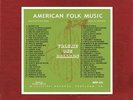
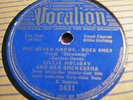
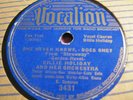
1907 ANTONIO PAOLI Puerto Rico LEONCAVALLO cond PAGLIACCI NO PAGLIACCIO NON SON
$
40


Favourite Auctions
To save auctions to your favourites, please login
If you don't have an account, please register
Description
Welcome to my new auctions of 2020. This is the FINAL WEEK of great auctions,
running until February 9th.
I will pack and bill your items after close of Feb 9th to combine them in one economical package.
Please wait for me to send you an invoice. DO NOT USE EBAY CHECKOUT if you want the lowest possible postage.
Pls shoot me a short email to request an invoice with the correct shipping charge
Rare 1908 MILAN Record of the Puerto Rican Star Tenor
Antonio Paoli.
In 1907, Pagliacci became the first opera to be recorded in its entirety, with the Puerto Rican tenor Antonio Paoli as Canio and under Leoncavallo's personal supervision.
Here the Second-to- Last Disc No 15
Antonio Paoli, NO PAGLIACCIO NON SON
Ruggero Leoncavallo cond Milan Teatro alla Scala Chorus
ORig Grand Prize Issue12" 78 rpm record
Condition:
EXCELLENT MINUS, faintest scratch, plays EXCEPTIONALLY quiet faint hiss
A GREAT COPY
Even the New York Times had good things to say about this recording:
VINTAGE 'PAGLIACCI' RETAINS ITS LUSTER
By PAUL TUROK; Paul Turok is a critic with a special interest in recorded music. Published: July 28, 1985¶ In 1892, midway through a career that had produced only mediocre rewards, Ruggiero Leoncavallo composed the opera ''Pagliacci'' to his own libretto. A hit at its Milan premiere the same year, the taut tale of adultery and revenge in a clever theatrical setting was quicklypicked up by the Vienna Opera, London's Covent Garden and New York's Metropolitan with success that still shows no signs of abating. In 1907, The Gramophone Company went to Milan and recorded the complete opera at La Scala, in the co-operative presence of Leoncavallo himself, although Carlo Sabaino actually wielded the baton. The only known complete copy of these landmark disks is in the hands of Yale University, where it was carefully taped for release by Pearl Records as a two-LP set (OPAL 826/7).
¶ The cast includes Antonio Paoli as the unhappy clown; Giuseppina Huguet as his young wife, Nedda; Ernesto Badidi as her lover, Silvio; Gaetano Pini-Corsi as Beppo, her stage lover in the play-within-a-play, and Francesco Cigada as the hunchback Tonio, whose unrequited declaration of love precipitates the tragedy. These names will be familiar to collectors of early recordings, for they were among the most respected opera singers of their time, although none of them attained the legendary status of a Scotti or Caruso. It is a wonderful performance, outclassing in every detail but recorded sound the recent release of the soundtrack to Franco Zeffirelli's film version of the opera, featuring Placido Domingo, Teresa Stratas, Alberto Rinaldi, Florindo Andreolli and Juan Pons in the same order of listing as the 1907 cast. The orchestra and chorus are again La Scala's, conducted by Georges Pretre (Philips 411 484-1, two disks).
¶ In comparing the two performances, surprises abound. The 1907 sound, poor as it may seem at first, is good enough that after becoming acclimated during the orchestral introduction, one can listen with reasonable satisfaction. The voices, in particular, emerge clearly and evenly. The La Scala orchestra, making allowances for changes in playing style as well as recording techniques, played as well in 1907 as it does now, and the La Scala chorus certainly is more precise and spirited on the old recording. Sabaino did not go on to garner a great reputation as a conductor, but his performance is faster and a good deal more taut than Pretre's, which tends to sag when not being carried by his star singers.
¶ The singing, however, provides the most fascinating comparisons. Whoever sings the role of Tonio is compensated for being a hunchback and whipped on the face by the heroine with one of the most rewarding singing roles in all opera, starting right out with the famous prologue. Both Cigada and Pons are excellent, with the latter's sound particularly beguiling on the modern recording. It takes a while to realize that if Cigada sounds so strong on a 1907 recording, he must have been remarkable in person. Like every one in the 1907 cast, his first priority seems to be the production of open-mouthed, even, well-rounded musical sounds of just the amount of power necessary to the musical line - in short, the tradition described by the overworked but still meaningful words ''bel canto.'' Dramatic vocal gestures are few and far between, compared to modern singing styles, with superb diction seemingly substituted. Domingo and Stratas, in comparison with Paoli and Huguet, are soft-edged, with the distinction between singing and vocal gestures of a dramatic nature blurred. In fact, of today's superstars, only Pavarotti's very best recordings project some of that old-time directness.
¶ The composer's presence at the 1907 recording sessions undoubtedly accounts for the almost exalted feeling of intensity. It is as if the entire cast is honored by the opportunity to immortalize themselves by being involved in the preservation of a contemporary masterpiece under its creator's aegis. There is an amazingly small range of interpretive freedoms; Leoncavallo's score is treated with respect and integrity, although several small cuts and cadential excesses obviously had become standard with the composer's approval. The modern cast gives more of a feeling of tourists looking in on a bit of local Italian color. Part of the lax impression made by Pretre's conducting may stem from his willingness to offer his singers liberties, although to their credit, they never take them in excess. A cut of some 60 bars of the last act, mostly of choral music but including a brief exchange between the illicit lovers important for the work's dramatic peroration, makes hash out of the score's integrity.

Antonio Paoli (April 14, 1871 û August 24, 1946) was a Puerto Rican tenor. He was known at the height of his fame as "The King of Tenors" and as the "Tenor of the Kings". He is considered to be the first Puerto Rican to reach international fame in the musical arts.
[edit] Early years
Paoli was born in Ponce, Puerto Rico. He was the son of Amalia Marcano Intriago, from the island of Margarita, Venezuela and of Domingo Paoli Marcatentti, from Corsica. When Paoli was young, his parents would often take him to operas at Ponce's La Perla Theater. Here, on one occasion he saw a performance by Italian tenor, Pietro Baccei, and at that moment knew what he wanted to do as an adult. His parents were very supportive of his ambition and guided him on this route during his youth, enrolling him in a school of "voice" directed by Ramon Marin. In 1883, when Paoli was only 12 years old, both his parents died and he went to live with his sister, Amalia, who was living in Spain and who was herself a singer.
Amalia Paoli
[edit] Debut
In 1884, Amalia helped Paoli to obtain two scholarships from her Majesty Queen Maria Christina, Queen Regent of Spain. Paoli started his studies at the Royal Monastery of El Escorial and in 1897, went to study at the Academia de Canto La Scala in Milan, Italy. On april 26th 1899, he made his debut in Gioacchino Rossini's opera William Tell in Paris, France. Paoli, also performed in the following countries: Argentina, Russia, Poland, Egypt, Hungary, Belgium, Cuba, Chile, Haiti, Colombia, Venezuela, Brazil, Canada and the United States.
[edit] Honors
Paoli was awarded The Cross of St. Mauricio medal by the Czar of Russia Nicholas II and in 1907, he was also decorated by Carlos I of Braganza. He was named as "Singer of the Royal Court" by William II of Germany. Paoli was the first opera artist to record an entire opera when he recorded Pagliacci by Ruggiero Leoncavallo. In 1912, he sang again in the opera Lohengrin in Vienna and received a standing ovation from the Austro-Hungarian Emperor Franz Joseph.
[edit] His return to Puerto Rico
In 1917, when World War I broke out in Europe, Paoli returned to Puerto Rico. He wanted to sing in the Metropolitan Opera House in New York, but apparently his competitor Enrico Caruso opposed this. Paoli eventually lost his fortune (2 million dollars) in bad investments and was forced to become a professional boxer in order to earn an income.
In 1922, Paoli started giving voice lessons and together with his sister, Amalia, established a school. Paoli helped produce Othello at the Municipal Theater in San Juan. In 1934, the Puerto Rican legislature honored Paoli by renaming the Municipal Theater "The Paoli Theater" and also gave him a life-time pension.
Antonio Paoli died of cancer in San Juan, Puerto Rico on August 24, 1946 and was buried in the Puerto Rico Memorial Cementery of Isla Verde. On April 13, 2005 the remains of Paoli and those of his wife Adina Bonimi (who had died in 1978) were transferred to Ponce and buried in the National Pantheon in Ponce by the base of his statue.
[edit] Music Conservatory
The Music Conservatory for which he worked so hard to establish was finally realized shortly after his death. In San Juan's "Centro de Bellas Artes" there is a 1,883 seat "Antonio Paoli Festival Hall". A book was written about Paoli by Jes·s M. L=pez: Antonio Paoli, el Le=n de Ponce; a numbered edition published by the author. However according to "Review of the Paoli Book" By Thomas Kaufman & Francois Nouvion, this book is full of mistakes, inventions and does not do justice to this great singer, It is recommended that the book be not used for research. The "Paoli Award" , founded in 1983, honor the effort, work and success of professionals dedicated to all media including: music and recording, television, radio, written communication, fashion and beauty. Originally an award designated for the outstanding achievements of Puerto Ricans, the award has branched out internationally since 1993 and now includes Hispanics and Latin Americans around the world.
More Great Records on sale right now:
https://www.ebay.com/sch/m.html?_ssn=carsten_sf&_from=R40&_nkw=&_sacat=0&_sop=1
http://shop.ebay.com/carsten_sf/m.html
====
A Quick NOTE ON GRADING AND SHIPPING:
As you can see from my feedback, I try hard to earn your POSITIVE FEEDBACK and FIVE STAR RATINGS.
If for any reason your transaction was NOT SATISFACTORY, pls contact me and I will work something out with you. YOU WILL NEVER HAVE A REASON TO GIVE ME A NEGATIVE RATING or a LOW STAR RATING.
Quick note on grading:
The Grade (Excellent to Poor, I don't give Mint) refers to the WEAR of the record. Any other defects are stated separately
When I listen to a record, I may also give it an aural grade (again E to P), and make a SUBJECTIVE judgment of the pressing quality for hiss and surface noise.
"SUPERQUIET" is basically noiseless, like a vinyl pressing.
"VERY QUIET" is an exceptionally quiet record for a given pressing.
"Quiet" is a record that is a great example without undue noise for a give pressing.
These judgments are SUBJECTIVE and will depend one the styli, phonograph etc. you use on your own equipment.
Multiple item shipping: I am happy to combine items for shipment in one parcel.
If you win multiple items, pls send me an INVOICE REQUEST to calculate the correct postage. Ebay check out will not give you the correct multiple item discount!
Records will be packed safely between corrugated cardboard in a sturdy box with plenty of padding for safe shipment.
Shipment is usually Media Mail, unless you request another service. Shipping is at your risk, I will be happy to insure items at your cost.
I charge actual postage plus a small fee for packing materials
As always, I guarantee your satisfaction. If you don't like the item, just return it, and I will refund the full purchase price.
If you are in the San Francisco area, I encourage pick-up in person.
US Domestic Shipping:
Here is a guideline for US Media Mail Shipping:
Prices below are for regular 78 rpm records. Up to about 5 records, I will ship Edison Discs for the same rates. Albums from Album Sets count as 1 record. Above that and for international shipments, it will be actual weight plus a small packing charge (1-3$ depending on size of shipment)
1 record: 4.85 – 5.75$
2 records: 6.75$
5 records: 9.00$
10 records: 12.00$
MANY MORE RECORDS: Don't worry. I safely ship 40 - 50 pounds of records double boxed in moving boxes, and even then Media Mail will probably not exceed 35$.
Please send me a message if you would like to get an estimate for you shipping rates!
I am very happy to ship records worldwide.
Please use the EBAY shipping cost only as a guideline. My actual charges are usually lower
One record usually ships for 25$ for 10" 25-35$ for most 12" records (Less for Canada).
As always, I would appreciate any suggestions and corrections from you, pls contact me with any question.
Thank you very much, and good luck bidding !!!
price rating


![silver disc / record presented to HUGH MCKENNA [ SENSATIONAL ALEX HARVEY BAND ]](https://www.popsike.info/php/thumbnail.php?url=https://www.popsike.pics/pix/20150704/331597750906.jpg)

![Wilson Love: Funny Money [Original & Unplayed new Copy]](https://www.popsike.info/php/thumbnail.php?url=https://www.popsike.pics/pix/20191114/113966370631.jpg)