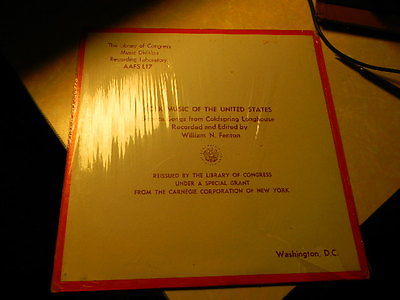
native american indian SENECA SONGS FROM COLDSPRING LONGHOUSE New York mint LP
$
49


Favourite Auctions
To save auctions to your favourites, please login
If you don't have an account, please register
Description
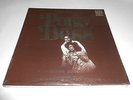
Seneca Songs From Coldspring Longhouse Sung by Chauncey Johnny John and Albert Jones Recorded and edited by William N. Fenton, Bureau of American Ethnology, Smithsonian Institution. An absolutely unplayed disc ina sleeve. Warning - I REMOVED the shrink wrap you see in the photos because of the damp-stain in the corner I've shown, to stop the growth of any mold. A very are record whose corner looks to have gotten wet at some point. AAFS L17.
This selection from the song bag of the Senecas, recorded at Cold Spring, N. Y., on the Allegheny River and issued as a second album from the Iroquois Indians of the Northeast, presents the voices of two singers who are well known the length of the Iroquois Longhouse, from Syracuse, N.Y., to Brantford, Canada, for the roles that they perform in the ceremonies of the Handsome Lake Religion. This album, with the exception of one record (5-A), was collected on a single field trip in November 1945, for the Library of Congress and the Smithsonian Institution on a grant-in-aid of research from the Viking Fund. We recorded at the Friends Indian School at Tunessassa (Quaker Bridge, N.Y. in 1941, at Clifford Crouse's home near Coldspring Longhouse in 1945, both places on the Allegany Reservation of the Seneca Nation.
What we have said of the people of the longhouse in the program notes to Songs from the Iroquois Longhouse (Smithsonian Institution, Publication 3691, 1942; Folk Music of the United States, vol. 6) holds a background for this album, which is localized to one community and somewhat more specialized in content. In particular, we are asking listeners to open their ears to hear out two rituals, as sung by two singers, almost in their entirety.
Of these, the Drum Dance, or Thanksgiving Dance, is one of the Four Sacred Rituals that is addressed to the Creator, and therefore belongs in the same class with the Great Feather Dance (album VI, record 1A).
Quavering-Changing-a-rib is a women's rite of curing, and its songs recount the courtship of a reluctant bachelor and a frog-woman, but the Seneca men love to sing these songs in the spring and early summer for their sheer musical qualities. It was Jesse Cornplanter and the Tonawanda Seneca singers who introduced me to it in 1934.
Bear Society Dance is also a curing rite, but of the shamanistic variety which accepts its member through dreams and also by possession. Its celebration is familiar as part of the Midwinter Festival, and Cringan (1898, p. 148) published a transcription of a Seneca Bear Dance song from Six Nations, Canada.
Fish Dance is the favorite Iroquois diversion and is offered as pure dessert. Indian young people still like to dance it as much as when Morgan first described it (L. H. Morgan, The League of the Hodenosaunee or Iroquois (1851) 2 vols., N.Y., 1901: 1, p. 273). Cringan (1898, p. 151) transcribed a Fish Dance song.
There is little to add to what I wrote (1942) about collecting songs among the Iroquois. I merely arrived at Allegany on the way home from Canada in the Recording Laboratory sound truck, picked up Chauncey Johnny John, stopped for Albert Jones, who had a good drum and rattles, and drove into Clifford Crouse's, where there is 60-cycle current, announcing that we had come to sing, and we went to work setting up the recorder on the dining-room table and the microphone in the living room. In two days we had made more than enough records for this album, including Fish Dance, which I had taken at the First Conference on Iroquois Research at Red House a month earlier, and Bear Dance, selected from the 1941 collection.
Chauncey Johnny John sang Great Feather Dance for album VI, and he received extended notice in the program notes. Albert Jones had recorded for me on wax cylinders in 1933, when he led the Coldspring Singers and Mutual Aid Society. As an official of the Snipe clan, his name "Ha'nodyenen's," is frequently announced for leading roles in the ceremonies in Coldspring Longhouse. He has a fine speaking and singing voice, he enunciates clearly, and he is an earnest preacher. But he prefers second parts to first, protesting, "I do not have the head for songs, and long speeches;" but leading singers seek Albert as a helper "to prop up the songs." On the other hand, Hau'no'on, "treads the swamp," as Chauncey says his name means now, although I understood it to mean "cold voice" in 1941, has always taken leading roles, which have been limited to song leader and ritualistic because Turtle clan matrons have identified his mother with the "Cayuga" in Canada, although his relatives there are considered "Senecas"; but now he likes to hear the ladies of his clan greet him, "Hai ha'nowagen'hji'," greetings, oldest Turtle man. His star reached the rim of heaven last summer (1946) when they came after him to serve as "professor" at the Summer Linguistics Institute at the University of Michigan. So now he has done everything.
The water drum and horn rattle, which were described in previous notes (1942), provide the accompaniment to the songs.
All records are shipped in cardboard record mailers with two filler boards. Combined shipping for records available.
USA, media: FREE first lp, FREE each additional lp.
USA, priority: $13.50 first lp, $4 each additional lp
GLOBAL SHIPPING PROGRAM AVAILABLE for International destinations
All forms of payment accepted, our add. provided with the invoice. Write with questions, we aim to please, and also stock thousands of books & photographs.
price rating