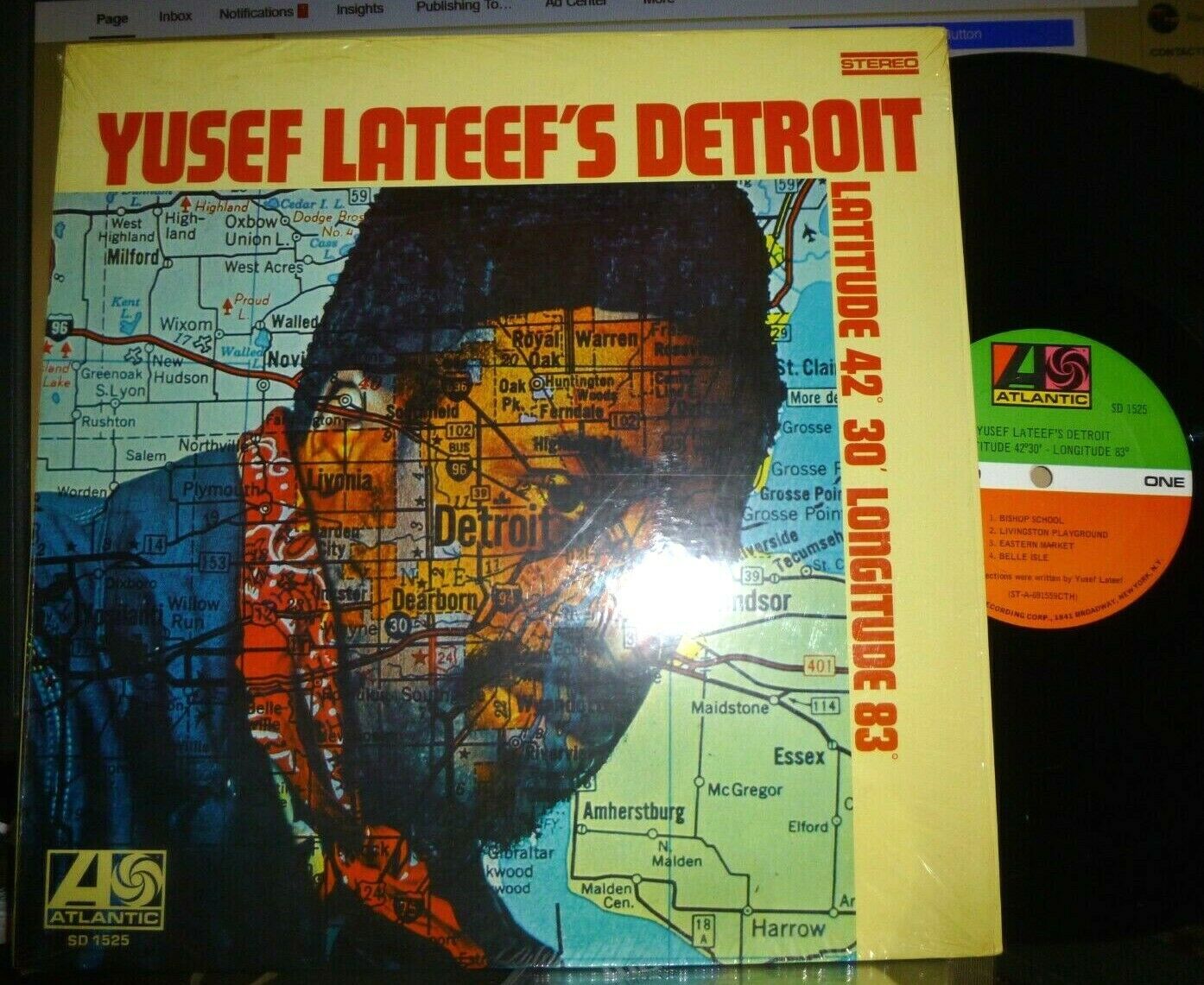
YUSEF LATEEF'S "Detroit Latitude 42...." LP Shrink, EX/NM Original 1969 ATLANTIC
$
20


Favourite Auctions
To save auctions to your favourites, please login
If you don't have an account, please register
Description
AllMusic Review by Thom Jurek [-]
After issuing the spiritually compelling and contemplatively swinging Complete Yusef Lateef in 1967, Dr. Yusef Lateef's sophomore effort for Atlantic shifted gears entirely. Lateef chose his old stomping grounds of Detroit for an evocative musical study of the landscape, people, and spirit and terrain. Lateef spent the late-'50s in the city recording for Savoy, and this recording captures the memory of a great city before it was torn apart by racial strife and economic inequality in 1967. There is no way to make a record that suggests Detroit without rhythm, and Lateef employs plenty of it here in his choice of musicians: conga players Ray Barretto and Norman Pride; Tootie Heath on percussion; Cecil McBee, Roy Brooks, and Bernard Purdie; electric bassist Chuck Rainey; electric guitarist Eric Gale; pianist Hugh Lawson; and a string quartet that included Kermit Moore. In other words, the same band from the Complete Yusef Lateef with some funky additions. The string section, as heard on the opener "Bishop School," "Belle Isle," "Eastern Market," and "Raymond Winchester" is far from the pastoral or classically seeking group of recordings past, but another rhythmic and melodic construct that delves deep into the beat and the almighty riff that this recording is so full of. For all of the soul-jazz pouring forth from the Blue Note and Prestige labels at the time, this album stood apart for its Eastern-tinged melodies on "Eastern Market"; the "Black Bottom," gutbucket, moaning bluesiness on "Russell and Elliot," with Gale and Lateef on tenor trading fours in a slowhanded, low-end groove; and the solid, Motown-glazed, rocking Latin soul of "Belle Isle." The album ends curiously with the nugget "That Lucky Old Sun," played with a back porch feeling, as if the urban-ness of the set, with all of its polyrhytmic intensity and raw soul, had to be tempered at the end of the day with a good-old fashioned sit in the yard as the city's energy swirled around beyond the borders of the fenced lot. Lateef blows a beautiful tenor here, uing a motif from Sonny Rollins' version of the tune and slides it all the way over to Benny Carter in its sheer lyricism. It's the perfect way to close one of Lateef's most misunderstood recordings.
Yusef Lateef ?– Yusef Lateef's Detroit Latitude 42° 30' Longitude 83°
Label:
Atlantic ?– SD 1525
Format:
Vinyl, LP, Album, CTH
Country:
US
Released:
1969
Genre:
Jazz
Style:
Jazz-Funk
Tracklist Hide Credits
A1 Bishop School 3:00
A2 Livingston Playground 3:37
A3 Eastern Market 4:15
A4 Belle Isle 3:12
B1 Russell And Eliot 4:47
B2 Raymond Winchester 2:35
B3 Woodward Avenue 2:11
B4 That Lucky Old Sun
Written-By – Beasley Smith, Haven Gillespie
7:25
Credits
Bass – Cecil McBee
Conductor – William S. Fischer (tracks: A1, A3, A4, B2)
Congas – Norman Pride (tracks: A2, A3, B2), Ray Barretto (tracks: A1, A4, B1, B3)
Cover – The Graffiteria
Drums – Bernard Purdie (tracks: A1, A2, A3, A4, B1, B2, B3), Roy Brooks (tracks: B4)
Electric Bass – Chuck Rainey
Electric Guitar – Eric Gale
Engineer – Steve Schaeffer (2), Steve Schaeffer (2)
Percussion – Albert Heath
Photography – Joel Brodsky
Piano – Hugh Lawson (tracks: A1, A4, B1,B3)
Producer – Joel Dorn, Joel Dorn
Strings – Emanuel Green (tracks: A1, A3, A4, B2), Gene Orloff (tracks: A1, A3, A4, B2), Kermit Moore (tracks: A1, A3, A4, B2), Selwart Clarke (tracks: A1, A3, A4, B2)
Tenor Saxophone, Flute – Yusef Lateef
Trumpet – Danny Moore, Jimmy Owens (tracks: A1, A4, B1, B3), Snooky Young, Thad Jones (tracks: A1, A4, B1, B3)
Written-By – Yusef Lateef (tracks: A1, A2, A3, A4, B1, B2, B3)
Notes
Recorded at Century Sound Studios, New York
CTH code on center label for Columbia Terre Haute pressing.
Barcode and Other Identifiers
Matrix / Runout (Side A runout stamp): ST A691560-1A CTH \ T
Matrix / Runout (Side B runout stamp): ST A691559-1A CTH \ T
GOLDMINE GRADING
MINT ---- It should appear to be perfect. No scuffs or scratches, blotches or stains, labels or writing, tears or splits. Mint means perfect.
NEAR MINT ---- Otherwise mint but has one or two tiny inconsequential flaws that do not affect play. Covers should be close to perfect with minor signs of wear or age just becoming evident: slight ring-wear, minor denting to a corner, or writing on the cover should all be noted properly.
VERY GOOD PLUS ---- The record has been handled and played infrequently or very carefully. Not too far from perfect. On a disc, there may be light paper scuffs from sliding in and out of a sleeve or the vinyl or some of the original luster may be lost. A slight scratch that did not affect play would be acceptably VG+ for most collectors.
VERY GOOD ---- Record displays visible signs of handling and playing, such as loss of vinyl luster, light surface scratches, groove wear and spindle trails. Some audible surface noise, but should not overwhelm the musical experience. Usually a cover is VG when one or two of these problems are evident: ring wear, seam splits, bent corners, loss of gloss, stains, etc.
GOOD ---- Well played with little luster and significant surface noise. Despite defects, record should still play all the way through without skipping. Several cover flaws will be apparent, but should not obliterate the artwork.
POOR ---- Any record or cover that does not qualify for the above "Good" grading should be seen as Poor. Several cover flaws.
price rating