WOW 4 x UKELELE IKE on RARE LEVAPHONE LABEL
£
84
$
111


Favourite Auctions
To save auctions to your favourites, please login
If you don't have an account, please register
Description
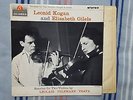
FOUR MEGA RARE UKELELE IKE IN EXCELLENT to NEAR MINT CONDITION ON THE RARE UK LEVAPHONE LABEL!!
Cliff Edwards got his start in show business as a teenager in St. Louis where he sang in movie theatres and saloons. While singing in the saloons he began to accompany himself on the ukulele and developed a style of improvised singing, which he called "effin". "Effin" sounds a lot like the human voice imitating a hot trumpet or kazoo solo. Edwards had a wonderful voice with at least a three octave range and he would inject his "effin" solos into his songs in the same way that a Jazz musician would take a solo. A good argument can be made that Edwards 1922 recordings with Ladds Black Aces and Bailey's Lucky Seven are the first recorded examples of scat singing, but some Jazz critics would disagee and point back to Gene Greene's 1911 Victor recording "King of the Bungaloos". Between 1913 and 1918 Edwards struggled to make a living traveling with carnivals and doing menial labor to get by. In 1917 he moved to Chicago where he took a job as a singer in the Arsonia Café going to tables and singing and playing the ukulele for tips. It was here that he started using the stage name of "Ukulele Ike". The pianist at the club was Bob Carlton who had written a novelty song that he called "Ja Da". Cliff became a sensation singing the song and he and Joe Frisco, a stuttering comedian and dancer, formed a vaudeville act that was successful enough to end up playing at the Palace in New York City. It is interesting to note that Frisco was instrumental in bringing Tom Brown's Dixieland Jazz Band north from New Orleans in 1915. After appearing in Ziegfeld Follies, Edwards and Frisco's act came to an end and Cliff teamed up with another dancer and singer named Pierce Keegan. They billed their act as "Pierce Keegan "Jazz Az Iz" and Cliff Edwards "Ukelele Ike" and toured the vaudeville circuit, performed in Zeigfeld's Midnight Frolic in 1919 and recorded five songs for Columbia which unfortunately were never issued. The act broke up in mid-1920 and Edwards then teamed up with Lou Clayton who would later work with Jimmy Durante in vaudeville. In 1922 Edwards recorded his first records with Ladds Black Aces and Bailey's Lucky Seven. In 1924 Edwards hit the bigtime when he appeared in George Gershwin's "Lady Be Good" on Broadway and introduced the song "Fascinatin' Rhythm" and stole the show. He went on to score other big successes in other Broadway productions and become a major star of vaudeville. When we think of the 1920s the image of a crooner with a ukulele comes to mind. This image is based on Edwards popularity and his uke. Throughout the 1920s Edwards recorded with top Jazz talents like Adrian Rollini, Red Nichols, Miff Mole, Vic Berton, Joe Tarto, among others. The records released under the name of Cliff Edwards and his Hot Combination are of particular Jazz interest. In 1929 Edwards scored another hit with his version of "Singin' In The Rain"in the movie "The Hollywood Revue Of 1929" and this role established him as a film star. He went on to appear in more than 100 motion pictures. Throughout the 1930s and early 1940s Edwards continued to be a much sought after actor in Hollywood. His singing and film roles led him to be cast as the voice of Jiminy Cricket in the Disney animated feature "Pinocchio". Cliff sang the song "When You Wish Upon a Star" in the film and it won an Oscar for best song in 1940. His rendition of this song is one of the great popular vocal performances of the 20th century and it became the theme of the Disney corporation. Edwards went on to be the voice of Jim Crow in the animated feature "Dumbo" and star in the Durango Kid "B movie" westerns. It is estimated that Edwards sold 74 million records during his career. Despite all of this success and earning millions of dollars in his career he went bankrupt several times due to alimony payments, income tax troubles, gambling, alcoholism and drug addiction. His star faded in the 1950s and 1960s and Edwards died broke and on welfare in 1971, a forgotten man.
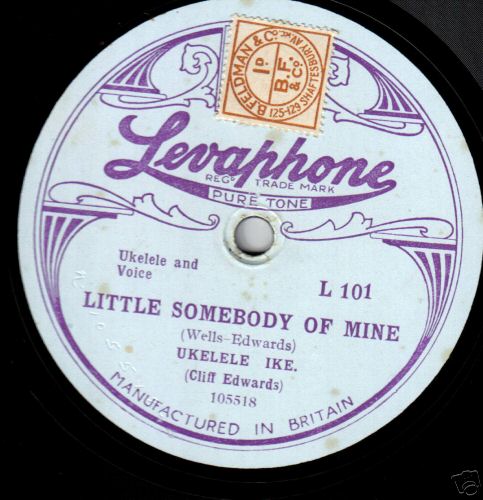
DISC DETAILS : LEVAPHONE L 101
Little Somebody Of Mine
(Gilbert Wells / Bud Cooper/ Cliff Edwards)
MATRIX # N105518
8-1924 New York,New York
Pathé Actuelle
Perfect
12152 B
How My Sweetie Loves Me
(She Loves Me All The Time)
(Sidney D. Mitchell / Lew Pollack / J. Fred Coots)
THIS SIDE ALSO HAS THE A-SIDE LABEL
(SEE PICTURE) MATRIX # N 105052
12-1923 New York,New York Pathé Actuelle
25114-A
Pathé Actuelle
032028-B
Perfect
11548-A
Perfect
12107-B
LEVAPHONE L 102
I Can't Get The One I Want
(Fred Rose / Herman Ruby / Lou Handman)
MATRIX # N 105311
5-1924 New York,New York Pathé Actuelle
032055
Perfect
12134-A
It's All The Same To Me
(Roy Turk / Lou Handman / Gus Edwards)
MATRIX # N 105660
11-1924 New York,New York Pathé Actuelle
032090 B
Pathé Actuelle
025124 B
Perfect
11558 B
Harmograph
988 A
LEVAPHONE L 106
Charley, My Boy!
(Gus Kahn / Ted Fiorito)
MATRIX # N 105552
9-1924 New York,New York Pathé Actuelle
025122-A
Pathé Actuelle
032079-A
Pathé Actuelle
10862-A
Pathé
6757
Perfect
12158
Perfect
11556
Harmograph
986
You're So Cute (Mama O' Mine)
(Cliff Edwards)
MATRIX # N 105312
5-1924 New York,New York Pathé Actuelle
032055 B
Perfect
12134-B
LEVAPHONE L 110
Isn't She The Sweetest Thing?
(Gus Kahn / Walter Donaldson)
MATRIX # N 105929
3-1925 New York,New York Pathé Actuelle
025136-A
Pathé Actuelle
10860
Perfect
11570
Harmograph
1026
I'll Buy The Ring
(And Change Your Name To Mine)
(Jack Mills / William Raskin / Ed Rose)
MATRIX # N 105824
2-1925 New York,New York Pathé Actuelle
1036
Perfect
025131
A RARE CHANCE TO PICK UP THESE RARE LEVAPHONE PRESSINGS!
ALL PLAYING SURFACES ARE IN EX+ TO M-
FOR LABEL CONDITIONS SEE PICTURES
DON'T MISS OUT - BID NOW!!
price rating