WOODY HERMAN: THE FOURTH HERD (2 MFSL MOTHERS)
$
56


Favourite Auctions
To save auctions to your favourites, please login
If you don't have an account, please register
Description
THE CHRISTMAS SEASON IS HERE!
FOR A LIMITED TIME WE WILL BE OFFERING VARIOUS DISCOUNTS ON SHIPPING INCLUDING FREE!
PLEASE VISIT ALL OF OUR other items!!
This offering:
USA: $3 FLAT FEE (PRIORITY MAIL)
International: $5 OFF (PRIORITY MAIL INT’L)
NOTE: For International discounts please wait for our invoice with discount before paying)
WOODY HERMAN: THE FOURTH HERD
MFSL 1-219
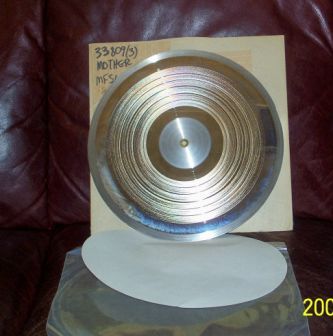
TWO “MOTHERS” (SIDE ONE AND SIDE TWO)
THESE ARE “FINAL” MOTHERS BEFORE PRESSING!
NOTE: ALTHOUGH THE IMAGE SHOWS ONE MOTHER THIS OFFERING IS FOR TWO OF THEM (SIDE 1 and 2)
NO RESERVE!
NEEDLESS TO SAY, THESE ARE ONE OF A KIND!
CONDITION: M- (both)
Many of you have seen, bid and purchased our MFSL “Lacquers” offered for auction. Upon our “collection inspection,” a few of these decade-plus items have been found and stored properly. THIS time, we have located a couple of “Mother” discs that take you another step back into the LP pressing process.
Following is a tutorial of the process and where the “Mother” comes into it:
The First Step In The Reissue Process Is To Procure The Master Tape.
The first question to ask is, "Which master tape to use?" The answer is somewhat involved and can vary, depending on the objectives of the reissue project. If the goal is to recreate the sound of the original release as closely as possible, then finding the so-called "production master tape" makes sense.
However, there are some caveats to consider. The production master tape may have been generated from a previous source, closer to the original performance. This earlier generation tape is often referred to as the "session tape" or "edited work part." In most cases, it is the same tape that was used during the recording sessions. The differences between session tapes and production masters can be slight. Or they may be significant. In any case, an increase in noise level of at least three dBs can be expected in any analog tape transfer.
In the early days of high fidelity, most major labels used production master tapes to cut their original records. This was due in part to the session tapes being "doctored" to correct recording problems in post-production. It also simplified the engineer's task of cutting the record. Since no further changes were made during this stage, the cutter was simply referred to as a "transcription engineer." One has to remember that this was years before the advent of so-called "mastering engineers."
Obviously, the question of which tape to use is a complicated one. The solutions can be equally problematic. For example, production masters were often compressed dynamically during the transfer of the edited work parts. Although this proved helpful during the cutting process, it also negatively affected sound quality.
Furthermore, cutter heads during those first years contained all sorts of anomalies. They peaked at certain levels instead of maintaining an even response. As a result, certain unwanted frequencies were unavoidably highlighted. In addition, most of the early cutter heads were unable to effectively handle the entire dynamic range of the original session tapes. Therefore, to avoid cutter head problems, overall sound quality was often compromised to achieve a flat transfer without equalization.
Another factor to consider is the number of tracks contained on the original session tapes. The earliest stereo recordings were made on two-track tapes that were run at 30 ips (inches per second). But these two-track tapes were not used in the cutting process because an edited side of an LP, recorded at 30 ips, required an amount of tape far exceeding the capacity of that era's 12-inch reels (the largest then available). This was partially remedied by transferring the 30 ips tapes to a 15 ips production master, thereby fitting an entire side of an LP onto a standard 10-inch reel.
By 1957, RCA and other companies started to use 15 ips, three-track tape recorders, which allowed more flexibility in microphone placement. However, the new three-track machines were also not used in post-production since there was no effective way of mixing the extra channel while cutting the record. The answer was to mix down the three-track tape and transfer the result to a two-track production master. Simply put, three-track tapes were not an option for cutting records at that time.
In the last 40 years, however, many things have changed. Tape recorders can now accommodate 14-inch reels, so that it is quite possible to use a 30 ips session tape to cut an entire side of a long-playing record. Mastering consoles can also allow a third channel of audio input during the mixing process. This extra track is passively mixed to both left and right channels.
Once a MASTER TAPE is chosen, engineers will compare it against an original issue LP to analyze differences in audio quality.
Next comes the “lacquer”
After hours of A/B-ing the tape and applying different amounts of equalization (ranging from none to a fair amount), preparations are made to transfer the results to lacquer.
A master lacquer is an aluminum disk, 14 inches in diameter and 1/8-inch thick. It is coated with a thin film of lacquer on both sides (only one of which, however, is recommended for use). This disk is put onto a lathe platter that spins at speeds of 33 1/3, 45, or 78 rpm. The cutter head is suspended on a motorized carriage, which moves linearly across the lacquer disk. Its speed is computer-controlled so that the resulting grooves do not run into each other. Cutter heads, like loudspeakers, contain magnetic coils, which are attached to a cutting stylus that resembles a V-shaped chisel.
As the tape is played on the mastering deck, its signal is amplified and sent to the cutter head, which continuously changes the position of the heated cutter stylus. This device cuts through the thin layer of lacquer material like a hot knife through butter. The resulting V-shaped groove is a physical analog of the master tape's stereo signal.
The carved-out lacquer material is continuously vacuumed away from the cutter stylus and collects in a nearby container. After a complete LP side is cut, the lacquer is inspected with a microscope attached to the lathe (see below). The engineers examine it for a clean cut, making sure that no grooves have collided.
It is interesting to note that the musical selections on the master tape are organized into a continuous LP side (including the silent spaces between the album tracks), so that the transfer can be made without stopping and starting the spinning platter.
The lacquer is then placed in a container and sent to the plating plant as soon as possible. The packaging is made of Styrofoam to minimize changes in temperature. Since the freshly cut lacquer material is somewhat malleable, its grooves are particularly sensitive to climate fluctuations.
Once the lacquer is cut, it goes to the plating plant to be electroplated. This process begins with packing the lacquer and gently cleaning it in a mild detergent-based solution. The lacquer is then rinsed repeatedly with highly purified (di) water before being placed on a spindle in the silvering booth. There it is then spun around and sprayed with liquefied silver.
Spraying liquefied silver onto a lacquer
After the lacquer is "silvered," it is re-cleaned with di water, attached to a bar, and placed in a pre-plate bath of dissolved nickel. When electrically charged, the nickel will naturally adhere to the silver on the lacquer surface.
The lacquer stays briefly in the pre-plate tank before it is spun around in the high-speed baths, where nickel is more quickly accumulated, using greater amperage. This process creates a key component called a master. The amount of time the lacquer stays in this solution determines the weight of the master, which is sometimes called a metal part.
High speed nickel baths for making stampers.
The master is next separated from the lacquer, creating an exact reverse image, with ridges instead of grooves. Sometimes it is used to press records in a process called one-step. In that case, the master is referred to as a one-step stamper. Unfortunately, it can only produce up to 800 records before wearing out. In addition, the lacquer cannot be re-used to form another master. To avoid these shortcomings, the master, like the lacquer before, is put back in the bath for more nickel plating, creating a new element called the mother.
Awww finally, the “Mother”
The mother is then sound-tested on a turntable with a normal stylus. Sound-testing the mother is virtually like playing a record on a standard phonograph. If a tick or pop is heard, the mother is stopped and backed up with the stylus still in the groove, in a fashion similar to the "scratching" of nightclub DJs! By gently moving the mother back and forth, using the stylus as a sort of chisel, most small ticks can be backed out. The ticks indicate impurities in the bottom of the groove, picked up from either the bath or air. In some cases, the tick cannot be backed out and must be removed with a tiny probe while carefully examining the disk with a microscope.
The sound-tested mother is then placed back in the baths and subjected to re-plating. This will produce yet another stamper. The mother can be re-plated up to eight times to produce multiple stampers. Similarly, the master can be re-plated up to four times, yielding numerous mothers, which will in turn produce new stampers.
This process may spawn as many as 25 stampers, which are capable of pressing upwards of 15,000 records!
Woody Herman: The Fourth Herd
Released in 1959, The Fourth Herd showcases the Herman group formed in 1954 that was one of the bandleader's strongest. This version of 'Herman's Herd' included Ernie Royal and Red Rodney on trumpets; Bob Brookmeyer, Jimmy Cleveland and Frank Rehak on tro mbones; Al Cohn and Zoot Sims on reeds; and Nat Pierce, Milt Hinton and Don Lamond on rhythm. The Fourth Herd also displayed one of the finest small bands of the period.
Tracks:
1. Panatela
2. Lament For Linda
3. Misery, Stay Away From My Door
4. In A Misty Mood
5. Catty'corner
6. The Thirteenth Instant
7. The Magpie
8. Blues For Indian Jim
9. The Devil And The Stoker
10. The Swing Machine
11. Summer Nights
12. Johnny On The Spot
Check out my other items!
SHIPPING COSTS ARE PER EBAY ESTIMATES – PLEASE FEEL FREE TO DISCUSS OTHER OPTIONS.
INSURANCE IS ALWAYS OPTIONAL – HOWEVER WE ARE NOT RESPONSIBLE FOR ITEMS SHIPPED WITHOUT IT.
WORLDWIDE PURCHASES ARE MOST WELCOMED!
THANKS AND GOOD LUCK!
price rating