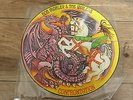
Vintage MIKE GORDON- WHY DON'T YOU DO RIGHT b/w You Got To Give- PLAY BACK ?
$
38


Favourite Auctions
To save auctions to your favourites, please login
If you don't have an account, please register
Description
Mike Gordon & the El Tiempos - Why Don't You Do Right
b/w You Got To Give
Label: Play Back PB-2306-A [& B]
Matrix Numbers: PB-2307 b/w PB-2307
Vinyl Wear Visual Grade: EX+ / VG+++ (labels like new; small surface scuff on Side A
and a cluster of shallow scuffs on Side B, all barely
audible -- please check out sound samples below)
Pressing Quality: 7 / 6.5 (there is a small "lip" warp, as purchased,
on the very edge of the disc before the run-in
groove, not affecting play at all using a tonearm
weight of 1.5 grams, which is considered minimal & light)
Loudness of Vinyl: Average
PLEASE SCROLL DOWN TO THE RED PANEL BELOW TO VIEW GRADING STANDARDS
SOUND SAMPLES TAKEN FROM ACTUAL RECORD AT FLAT RESPONSE
This is an vintage reissue pressing of the 1954 recording "Why Don't You Do Right" by Mike Gordon (written by Kansas Joe McCoy), issued on the Play Back label out of Glendale, California. Recorded in New York City, N.Y. on January 27, 1954, the studio band features Sam Taylor on sax and possibly Mickey Baker on guitar, among others. The B-side is "You Got To Give". This pair of tunes was originally credited to "Mike Gordon & the El Tiempos" and was issued as a 78 RPM on the Cat label, and also as the 45 single Cat-101 (the latter format had been introduced in 1949 by RCA and was gaining in popularity; 78 RPMs continued to be manufactured until around 1960). As for the Play Back label, I have been unable to find any information that might indicate the age of this particular pressing: I acquired my copy in the mid-70s from an oldies collector who said at the time that it was already an old pressing (it certainly has an old-fashioned look), so it could date anywhere from possibly the late 50's to the mid-60s? I compiled the following from various sources on the Web: A vocalist on the New York City club scene, Mike Gordon (born Dec. 31, 1922 in Santo Domingo - died November 17, 1988 in Boston) seems to have been more a songwriter than a performer and only had a two year recording career. Making his debut on the Cat label in 1954, the following year he cut one single for Savoy as Big Mike. In 1956 he made his final recordings on the Baton label billed as "Big Mike" Gordon. He went on to live and play in the Boston area, under the name JB Gordon & The Unknowns, later on calling himself Jelly Belly. In the early 70s, he held down long engagements at the Highland Tap Room, under the el in Boston's South End, and mentored many young blues players. Often squired by great young female singers like Ricia Lee and Betty "Rock-em, Sock-em" Crawford, he was considered quite a showman. "Why Don't You Do Right" is included on the 3-CD set "Jumping the Shuffle Blues: Jamaican Sound System Classics 1946-1960", a collection of R&B classics that were popular on the Jamaican dancehall scene during the 50s and many of which were covered there during the early Ska era. One can understand its musical appeal to Jamaicans, as the arrangement is like a Caribbean rhumba but played with a blues shuffle feel and this song b/w Jack McVea's "Two Timin' Baby" was released there by Jamaican record pioneer Clement Coxson Dodd on a bootleg pressing. In addition, Gordon's song, and other records like "Salt Pork" by Louis Jordon & His Tympany 5 (also included on the aforementioned CD compilation) were also pressed in Jamaica on the Play Back label, but with Louis spelled "Lewis".This record is from my personal collection; I'm not really a buy-and-sell-or-trade type of seller. I acquired this record unplayed in 1975, played it a few times, recorded it to cassette and then put it back in its sleeve for the next 37 years! Visually, the vinyl shows very little sign of wear at all. It's been wet cleaned, then both sides archived to CD by me as part of the grading process. Guaranteed free of skips when I used a tonearm lightly weighted at 1.5 grams.
PRICE: this same record, in lesser condition with WOL, recently brought $104.00 at auction here on Ebay, but rather than put one of those annoying "secret reserves" on the price, bidding on this one simply starts at $37.99, or Buy It Now for $89.00. ATTENTION BIDDERS: Please carefully read this listing in its entirety, as I have no return policy: my record description is intended to be absolutely honest, accurate and thorough enough in the first place, so you can decide if you want to buy it AS DESCRIBED, AS HEARD in the sound samples and AS IS. RECORD GRADING STANDARDS
In grading the sound quality of a vinyl record (assuming it's been cleaned and there's no significant warpage), there are three main issues:
1.) Vinyl Visual Grade made by judging the visible wear from usage.
2.) Pressing quality after manufacture, which is the amount of surface noise such as pops/clicks/hisses/buzzes due to imperfections in the grooves of the record like small pits or bubbles. This is partially determined by vinyl quality/purity, temperature control and cleanliness of the record stamping machine. Other problems include the record being pressed off-center ("drunk") resulting in a wobbly, pitch-wavering sound.
TIP for off-center pressings: With 45's, you can compensate during playback for a drunk pressing by removing the centering "dome" from the turntable spindle, slowly turning the record by hand while observing in which direction the grooves are off center, and then pushing the record slightly off-center in the opposite direction until the grooves themselves are centered. It's an acquired skill.
3.) Loudness of Vinyl (Mastering volume) and the resulting Signal-to-Noise Ratio: how loudly ("hotly") or softly ("sleepily") the record was mastered to the stamper from the master tape of the music. With a hot pressing, the loudness of the music overpowers and masks the fainter sound of the surface noise. With a sleepy pressing, the music is dimmer and down closer to the level of surface noise; the listener has to turn up the volume, making the surface noise more audible along with the music. Other mastering problems include exaggerated tone settings and distortion, especially in high frequencies ("S" sounds) and upper midrange frequencies ("squawking" in the vocals or other tinny instruments). Too much bass and the needle will hop right out of the groove!
**********
*******
**
*
Gradings for visually detectable wear on vinyl records
MINT (M) The record itself is in brand new condition with no surface marks or deterioration in sound quality. The cover and any extra items such as the lyric sheet, booklet or poster are in perfect condition. Records advertised as Sealed or Unplayed should be Mint.
NEAR MINT (NM+/-) As above, but only played a few times. The cover and any extra items such as the lyric sheet, booklet or poster are in nearly perfect condition.
EXCELLENT (EX+/-) The record shows some signs of having been played, but there is very little lessening in sound quality. The cover and packaging might have slight wear and/or creasing.
VERY GOOD (VG+/-) The record has obviously been played many times, but displays no major deterioration in sound quality, despite noticeable surface marks and the occasional light scratch. Normal wear and tear on the cover or extra items, without any major defects, is acceptable.
GOOD (G+/-) The record has been played so much that the sound quality has noticeably deteriorated, perhaps with some distortion and mild scratches. The cover and contents suffer from folding, scuffing of edges, spine splits, discoloration, etc.
FAIR (F+/-) The record is still just playable but has not been cared for properly; it may even jump. The cover and contents will be torn, stained and/or defaced.
POOR (P+/-) The record will not play properly due to scratches, uncleanable dirt etc. The cover and contents will be badly damaged or partly missing.
BAD (+/-) The record is unplayable or might even be broken, and is only of use as a collection-filler.
**********
*******
**
*
RATINGS FOR PRESSING QUALITY ON A SCALE OF 10 DOWN TO 1
10: No audible surface noise (nearly impossible to achieve). Example: Classical or audiophile music pressings on "virgin" high-quality vinyl and manufactured under "laboratory" conditions, often of European or Japanese origin. Most really good pressings will only rate a 9 anyway.
9: Very few barely audible clicks. No pops at all.
8: Frequent softly audible clicks and no pops.
7: More frequent audible clicks and occasional pops.
6: Frequent audible clicks and pops.
5: Frequent noticable clicks and pops.
4: Very frequent noticable clicks and loud pops.
3: Extremely frequent loud clicks and loud pops, possibly with occasional hisses/buzzes.
2. Constant loud clicks and loud pops, with frequent hisses/buzzes
1: Virtually unlistenable, might as well've been pressed on peanut-brittle!
Go buy the re-issue of the song on CD made directly from the master
tapes.
**********
*******
**
*
STANDARDS FOR RATING MASTERING VOLUME
HOT (+/-)
AVERAGE (+/-)
SLEEPY (+/-)
**********
*******
**
*
HOW I GRADE RECORDS FOR SALE:
</?????????????????>
For records with a visual wear rating between VG and NM++ , additional ratings for pressing quality and signal-to-noise ratio are included. It's entirely possible for an M or barely played NM record to sound pretty bad because it was poorly pressed in the first place.
For records with a visual wear rating below VG , it is often too difficult to tell the difference between surface noises due to wear and those due to pressing quality, so only a single condition grading is offered.
About grading integrity : it is my strict policy to grade these records as carefully and truthfully as possible. It's a common complaint that many record sellers tend to overgrade their stock: more than once, I've purchased a few "VG+" or "EX" records on Ebay, and eagerly put one on the turntable only to find it's a nearly unlistenable mess. Yuck! This is why I have no return policy: my record description is intended to be honest and thorough enough in the first place, so you can decide if you want to buy it AS DESCRIBED and AS IS.
About Shipping/Handling Fees & Seller Ratings Shipping Fees I have selected the cheapest possible shipping rates available to me for customers. Please be aware that the United States Post Office sets these prices, NOT me! Unfortunately, Ebay combines both the shipping & handling charges on the invoices that sellers send to buyers, giving the impression that the shipping rate is too high. Please keep this in mind when receiving my invoices. With 45's sent within the United States, it's actually a bit cheaper by weight to send one 45 by First Class than by Media Mail. Media Mail works better for multiple items sent in the same package and I'm very happy to combine shipping for both domestic & overseas customers. Unlike the bigger, high-volume sellers on Ebay who are rewarded substantial discounts on their fees from shippers and from Ebay, I am only a collector gradually selling off my records and thus not in a position to offer free or discounted shipping. High bidders may want to consider insuring their purchases, since even the best packed records do occasionally arrive broken, and you can only get all your money back if you fully insure your purchase.Within the continental US:
SINGLES are shipped by USPS Priority Mail (partial insurance included, full insurance optional) or First Class Mail (cheaper, insurance optional).
ALBUMS are shipped by USPS Priority Mail (partial insurance included, full insurance optional) or Media Mail (cheaper, insurance optional).
To preview a USPS Mail option for shipments to your area, please use the Shipping Calculator provided by Ebay.
International purchases:
Records are usually shipped by USPS International First Class Mail (no insurance available), or USPS Priority Mail International (partial insurance included).
To preview a USPS International Mail option for shipments to your country, please use the Shipping Calculator provided by Ebay.
Handling fees:
To maximize the safety of records, I cut & fold custom-made mailers from clean, recycled corrugated cardboard for each shipment (see photo below) --- fairly time-consuming work! LP's are placed inside clean recycled plastic shopping bags. For shipments within the U.S., there is a flat $3.00 handling fee, and $0.70-0.80 of this goes to USPS Delivery Confirmation with a tracking number which lets me know the buyer has received the shipment. For foreign shipments, there is a flat $3.50 handling fee, and customs forms have to be filled out which provides the buyer and me with a form number useful in tracing the package if it gets hung up in customs.Weights: One 45 in cardboard mailer = approx. 6 oz.
Each additional 45 = approx. 1.2 oz.
LP in cardboard mailer = approx. 1 lb. 3 oz.
Each additional LP = approx. 8 oz.
Payment Terms: Right now I ONLY accept PAYPAL methods of payment. If you wish to make a PayPal Instant Payment, make sure your bank account is correctly linked to your PayPal account, so your payment will be virtually IMMEDIATE.
To pay a seller using your checking account (INSTANT PAY OPTION), please follow these steps:
a) Log in to your PayPal account at the link below:
https://www.paypal.com/cgi-bin/webscr?cmd=_login-run
b) Click on the "Send Money" tab
c) Enter the required information
d) Click "Continue"
e) Click the "Funding Options" link under the Source of Funds heading
f) Click the "Add Bank" link next to "Instant Transfer"
g) Enter the information on the following page. (You will need to know
your bank account number and routing number. You can find these at the
bottom of one of your checks.)
h) Click "Add Bank Account"
i) Next, select the radio button next to "Instant Transfer" and click
"Continue"
j) Review the information on the Payment Details page and click "Send
Money" to complete your transaction
price rating