Vincenzo Tempera - Paganini Horror / Sub Ost Limited Blue Vinyl New & Sealed
$
25




Favourite Auctions
To save auctions to your favourites, please login
If you don't have an account, please register
Description
Vincenzo Tempera - Paganini Horror / Sub Ost Limited Blue Vinyl New & Sealed
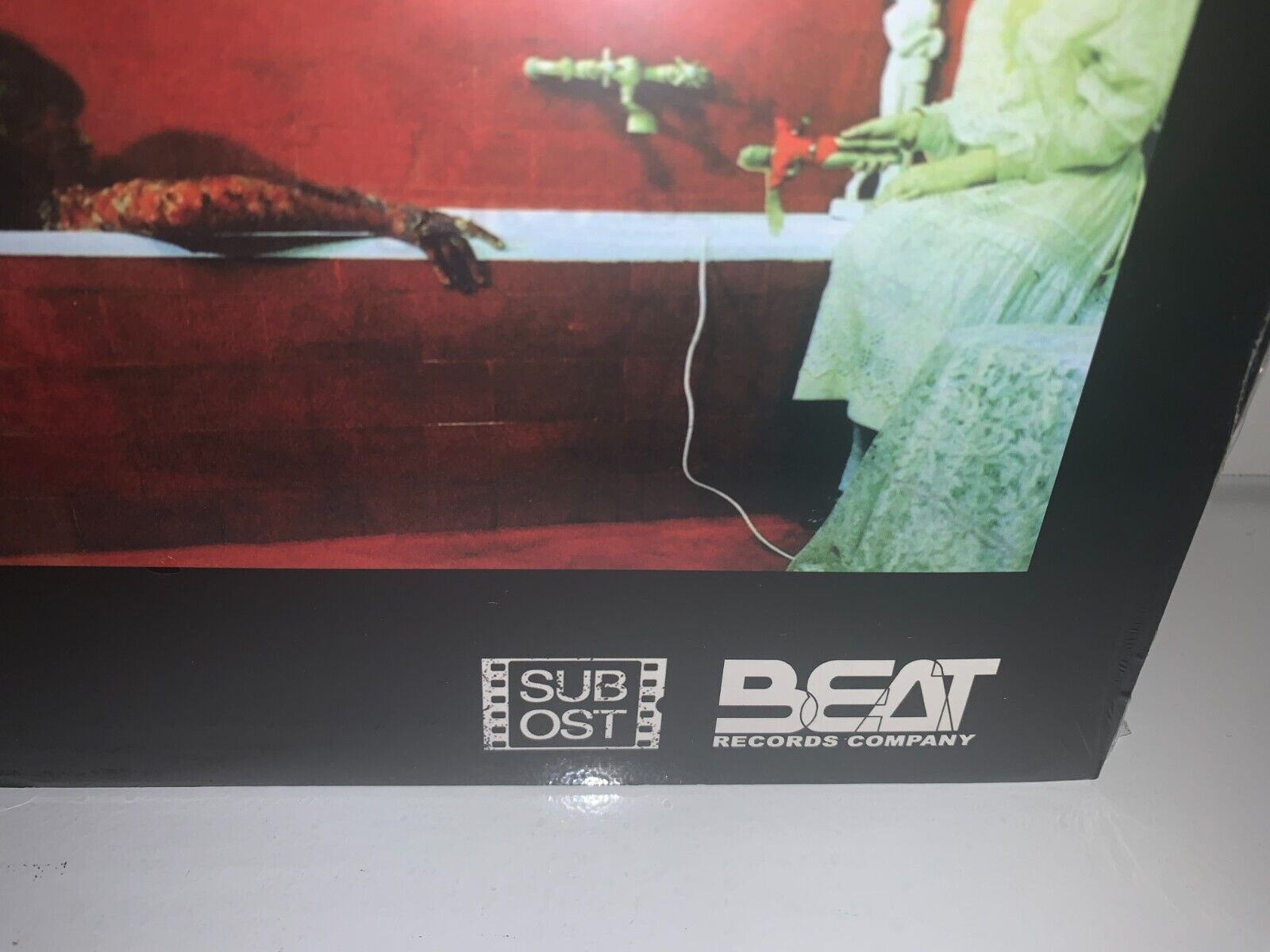
New and factory sealed vinyl from Italy.
Each copy has some degree of a hole in the shrink. Just from stretching and packing. Some have a smaller hole others a bigger hole. See all pictures to understand what I mean. any questions please ask.
All 100% new and still sealed.
A1 Paganini Horror Seq.1 A2 Stay The Night A3 Paganini Horror Seq.2 A4 Paganini Horror Seq.3 A5 Paganini Horror Seq.4 B1 Paganini Horror Seq.5 B2 Paganini Horror Seq.6 B3 Paganini Horror Seq.7 B4 The Wind Of Time C1 Paganini Horror Seq.8 C2 Paganini Horror Seq.9 C3 Paganini Horror Seq.10 C4 Paganini Horror Seq.11 D1 Paganini Horror Seq.12 D2 Paganini Horror Seq.13 D3 Paganini Horror Seq.14 D4 Stay The Night Credits Film Director – Luigi Cozzi Lyrics By – Lucia De Masi (tracks: A2, B4, D4) Written By, Composed By – Vincenzo Tempera Notes Limited to 300 copies on blue vinyl
One of the most delirious films ever made in Italy. A really cult trash. Or, simply, a photograph of cinema of the Eighties, between dialogues at the limits of common sense and craft special effects. “Paganini Horror” (1989), directed by Luigi Cozzi, is one of those movies to be seen at least once. The low budget justifies some imperfections. A tough challenge convincing spectators and, especially, critics. The problems are, perhaps, to be found elsewhere. Despite the presence of Donald Pleasence and Daria Nicolodi in the cast, the level of acting is low, equally uncertain the dubbing, controversial the photography, with the blue filter used as a night effect. Too tomatoes on the screen to replace the blood. Also the direction appears, unfortunately, less convincing than in the past. Yet the script “Paganini Horror” was not so bad, because it had a couple of original ideas and elements that were not abused.
A pop group is in crisis, the record company rejected songs to the sender, because there are too monotonous and uncreative. An idea is necessary to re-launch the band. Drummer buys from a mysterious individual a score of violinist Niccolò Paganini. The intention is to make a dance version of it. Once convinced the production, you need to shoot a video clip. For the filming, drawing inspiration from Michael Jackson’s Thriller with dancing zombies, the band chooses a patrician villa located on an island in the Venice lagoon. A not random choice, because it seems that right there that the famous composer have made a pact with the devil. The musician from Genova was gifted with an extraordinary technique, almost voted to excess. The speed of execution one of his strengths. Inevitable the rupture of the violin strings at the end of his concerts. His own compositions were also considered unplayable by other violinists. His virtuosity was, however, surrounded by a halo of mystery.
The figure of Niccolò Paganini connected to Satan, a widespread rumor probably also motivated from identifying the violin as an ‘instrument of the evil’. A similar association of ideas was also due to his outward appearance. His body was thin, tired by syphilis, and the artist used to wear black. His face ashen, his eyes returned to their orbits. Nose and chin had approached, because the teeth had fallen as a result of mercury taken to combat the disease. In practice, a skeleton in a tuxedo. A bizarre image well reported, albeit with some freedom, on the poster designed by the hand of Enzo Sciotti, a true illustrator of the past, with hundreds of original works, or gadgets for the seventh art. And, predictably, the cloaked spirit of Niccolò Paganini, now with a mask to cover the face, haunts the location chosen by the group. His favorite instrument was armed with knife. The deaths follow one after the other.
It is the revenge of the composer towards consumerism and, of course, low-quality products, perhaps, constructed around a table or ready to plagiarize other people’s art. A real critique of modernity is hidden behind the screen of a commercial horror: this is the other side of “Paganini Horror”, born from the minds of Luigi Cozzi, screenwriter of “4 Mosche Di Velluto Grigio” (1971), and Daria Nicolodi, actress in “Profondo Rosso” (1975) and former wife of Dario Argento. The soundtrack of the film shows, however, the sign of Vince Tempera, former keyboardist for Il Volo, a group with Alberto Radius and Mario Lavezzi, and author of several Italian openings of Japanese anime from the Seventies onwards, of all those “UFO Robot Goldrake” (1975), “Captain Harlock” (1977) and “Hello! Spank” (1981). Vince Tempera, for decades a Francesco Guccini collaborator, was, however, also composer of fine soundtrack.
His name is often associated with those of Franco Bixio and Fabio Frizzi. The three wrote the scores for some pillars of the tricolor comedy, such as “Fantozzi” (1975) and “Febbre Da Cavallo” (1976), a classic by Lucio Fulci as “Sette Note In Nero” (1977) and cop movies like “Vai Gorilla” (1975), “Rome, L’Altra Faccia Della Violenza” (1976) and “La Banda Vallanzasca” (1977). The score of “Paganini Horror” is, however, one of his last solo works. Never released in over twenty-five years, the soundtrack was published first as cd on the behalf of Beat Records Company and, a few months later, on vinyl, as a second release of the Sub Ost catalog, after the repress of “Manhattan Baby” (2016) score. The content of “Paganini Horror (Colonna Sonora Originale)” (2016) is sinister as the sound of a violin and characterized by synthetic themes, thanks of a great mastery of the oscillators, plus a couple of rock incursions.
Side A kicks off with Seq. 1, an ethereal introduction, or the main theme, steeped in mystery, the ideal to characterize the image in succession on the screen. The rock song named Stay The Night is tailored to the band of the movie and a small leitmotiv of numerous horror of that period, ready to wring an eye to even metal sounds. This is the case of the soundtrack of “Phenomena” (1985), one of the first examples of compilation imposed by Italian directors. In that case, Dario Argento employed again the Goblin, temporarily reduced to only Claudio Simonetti and Fabio Pignatelli, who signed almost all of the score but, in the course of the film, as well as on some prints on cd and vinyl, the songs of the duo were combined with those of Iron Maiden, Motörhead, Simon Boswell, Andi Sex Gang and even Frankie Goes To Hollywood ones. Stay The Night is sung in English by Lucia De Masi and the same is heard during the end credits.
Seq. 2 retrieves the initial theme, but adds increasing tensions and wind bursts. The same are the focus of Seq. 3, with sharp tones and a greater contribution of the arches. The short Seq. 4 continues on the previous lines. Vince Tempera’s operation is due to a simple cut and paste of one long track. Fragmented. Side B starts from Seq. 5 and its synthesizers. A little break over the gloomy drones. Among ascents and descents, Seq. 6 suggests a shy glimmer of light. The atmosphere tries to heat up. The pentagram is enriched, at last, of some new notes. The keyboards are at the center of the composition and, after an initial explosion, help to liven up the next Seq. 7. A crescendo of suspense. The rhythm becomes urgent at the entrance of the percussions. After that, even the voice of Lucia De Masi for the energetic The Winds Of Time.
As in the previous case, a song like that fully embodies the typical sound mood of the penultimate decade of the last century. On tiptoe, side C branded the gap with the ambient of Seq. 8. Distorted voices, guitar chords and violins the main elements of Seq. 9, almost to advocate the symbol song of “L’Ultimo Dei Mohicani” (1992) written by Trevor Jones. A minimal approach, then, the next Seq. 10, characterized by sketchy beats and the fugues of the arches. The sound of Seq. 11 appears swollen and tired, but a sudden detachment arouses again the attention of the listener. Side D starts with Seq. 12 and already heard violin notes. In Seq. 13 are, once again, the oscillators to dominate the scene, with a whirling tail strike. Seq. 14 the last final dirge before the inevitable return of the aforementioned Stay The Night. On the one hand, the electronic drums and the guitar. On the other, bridge and loud chorus. Enthralling.
price rating

![COXSONE/DIAMOND BABY - BOB MARLEY & THE WAILERS [SKA]](https://www.popsike.info/php/thumbnail.php?url=https://www.popsike.pics/pix/20091216/290382039510.jpg)