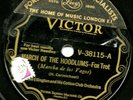
VERY RARE 1927 DUKE ELLINGTON 78 " EAST ST LOUIS TODDLE-OO " US VICTOR 21703 EX+
£
43
$
57


Favourite Auctions
To save auctions to your favourites, please login
If you don't have an account, please register
Description
A REALLY EXCELLENT COPY OF THIS RARE 78 ON THE ORIGINAL VICTOR LABEL FROM DUKE ELLINGTON AND HIS COTTON CLUB ORCHESTRA
imported into the UK by Levy's Records
EAST ST LOUIS TODDLE-OO
b/w GOT EVERYTHING BUT YOU
Duke Ellington brought a level of style and sophistication to Jazz that it hadn't seen before. Although he was a gifted piano player, his orchestra was his principal instrument. Like Jelly Roll Morton before him, he considered himself to be a composer and arranger, rather than just a musician. Duke began playing music professionally in Washington, D.C. in 1917. His piano technique was influenced by stride piano players like James P. Johnson and Willie "The Lion" Smith. He first visited New York in 1922 playing with Wilbur Sweatman, but the trip was unsuccessful. He returned to New York again in 1923, but this time with a group of friends from Washington D.C. They worked for a while with banjoist Elmer Snowden until there was a disagreement over missing money. Ellington then became the leader. This group was called The Washingtonians. This band worked at The Hollywood Club in Manhattan (which was later dubbed the Kentucky Club). During this time Sidney Bechet played briefly with the band (unfortunately he never recorded with them), but more significantly the trumpet player Bubber Miley joined the band, bringing with him his unique plunger mute style of playing. This sound came to be called the "Jungle Sound", and it was largely responsible for Ellington's early success. The song "East St. Louis Toodle-Oo" is a good example of this style of playing. The group recorded their first record in 1924 ("Choo Choo (Gotta Hurry Home)" and "Rainy Nights (Rainy Days)", but the band didn't hit the big time until after Irving Mills became their manager and publisher in 1926. In 1927 the band re-recorded versions of "East St.Louis Toodle-Oo," debuted "Black and Tan Fantasy" and "Creole Love Call", songs that would be associated with him the for rest of his career, but what really put Ellington's Orchestra over the top was becoming the house band at the Cotton Club after King Oliver unwisely turned down the job. Radio broadcasts from the club made Ellington famous across America and also gave him the financial security to assemble a top notch band that he could write music specifically for. Musicians tended to stay with the band for long periods of time. For example, saxophone player Harry Carney would remain with Duke nonstop from 1927 to Ellington's death in 1974. In 1928 clarinetist Barney Bigard left King Oliver and joined the band. Ellington and Bigard would later co-write one of the orchestra's signature pieces "Mood Indigo" in 1930. In 1929 Bubber Miley, was fired from the band because of his alcoholism and replaced with Cootie Williams. Ellington also appeared in his first film "Black and Tan" later that year. The Duke Ellington Orchestra left the Cotton Club in 1931 (although he would return on an occasional basis throughout the rest of the Thirties) and toured the U.S. and Europe. Unlike many of their contemporaries, the Ellington Orchestra was able to make the change from the Hot Jazz of the 1920s to the Swing music of the 1930s. The song "It Don't Mean a Thing (If It Ain't Got That Swing)" even came to define the era. This ability to adapt and grow with the times kept the Ellington Orchestra a major force in Jazz up until Duke's death in the 1970s. Only Louis Armstrong managed to sustain such a career, but Armstrong failed to be in the artistic vanguard after the 1930s . Throughout the Forties and Fifties Ellington's fame and influence continued to grow. The band continued to produce Jazz standards like "Take the 'A' Train", "Perdido", "The 'C' Jam Blues" and "Satin Doll". In the 1960s Duke wrote several religious pieces, and composed "The Far East Suite". He also collaborated with a very diverse group of musicians whose styles spanned the history of Jazz. He played in a trio with Charles Mingus and Max Roach, sat in with both the Louis Armstrong All-Stars and the John Coltrane Quartet, and he had a double big-band date with Count Basie. In the 1970s many of Ellington's long time band members had died, but the band continued to attract outstanding musicians even after Ellington's death from cancer in 1974, when his son Mercer took over the reins of the band.
Duke Ellington's stay at the Cotton Club has become one of the enduring legends of Jazz. Movies, songs and books have celebrated the orchestra's residency at the club which was located on the second floor of 644 Lexington at the corner of West 142nd Street in the Harlem section of New York City. It all began late in May of 1927 when Andy Preer who had been leading the house band at the Cotton Club died. In looking for a replacement the first choice was King Oliver's band, but they were not offering enough money for Oliver's taste and he turned down the job. The gig went to Duke Ellington and his men. The Cotton Club was owned by a consortium of mobsters led by bootlegger Owney Madden. The club's decor was modelled after the old South of plantations and slavery, hence the name The Cotton Club. The club was also segregated, only Whites were allowed in the audience, while the waiters and entertainers were all African-American, with the exception of occasional guest star appearances. The show was a musical revue which featured dancers, singers, comedians and variety acts, as well as Duke's band which supplied music for the floor show and singers. The Orchestra also played independently for dancing pleasure of the audience. There were two floor shows a night at midnight and 2am. What made Duke Ellington and his Cotton Club Orchestra famous were the weekly broadcasts on radio station WHN. These broadcasts were heard all over the country and gave Ellington national exposure. The band's first stay at the club began on December 4th, 1927 and continued until June 30th, 1930. They returned in September and October of 1930 and again in January of 1931. They were at the club in February of 1932 and in the spring of 1933 and appeared there for the last time in 1937 and 1938 in the club's new location downtown.
RECORD DETAILS:
US VICTOR 21703 10" 78 rpm SHELLAC imported by Levy's into the UK
Title Recording Date Recording Location Company East St. Louis Toodle-Oo
(Duke Ellington / Bubber Miley) 19th Dec 1927 New York, New York Victor
21703-A Got Everything But You
(Jack Palmer / Andy Razaf) 26th March 1928 New York, New York Victor
21703-B
CONDITION - EX/EX+ NICE COPY!
Two GREAT sides from Duke Ellington and his Orchestra
ONE ONLY AVAILABLE!!
DON'T MISS OUT - BID NOW!!
price rating