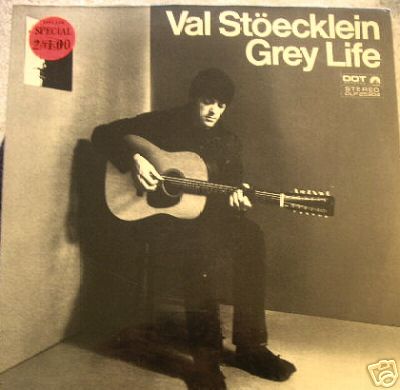
VAL STOECKLEIN of Blue Things -Grey Life 1968 LP SEALED
$
25


Favourite Auctions
To save auctions to your favourites, please login
If you don't have an account, please register
Description
SPECIALIZING IN OBSCURE, INTERESTING & EXCELLENT VINYL - MOSTLY NOT YOUR RUN-OF-THE-MILL STUFF
CHECK OUT MY OTHER SIXTIES ALBUM LISTINGS
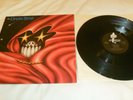
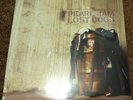
Val Stoecklein -"Gray Life", stereo, on Dot 25904.
Record Grade: Sealed, unplayed
Cover Grade: Sealed, bb hole top left corner
Labels: N.A.
About the Artist and Album: by Jason Ankeny
Best remembered for fronting the cult-favorite folk-rock combo the Blue Things, Val Stöecklein also cut a solo LP, Grey Life, now celebrated in the same pantheon of such masterpieces of melancholy and madness as Alexander "Skip" Spence's Oar and Scott Walker's Scott 4. Born Valerian Richard Stecklein in Hutchinson, Kansas in 1941, he played as a high schooler in the rock & roll band the Dukes but gravitated towards folk music upon entering Ft. Hays State College, where he made his recorded debut performing original songs "Desert Wind" and "Nancy Whiskey" on a demo credited to the Hi-Plains Singers. Stecklein next joined a 14-piece collegiate folk troupe known as the Impromptwos and was the featured vocalist on a self-titled LP the group cut in late 1963. The following year, he joined roommate Mike Chapman and fellow Dukes alum Richard Scott in the Blue Boys, a popular local group that, in mid-1964, cut a series of acetates at Damon Studios in Kansas City and resulted in a recording contract with producer Ray Ruff's Amarillo, Texas-based Ruff label. Their debut single, "Mary Lou," followed in early 1965. To avoid confusion with the late Jim Reeves' backing unit, the Blue Boys were credited as the Blue Things. After releasing a follow-up Ruff single, "Pretty Thing—Oh," the Blue Things signed to RCA and made their label debut with "La Do Da Da," a Merseybeat-inspired update of the old Dale Hawkins tune. The folk-rock ballad "Doll House" followed in the spring of 1966, complete with an advertising campaign illustrated by Stecklein's roommate S. Clay Wilson, who later became one of the most significant figures in the underground comic book community. The tale of a young prostitute, "Doll House" was deemed too controversial for airplay on most stations, but Stecklein and Chapman were undaunted and set to work on the Blue Things' classic "The Orange Rooftop of Your Mind," widely considered a landmark entry in the canon of U.S. psychedelia. In 1967 Stecklein suffered a nervous breakdown while on tour and was forced to quit the band. Variously attributed to the breakup of his first marriage, alcoholism and LSD, his collapse resulted in admission to Topeka's Menninger Clinic, where he was diagnosed with bipolar disorder. The Blue Things continued for about a year without Stecklein and they relocated to California before they split in late 1968. By that time, Stecklein was in Los Angeles. He exited the Menninger Clinic, renewed a contact with Ruff, who had become the A&R director of Dot Records, and signed a solo deal with the label, changing the spelling of his surname to Stöecklein in the process. Stöecklein entered L.A.'s legendary Gold Star Studios with Ruff and big-band arranger Dick Hieronymous and recorded 1968's Grey Life, an introspective yet overwrought folk-rock epic that remains as one of the most critically-divisive efforts of its era. Dot nevertheless thought it a potential smash and lined up a national tour, but at the eleventh hour Stöecklein refused to promote the album and it tanked. After one final solo single, 1969's "All the Way Home," he dropped from sight, although Ruff kept him on retainer as a songwriter and he contributed to Ecology's 1971's LP Environment/Evolution and Ruff's Biblical rock opera Truth of Truths. Following the 1984 death of his father, Stöecklein returned to Kansas and, in the years to follow, cut dozens of demos that never saw the light of day. He also moved to Nashville in an attempt to restart his songwriting career, but returned home within weeks. In May of 1993, Stöecklein committed suicide; he was 52 years old
MY GRADING SYSTEMS: I’ve been told that I grade conservatively. My NM (near mint) is my highest grade for opened records (which would also include unplayed records). It’s a 9 or 10 on a 1-10 scale. M- would be equivalent to an 8; VG++ to a 7; VG+ to a 6; VG to a 5; VG- to a 4; G to a 3; F to a 2 and P to a 1. The same scale applies when I grade covers (jackets). Significant defects are specifically noted and taken into consideration in the grade.
GRADING DESCRIPTIONS
RECORDS:
- GRADING Grading is based on the following criteria
- Sealed = store stock new
- Near Mint = like new or near new with only one or two small insignificant defects, a 9 or better on a 1-10 scale
- Mint- = extremely nice. Would be Near Mint, except for a couple of light hairlines or scuffs, which do not affect play
- VG++ = still a very nice record with all or nearly all of its original gloss but may have a few more light, surface marks, hairlines, needle tracks or the like which should not materially effect play
- VG+ = a nice, but used record that may have a series of light scuffs or scratches. It probably plays with a few pops, but has no serious problems.
- VG = a well-used record that still should sound OK when played, but may have moderate surface noise, pops, etc.
- VG- = a very well-worn record that plays through without skipping, but will do until a better copy comes along.
- Good = not actually good at all but probably will play through but with much in the way of surface noise, pops, crackles, etc. Still, will have no cracks, chips or the like
- Fair = you’re getting this record just to own but not to play
- Poor = the sky’s the limit, generally I will discard a record this bad (and sell the cover, jacket or sleeve alone) unless the label holds some particular interest
VISUAL GRADING: All records are visually graded only unless I state that they are play-graded. Some major labels such as the one that uses the Nipper logo - for example, were pressed on better quality vinyl and will sound better than a record which visually appears the same on budget labels. Recording techniques also varied. The sound on live albums may be far inferior to studio recordings. There may also be defects in the pressing which are invisible. The point is that an album on a major label graded VG+ may sound noticeably better than an album on a budget label that is visually graded Near Mint. I have no problem issuing a refund if you are dissatisfied with the sound on a record as long as it’s requested as per my stated return policy below. But please don’t be shocked if a record visually graded Near Mint doesn’t sound state of the art. If I base my grade on a PLAY GRADE, I will state this specifically in my grading section.
COVERS: There are really too many possible defects regarding covers to be as specific in my definitions as I had been with my record grades. But please keep in mind these general grading guidelines:
- I will give greater weight to the condition of the front cover than back cover when assigning an overall grade
- No cover with a cut out hole or saw mark will be graded Near Mint even if it is still in factory shrink and there is no other wear
- I will not reduce the grade of a cover for stickers which are glued to the jacket by the record company (eg. Contains the hit song Expressway to Your Heart); but will reduce the grade for stickers glued on the cover by stores, previous owners, etc.
- If I write that a cover has a bb hole, I’m talking about a small cut out hole
- A saw mark is a narrow cut in the perimeter of the cover, could be anywhere and vary in length from 1/2” to 2” at the most.
- The overall grade takes into consideration any stated defects. For example, if I grade a cover VG+ and then state it has 6” top and bottom seam splits - I’ve already reduced the grade because of the seam splits. If the seams weren’t split, the cover would be graded higher such as VG++ or Mint-.
Shipping Costs:
The buyer pays for shipping. For one or two albums, the cost for priority mail in the United States is $6.50 (if you live west of the Mississippi, the cost is $7.50). For media rate postage within the U.S. the cost will be $4.00 for one or two albums.The cost for shipping a 7” record via 1st class is $2.75 and the cost for shipping a compact disc via 1st class is $3.50.
Save money when I mail 2 or more records in the same package.
Insurance is optional but highly recommended for “high ticket” purchases. Insurance is available only on purchases of over $10.00. The cost for insurance is $1.30 for up to $50; $2.20 for up to $100; $3.20 for up to $200 and $1.00 additional for each additional $100 of insurance. Rates are quoted in my winning bid notices. The shipping charges for box sets, multi-record sets and other items of non-standard size and weight will be quoted.
International Shipments: Overseas customers are welcome to bid. Postage to the U.K., western Europe and Latin America is $12.00 for airmail and $6.50 for surface for one album. Canada is $6.00 airmail (no surface option). To all other countries, postage is $14.00 airmail and $7.00 surface. 7“ records are $5.50 airmail anywhere in the world. Save on shipping cost per record when I mail two or more records in one package.
Please check out my other eBay auctions
. I’ve been listing all types of records - mostly LP’s - including 50’s and 60’s rock ‘n’ roll, country, folk jazz, blues, personalities, new wave and punk, surf, psych, spoken word, comedy, etc., etc....... I try to list unusual, unique or obscure records, not the ones that you see all the time. While a majority of my listings are albums, you’ll often find a nice selection of 45’s, EP’s or picture sleeves...and an occasional 78 or two.My return policy: I don’t get many returns but customers are important to me so I like to offer a relatively hassle-free return policy. However, in order to return the record or other item, you must notify me by e-mail of your intent shortly after your receipt of the record or other item and within a reasonable time after the auction’s close. Also, the item must be returned in its original condition , i.e. the way it was shipped when it left my hands. While a very high percentage of my records arrive safe and sound (I use professional mailers and a filler or two, more for 78’s), they occasionally are damaged in transit. If that happens, I won’t accept the return of the record or other item - that’s why you have the option of obtaining insurance.
My Feedback Policy: Because I've been burnt on a few occasions, I've decided I'm only going to respond to feedback once it is left for me (and I'll try to do so on a weekly basis if not more often).
Any other questions? About anything? Please e-mail me at ibuyvinyl@nc.rr.com .
price rating