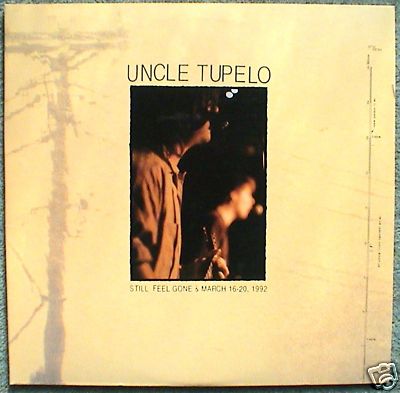
UNCLE TUPELO -STILL FEEL GONE+MARCH 16-20 1992 Vinyl LP
£
26
$
34


Favourite Auctions
To save auctions to your favourites, please login
If you don't have an account, please register
Description
UNCLE TUPELO
STILL FEEL GONE
+
MARCH 16-20 1992
2 SINGLE LP's in one double
Near Mint
Vinyl LP
1992 original release vinyl LP on the ROCKVILLE record label Cat n# ROCK6110-1 Made in USA?
The album cover is in NM condition. there is a date written in black marker on the inside of the double sleeve.
The vinyl itself is in NM condition there are just a couple of papercuts which cannot be heard when the LP is played..
If you are not fully satisfied you may return this album with a full refund inc postage.
If you need anymore information and pictures please get in touch, thanks.
Sorry if the shipping charges seem a bit high, the reason being i use heavy/strong packaging
THIS IS AS GOOD EXAMPLE OF WELL LOOKED AFTER OLD LP RECORD
Full track list
STILL FEEL GONE
Side One
1 Gun
2 Looking For A Way Out
3 Fall Down Easy
4 Nothing
5 Still Be Around
6 Watch Me Fall
7 Punch Drunk
Side Two
8 Postcard
9 D. Boon
10 True To Life
11 Cold Shoulder
12 Discarded
13 If That's Alright
MARCH 16-20 1992
Side Three
"Grindstone" (Farrar) — 3:16
"Coalminers" (Traditional) — 2:33
"Wait Up" (Tweedy) — 2:09
"Criminals" (Farrar) — 2:20
"Shaky Ground" (Farrar) — 2:49
"Satan, Your Kingdom Must Come Down" (Traditional) — 1:53
"Black Eye" (Tweedy) — 2:19
"Moonshiner" (Traditional) — 4:23
Side Four
"I Wish My Baby Was Born" (Traditional) — 1:39
"Atomic Power" (Louvin, Louvin, Bain) — 1:51
"Lilli Schull" (Traditional) — 5:15
"Warfare" (Traditional) — 3:43
"Fatal Wound" (Tweedy) — 4:09
"Sandusky" (Farrar, Tweedy) — 3:43
"Wipe The Clock" (Farrar) — 2:36
The Band - STILL FEEL GONE
Sean Slade / Organ, Piano, Producer, Engineer
Jeff Tweedy / Guitar (Acoustic), Bass, Guitar, Vocals
Brian Henneman / Guitar (Acoustic), Guitar
Chris Bess / Piano, Accordion
Jay Farrar / Guitar (Acoustic), Banjo, Guitar, Mandolin, Vocals, Guitar (Electric), Harmonica
Rich Gilbert / Optigan
Michael Heidorn / Drums
Gary Louris/Guitar (Electric) .
All Music Guide Review STILL FEEL GONE
Uncle Tupelo clearly defined their nervy Gram Parsons-meets-the Minutemen sound on their debut album, 1990's No Depression, and their 1991 follow-up, Still Feel Gone, found them branching out into new variations of their previously established themes. While No Depression was dominated by breakneck tempos with the occasional slow, contemplative number thrown in for variety, Still Feel Gone found Uncle Tupelo taking a closer look at the middle ground, as evidenced by the high-strung acoustic guitars of "Still Be Around," the measured but powerful Crazy Horse stomp of "Looking for a Way Out," the lonesome shuffle of "True to Life," and the stark atmospherics of "If That's Alright" (the latter of which in retrospect sounds like the first dawning of the ideas Jeff Tweedy would explore with Wilco). But plenty of what made No Depression so impressive is still on view here, including the brutal stutter-step of "Gun," the simple but powerful declaration of "Watch Me Fall," and the heartfelt tribute to an obvious influence, "D. Boon." And if anything, the band sounds even more powerful this time out, and the broader picture of their abilities only confirms how strong a combination Jay Farrar, Jeff Tweedy, and Mike Heidorn really were. If Still Feel Gone isn't as immediately impressive as No Depression, a few plays confirms it's still the work of a gifted band at full strength, and this reissue gives the album the special treatment it deserves. ~ Mark Deming, All Music Guide
ROLLING STONE REVIEW - STILL FEEL GONE
Uncle Tupelo knows a thing or two about exorcising demons. No Depression, the debut album by the Belleville, Illinois, trio, was one of the loudest, loneliest wails in recent memory to arise from the Midwest's recession-plagued plains. With Still Feel Gone, its stirring second outing. Uncle Tupelo has proven itself to be the poetic voice of small-town isolation and smoky-barroom imprisonment.
While Still Feel Gone lacks some of the crunch of its predecessor, the band has not sacrificed its power by stripping away a layer or two from its country-grunge anthems. Vacillating between poignant acoustic balladry and full-tilt punk energy, Uncle Tupelo still comes off as equal parts Gram Parsons and Gang Green.
The characters that populate Still Feel Gone are far from one-dimensional caricatures of rural life. Songwriters Jay Farrar and Jeff Tweedy write with an insightful eye and ragged beauty that bring their images alive without coming off as rote shrieks of youthful disenchantment. On "Still Be Around," Farrar growls about a life "when the Bible is a bottle and a hardwood floor is home/When morning comes twice a day or not at all," and the listener is instantly drawn into his world.
The band's other ace in the hole comes from the contrasting vocal styles of Farrar and Tweedy. While Tweedy sings with a pop-perfect boyish lilt, Farrar's powerful rasp sounds like he's been gargling with Wild Turkey since puberty. The balance of innocence and hardedged rawness helps give Uncle Tupelo an emotional range reminiscent of the glory days of Hüsker Dü's Bob Mould and Grant Hart.
A first-rate example of the power of no-frills production and direct expression, Uncle Tupelo's work stands as a testimonial to what can be accomplished with drums, guitar, bass and plenty of focused frustration. It would be a crime if the band's screams from the factory belt went unheard.
CHRIS MUNDY .
THE BAND - MARCH 16-20 1992
Jay Farrar – bass guitar, guitar, 12 string guitar, harmonica, vocals
Jeff Tweedy – bass guitar, guitar, 12 string guitar, vocals
Mike Heidorn – drums, cymbals, tambourine
Brian Henneman – banjo, bouzouki, guitar, mandolin, slide guitar
John Keane – banjo, bass guitar, guitar, pedal steel guitar, steel guitar, engineering, mixing
Peter Buck – producer, feedback
David Barbe – bass guitar, engineering
Andy Carlson – violin
Brian Holmes, Billy Holmes – accordion
March 16–20, 1992 is the third studio album by alternative country band Uncle Tupelo, released on August 3, 1992. The title refers to the five-day span during which the album was recorded. An almost entirely acoustic recording, the album features original songs and covers of traditional folk songs in near equal number, and was produced by R.E.M. guitarist Peter Buck.
Background
In 1990, R.E.M. guitarist Peter Buck attended an Uncle Tupelo concert at the 40 Watt Club in his hometown of Athens, Georgia. Buck was particularly impressed with the band's rendition of the Louvin Brothers' "Great Atomic Power", and contacted the band after the show. Uncle Tupelo singers Jay Farrar and Jeff Tweedy exchanged their interests in bluegrass music with Buck, and decided to collaborate on an acoustic music project in the future.[1]
Two years later, the alternative rock of bands such as Nirvana broke into the mainstream. Farrar was irate about the pressure from the music industry to sound like the trend:[2]
This should insulate us from that industry bullshit, people looking for the next Nirvana. I don't think anybody is the next Nirvana, certainly not us. People always talk about the next Beatles, the next Elvis. You can't predict that stuff.
Uncle Tupelo's frustrations with their record label Rockville Records grew when the label refused to pay the band's royalties for the sales of their first two albums. This resulted in a "nothing-to-lose context" for the recording of a third album. In what was a sharp contrast to the popular music styles at the time, Uncle Tupelo decided to record an album of folk songs.[3]
Recording
Before the band began recording, drummer Mike Heidorn announced that he intended to leave the band for personal reasons. However, Heidorn wanted to work with Peter Buck, so he agreed to postpone his departure until after the March 16–20, 1992 recording sessions.[4]
The band stayed at Peter Buck's house while in Athens, Georgia to record the album. Buck offered to host the band for free, so that the US$13,500 budget allotted by Rockville could be spent exclusively to pay the fees of the recording studio and audio engineers David Barbe and John Keane. Buck encouraged the band to arrange a certain amount of material each night to keep the band on pace. Guitarist Brian Henneman also contributed with his well-honed guitar skills and learned how to play mandolin—the same one that Buck used in R.E.M.'s hit "Losing My Religion"—and bouzouki for the album.[3] The five-day span that the band spent in the recording studio was ultimately used as the title of the album.[1]
The album's content reflected folk themes juxtaposed with new material from Tweedy and Farrar. Several of the songs have Christian themes but were placed on the album to reflect the "madness and fear that would drive men to wish for such redemption". Jeff Tweedy's lyrics were strongly influenced by Nick Drake's 1972 album Pink Moon. Farrar's "Criminals" paraphrases a George H. W. Bush campaign speech and was considered by music journalist Greg Kot to be one of the band's "angriest songs". Farrar's rendition of Sarah Ogan's "Come All You Coal Miners"[5] (the title was shortened to "Coalminers" and the song listed as "traditional" on the album) lamented the harsh working conditions in the coal mining industry, but the choice was received poorly by some of the band's closest peers; according to singer Nick Sakes of Dazzling Killmen:[6]
We could occasionally imitate Jay's singing and insert our own words: 'It gets real hot working down at my mom's bookstore.' It was a little too much to hear these songs about coal miners coming from regular dudes that worked in record stores and bought SST albums and went to Black Flag shows.
Three songs, the gospel tune "Warfare", the hymn "Satan, Your Kingdom Must Come Down" and the ballad "I Wish My Baby Was Born" were taken from High Atmosphere, a compilation of songs recorded by John Cohen in Virginia and North Carolina.[7] Along with Ogan's version of "Coalminers", the murder ballad "Lilli Schull" had previously been released on Oh My Little Darling, a compilation of Southeastern folk song types released on New World Records.[8]
Release and reception
March 16–20, 1992 sold more copies than their first two albums, No Depression and Still Feel Gone, combined. Uncle Tupelo embarked on a tour of small clubs to promote the album. However, the band resisted performing material from March, since many of the venues attracted a punk rock audience; Tweedy thought "it would have been suicide" if Uncle Tupelo performed acoustic songs.[9]
The album generated mostly positive reviews. Jason Ankeny of Allmusic called the album "a brilliant resurrection of a bygone era of American folk artistry".[10] Bill Wyman of Entertainment Weekly remarked that it was "a moving and sincere New Depression manifesto".[11]
March was re-issued in 2003 through Legacy Records. The re-release contained five bonus tracks: acoustic demos of "Grindstone" and The Stooges' "I Wanna Be Your Dog", a live version of "Moonshiner", the previously unreleased "Take My Word", and a version of the theme song from The Waltons. Reviews for the re-issue were also mostly positive. Pitchfork Media writer William Bowers called March Uncle Tupelo's best album "by far", claiming "The acoustic guitar has rarely sounded better than it does here." However, Bowers also criticized the addition of the bonus tracks.
ROLLING STONE REVIEW - March 16-20, 1992
Uncle Tupelo crawled out of the factory town of Belleville, Illinois, in 1987 with what turned out to be one of the most durable ideas of the modern-rock era: using loud, fervent guitars to support the churchgoing earnestness of hillbilly songs. By the time the band dissolved, four studio albums later, songwriters Jay Farrar and Jeff Tweedy -- who went on to found Son Volt and Wilco, respectively -- had helped spark the thriving alt-country genre.
These long-overdue reissues -- which include the three Rockville Records efforts as well as the band's 1993 major-label debut (and swan song), Anodyne -- should lift Uncle Tupelo out of historical-footnote status. One revelation is the band's impressive songwriting range, which stretches from Farrar's apocalyptic, transcendence-seeking tunes to Tweedy's two-beat curiosities and sad love odes. Each title has been remixed and crisply remastered, and each offers previously unreleased bonus material.
Tupelo evolved quickly. The first phase, documented on 1990's No Depression and its follow-up, 1991's Still Feel Gone, finds the band drawing on both the Stones and the Clash to forge its own fire-breathing power-chord stomp. The second phase, which begins with "Sauget Wind," a Farrar-ballad outtake from Still Feel Gone, flowers fully on the Peter Buck-produced live-in-the-studio collection March 16-20, 1992 -- a triumph of austere, delicately embroidered acoustic atmospheres that put the emphasis on the narratives. The final phase, Anodyne, combines Uncle Tupelo's early headstrong rock with the nuances of March 16-20, and shows that this band, alone among American acts of its generation, understood how to connect Woody Guthrie to the Minutemen to Marvin Gaye.
For all the lore surrounding this band's performances, most of the bonus material falls into the "pleasant but inconsequential" category. But there are a handful of undeniable gems: notably, Anodyne's live jam of "Suzy Q," which finds Farrar spitting blue fury over a rhythm bed that evokes both the open prairie and the murky Delta swamp.
TOM MOON
Thanks for taking the time to look at this auction
RECORD COLLECTOR GRADING SYSTEM
In order to assist everyone who buys and sells rare discs, Record Collector magazine has originated a set of standards for the condition
of second-hand records, cassettes and CDs. Anyone buying or selling records through the magazine must use our conditions to state what
amount of wear and tear the disc, its sleeve and/or contents have been subject to. The seven standard condition categories, and a description
of what each one means, are listed below:
MINT: The record itself is in brand new condition with no surface marks
or deterioration in sound quality. The cover and any extra items such
as the lyric sheet, booklet or poster are in perfect condition. Records
advertised as Sealed or Unplayed should be Mint.
EXCELLENT: The record shows some signs of having been played, but there
is very little lessening in sound quality. The cover and packaging
might have slight wear and/or creasing.
VERY GOOD: The record has obviously been played many times, but
displays no major deterioration in sound quality, despite noticeable
surface marks and the occasional light scratch. Normal wear and tear on
the cover or extra items, without any major defects, is acceptable.
GOOD: The record has been played so much that the sound quality has
noticeably deteriorated, perhaps with some distortion and mild
scratches. The cover and contents suffer from folding, scuffing of
edges, spine splits, discoloration, etc.
FAIR: The record is still just playable but has not been cared for
properly and displays considerable surface noise; it may even jump.
The cover and contents will be torn, stained and/or defaced.
POOR: The record will not play properly due to scratches, bad surface
noise, etc. The cover and contents will be badly damaged or partly
missing.
BAD: The record is unplayable or might even be broken, and is only of use as a collection-filler.
price rating


![Woogies [Louis Madison]: Chippy Man / Please Don't [ new Unplayed Copy]](https://www.popsike.info/php/thumbnail.php?url=https://www.popsike.pics/pix/20180922/123385004952.jpg)