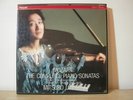
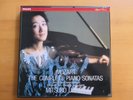
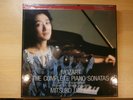
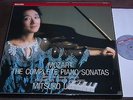
UCHIDA Mozart Complete Piano Sonatas 7LP Philips MINT
$
316


Favourite Auctions
To save auctions to your favourites, please login
If you don't have an account, please register
Description
COMPLETE 7 LP SET OF DIFFICULT TO FIND UCHIDA MOZART SONATAS
ORIGINAL DUTCH PRESSINGS
CONDITION IS MINT- FOR COVERS AND LPS. NO SCRATCHES OR SCUFFS ON LPS.
FREE SHIPPING IN US
MITSUKO UCHIDA Mozart Complete Piano Sonatas 7LP Philips MINT-
Mozart
- The Complete Piano Sonatas -
Mitsuko Uchida - Piano
Philips 420 185-1 KV 284 AND 570
Philips 412 617-1 KV 279, 457, AND 576
Philips 412 616-1 KV 330 and 333
Philips 412 123-1 KV 331 and 332
Philips 412 122-1 KV 533, 494 and 545
Philips 412 741-1 KV 309, 310, 311
Philips 420 186-1 KV 280, 281, 282, 283.
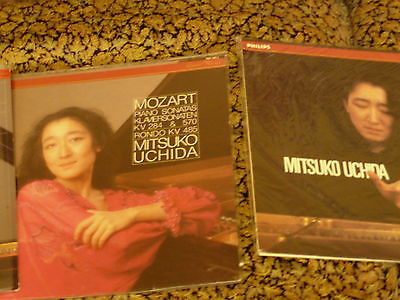
ALL COVERS ARE IN MINT CONDITION.
These LPs are in Digital Stereo. Philips did publish a 7 LP Box (422 124-130).
This is not the original boxed collection but the 7 LPs from the Original DUTCH pressing 1988.
These are the Individual LPs from the Original First Pressing 1984.
Stunning Copy of Legendary Recordings
A Must Have For All Audiophile Music Lovers
This is one Of The Most Acclaimed Sets Of MITSUKO UCHIDA’s Recordings.
From the original Gramophone review 2/1989
Both artists [Uchida and Zacharias] are very well recorded. In fact, I've rarely heard a more natural-sounding reproduction of a piano than Uchida's in London's Henry Wood Hall. In his German venues Zacharias often emerges lighter and more glistening, a shade less full-bodied. In their sound-world, both recordings struck me as ideally attuned to each player's special style.
Generalizations, as we all know, can be dangerous. But in general Uchida's Mozart could be described as the more authoritative of the two. As so often before, I again had the impression that she has thought long and deeply about the music, and has completely made up her mind as to how she wants it to go. Zacharias (rather like Andras Schiff on Decca) seems to leave more to spontaneous keyboard impulse. Impulse is certainly the word where rhythm is concerned, for while always a genuine enough response to the mood of the moment, his time-keeping (especially in slow movements) lacks Uchida's basic stability. Tiny details of ornamentation also sound as if done in the delight of the moment (certainly in these four volumes there are none of the excesses that worried some reviewers in the first two).
All in all I enjoyed Zacharias most in the earlier works, especially his light-fingered sparkle in livelier moods. He relishes flashes of surprise and wit in the music's constructional cunning more overtly than Uchida—and not least in the concluding variations of the 'Durnitz' Sonata in D, K284. Even if his daredevil exuberance here overflows in a few questionable liberties of tempo change, I'm sure Mozart himself would have smiled. But at the risk of being branded a killjoy, I cannot condone his introduction of his wife to manipulate what he calls the ''janissary stops'' (i.e. extraneous percussion) towards the end of an alreadily somewhat crudely accented and coloured Alla turca finale in the A major Sonata, K331. Nor, incidentally, do I like his plunge into its Menuetto at exactly the same tempo as he ended the first movement variations—just as if it were yet one more of them.
My main disappointment was nevertheless in the maturer slow movements. Even in the Adagio opening of the early E flat Sonata, K282, his phrasing lacks Uchida's sustained poise and breadth. In later contexts like the Andante cantabile con espressione in K310 in A minor, the Adagio of K457 in C minor and most of all, the great Andante of K533 in F, the little extra time she allows herself brings a more laden as well as more shapely melodie line (though his embellishment has an exquisite delicacy all its own), just as her far stricter observance of Mozart's own dynamic markings results in greater depth and intensity of characterization in general. Nowhere is Zacharias more misguided in this latter respect than in his smoothing out of the pain and stress in the course of that K533 Andante. Some of the faster movements of the later sonatas also struck me as more urgently motivated from Uchida, notably in K457 in C minor. In toto her greater maturity and purity win the day: of this pair I would definitely recommend her as the more consistently reliable guide. But in his less predictable way Zacharias remains a Mozartian of refreshing spontaneity, often reminding me of the composer encountered in those ever engaging early letters.'
price rating