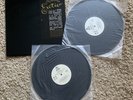
Traditional Anthology Of Hungarian Folk Music 1 5LP Box Set EX/VG+ booklet
$
60


Favourite Auctions
To save auctions to your favourites, please login
If you don't have an account, please register
Description
For shipping information, see below.
Anthology Of Hungarian Folk Music I.
Dance Music
Series editor Dr.Zoltán Falvy - Director of the Musicological Institute of the Hungarian Academy of Sciences.
Hungaroton - LPX 18112-16
1985
Excellent/ Very Good +
Box set: 5 LPs + 40 pages booklet (english and hungarian) - musical examples, lyrics, photos, notes.
Preface
"The collection of Hungarian folk music started with Béla Vikár's 1895 phonograph recordings. After the first few hundred folksongs it became clear that a musical idiom was alive among the rural population and that it was important that this become known, arranged systematically and published, being something of value to those who lived in towns as well, and to music in Hungary, indeed in the whole of Europe.
Zoltán Kodály and Béla Bartók after their 1905-6 collecting tours using a phonograph gave priority to the publication of this material in the form of scores. As early as in 1906 they published 20 Hungarian folksongs with piano accompaniment. They only started on scholarly research into the material after that date while continuing their collecting work. The first folk-music records were planned in the 1930s, and in 1936 the Hungarian National Museum, with the help of the Hungarian Academy of Sciences, issued four records complete with programme leaflets entitled Hungarian Folk Music Gramophone Recordings (Series No.1). The four records contained 27 melodies from Somogy and Tolna counties, i.e. Transdanubian melodies which had been collected from a handful of singers and from a long shepherd’s pipe player. The recordings were made by Béla Bartók, László Lajtha and Vilmos Seemayer, and the melodies transcribed by Béla Bartók and Zoltán Kodály. (The scores were included in the programme leaflet.) The notes were arranged, the leaflets edited and the texts translated into English by Dénes Bartha. In the Preface he wrote:
„Following Béla Bartók Hungarian folk music is usually divided into four dialect regions. The 27 melodies in the present, first series originate from dialect region I (Transdanubia), and are typical of it. In other areas the same songs occur in variants that differ to a greater or lesser degree (for example the László Fehér Ballad, No.19) The 27 melodies recorded and published here are of course a mere fragment of the Hungarian folk music of Transdanubia, but in the given present circumstances we had to rest content with doing this much.”
The preparation of the further folk music recordings continued in 1937-38. The new project had a broader base and was given the title „Patria”. It became a series of folk tales and folk music as a joint undertaking by Hungarian Radio and the Ethnographical Museum. In the preface to the programme leaflet, Gyula Ortutay pointed out that text editions and scores were insufficient for those doing ethnographic research: „The style and innermost features of oral tradition cannot be fully perpetuated in writing. Something, almost the most decisive aspect, is always lacking and cannot be indicated.”
Hungary had been the first country in Europe to collect its folk music on phonograph cylinders, but it lagged behind in recording on discs, although records constituted one form of „perpetuation” and also assisted research work and scholarly observation on a „laboratory level”. The rural sociologists of the 1940s and their young assistants selected the folksongs and folk tales for the first Patria records. The 107 records included 530 songs, 9 melodies for flute, 7 for violins and 14 for bagpipes. This appeared first, and was followed by 20 folk tale records. A further 30 matrixes were prepared and test mouldings were, but the records were not issued. After these 157 records that had been prepared and in part released, almost 100 other micro-moulds were made after the Second World War (before the 1960s), relying largely on the work of László Lajtha, but these records have never been released either. And yet there was a public demand for recorded folk music, and in the 1950s the Institute of Folk Art reissued some 50 pieces from the first series. More modern techniques and reliving Hungarian ethnomusicology are in evidence in a long-playing record compiled by the Folk Music Research Group of the Hungarian Academy of Sciences for the IFMC (today the ICTM) congress held in Hungary. It was issued in 1964, and contained 23 melodies. The record is arranged according to folksong types selected from what are known as the old-style and the new-style. Benjamin Rajeczky has expanded this principle in a more recent series of records of his entitled Hungarian Folk Music 1 (1968), 2 (1972) and 3 (1982). The Lps include 250 melodies in the following grouping: I. A, B – Ancient Layer; II. A – European Inheritance; II. B – New Style Melodies; III. A, B – Instrumental Folk Music; IV. A, B – Melodies to accompany Folk Customs. This arrangement was repeated in all three albums. Meanwhile, in 1980, Bálint Sárosi’s album, Hungarian Instrumental Folk Music appeared. The arrangement is by types of instruments used and not types of melodies.
The early 1980s brought two centenaries which provided opportunities for the release of archival material. The first marked the centenary of the birth of Béla Bartók. It was edited and annotated by László Somfai and entitled Hungarian Folk Music Records with Béla Bartók’s Notations. (Of the three records, two were accompanied by Bartók’s transcriptions and one by those of Jen? Deutsch.) The other, marking the centenary of Zoltán Kodály’s birth, was edited by Lujza Tari and entitled Hungarian Folk Music from Zoltán Kodály’s Phonograph Recordings. Since the 1960s folksongs have appeared on a few 7-inch records, some with book supplements and some independently. In 1965 Denis Dille issued a few copies of phonograph-cylinders from Bartók’s collection of Arab music in Biskra, as a supplement to his Documenta Bartókiana. After 1970, a foil disc was issued by the folk music collection of the Ethnographical Museum, containing melodies originally collected by Béla Vikár, Béla Bartók, Zoltán Kodály and László Lajtha, edited by Pál Sztanó and Margit Tóth. Some provincial museums have also issued records of items on their collections (e.g. The Folk Music of Somogy, ed. Imre Olsvai as a supplement to a volume by Árpád Együd: The Ethnography of Somogy County).
The Musicological Institute (the successor to the Folk Music Research Group) of the Hungarian Academy of Sciences is now issuing 30 LPs of folksongs, as evidence of the fact that recent years have not meant a decline in interest in Hungarian folk music. Ethnomusicologists have selected several hundred vocal and instrumental examples from a collection of nearly 150,000 folksongs bringing to bear great scholarly experience, serious collecting activity and a knowledge of the latest methods int he arrangement of melodies. For the first time a proper, distinct place is assigned to the folk dance (on five records), in an effort to meet a demand evident since the 1970s and the folk dance movement. Relaxation and a laid brack attitude have gone hand in hand with fashion and, the music used for folk dancing has often distorted the original musical material, developing stereotype rhythms that deviate from the source. The records released here present dance dialects in a geographical arrangement.
In compiling this series of records the editors have kept Bartók’s noting in mind. The melodies on the 30 records follow a geographical arrangement. Within that the arrangement is according to genres. The groups are as follows:
1. Dance music of the Hungarian people (arranged by dance dialects)
2. Western dialects (Small Hungarian Plain, Transdanubia, Syrmia)
3. Northern dialects (The Mátyus country, the Zobor region, Palots country, and the North-Eastern Hills)
4. Central dialects (Great Hungarian Plain and the Tisza region)
5. Eastern dialects
a) The Székely country, Kalotaszeg, the Transylvanian Heath and Gyimes
b) Moldavia
This splendid undertaking by Hungarian ethnomusicologists has been undertaken in parallel with the ongoing work on a series of books Corpus Musicae Popularis Hungaricae and the publication of scores, folksong types and the latest results in creating a new typology for folk music. Each strand of this variegated work is of equal importance, and each ultimately aims at presenting the folk tradition from as many angles as possible, and at sustaining it through allowing it to be known from all its authentic sources."
Dr. Zoltán Falvy
(1501g<Item's weight with packing: <2000g)
Delivery times:
to Europe: 3-5 working days
to other countries: 5-10 working days
Shipping (registered, priority): safe packing + tracking number
Feel free to contact me with any questions. Check out my other items!
General shipping informations:
(Double LP = 2LP and the box sets have special prices)(I combine shipping)
To European countries:
1LP (1-500g): 13$
2-3LPs (501-1.000g): 19$
4-5LPs (1.001-1.500g): 26$
6-7LPs (1.501-2.000g): 31$
2kg-3kg: 37$ (Austria, Germany, Slovakia) and 49$ (France, Great Britain, Italy)
3kg-4kg: 38$ (Austria, Germany, Slovakia) and 52$ (France, Great Britain, Italy)
4kg-5kg: 40$ (Austria, Germany, Slovakia) and 57$ (France, Great Britain, Italy)
(European countries: Albania, Andorra, Austria, Armenia, Azerbaijan, Belgium, Belarus, Bosnia & Herzegovina, Bulgaria, Cyprus, Czech Republic, Croatia, Denmark, Estonia, Finland, France, Georgia, Germany, Gibraltar, Greece, Iceland, Ireland, Italy, Kosovo, Latvia, Liechtenstein, Luxemburg, Lithuania, Malta, Monaco, Montenegro, Moldova, Netherlands, Norway, Poland, Portugal, Russia, Romania, San Marino, Scotland, Serbia, Slovakia, Slovenia, Turkey, Sweden, Switzerland, Spain, Ukraine, United Kingdom, Republic of Macedonia, Vatican)
To other countries (worldwide):
1LP (1-500g): 14$
2-3LPs (501-1.000g): 21$
4-5LPs (1.001-1.500g): 29$
6-7LPs (1.501-2.000g): 35$
2kg-3kg: 67$ (Australia, Japan, Canada, USA)
3kg-4kg: 71$ (Australia, Japan, Canada, USA)
4kg-5kg: 77$ (Australia, Japan, Canada, USA)
Grading:
Mint: Absolutely perfect in every way. Certainly never been played, possibly even still sealed.
Near Mint: The record should show no obvious signs of wear. A 45 RPM or EP sleeve should have no more than the most minor defects, such as almost invisible ring wear or other signs of slight handling. An LP cover should have no creases, folds, seam splits or other noticeable similar defects. No cut-out holes, either. And of course, the same should be true of any other inserts, such as posters, lyric sleeves and the like.
Very Good Plus: Record surfaces may show some signs of wear and may have slight scuffs or very light scratches that don't affect one's listening experiences. Slight warps that do not affect the sound are "OK". The label may have some ring wear or discoloration, but it should be barely noticeable. The center hole will not have been misshapen by repeated play. Picture sleeves and LP inner sleeves will have some slight wear, lightly turned up corners, or a slight seam split. An LP cover may have slight signs of wear also and may be marred by a cut-out hole, indentation or corner indicating.
Very Good: Surface noise will be evident upon playing, especially in soft passages and during a song's intro and fade, but will not overpower the music otherwise. Groove wear will start to be noticeable, as with light scratches (deep enough to feel with a fingernail) that will affect the sound. Labels may be marred by writing, or have tape or stickers (or their residue) attached. The same will be true of picture sleeves or LP covers.
Good/Good Plus: A record in Good or Good Plus condition can be put onto a turntable and will play through without skipping. But it will have significant surface noise and scratches and visible groove wear (on a styrene record, the groove will be starting to turn white). A cover or sleeve will have seam splits, especially at the bottom or on the spine.
price rating

![John Miles - Rebel [Vinyl LP] | Decca | UK, 1976 | NM/VG](https://www.popsike.info/php/thumbnail.php?url=https://www.popsike.pics/pix/20240627/204857125254.jpg)


![King Diamond - Abigail [White Vinyl] + Them [Blue Vinyl] LP BUNDLE / US SELLER](https://www.popsike.info/php/thumbnail.php?url=https://www.popsike.pics/pix/20140719/371105113937.jpg)



![JAMIE CULLUM - The Pursuit, Vinyl Record [Sealed 2009 1st issue gatefold 2 x LP]](https://www.popsike.info/php/thumbnail.php?url=https://www.popsike.pics/pix/20160408/272205227257.jpg)