The Who: Tommy - Orig 1st Press Japanese 2LP NM+
$
61


Favourite Auctions
To save auctions to your favourites, please login
If you don't have an account, please register
Description
The Who
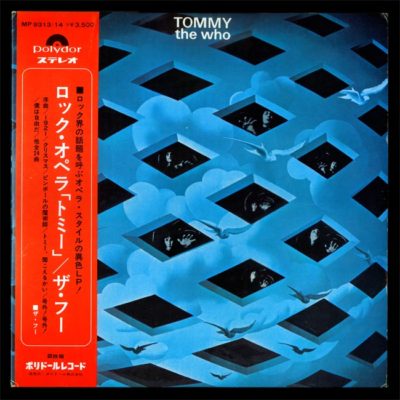
Original 1969 Japanese 1st Pressing with OBI and Lyric Booklet
Tommy
Polydor MP 9313
Record: MINT-
(One or two plays at most! No marks!)
Sleeve:NM
(A little edge wear)
Actual Item Scans & Photos
Tommy is the fourth album by English rock band The Who, released by Track Records and Polydor Records in the UK and Decca Records/MCA in the US. A double album telling a loose story about a "deaf, dumb and blind boy" who becomes the leader of a messianic movement, Tommy was the first musical work to be billed overtly as a rock opera. Released in 1969, the album was mostly composed by Pete Townshend. In 1998 it was inducted into the Grammy Hall of Fame for "historical, artistic and significant value". It has sold over 20 million copies worldwide.
Characters
Tommy: The main character of the story, from whom the album gets its name.
Father: Sometimes referred to as "Captain Walker", whose son is the album's protagonist.
Mother: Mrs. Walker, Tommy's mother.
The Lover: A romantic partner of Tommy's mother.
Uncle Ernie: Referred to as Tommy's "wicked uncle", a paedophile. Becomes an aide to Tommy at the end of the story.
Cousin Kevin: Tommy's cousin who brutalises him when the two are left alone.
The Hawker: A pimp for prostitute the Acid Queen, who peddles her services.
The Gypsy: A prostitute who deals in acid and exposes Tommy to the drug in an attempt to heal him.
The Local Lad: The reigning champion of the game of pinball, until Tommy beats him.
The Doctor: A doctor who attempts to heal Tommy and finds out that his disabilities are psychological rather than physical.
Synopsis
British Army Captain Walker is reported missing, and is believed dead. His widow, Mrs. Walker, gives birth to their son, Tommy. Years later, Captain Walker returns home and discovers that his wife has found a new lover. Captain Walker confronts the two, and the lover is subsequently killed in the struggle. To cover up the incident, Tommy's parents tell him that he didn't see or hear it, and that he will never tell anyone about the incident. Traumatised, Tommy subsequently becomes blind, deaf and mute. Now in a semi-catatonic state, Tommy's subconscious manifests as a figure dressed in silvery robes who guides him on a journey of enlightenment. Years pass, and Tommy becomes a young man, now interpreting physical sensations as music.
During Christmas, Tommy's parents worry that his soul is at risk of damnation, since he is unaware of Jesus or prayer. One day, Tommy is left alone with his cousin Kevin, who bullies and tortures him for his own amusement. A pimp referred to as "the Hawker" is introduced and peddles his prostitute's sexual prowess, reputed to heal the blind, the deaf and the mute. Tommy is ultimately taken to this woman, who calls herself the Acid Queen, and she tries to coax Tommy into full consciousness with hallucinogenic drugs and sex. When this does not work, Tommy's parents reluctantly leave him temporarily in the care of his Uncle Ernie, who is an alcoholic child molester. He takes this opportunity to abuse Tommy without fear of being caught. Eventually, Tommy is discovered to have a talent for pinball, and quickly defeats the local champion of the game.
Tommy's father finds a medical specialist in another attempt at 'curing' him. After numerous tests, the doctor informs Tommy's parents that his disabilities are psychosomatic, rather than physical. Meanwhile, Tommy is internally trying to reach out to them. His mother continues to try to reach him, and becomes frustrated that he ignores her while staring directly at a mirror, despite his apparent inability to see. Out of this frustration she smashes the mirror and brings Tommy back into reality. This "miracle cure" becomes a public sensation and Tommy attains a guru-like status. Thereafter he assumes a messianic mantle and attempts to enlighten those willing to follow him. During one of Tommy's sermons, a reverend's daughter, Sally Simpson, sneaks out of her home to meet with Tommy. As the police try to control the crowd, Sally is thrown from the stage and suffers a gash on her face. Tommy opens his own home to anyone willing to join him, and urges them to bring as many people with them as they can. When his house becomes too small to accommodate them, a camp is built with the intended purpose of spreading Tommy's teachings. Tommy's Uncle Ernie assists him at this camp, but uses it as an opportunity for profit and exploiting Tommy's disciples. Now with all necessary resources at his disposal, Tommy instructs his followers to blind, deafen and mute themselves in order to truly reach enlightenment. They eventually reject his methods and ideology after finding that his enlightenment is not reached by being cured, but by discovering a state of awareness while blind, deaf and mute.
Analysis and history
Townshend's inspiration for the album came from the teachings of the Meher Baba and other writings and expressing the enlightenment he believed that he had received. A year prior to the album's release, Pete Townshend had explained many of his ideas during a famous Rolling Stone interview.
When asked what his opinion of Tommy was, John Entwistle replied:
I think it's just an association of ideas really. It took us eight months altogether, six months recording, two months mixing. We had to do so many of the tracks again, because it took so long we had to keep going back and rejuvenating the numbers, that it just started to drive us mad, we were getting brainwashed by the whole thing, and I started to hate it. In fact I only ever played the record twice- ever. I don't think Tommy was all about [what] was on the record- I think it's on the stage. The message is much stronger on stage than on record.
When it was released, critics were split between those who thought the album was a masterpiece, the beginnings of a new genre, and those that felt it was exploitative. The album was banned by the BBC and certain US radio stations. Ultimately, the album became a commercial success, as did The Who's frequent live performances of the rock opera in the following years, elevating them to a new level of prestige and international stardom. However, unlike later rock operas, the album was not accompanied by live theatrical shows, but simply raw concerts in which the band performed all of the album's songs in the usual live Who formation of a "power trio" along with a lead vocalist. Recordings of such shows from the Tommy tour can be heard on the second disc of the Deluxe edition of Live At Leeds and on Live At The Isle Of Wight Festival 1970.
Although Tommy is usually described as a rock opera, author and Who historian Richard Barnes states that this definition is not strictly correct, since Tommy does not utilise the classic operatic formulae of staging, scenery, acting and recitative. According to Barnes, Tommy could be more accurately described as a "rock cantata" or a "rock song cycle". It most closely resembles an oratorio (e.g. Handel's "Messiah") in form, as it includes instrumental, choral and solo sections, with no dialogue between characters, and no sets, costumes or choreography. A counter-argument to Barnes would be that new operas are frequently performed without the first three features before a full mounting, similarly to Tommy, and some of its songs, such as "1921", "Christmas", "Do You Think It's All Right?" and "Go to the Mirror" have the qualities of recitative and dialogue, while it has subsequently been performed with choreography and costuming, including by the Seattle Opera in 1971 and by a Canadian ballet company (dancing to the album recording) shortly thereafter.
Musically, Tommy is a complex set of pop-rock arrangements, generally based upon Townshend's acoustic guitar and built up with many overdubs by the four members of the band using many instruments, including bass, electric and acoustic guitars, piano, organ, drum kit, gong, timpani, trumpet, French horn, three-part vocal harmonies and occasional doubling on vocal solos. Many of the instruments only appear intermittently—the track "Underture" features a single toot on the horn—and when overdubbed many of the instruments are mixed at low levels. Townshend mixes in fingerpicking with his trademark power chords and fat riffs. His interest in creating unique sounds is evident throughout the album, most notably on "Amazing Journey" and the curious chirping/whistle sound heard during the song, which was created by playing a taped recording of claves in reverse.
The tracks "Pinball Wizard", "Go to the Mirror!", "I'm Free", "Christmas", and "See Me, Feel Me" were released as singles and received airplay on the radio. "Pinball Wizard" reached the top 20 in the US and the top five in the UK. "See Me, Feel Me" landed high in the top 20 in the US and "I'm Free" reached the top 40.
Several structural precedents for Tommy exist in Townshend's work, including "Glow Girl" (1968), "Rael" (1967), and the sectional work "A Quick One While He's Away" (1966). In 2004, Uncut released a CD titled The Roots of Tommy containing music that they asserted influenced Tommy's creation. Among the included songs are the blues songs that Townshend included or attempted to, such as Mose Allison's "Young Man Blues" and Sonny Boy Williamson's "Eyesight to the Blind," as well as The Pretty Things' "S.F. Sorrow Is Born," material from Mark Wirtz's A Teenage Opera, and music by groups such as The Zombies, The Jimi Hendrix Experience, Nirvana (UK), The Kinks. Music hall comedian Max Miller is said to have influenced the character of Uncle Ernie.
Recognition
In 2003, the album was ranked number 96 on Rolling Stone's list of the 500 greatest albums of all time. The album was ranked number 90 on VH1's 100 Greatest Albums of Rock & Roll and appears in the book 1001 Albums You Must Hear Before You Die. NME named it the 16th on "NME Writers All Time Top 100" in 1974. Q ranked it 9th on their list of "The Music That Changed The World: Part One 1954–1969" in 2004. Upon its release in 1969, Life declared, "For sheer power, invention and brilliance of performance, Tommy outstrips anything that has ever come out of a rock recording studio."
Editions and cover art
Tommy was originally released as a two-LP set with a booklet including lyrics and images to illustrate parts of the story. The cover is presented as part of a triptych-style fold-out cover. All three of the outer panels of the triptych are spanned by a single pop art painting by Mike McInnerney. The drawing is a sphere with diamond-shaped cutouts and an overlay of clouds and seagulls rendered with a figure-ground ambiguity. To one side a star-spangled hand bursts from the dark background, index finger pointing forward.
Track listing
All songs written by Pete Townshend, except where noted.
Side one
1. "Overture" 3:50
2. "It's a Boy" 2:07
3. "1921" 3:14
4. "Amazing Journey" 3:25
5. "Sparks" 3:45
6. "Eyesight to the Blind (The Hawker)" (Sonny Boy Williamson II) 2:15
Side two
1. "Christmas" 5:30
2. "Cousin Kevin" (John Entwistle) 4:03
3. "The Acid Queen" 3:31
4. "Underture" 9:55
Side three
1. "Do You Think It's Alright?" 0:24
2. "Fiddle About" (Entwistle) 1:26
3. "Pinball Wizard" 3:50
4. "There's a Doctor" 0:25
5. "Go to the Mirror!" 3:50
6. "Tommy Can You Hear Me?" 1:35
7. "Smash the Mirror" 1:20
8. "Sensation" 2:32
Side four
1. "Miracle Cure" 0:10
2. "Sally Simpson" 4:10
3. "I'm Free" 2:40
4. "Welcome" 4:30
5. "Tommy's Holiday Camp" (Keith Moon) 0:57
6. "We're Not Gonna Take It" 6:45
Personnel
The Who
Roger Daltrey – lead vocals, harmonica, tambourine
Pete Townshend – guitars, banjo, keyboards, lead vocals on tracks 2, 3, 8 (with Daltrey and Entwistle), 9, 14, 16, 18, and 23, co-lead vocals on tracks 7, 11, 13, 15, and 22, backing vocals
John Entwistle – bass guitar, French horn, lead vocals on "Cousin Kevin" (with Townshend and Daltrey) and "Fiddle About", backing vocals
Keith Moon – drums, percussion, backing vocals
Additional musicians
Paul Townshend – backing vocals
Simon Townshend – backing vocals
Please use shipping calculator for US postage costs.
I offer Media Mail or Priority Mail within the US.
$1 handling cost to cover materials:
A New LP shipping box and bubble wrap sheets.
International shipping is also available AT COST
I happily ship worldwide!
Email me for a country-specific shipping quote or wait for invoice.
(Please ignore the first Ebay automatic invoice. Second invoice will have your specific postage cost).
You pay only the ACTUAL international postage, plus $1 for materials.
Recent postal regulation changes have made First Class International Mail NOT insurable or trackable.
Express Mail International also available.
Due to several recent losses to overseas buyers (packages were lost/stolen and I lost items and all money to chargebacks), I must change my International shipping policy.
International buyers from Mexico and Brazil must choose Priority Mail International.
First Class International Mail is NOT trackable or insurable.
I will only ship via First Class International Mail to Mexico or Brazil if I receive a request in an email from buyer through Ebay's message system stating that you accept responsibility for any loss or theft in postal transit and that buyer will NOT file claim for non-receipt of item.
Sorry, I know Priority Mail International Mail is VERY expensive but I WILL NOT lose any more items and money to International buyers who choose First Class Mail without accepting the above method.
United States: I prefer Paypal for payment.
Ebay has banned other payment methods, but email me if you need another option.
International: Paypal only please.
Substantial postage reductions for multiple auction wins!
South Africa Keywords: Beatles Lennon McCartney stereo mono horzu rim print perimeter print gramophone tax code KT france French German Germany English British England Britain recording first published Starr Harrison parlophone apple Odeon pressing French uk English British rare emi e.m.i. George martin lp reel 45rpm 33rpm asher
price rating