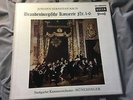
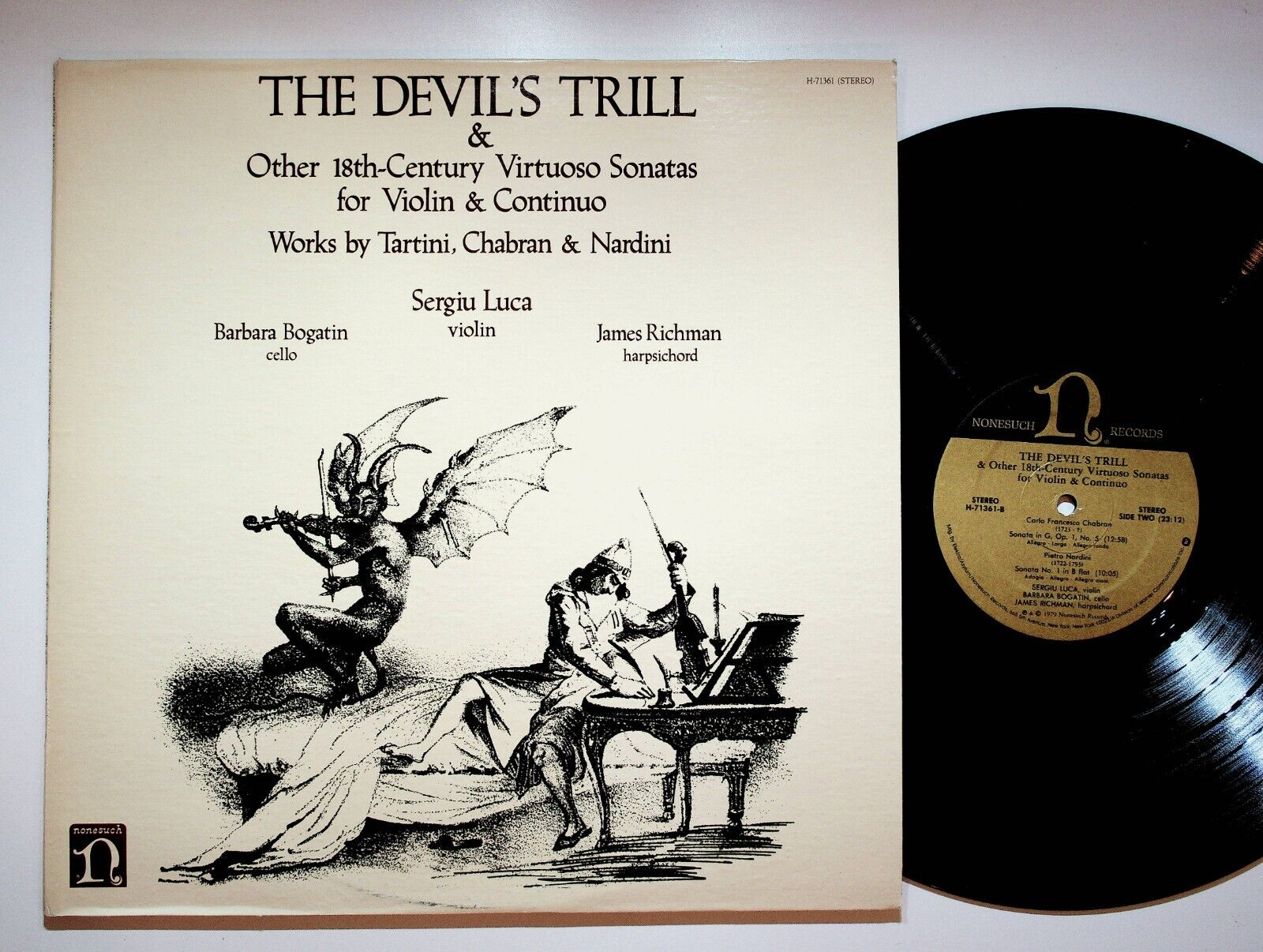
The Devils Trill Tartini Chabran Nardini Violin Continuo Vinyl LP Record VG+
$
52



Favourite Auctions
To save auctions to your favourites, please login
If you don't have an account, please register
Description
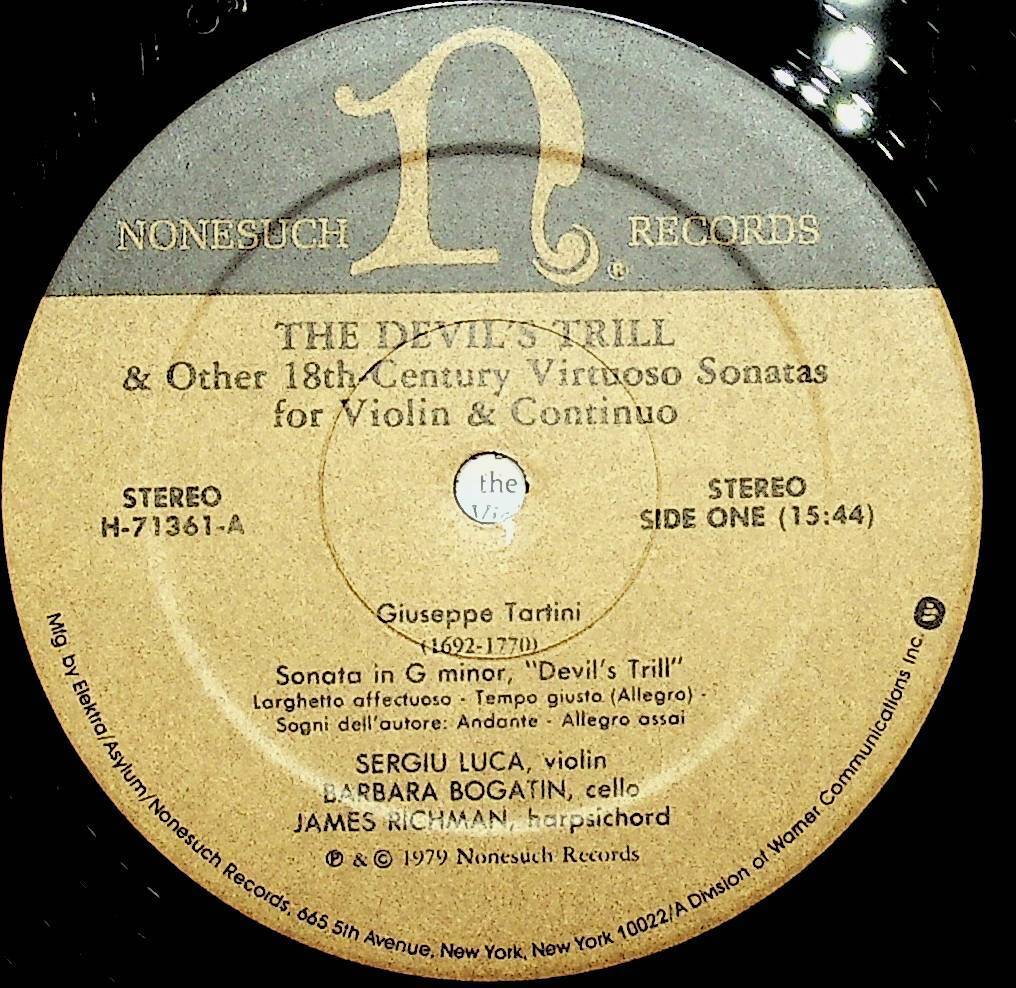
1979 The Devils Trill Tartini Chabran Nardini Violin Continuo Vinyl LP Record VG+
Record Grade per Goldmine Standard: VG+
Tartini, Chabran & Nardini - Barbara Bogatin, Sergiu Luca, James Richman – The Devil's Trill & Other 18th-Century Virtuoso Sonatas For Violin & Continuo
THE DEVIL’S TRIT I & Other 18th-Century Virtuoso Sonatas for Violin & Continue Side One (15:44) Giuseppe Tartini (1692-1770) Sonata in G minor, "Devil's Trill" (original version) Larghetto affectuoso (5:36)—Tempo giusto (Allegro] (4:26) — Sogni dell ('] autore: Andante-Allegro assai (5:39) Side Two (23:12) Carlo Francesco Chabran (1723-?) Sonata in G, Op. 1, No. 5 (12:58) Allegro (5.02)—Largo (4:37)—Allegro rondo (3:08) Pietro Nardini (1722-1793) Sonata No. 1 in B flat (10:05) Adagio (3:38)—Allegro (3:33)—Allegro assai (2:48) Sergiu Luca, violin Barbara Bogatin. cello James Richman, harpsichord The three violin sonatas presented here open a horizon to a hitherto little-explored source of 18th-century violin music—Jean Baptiste Cartier's L'Art du violon (Paris, 1798). This remarkable collection, rich in Italian, French, and Ger- man works from ca. 1700 to ca. 1770, encompasses the entire range of styles from the virtuoso to the cantabile. One of its many treasures is the first printed version of Tartini's "Devil's Trill" Sonata. It is also an early source for the Chabran and Nardini sonatas heard here. The publication of this volume reflects one of the more benign aspects of the French Revolu- tion, which, in its espousal of public education and instruc- tion, prompted the founding of the Paris Conservatory in 1795 and the sponsoring of various books of instruction, among them the Cartier L'Art du violon and a Methode de violon (Paris, 1802-03) written jointly by the celebrated French violinist- pedagogues Baillot, Rode, and Kreutzer. L'Art du violon is arranged in two sections, the first containing a brief digest of the more important 18th-century treatises on violin playing, the second consisting of an an- thology of 18th-century violin sonatas (set mostly for violin solo and basso continue) by the principal violin composers of the era—from Corelli to Tartini and Nardini in Italy, from Leclair to Gavinies in France, and from Johann Sebastian Bach to Stamitz and Cramer in Germany. There are 154 numbered movements by 57 different composers, the final work being the fugue from Bach's Sonata in C for Unaccompanied Violin, BWV 1005 (see Nonesuch HC-73030), Bach's only representa- tion in the collection. J, B. Cartier (1765-1841) was a French violinist who studied with the influential Viotti in Paris beginning in 1783; but his major contribution was to be the assembling and publishing of L'Art du violon, which made available to French violinists this large and varied repertory of sonatas. The col- lection is still valuable today as a primary source of the 18th- century violin sonata in its various national, musical, and technical manifestations. Happily, it is now easily accessible in a modern facsimile edition. Giuseppe Tartini was one of the most famous musicians of his time. He was a prolific composer of violin sonatas and concertos, a distinguished performer and teacher (Tartini founded the "School of Nations" in Padua in 1728), the author of various commentaries on music and violin playing (e.g., "Treatise of Ornaments," "A Letter of Instruction"), and he was an "improver" of the Corelli bow. Today, Tartini is un- doubtedly best known as the composer of a single composi- tion, the "Devil's Trill" Sonata. This work has maintained an unusual attraction both for the public and for violinists because of the beauty of the music, the challenge of its technical difficulties, and the romantic scenario of the last movement and its vivid depiction as program music. Cartier appends a note explaining the origin of the sonata's title, as follows: Sonata of TARTINI, which his School had named the "Devil's Trill,'' in accord with a dream of the Master, who said he had seen the devil at the foot of his bed executing the trill written in the final piece of this sonata. This piece is very rare; I owe it to Baillot, whose love for the beautiful pieces of TAR- TINI has persuaded him to let me have it (for publication]. The complete story is told by Tartini himself in Lalande's Voyage d'un Francois en Italic (1765-66): One night in the year 1713 I dreamed I had made a pact with the devil for my soul. Everything went as I wished, my new servant anticipated my every desire. Among other things, I gave him my violin to see if he could play. How great was my astonish- ment on hearing a sonata so wonderful and so beautiful, played with such great art and in- telligence, as I had never even conceived in my boldest flights of fantasy. 1 felt enraptured, transported, enchanted; my breath failed me, and—I awoke. I immediately grasped my violin in order to retain, in part at least, the impression of my dream. In vain! The music which I at this time composed is indeed the best that I ever wrote, and I still call it the "Devil's Trill," but the difference between it and that which so moved me is so great that I would have destroyed my instrument and have said farewell to music forever if it had been possible for me to live without the enjoyment it affords me. The "Devil's Trill" Sonata must have circulated in manuscript for many years before its publication by Cartier in 1798. It could not have been composed later than ca. 1750, because the whole of the first "devil's trill" is quoted by Leopold Mozart in his Violinschule of 1756 as an example of an "accompanied trill"—that is, a continuous trill accom- panied by another part, resulting in double stops. A virtuoso effect, Tartini's device involves extensions of the fingers and shifting of the fingers while trilling. The first movement of the sonata is characterized by a flowing and dotted rhythm in cantabile style. The double stops in the violin part (including ninths and tenths), together with the cello line, create a basic trio of principal voices, with which Tartini produces a remarkably rich combination of sonorities. The second movement is modeled on the Corellian moto perpetuo, but Tartini has increased the difficulties of his model by including cross-string passages and broken chords over a wider range, numerous trills (including syncopated ones), a greater variety of bowings, and more dramatic thematic material. The last movement, entitled "Dreams of the Composer," follows the "program" explained by Cartier. After an opening Andante that evokes Tartini's dream-like state, the Allegro assai depicts the devil in double and triple stops, leading directly to the "devil's trill" itself, which continuously rises in pitch and intensity. This same scheme ("dream-like" music followed by "devil's trills”) recurs twice more. Finally, a peroration of brilliant figuration and rapid double stops in thirds prepares for a cadenza to be improvised by the per- former. The movement concludes with four adagio measures of grandly sonorous chords that suggest the magnitude of the subject and the grandeur with which Tartini has endowed his recollected dream. Little is known of the life and music of Carlo Francesco Chabran (Chiabrano). Born in 1723 in Turin, he was the nephew and pupil of G.B. Somis, himself a pupil of Corelli. In 1751 he journeyed to Paris, where he enjoyed great success as a virtuoso. His Opus 1 may well be the very music with which he first impressed the Parisian audiences at the Concerts spirituels. He died in London; the date of his death is- unknown. Chabran's music reflects the harmonic orientation of texture and form and the virtuosity typical of such Tartini H-71361 (Stereo) pupils as Nardini and Alberghi. Among its most striking traits are numerous varieties of staccato bowings, on- and off-string strokes, double stops (especially running double stops in thirds), and broken chords spread over the instrument. The sudden appearance of natural harmonics in the opening move- ment of the Sonata in G, Op. 1, No. 5, produces a remarkable effect (following the earlier lead of Mondonville). This is vivacious music, meant to be played with the joyous abandon of a virtuoso violinist completely assured of his powers. The Largo, with its unison opening characteristic of the new har- monic style ca. 1750, is essentially an aria with considerable written-out figuration, rich in expressive appoggiaturas. (In accord with the performance practice of the time, additional ornamentation is freely improvised here by the performers.) In) the Allegro rondo finale, virtuoso effects again prevail, pecially double-stop thirds, double-stop trills, triplet staccatos (slurred and unslurred), and short, broken-chord figures repeated as echo effects. Pietro Nardini, Tartini's favorite pupil, returned to Padua to stay with his teacher at the time of the latter's final illness and death in 1770. Shortly afterward, Nardini assumed the directorship of music at the Grand Duke of Tuscany's court in Florence, a position he held until he died. Leopold Mozart singled him out for the beauty and purity of his tone and for the tastefulness of his cantabile playing. The Sonata No. 1 in B flat opens with an Adagio that combines the lyric and the ornate, in the style of Corelli. In his publication. Car- tier prints both Nardini's unadorned melody and another ver- sion of it, written out in the ornamental style in which it would normally have been improvised in performance. (The im- provised embellishments here take Cartier's ornamented ver- sion as a point of departure.) Only one explicit expression mark appears in the printed score—an "rf" ( = rinforzando), evidently an early use of this direction to "reinforce" or make a crescendo. The following Allegro is a precursor of early Mozart with respect to its freely constructed sonata form, chromatic passage work, and novel violinistic turns of phrase. Especially notable are Nardini's double stops in the high posi- tions to produce unusual sonorities. The concluding Allegro assai has the playful air of a character drawn from the opera DAVID D. BOYDEN The Instruments The three sonatas recorded here are performed on a "grand pattern" violin made by Nicola Amati in 1669 and restored to resemble its original specifications by luthier Rene Morel (of the firm J. Fran^ais, New York). In accord with 18th- century practice, its gut strings are tuned approximately a semitone below modern concert pitch, resulting in lower ten- sion and a mellower sound. The Tartini and Chabran sonatas are played with a type of bow similar to the "improved" Tar- tini bow of ca. 1740—a bow with a slightly convex stick, shorter than the modern bow, and with a pike's head. The Nardini sonata is played with a so-called "transitional" bow made by Betts, probably around 1770. This bow already em- bodies such essential features of the modern bow (perfected by F. Tourte around 1785) as a concave stick and a hatchet head. Such a bow may well have been used by Nardini at the time of the publication of his Sonata No. 1 in 1760. The cello heard here is labeled "Jacob Weiss, Salzburg 1737"; it has been restored to Baroque disposition by William Monical. The harpsichord is a copy after Blanchet, ca. 1740, built by William Dowd in 1977. SOURCE: J.B. Cartier, L'Art du violon, Paris, 1798. Facsimile reprint of third edition [1803?l by Broude Brothers Limited, New York, 1973. recorded February 1978, New York engineering/Frank Dickinson musical supervision & tape editing/Judith Sherman mastering/Robert C. Ludwig (Masterdisk Corp.) a Dolby-system recording coordinator/Teresa Sterne cover illustration/ 19th-century engraving of Tartini composing "Devil's Trill" Sonata (artist unknown); reproduced from program booklet of V/// Festival Internationale del Violino Giuseppe Tartini, Padua, May 1978. design & art direction/Neil Terk
LP412
price rating












![|222442| Johann Sebastian Bach - Brandenburg Concertos [Vinyl] New](https://www.popsike.info/php/thumbnail.php?url=https://www.popsike.pics/pix/20191128/184059242640.jpg)