The Cure "Bloodflowers" 2x LP OOP Orig Smiths AFI EX+
$
110


Favourite Auctions
To save auctions to your favourites, please login
If you don't have an account, please register
Description
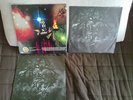
The Cure "Bloodflowers" 2xLP Elektra Records (US)
Vinyl is in EX+, Jacket is VG+ still in shrink.
Original Press!
Classic! Out of Print!!
Track Listing:
A1Out Of This World 6:43
A2
Watching Me Fall 11:13
B1
Where The Birds Always Sing 5:43
B2
Maybe Someday 5:06
B3
Coming Up 6:26
C1
The Last Day Of Summer 5:36
C2
There Is No If… 3:43
C3
The Loudest Sound 5:09
D1
39 7:18
D2
Bloodflowers 7:28
In 1985, the new lineup—Smith, Tolhurst, Gallup, Thompson, and Williams—released The Head on the Door, an album which managed to meld the melodic and pessimistic aspects of the band they had previously shifted between. The Head on the Door reached number seven in the UK and was the band's first entry into American Top 75 at number 59, a success partly due to the international impact of the LP's two singles, "In Between Days" and "Close to Me". Following the album and further world tour, the band released the singles compilation Standing on a Beach in three formats (each with a different track listing and a specific name) in 1986. This compilation made the US Top 50, and saw the re-issue of three previous singles: "Boys Don't Cry" (in a new form), "Let's Go To Bed" and later "Charlotte Sometimes". This release was accompanied by a VHS or LaserDisc called Staring at the Sea, which featured videos for each track on the compilation. The Cure toured to support the compilation and released a live concert VHS of the show, filmed in the south of France called The Cure in Orange. During this time, The Cure became a very popular band in Europe (particularly in France, Germany and the Benelux countries) and increasingly popular in the U.S., where the closing date of their tour in Los Angeles resulted in tragedy when a fan committed suicide by stabbing himself to death as the band took the stage.
Increasing commercial success (1983–1988)
With Gallup's departure from The Cure and with Smith's work with Siouxsie & the Banshees, rumours spread that The Cure had broken up. In December 1982, Smith remarked to Melody Maker, "Do The Cure really exist any more? I've been pondering that question myself [. . .] it has got to a point where I don't fancy working in that format again." He added, "Whatever happens, it won't be me, Laurence, and Simon together any more. I know that."
Parry was concerned at the state of his label's top band, and became convinced that the solution was for The Cure to reinvent its musical style. Parry managed to convince Smith and Tolhurst of the idea; Parry said, "It appealed to Robert because he wanted to destroy The Cure anyway." With Tolhurst now playing keyboards instead of drums, the duo released the single "Let's Go to Bed" in late 1982. While Smith wrote the single off as a throwaway, "stupid" pop song to the press, it became a minor hit in the UK, reaching number 44 on the singles chart. It was followed in 1983 by two more successful songs: the synthesizer-based "The Walk" (number 12), and the jazz-influenced "The Lovecats", which became the band's first British Top 10 hit, reaching number seven. The group released these studio singles and their B-sides as the compilation album Japanese Whispers, designed by Smith for the Japanese market only, but released worldwide on the decision of the record company. The same year, Smith also recorded and toured with Siouxsie & the Banshees, contributing as guitarist on their Nocturne live video and their Hyaena studio album. Meanwhile, he recorded the Blue Sunshine album with Banshees bassist Steven Severin as The Glove, while Lol Tolhurst produced the first two singles and debut album of the English band And Also The Trees.
In 1984, The Cure released The Top, a generally psychedelic album on which Smith played all the instruments except the drums—played by Andy Anderson—and the saxophone—played by returnee Porl Thompson. The album was a Top 10 hit in the UK, and was their first studio album to break the Billboard 200 in the U.S., reaching number 180. Melody Maker praised the album as "psychedelia that can't be dated", while pondering, "I've yet to meet anyone who can tell me why The Cure are having hits now of all times." The Cure then embarked on their worldwide "Top Tour" with Thompson, Anderson, and producer-turned-bassist Phil Thornalley on board. Released in late 1984, The Cure's first live album, Concert consisted of performances from this tour. Near the tour's end, Anderson was fired for destroying a hotel room and was replaced by Boris Williams. Thornalley also left due to the rigors of the road. However, the bassist slot was not vacant long, for a Cure roadie named Gary Biddles had brokered a reunion between Smith and former bassist Simon Gallup, who in the meantime had been playing in the band Fools Dance. Soon after reconciling, Smith asked Gallup to rejoin the band. Smith was ecstatic about Gallup's return and declared to Melody Maker, "It's a group again."
In 1985, the new line-up of Smith, Tolhurst, Gallup, Thompson, and Williams released The Head on the Door, an album which managed to bind together the optimistic and pessimistic aspects of the band's music that they had previously shifted between. The Head on the Door reached number seven in the UK and was the band's first entry into American Top 75 at number 59, a success partly due to the international impact of the LP's two singles, "In Between Days" and "Close to Me". Following the album and further world tour, the band released the singles compilation Standing on a Beach in three formats (each with a different track listing and a specific name) in 1986. This compilation made the US Top 50, and saw the re-issue of three previous singles: "Boys Don't Cry" (in a new form), "Let's Go To Bed" and later "Charlotte Sometimes". This release was accompanied by a VHS or LaserDisc called Staring at the Sea, which featured videos for each track on the compilation. The Cure toured to support the compilation and released a live concert VHS of the show, filmed in the south of France called The Cure in Orange. During this time, The Cure became a very popular band in Europe (particularly in France, Germany and the Benelux countries) and increasingly popular in the U.S.
Kiss Me, Kiss Me, Kiss Me and worldwide success (1987–1993)
In 1987, The Cure released the double LP Kiss Me, Kiss Me, Kiss Me, which reached number six in the UK, the Top 10 in several countries and was the band's first entry into the U.S. Top 40 at number 35 (where it was certified platinum), due to the combination of the band's rising popularity and the success of lead single, "Why Can't I Be You?". The album's third single, "Just Like Heaven" was the band's most successful single to date in the US, being their first to enter the Billboard Top 40. After the album's release, the band embarked on the successful Kissing Tour. During the European leg of the tour, Lol Tolhurst's alcohol consumption was interfering with his ability to perform so The Psychedelic Furs keyboardist Roger O'Donnell was frequently called upon to stand in for him.
In 1989, The Cure released the album Disintegration, which saw a return to the gothic atmospheres of earlier releases like Faith and Pornography. It became their highest charting album in the UK to date, entering at number three and featuring three Top 30 singles in the UK and Germany ("Lullaby", "Lovesong" and "Pictures of You"). Disintegration also reached number twelve on the US charts. The first single stateside, "Fascination Street", reached number one on the American Modern Rock chart, but was quickly overshadowed when its third US single, "Lovesong", reached number two on the American pop charts (the only Cure single to reach the US Top 10). By 1992, Disintegration had sold over three million copies worldwide.
During the Disintegration sessions, the band gave Smith an ultimatum that either Tolhurst would have to leave the band or they would. In February 1989, Tolhurst's exit was made official and announced to the press; this resulted in Roger O'Donnell becoming a full-fledged member of the band and left Smith as The Cure's only remaining founder member. Smith attributed Tolhurst's dismissal to an inability to exert himself and issues with alcohol, concluding, "He was out of step with everything. It had just become detrimental to everything we'd do." Because Tolhurst was still on the payroll during the recording of Disintegration, he was credited in the album's liner notes as playing "other instruments", however it has since been revealed that he contributed nothing to the album in either performance or song writing. The Cure then embarked on the Prayer Tour, which saw the band playing stadiums in America.
In May 1990, Roger O'Donnell quit and was replaced with the band's guitar technician Perry Bamonte. That November, The Cure released a collection of remixes called Mixed Up. The album was not well received and quickly slid down the charts. The one new song on the collection, "Never Enough", was released as a single. In 1991 The Cure were awarded the BRIT Award for Best British Band. That same year Tolhurst filed a lawsuit against Smith and Fiction Records in 1991 over royalties payments, and claimed joint ownership of the name "The Cure" with Smith; the verdict was handed out in September 1994 in favour of Smith. In respite from the lawsuit, the band returned to the studio to record their next album. Wish reached number one in the UK and number two in the US and yielded the international hits "High" and "Friday I'm in Love". The Cure also embarked on the "Wish Tour" with Cranes, and released the live albums Show (September 1993) and Paris (October 1993). As a promotional exercise with the Our Price music chain in the UK, a limited edition EP was released consisting of instrumental outtakes from the Wish sessions. Entitled Lost Wishes, the proceeds from the four-track cassette tape went to charity.
In the years between the release of Wish and the start of sessions for The Cure's next album, the band's line-up shifted again. Thompson left the band once more during 1993 to play with Robert Plant and Jimmy Page of Led Zeppelin, and Bamonte took over as lead guitarist. Boris Williams also left the band, and was replaced by Jason Cooper (formerly of My Life Story).
Later years (1999–2009)
With only one album left in their record contract and with commercial response to Wild Mood Swings and the Galore compilation lacklustre, Smith once again considered that the end of The Cure might be near and thus wanted to make an album that reflected the more serious side of the band. The Grammy-nominated album Bloodflowers was released in 2000 after being delayed since 1998. According to Smith, The album was the third of a trilogy along with Pornography and Disintegration. The band also embarked on the nine-month Dream Tour, attended by over one million people worldwide. In 2001, The Cure left Fiction and released their Greatest Hits album and DVD, which featured the music videos for a number of classic Cure songs. In 2002, the band headlined twelve major summer music festivals, and played three extended concerts (one in Brussels, two in Berlin) in which they performed the albums Pornography, Disintegration and Bloodflowers in their respective entireties each night. The Berlin performances were released on DVD as The Cure: Trilogy in 2003.
In 2003, The Cure signed with Geffen Records. In 2004, they released a new four-disc boxed set on Fiction Records titled Join the Dots: B-Sides and Rarities, 1978-2001 (The Fiction Years). The compilation includes seventy Cure songs, some previously unreleased, and a 76-page full-colour book of photographs, history and quotes, packaged in a hard cover. The album peaked at number 106 on the Billboard 200 album charts. The band released their twelfth album The Cure on Geffen in 2004, which was produced by Ross Robinson. It made a top ten debut on both sides of the Atlantic in July 2004. To promote the album, the band headlined the Coachella Valley Music and Arts Festival that May. From 24 July to 29 August, The Cure headlined the Curiosa concert tour of North America. While attendances were lower than expected, Curiosa was still one of the more successful American summer festivals of 2004. The same year the band was honoured with an MTV Icon television special.
The Cure in concert in 2004. From left to right: Robert Smith, Jason Cooper, and Simon GallupIn May 2005, Roger O'Donnell and Perry Bamonte were fired from the band. O'Donnell claims Smith informed him he was reducing the band to a three-piece. Previously O'Donnell said he had only found out about the band's upcoming tour dates via a fan site and added, "It was sad to find out after nearly 20 years the way I did but then I should have expected no less or more." The remaining members of the band—Smith, Gallup and Cooper—made several appearances as a trio before it was announced in June that Porl Thompson would be returning for the band's 2005 Festival summer shows, as well as their set at Live 8 in Paris on 2 July. Later that year, the band recorded a cover of John Lennon's "Love" for Amnesty International's charity album Make Some Noise. It is available for download on the Amnesty website, while the album was released on CD in 2006. On 1 April 2006, The Cure appeared at the Royal Albert Hall on behalf of the Teenage Cancer Trust. It was their only show through to the end the year. In December a live DVD, entitled The Cure: Festival 2005 including 30 songs of their 2005 Festival tour was released.
The Cure began writing and recording material for their thirteenth album in 2006. Smith initially stated it would be a double album. The Cure announced a last-minute postponement of their autumn 2007 North American 4Tour in August in order to continue working on the album, rescheduling the dates for spring 2008. Titled 4:13 Dream, the album was released in October 2008. The group released four singles and an EP—"The Only One", "Freakshow", "Sleep When I'm Dead", "The Perfect Boy" and Hypnagogic States respectively—on or near to the 13th of each month, in the months leading up to the album's release. In February 2009, The Cure received the 2009 Shockwaves NME Award for Godlike Genius.
All records are shipped in professional 7” & 12” box mailers. All CDs are shipped in padded bubble mailers. Buy multiple items and save on shipping. Thanks for Visiting!!
price rating