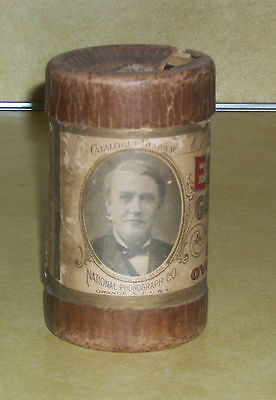
THOMAS EDISON GOLD MOULD RECORD CYLINDER ARTHUR COLLINS LAWDY SAKES FEED MY DOG
$
30


Favourite Auctions
To save auctions to your favourites, please login
If you don't have an account, please register
Description
THOMAS EDISON GOLD MOULD RECORD CYLINDER ARTHUR COLLINS LAWDY SAKES FEED MY DOG
GREETINGS, FEEL FREE TO
"SHOP NAKED."©
We deal in items we believe others will enjoy and want to purchase.
We are not experts.
We welcome any comments, questions, or concerns.
WE ARE TARGETING A GLOBAL MARKET PLACE.
Thanks in advance for your patronage.
Please Be sure to add WDG to your favorites list!
NOW FOR YOUR VIEWING PLEASURE…
Edison 2-min Cylinder #8719
For De Lawdy Sakes Feed My Dog
Arthur Collins (image for display only)
Patent Pending
For De Lawdy Sakes Feed My Dog
performed in a Black / African-American / Person of Color...."dialect"(?)
Click here to listen to excerpt.
https://dl.dropboxusercontent.com/u/6666461/8719.mp3
How does it play?
Plays loud and clear over light, but noticeable, surface/wear noise
How does it look?
Black, bright and glossy - VERY light (if any) wear visible
-----------------------
FYI
Thomas Alva Edison (February 11, 1847 – October 18, 1931) was an American inventor and businessman. He developed many devices that greatly influenced life around the world, including the phonograph, the motion picture camera, and a long-lasting, practical electric light bulb. Dubbed "The Wizard of Menlo Park", he was one of the first inventors to apply the principles of mass production and large-scale teamwork to the process of invention, and because of that, he is often credited with the creation of the first industrial research laboratory.
Edison was a prolific inventor, holding 1,093 US patents in his name, as well as many patents in the United Kingdom, France, and Germany. More significant than the number of Edison's patents, are the impacts of his inventions, because Edison not only invented things, his inventions established major new industries world-wide, notably, electric light and power utilities, sound recording and motion pictures. Edison's inventions contributed to mass communication and, in particular, telecommunications. These included a stock ticker, a mechanical vote recorder, a battery for an electric car, electrical power, recorded music and motion pictures.
His advanced work in these fields was an outgrowth of his early career as a telegraph operator. Edison developed a system of electric-power generation and distribution to homes, businesses, and factories – a crucial development in the modern industrialized world. His first power station was on Pearl Street in Manhattan, New York.
Early life
Thomas Edison was born in Milan, Ohio, and grew up in Port Huron, Michigan. He was the seventh and last child of Samuel Ogden Edison, Jr. (1804–96, born in Marshalltown, Nova Scotia, Canada) and Nancy Matthews Elliott (1810–1871, born in Chenango County, New York). His father had to escape from Canada because he took part in the unsuccessful Mackenzie Rebellion of 1837. Edison reported being of Dutch ancestry.
In school, the young Edison's mind often wandered, and his teacher, the Reverend Engle, was overheard calling him "addled". This ended Edison's three months of official schooling. Edison recalled later, "My mother was the making of me. She was so true, so sure of me; and I felt I had something to live for, someone I must not disappoint." His mother taught him at home. Much of his education came from reading R.G. Parker's School of Natural Philosophy and The Cooper Un.
Edison developed hearing problems at an early age. The cause of his deafness has been attributed to a bout of scarlet fever during childhood and recurring untreated middle-ear infections. Around the middle of his career, Edison attributed the hearing impairment to being struck on the ears by a train conductor when his chemical laboratory in a boxcar caught fire and he was thrown off the train in Smiths Creek, Michigan, along with his apparatus and chemicals. In his later years, he modified the story to say the injury occurred when the conductor, in helping him onto a moving train, lifted him by the ears.
Edison's family moved to Port Huron, Michigan, after the railroad bypassed Milan in 1854 and business declined; his life there was bittersweet. Edison sold candy and newspapers on trains running from Port Huron to Detroit, and sold vegetables to supplement his income. He also studied qualitative analysis, and conducted chemical experiments on the train until an accident prohibited further work of the kind.
Edison obtained the exclusive right to sell newspapers on the road, and, with the aid of four assistants, he set in type and printed the Grand Trunk Herald, which he sold with his other papers. This began Edison's long streak of entrepreneurial ventures, as he discovered his talents as a businessman. These talents eventually led him to found 14 companies, including General Electric, which is still one of the largest publicly traded companies in the world.
Beginning his career
Edison began his career as an inventor in Newark, New Jersey, with the automatic repeater and his other improved telegraphic devices, but the invention that first gained him notice was the phonograph in 1877. This accomplishment was so unexpected by the public at large as to appear almost magical. Edison became known as "The Wizard of Menlo Park," New Jersey.
His first phonograph recorded on tinfoil around a grooved cylinder. Despite its limited sound quality and that the recordings could be played only a few times, the phonograph made Edison a celebrity. Joseph Henry, president of the National Academy of Sciences and one of the most renowned electrical scientists in the US, described Edison as "the most ingenious inventor in this country . . . or in any other". In April 1878, Edison travelled to Washington to demonstrate the phonograph before the National Academy of Sciences, Congressmen, Senators and US President Hayes. The Washington Post described Edison as a "genius" and his presentation as "a scene . . . that will live in history". Although Edison obtained a patent for the phonograph in 1878, he did little to develop it until Alexander Graham Bell, Chichester Bell, and Charles Tainter produced a phonograph-like device in the 1880s that used wax-coated cardboard cylinders.
Menlo Park
Edison's major innovation was the first industrial research lab, which was built in Menlo Park, a part of Raritan Township, Middlesex County, New Jersey (today named Edison in his honor). It was built with the funds from the sale of Edison's quadruplex telegraph. After his demonstration of the telegraph, Edison was not sure that his original plan to sell it for $4,000 to $5,000 was right, so he asked W.U.to make a bid. He was surprised to hear them offer $10,000 ($206300 in today's dollars.), which he gratefully accepted.
The quadruplex telegraph was Edison's first big financial success, and Menlo Park became the first institution set up with the specific purpose of producing constant technological innovation and improvement. Edison was legally attributed with most of the inventions produced there, though many employees carried out research and development under his direction. His staff was generally told to carry out his directions in conducting research, and he drove them hard to produce results.
Final years and death
Edison was active in business right up to the end. Just months before his death, the Lackawanna Railroad inaugurated suburban electric train service from Hoboken to Montclair, Dover, and Gladstone in New Jersey. Electrical transmission for this service was by means of an overhead catenary system using direct current, which Edison had championed. Despite his frail condition, Edison was at the throttle of the first electric MU (Multiple-Unit) train to depart Lackawanna Terminal in Hoboken in September 1930, driving the train the first mile through Hoboken yard on its way to South Orange.
This fleet of cars would serve commuters in northern New Jersey for the next 54 years until their retirement in 1984. A plaque commemorating Edison's inaugural ride can be seen today in the waiting room of Lackawanna Terminal in Hoboken, which is presently operated by New Jersey Transit.
Edison was said to have been influenced by a popular fad diet in his last few years; "the only liquid he consumed was a pint of milk every three hours". He is reported to have believed this diet would restore his health. However, this tale is doubtful. In 1930, the year before Edison died, Mina said in an interview about him, "correct eating is one of his greatest hobbies." She also said that during one of his periodic "great scientific adventures", Edison would be up at 7:00, have breakfast at 8:00, and be rarely home for lunch or dinner, implying that he continued to have all three.
Edison became the owner of his Milan, Ohio, birthplace in 1906. On his last visit, in 1923, he was reportedly shocked to find his old home still lit by lamps and candles.
Thomas Edison died of complications of diabetes on October 18, 1931, in his home, "Glenmont" in Llewellyn Park in West Orange, New Jersey, which he had purchased in 1886 as a wedding gift for Mina. He is buried behind the home.
Edison's last breath is reportedly contained in a test tube at the Henry Ford Museum. Ford reportedly convinced Charles Edison to seal a test tube of air in the inventor's room shortly after his death, as a memento. A plaster death mask was also made.
(THIS PICTURE FOR DISPLAY ONLY)
---------------------------
Thanks for choosing this auction. You may email for alternate payment arrangements. We combine shipping. Please pay promptly after the auction. The item will be shipped upon receipt of funds. Remember if you are outside the continental US there will be additional shipping costs. Also, INTERNATIONAL CUSTOMS is the international buyers obligation and must be aware of their own customs laws. We cannot be responsible for seized or quarentine purchases. If your shipping costs seems high, it is because we ensure that your purchase is well packed, quickly delivered, and insured to arrive safe and sound. WE ARE GOING GREEN, SO WE DO SOMETIMES USE CLEAN RECYCLED MATERIALS TO SHIP. DO NOT BE TOO PERSNICKETY.
Please leave feedback when you have received the item and are satisfied. Please respond when you have received the item.
*****
5*'s
*****
If you were pleased with this transaction, please respond with all 5 stars! If you are not pleased, let us know via e-mail. Our goal is for 5-star service. We want you to be a satisfied, return customer.
Please express any concerns or questions. More pictures are available upon request. The winning bid will incur the cost of S/H INSURED FEDEX OR USPS. See rate calculator or email FOR ESTIMATE. International Bidders are Welcome but be mindful if your country is excluded from safe shipping. Additional costs will be applied to postage outside the USA.
Thanks for perusing THIS and ALL our auctions.
Please Check out our other items!
WE like the curious and odd.
BUY, BYE!!
price rating